
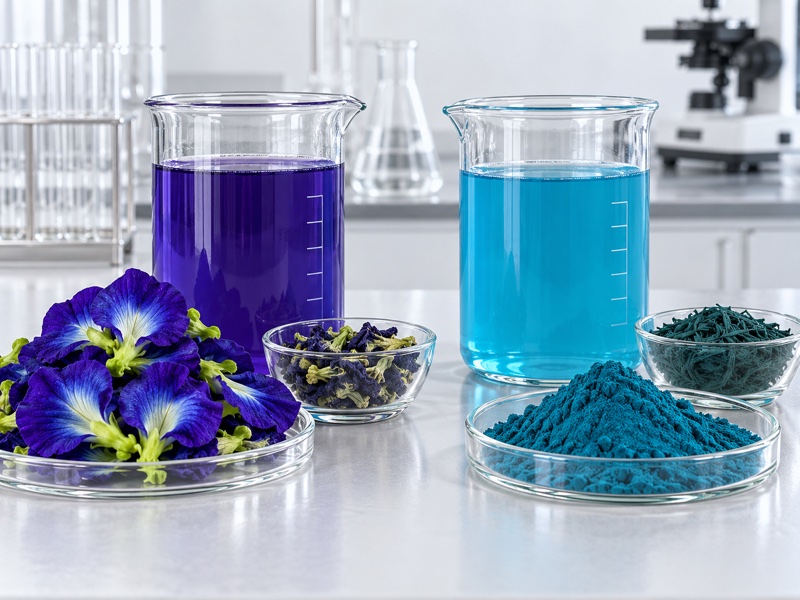
Butterfly pea flower and blue spirulina can both color food blue, but they come from different sources and respond differently to acidity, heat, and the recipe around them. A team choosing a “natural blue” can lose weeks by testing only the shade in water. The real decision is which ingredient looks right after processing, storage, and serving in the finished product. This butterfly pea flower vs blue spirulina comparison gives you a practical way to test both before committing to a label or supply contract.
1. What are butterfly pea flower and blue spirulina?
Butterfly pea flower extract comes from the petals of Clitoria ternatea, while blue spirulina extract comes from cultivated Arthrospira biomass. They are different ingredients with different dominant pigments and manufacturing routes. Butterfly pea’s color comes mainly from anthocyanins; spirulina extract’s blue comes principally from phycocyanins. Neither term tells you the full composition of a commercial powder or liquid preparation. Ask for the actual ingredient declaration and technical specification before comparing samples.
What should the sample labels state?
They should identify the botanical or microbial source, extract form, carrier, grade, intended use, and lot. The composition guide explains the spirulina side of the comparison. A butterfly pea infusion prepared in a kitchen is also not necessarily equivalent to a commercial color extract. Keep the form consistent in your trial: dry powder versus dry powder, or compare at equal finished color if forms differ. The identity record lets quality and regulatory teams review the same material R&D tested.
| Feature | Butterfly pea flower | Blue spirulina |
|---|---|---|
| Source | Flower petals | Cultivated Arthrospira |
| Main color family | Anthocyanins | Phycocyanins |
| Common form | Extract or infusion | Extract or color preparation |
Start with identity.
2. How do the blue pigments differ?
Butterfly pea anthocyanins and spirulina phycocyanins are chemically different color systems. That difference helps explain why a pH change can create a dramatic blue-to-purple shift in one formula while causing a different stability problem in another. But a chemical name alone does not predict every finished food. Concentration, carrier, processing, and matrix matter. Compare the two at the same finished shade under the conditions your product will encounter.
What is a fair bench comparison?
Prepare both colors in the exact recipe base at doses that give an approved starting hue, then hold all other variables constant. Record pH, temperature, light, and package. A review of butterfly pea anthocyanin color at different pH and a review of phycocyanin extraction and stability explain why these are separate systems. A side-by-side glass is useful for screening, but shelf-life and process tests decide commercial fit.
| Comparison | Keep constant |
|---|---|
| Fresh shade | Same viewing light |
| Acid response | Same base and acid level |
| Heat response | Same process profile |
| Storage | Same package and time |
Equal finished color makes the comparison meaningful.
3. Which color changes more with acidity?
Butterfly pea flower is known for pronounced pH-dependent hue changes, often moving toward purple or pink as acidity rises. Spirulina extract can also lose or shift blue under unfavorable acidic conditions, but it does not behave like an interchangeable version of butterfly pea. Exact results vary by commercial preparation. A lemon drink that is attractive with one color may be unstable or a different hue with the other. Measure the finished formula’s pH and observe the product over time.
How should an acid ladder be built?
Create a control and several acid levels in the same base for each color. Record the immediate hue, flavor, pH, haze, and appearance after the intended hold. The blue lemonade article illustrates why a citrus concept needs more than a drop-in color substitution. If the desired shade is actually violet, butterfly pea’s pH response may be useful. If the brief requires a stable cyan blue, that same response may be a drawback. Choose the target hue before choosing the ingredient.
| Product brief | Question to test |
|---|---|
| Blue lemonade | What happens at the final pH? |
| Color-changing drink | Is the change intentional and repeatable? |
| Neutral frosting | Which gives the approved shade? |
Acidity can be a design tool or a source of complaints.
4. Which ingredient handles heat better?
Neither ingredient should be assumed heat-stable in every food; test the exact preparation and process. Phycocyanin can lose blue under heat, while butterfly pea anthocyanins can change with heat and other formulation conditions. A short bake, a hot-fill drink, and a gently heated syrup are different exposures. The relevant result is color in the saleable product after cooling and storage. Do not compare supplier stability claims made under different test methods.
What should a heat trial record?
Use the process temperature, hold time, pH, and package planned for production. Keep unheated controls for both colors, then photograph and measure the finished products after cooling. The recipe guide shows why a bright batter is not proof of a bright baked slice. If either color fails, try it in a cold frosting or post-process layer only if the food-safety plan permits. A safer process should never be weakened merely to protect a shade.
| Process | Main observation |
|---|---|
| Baking | Crumb after cooling |
| Pasteurization | Color after heat and storage |
| Hot fill | Color in the sealed pack |
| Cold mix | Light and time stability |
Judge the product after the full process, not halfway through it.
5. Do the two ingredients taste different?
They can, and the difference depends on grade and dose. A butterfly pea preparation may have a mild floral or earthy note, while blue spirulina extract is often chosen for a milder profile than whole green spirulina. Neither is guaranteed flavorless. Carriers and co-ingredients can contribute as much to taste as the pigment source. A color that needs a high dose may change the recipe’s flavor even when a small test sample seemed neutral.
How can sensory testing avoid visual bias?
Prepare a blind taste comparison in a base that can hide the color, or use coded opaque cups. Then reveal the colors and assess appearance separately. The taste guide gives context for extract versus whole biomass. Compare at equal target shade, not equal gram weight, because pigment strengths differ. Include an uncolored control so tasters can identify what each color adds to flavor. If the product is a delicate tea, a small note may matter more than in a strongly flavored smoothie.
| Sensory attribute | Why it matters |
|---|---|
| Aroma | First impression |
| Aftertaste | Repeat purchase |
| Mouthfeel | Carrier or sediment |
| Hue | Product promise |
The winning color should not make the food worse to eat.
6. Which foods suit each color best?
The better ingredient depends on the finished recipe, not a universal ranking. Butterfly pea can suit color-changing drinks or products where its hue shift is intentional. Blue spirulina can suit pale, low-acid applications when a cyan or turquoise tone is wanted, provided process and storage tests pass. Both may be tested in desserts, drinks, and decorative components under local use rules. A supplier application sheet is a starting point, not a substitute for a pilot in your actual matrix.
What should a format screen include?
Choose a few realistic applications: a neutral beverage, an acidic beverage, a cold frosting, and a heated food if relevant. Use the same desired shade standard and record dose, cost, flavor, and color retention. The blue ice cream guide describes one cold opaque matrix where the blue reads differently from water. Avoid making a product line decision from a single glass. The color may be better in one SKU and worse in another.
| Application | Useful first comparison |
|---|---|
| Clear drink | Shade, haze, acid response |
| Frozen dessert | Color after freezing |
| Frosting | Dispersion and display |
| Baked good | Post-bake crumb color |
Select color per product, even within the same brand.
7. Are the regulatory rules the same?
No, each color has its own identity and permitted-use rules in each jurisdiction. In the United States, spirulina extract appears in 21 CFR 73.530, while butterfly pea flower extract appears in 21 CFR 73.69. The listed food categories and conditions must be checked for the exact product; the permission for one ingredient does not transfer to the other. Rules can change, and a 2026 spirulina amendment was delayed indefinitely. Have the current destination-market text reviewed before printing a label.
What should regulatory teams receive?
Provide both exact grade specifications, planned use levels, formula, category, process, destination markets, and draft label. Ask whether a color-additive declaration, purity limit, or special restriction applies. Do not use “natural” as a substitute for a legal classification. The natural blue label article makes that distinction for spirulina. If you need a color for multiple countries, review each market rather than assuming a single US decision covers them all.
| Review item | Why compare it |
|---|---|
| Legal identity | Confirms what is being sold |
| Food category | Determines permitted use |
| Specification | Defines purity controls |
| Label wording | Prevents misdeclaration |
Regulatory fit can decide the shortlist before flavor trials do.
8. How should cost be compared?
Compare cost at the dose needed to reach and retain the approved color in the finished product. Price per kilogram alone rewards a weak or unstable ingredient that may need a much higher dose. Include processing loss, off-spec waste, storage conditions, and purchase minimums. A preparation with a lower unit price can be more expensive once a real shelf-life target is applied. Ask for quotes tied to grade, lot documentation, and a realistic annual volume.
What is the simplest cost model?
Calculate ingredient grams per finished unit times landed price per gram, then add the cost of any formulation or package change. Record the starting shade and shelf-end shade separately. The powder buying guide explains why matching final performance matters when comparing suppliers. If one color forces a protective package or process change, count it. A sample that is cheap in a beaker may be expensive in distribution.
| Cost input | Why include it |
|---|---|
| Dose to shade | Main ingredient spend |
| Color retention | Shelf waste |
| Package change | Added unit cost |
| Minimum order | Inventory risk |
Buy finished-product performance, not powder weight.
9. What quality documents should buyers request?
Buyers should request product specifications, batch COAs, identity and traceability information, and relevant contaminant and microbiology results for each ingredient. Do not assume the same quality limits or methods apply to a flower extract and a spirulina extract. Ask for carriers and processing aids that may affect label wording or allergen review. If organic status matters, verify it for the exact product and transaction. A marketing page cannot replace batch-specific evidence.
How can you compare supplier files?
Build a side-by-side checklist covering source, grade method, lot results, shelf life, storage, and manufacturing site. Ask about color variation and complaint handling. The contact team can provide blue spirulina extract details for a specific application; obtain the butterfly pea supplier’s documents directly from that supplier. Do not assume that a supplier’s portfolio certificates cover every offered item. A clear file makes pilot failures easier to trace.
| Document | Purpose |
|---|---|
| Specification | Agreed limits |
| Lot COA | Actual batch result |
| Composition | Carrier and label review |
| Traceability | Source and recall readiness |
Comparable paperwork makes the color comparison fairer.
10. Which natural blue should you choose?
Choose the ingredient that delivers the target shade, flavor, stability, legal fit, and supply reliability in the actual finished product. Butterfly pea is useful when its pH-responsive palette supports the concept; blue spirulina is useful when its particular cyan blue suits the matrix and process. Neither is automatically superior because both are derived from natural sources. Test both at realistic doses, then repeat the winning trial with a production lot. Give R&D, quality, and regulatory teams the same decision record.
What belongs in the final decision sheet?
Include starting and shelf-end color, sensory results, pH, process, dose, cost, legal review, supplier documents, and any packaging changes. If the product changes, reopen the decision rather than carrying the original color choice across every SKU. A blue drink overview can help frame beverage trials, but the signed decision should reflect the actual formula. Put a cut-off date on pricing and regulation checks because both can change. The choice must be repeatable.
| Decision factor | Evidence |
|---|---|
| Appearance | Finished-pack color standard |
| Taste | Blind sensory test |
| Stability | Realistic shelf trial |
| Compliance | Market-specific review |
| Supply | Approved lot and terms |
The right blue is the one that survives your product’s real conditions.
Frequently Asked Questions
Can I swap butterfly pea flower for blue spirulina?
Not without retesting. Their pigments and pH behavior differ, and a direct weight substitution can change color and flavor.
What’s the best natural blue for lemonade?
It depends on your target hue and acid level. Test both colors in the finished lemonade over its intended hold time.
How do I know which is cheaper?
Compare cost at the dose that gives the approved shade after processing and storage. Price per kilogram is only the beginning.
Can both colors be used in the United States?
Yes, for specified uses under separate rules. Check the current food-category conditions for each ingredient before launch.
Can I call either one organic?
Only if a valid certification chain supports the exact product and transaction. Natural origin alone does not establish organic status.
Conclusion
Butterfly pea flower and blue spirulina both offer natural-source blues, but their chemistry and performance are different. You now have a practical way to compare pH response, heat, flavor, cost, regulatory fit, and supplier documents in the same finished recipe. If you are assessing blue spirulina for a food or beverage, contact us with your matrix and target market for relevant extract information. We believe the best color decision is the one a customer can recognize at the end of shelf life.