
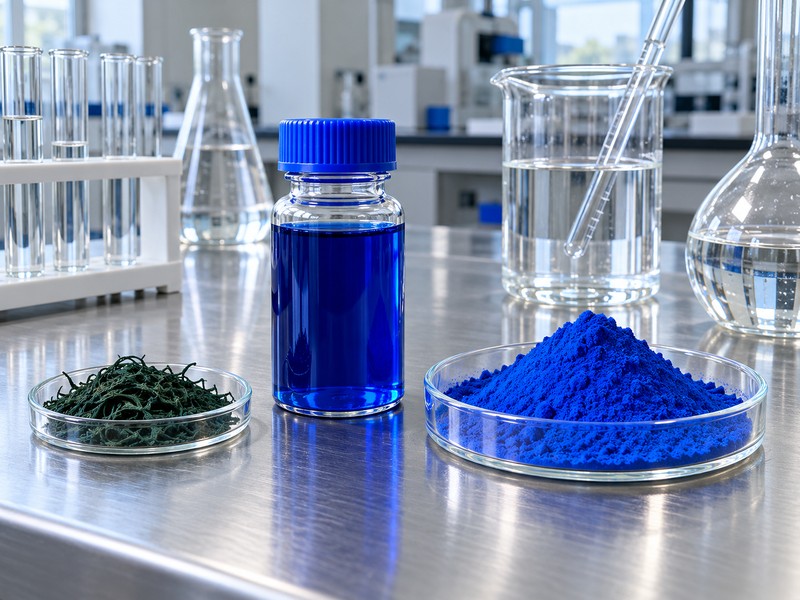
Blue spirulina is usually made from a phycocyanin-rich extract of cultivated Arthrospira biomass, sometimes blended with a food carrier for a usable powder. It is not simply whole green spirulina dyed blue. If you ask what is blue spirulina made of because you are reading a label or buying an ingredient, the exact answer depends on the supplier’s formulation. Look for the organism source, extraction process, carrier, color specification, and lot documentation rather than relying on the front of the pack.
1. What is the source organism?
The source is typically cultivated Arthrospira, commonly called spirulina. It is a cyanobacterium, although food marketing often calls it blue-green algae. Its biomass contains several pigments and other components; the blue color comes chiefly from phycocyanins. The source organism matters because a blue extract has a different composition from the whole dried biomass. A credible specification should name the source and describe the ingredient you are actually buying.
Why do both “spirulina” and “Arthrospira” appear?
Common names, older taxonomic language, and regulatory terms do not always match scientific naming exactly. A supplier may use “spirulina extract” as the food ingredient name and Arthrospira platensis to identify the cultured organism. Ask for the technical specification if a label only says “blue algae” or gives an unclear botanical name. For a commercial food, confirm the name accepted in the destination market. Do not assume two products are interchangeable just because their marketing uses the same blue color.
| Term | Usually refers to | Buyer question |
|---|---|---|
| Spirulina | Common trade name | Whole biomass or extract? |
| Arthrospira | Source organism | Which species and source? |
| Phycocyanin | Blue pigment-protein | How is content measured? |
The exact ingredient identity should survive a label audit.
2. What creates the blue color?
Phycocyanins, especially C-phycocyanin, create the characteristic blue color. These are water-soluble pigment-protein complexes found in the source biomass. Extraction enriches the blue fraction, while leaving much of the green whole-biomass appearance behind. A blue powder may still vary from pale to deep blue depending on concentration, carrier, moisture, and how it is processed. Color intensity alone does not tell you the total composition or safety of a product.
What should a color specification report?
Ask for the supplier’s method, target range, and lot result for the color grade. Some suppliers use codes such as E3, E6, E18, E25, or E35; these are not universal percentages of phycocyanin. If your purchasing decision requires an actual component concentration, request a validated assay and its units. Compare grades in the finished food at matched color, not by powder appearance. A darker powder can be a poor choice if it dissolves badly or changes flavor.
The blue spirulina page is a starting point for discussing grades; the lot specification should define what is delivered.
3. How is the blue fraction separated?
The blue fraction is generally separated by processing cultivated spirulina biomass to release and collect water-soluble pigments. Actual methods vary by manufacturer and grade, including extraction, filtration, concentration, and drying. The process determines color strength, residual components, microbiological controls, and cost. A buyer does not need every proprietary detail, but needs enough information to assess food suitability and consistency. A supplier should be able to explain the ingredient pathway without hiding the identity of the final material.
Which process questions are practical?
Ask whether the material is an aqueous extract, how it is dried, what carriers remain, and which controls are applied before release. Request documents for the actual facility and product, not a generic company brochure. If a manufacturer changes the extraction or carrier system, your beverage color or label may change. Include change notification in the supply agreement. The purpose is to keep a successful trial repeatable at commercial scale.
| Process stage | Possible effect on buyer’s product |
|---|---|
| Extraction | Pigment yield and composition |
| Separation | Clarity and residual solids |
| Drying | Solubility and color stability |
| Blending | Carrier and label declaration |
Each stage can affect the powder you use.
4. Do blue spirulina powders contain carriers?
Some do, and the carrier should be named on the ingredient declaration. A carrier can help convert a concentrated extract into a stable, measurable powder, but it may affect sweetness, solids, allergens, or label wording. Two blue powders with the same visual shade can have different carrier loads. A product sold as “pure blue spirulina” should still be checked against the full specification. The front-label phrase is not a substitute for a complete ingredient statement.
How do you compare two supplier quotes?
Ask for the same information from each supplier: ingredient declaration, color strength method, moisture, solubility, carrier, recommended storage, and lot COA. Calculate the amount needed for an approved finished color. Then compare cost per saleable serving, not only price per kilogram. If a lower-priced grade needs double the dose, it may also add more carrier. Keep the test base and process identical so the comparison means something.
The contact page can help start a product-specific documentation request.
5. Is blue spirulina the same as whole green spirulina?
No, blue extract and whole green spirulina are different ingredient forms. Whole biomass retains a broader mix of pigments and nutrients and commonly looks dark green. The blue extract is selected for its water-soluble pigment fraction and often used primarily as a food color. Nutrition claims about whole spirulina should not be copied onto a blue extract without evidence for that product. A buyer should specify which form is required before requesting a sample.
Which form fits which application?
Choose based on the desired function. A clean blue smoothie or confection usually calls for blue extract, while a green supplement or savory blend may use whole biomass. Taste, color, nutrition, solubility, and regulatory category all differ. Test both only if the product brief allows a color and flavor comparison. For an ingredient list, use the actual supplied material rather than a broad shorthand.
| Form | Typical appearance | Primary formulation question |
|---|---|---|
| Whole spirulina | Green | Nutrient and flavor fit |
| Blue extract | Blue | Color and stability |
| Blue premix | Varies | Full formula and carrier |
The whole spirulina range covers a separate purchasing decision.
6. What else can be present in the final powder?
Besides the blue pigment fraction, a final powder can contain water, residual source components, a declared carrier, and constituents that vary with manufacturing. The exact proportions cannot be inferred from the product photograph. Quality specifications should set limits for relevant microbiological and chemical attributes. A high pigment reading does not replace contaminant testing. Evaluate the whole ingredient as supplied, especially when it will enter a product for children or a regulated market.
What should a lot certificate show?
The certificate of analysis should identify the product and lot, test methods, results, dates, and acceptance criteria. Review relevant microbial limits, heavy metals, color measure, and other controls appropriate to the source and market. Check that the certificate matches the sample and commercial shipment. If a seller provides a certificate from a different factory or an earlier grade, request the correct one. A good quality record makes a claim verifiable instead of merely reassuring.
| Document item | What it helps verify |
|---|---|
| Lot identifier | Traceability |
| Color result | Grade consistency |
| Microbiological results | Hygienic quality |
| Chemical limits | Agreed contaminant controls |
Read the result column, not just the certificate heading.
7. Does “natural” tell you its ingredients?
No, “natural” does not reveal the full ingredient list or prove organic certification. A spirulina-derived pigment may be described as natural in some commercial contexts, but claim rules differ by market and finished-product category. A carrier can also affect how the final ingredient is declared. If you need organic status, obtain current certification for the exact product, facility, transaction, and destination market. Conventional material should be treated as conventional unless that documentation is supplied.
How should a label claim be checked?
Start with the full formula, specification, and target-market rules. Ask which part of the claim applies to the blue extract and which part applies to the finished food. A “natural blue” description is not permission to imply an unsupported health benefit. If a product is sold in several countries, maintain the approved wording for each. Have a qualified regulatory reviewer sign off before printing packaging.
The about page gives company background, but product claims need product-specific evidence.
8. Is blue spirulina suitable for every food?
No, blue spirulina extract is not automatically suitable for every food. Phycocyanin can be sensitive to acidic pH, heat, light, and long storage, so a bright water sample may fail in lemonade or a baked product. Its permitted food-color uses also vary by jurisdiction. In the United States, 21 CFR 73.530 sets specified uses and conditions for spirulina extract. Check the exact food and process rather than assuming that a food-grade powder can go anywhere.
What should a finished-product trial include?
Use the intended base, dose, heat process, pH, package, and shelf life. Observe color, sediment, flavor, and stability at planned checkpoints. Compare a control product and two or more measured doses. If the shade fades, investigate the formula and package before increasing the pigment. Record both technical performance and regulatory approval as part of the selection decision.
| Application | Early test priority |
|---|---|
| Smoothie | Base color and separation |
| Lemonade | Acidity and shelf-life color |
| Ice cream | Frozen shade and texture |
| Confection | Heat and permitted use |
Test the food customers will buy, not a simplified lab mix.
9. Can the ingredient name differ by market?
Yes, ingredient names and color declarations can differ by jurisdiction and product category. One market may specify a regulated color-additive name, while another may require different labeling or may not permit the use in the same food. A supplier’s label example is only a starting point. The final manufacturer is responsible for checking local rules and the current permitted use. A recipe intended for several markets may need separate regulatory reviews and packaging files.
Which files should travel with the ingredient?
Keep the technical specification, ingredient statement, lot COA, country-specific compliance information, and approved final-food label together. Note the manufacturer and facility associated with those documents. If the supplier changes a carrier or production site, recheck the files and the finished label. Good document control prevents a small ingredient change from becoming a packaging error. It also lets customer service answer a composition question with the right version.
The factory overview is useful context, while the exact facility and certificate should be verified for each supplied lot.
10. How should a buyer choose a blue spirulina ingredient?
Choose by matching composition, documentation, and finished-product performance to the application. Start with the intended food, target shade, processing conditions, shelf life, package, and market. Request several appropriate grades with full ingredient declarations and lot records. Test them at equal finished color, then compare taste, solubility, stability, and cost per serving. Avoid treating a grade code or marketing phrase as proof of quality by itself.
What should go in the purchasing brief?
State the product base, expected annual volume, required documents, permitted carriers, allergen needs, and change-notification expectations. Include a color standard based on the finished product. Ask who manufactures the ingredient and who handles export documentation for your shipment. A trial sample from one plant does not approve every future source. When the brief is specific, a supplier can propose a defensible grade rather than a generic blue powder.
The OEM services page is a practical next step when composition questions are part of a broader product brief.
FAQ
Can I assume blue spirulina is just dried algae?
No. Most blue products are extracts or formulated powders, while whole dried spirulina is usually green. Read the exact ingredient declaration.
What’s the best way to check the carrier?
Ask for the complete specification and ingredient statement for the purchased grade. Do not infer carrier content from color intensity or a front-label claim.
How do I know if the powder is really blue spirulina?
Check the source organism, product identity, supplier traceability, and lot certificate. A laboratory assay may be appropriate for high-value or disputed supply.
Can blue spirulina be organic?
It may be, but only if the exact product and supply chain have valid certification for the claim and market. Conventional material should not be described as organic without that proof.
Can I use the same grade in every recipe?
Not automatically. Base color, acidity, heat, and package can change the result, so test the chosen grade in each finished application.
Conclusion
Blue spirulina is typically a phycocyanin-rich extract from cultivated Arthrospira, sometimes formulated with a carrier. You can now read a powder specification with the right questions in mind: source, pigment, carrier, lot controls, permitted use, and stability in your food. If you are selecting an ingredient, contact us with the application and destination market so we can discuss suitable samples and documentation. An honest blue ingredient is one whose composition can be explained as clearly as its color can be seen.