
The best blue spirulina recipes use the extract where its vivid color survives the process and its mild flavor fits the food. A photo can inspire a launch, but a commercial recipe has to work with real ingredients, staff, packaging, and shelf life. A blue smoothie, frosting, or ice cream each asks something different of the powder. This guide turns blue spirulina recipes into practical starting formulas and tests for cafés, food developers, and brands.
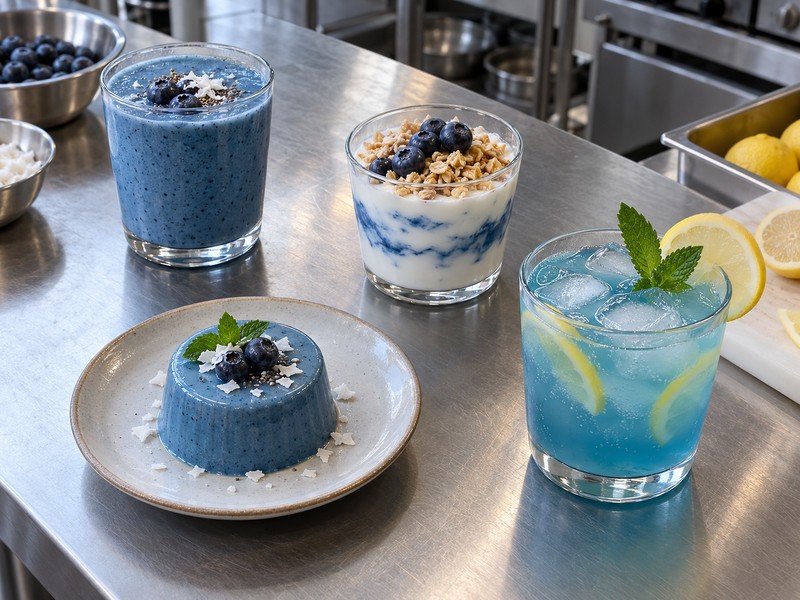
1. What ingredient do blue spirulina recipes need?
Blue spirulina recipes usually need a phycocyanin-rich spirulina extract, not whole green spirulina powder. The extract gives a blue shade with a different flavor and composition from dried whole biomass. Commercial powders can include carriers, so read the ingredient declaration and test the exact grade. A recipe’s successful dose depends on the base, process, and desired color; there is no reliable universal spoonful.
How should you set up a recipe test?
Request a food-grade blue extract specification and lot-specific COA. Weigh a reference dose, record the full formula, and photograph the result under consistent light. Keep a no-color control for taste and texture comparison. If the supplier uses E3, E6, E18, E25, or E35 terms, ask how those grades are measured rather than treating them as purity percentages.
| Trial note | Why it belongs in the file |
|---|---|
| Exact extract lot | Ties the recipe to the COA |
| Carrier declaration | Affects label and possibly texture |
| Dose by weight | Makes the recipe repeatable |
| Color reference | Defines success beyond a photo filter |
Once that file exists, individual recipes become easier to compare.
2. How do you make a blue spirulina smoothie?
Blend a pale fruit or milk base first, then add a measured blue extract dose that reaches the target shade without an off-note. Coconut, banana, light dairy, and some plant milks are useful starting bases because they allow the blue to show. Dark berries and strongly yellow fruit can shift the color. The recipe should specify fruit weight, liquid, ice, powder dose, blend time, and serving cup.
What should a smoothie pilot compare?
Make a no-color control and three measured blue doses. Taste blind, then compare the colors. Check the cup at service and after partial ice melt; a bright first sip can become pale and watery. If the recipe will be bottled, run a separate shelf-life and safety study. A fresh café smoothie is not a proxy for a retail product.
The OEM service overview can frame a scaled product discussion, but the formula should be proven in the intended equipment.
3. Can you make a blue lemonade that stays blue?
You can make blue lemonade, but lemon acidity may challenge phycocyanin color stability. Start with a good-tasting lemonade, then test the extract across the safe pH range of the finished recipe. A very sour version may look vivid immediately and fade during holding. Do not raise pH solely for color without a validated preservation plan.
What is a useful lemonade sequence?
Make a measured lemon-and-sweetener base, record its pH, and prepare a small blue premix before combining. Compare fresh shade, taste, and shade after the normal service window. If the color fails, review acid blend, dose, and package one variable at a time. For a sparkling version, repeat the test with the intended carbonation and bottle. The finished glass, not a blue concentrate, is what customers buy.
| Lemonade variable | Main risk |
|---|---|
| Lemon concentration | Color fading and sharpness |
| Sweetness | Masking an off-note or overloading sugar |
| Carbonation | Perceived acidity and foam |
| Clear package | Light exposure during sale |
The recipe is ready only when color and citrus taste survive together.
4. What makes a good blue spirulina latte?
A good blue latte uses a pale milk base, an evenly dispersed extract, and a temperature that preserves the intended shade. It may contain no coffee; if espresso or tea is added, the complete drink’s caffeine status changes. Milk alternatives can shift both color and flavor. For café service, the recipe must work across staff shifts rather than in one carefully staged cup.
How should a café test it?
Compare the same measured extract dose in dairy and plant bases, hot and iced. Make a small premix to avoid blue specks, then record milk temperature, foam, shade, and aftertaste. Taste after the cup has waited as long as a real order might wait. If the blue fades in hot service, an iced version may be the more honest menu item. Write a card with grams, volume, temperature, and an acceptable color photo.
If the latte uses a syrup or premix, check its full ingredient and allergen declaration before menu copy is approved.
5. How do you color chia pudding blue?
Mix the blue extract into the liquid before adding chia seeds, then let the pudding hydrate under controlled refrigeration. This gives a more even color than sprinkling powder over a thick finished pudding. Coconut or other pale milks show the blue clearly, while fruit purées can alter it. The overnight texture and shade matter more than the appearance immediately after mixing.
What should you check after hydration?
Measure chia, liquid, sweetener, and extract by weight. Compare color and texture at mixing, after full hydration, and near the intended sale time. Look for settling, uneven blue streaks, and an earthy finish. If you add an acidic fruit layer, test how the color looks at the interface after storage. A layered cup may be attractive but should still taste balanced when customers stir it.
| Checkpoint | Observation |
|---|---|
| At mixing | Dispersion and initial shade |
| After hydration | Final thickness and color uniformity |
| At sale time | Separation, taste, and layer appearance |
Use the final refrigerated product as the approval sample.
6. Can a smoothie bowl hold the blue shade?
A smoothie bowl can hold blue color if its base is pale and the topping choices do not overwhelm it. Because a bowl is thick, it may need a different mixing sequence from a drink. Banana, coconut, and light-colored frozen fruit are common starting points. Dark berry purée can make the blue muddy; acidic toppings can create localized changes where they touch the base.
How should a bowl be assembled for service?
Weigh the base ingredients and extract, blend to a consistent thickness, and serve in the intended bowl. Add toppings only after recording the base shade. Compare the appearance at service and after a realistic wait. If a café posts a vivid photo, train staff on portion and topping placement so the sold bowl resembles it. The recipe should also state safe frozen-food handling and maximum service time.
A bowl is usually eaten slowly, so texture and color after ten minutes deserve attention, not only the first photograph.
7. Does blue spirulina work in ice cream?
Blue spirulina can color ice cream if the extract survives the mix process and the final shade looks good after freezing. A cold-mixed no-cook base and a heat-treated dairy mix present different challenges. Fat, milk proteins, air, and overrun change perceived color. Test the extract at the point in the process where it will be added in production, with a validated food-safety procedure.
What should a frozen-dessert pilot record?
Measure shade in liquid mix, after churning, after hardening, and after serving temperature is reached. Taste for any extract note and check for streaks or specks. Compare several use levels by cost per finished portion. If the product is displayed in an open freezer, add light exposure to the trial. A powder that looks blue in a beaker may appear pale once the ice cream is aerated.
| Stage | Main observation |
|---|---|
| Liquid mix | Dispersion and starting hue |
| After freezing | Color loss or paleness |
| At serving | Flavor, texture, and final shade |
Approve the scoop, not only the liquid mix.
8. How can bakers use blue spirulina in frosting?
Bakers can use blue extract in a cool frosting or glaze, but should test the complete recipe for shade and stability. A white base shows color clearly. Butter, cream cheese, plant fats, acidity, and light exposure can alter the result. Baking the pigment into a high-heat cake is a different problem from tinting a cooled topping; the process step should be chosen deliberately.
What should a bakery test before a launch?
Make small batches with measured doses and compare the frosting just after mixing, after piping, and during display. Check flavor, texture, and whether the color stains packaging or fades under lights. If the topping is added to an acidic fruit cake, inspect the contact area after storage. Record the approved dose by weight per batch and train staff to use the same base recipe.
For a shelf-stable packaged bakery product, perform a separate finished-product review. The café trial cannot establish a packaged shelf life.
9. Are powdered drink mixes a useful application?
Powdered drink mixes can be useful because blue extract and other dry ingredients can be blended before a customer adds liquid. Yet dry blending introduces its own risks: segregation, clumping, uneven sachet fill, and different color when mixed with tap water or milk. The carrier and particle behavior of the extract matter. A successful powder blend is judged after reconstitution, not while it sits in the sachet.
How do you test a dry mix?
Blend a small lot with the intended sweetener or functional ingredients, then sample from the top, middle, and bottom for color uniformity. Fill representative sachets and test them in the liquid and temperature printed on the label. Check dissolution, taste, and shade after normal stirring. Run moisture and shelf-life checks under the proposed package conditions. If the powder settles in a tub, include a clear mixing instruction.
The blue extract product information is a starting point for grade selection; the finished mix requires its own qualification.
10. How should a brand choose its first blue recipe?
Choose the first recipe by commercial fit and technical risk. A cold smoothie, chia pudding, or cool frosting can be a simpler visual pilot than a hot-filled acidic bottled drink. That does not mean the latter is impossible; it means the testing burden is higher. Start with the format that your team can make safely and repeatedly, then build evidence before expanding the range.
What should the first pilot brief include?
State the target consumer, recipe base, finished shade, sensory standard, process, package, shelf life, market, and ingredient cost limit. Request the extract specification and COA before buying in volume. Test a dose ladder in the real formula, keep a control, and document every change. When one recipe passes, its records become a useful starting point for the next format, though they do not replace its own trials.
| Product | Development priority |
|---|---|
| Café smoothie | Consistent base, dose, and service time |
| Chia pudding | Hydration, layers, and refrigeration |
| Ice cream | Process point and frozen shade |
| Bottled lemonade | Acid, package, and shelf life |
Pick the next product based on the unsolved risk, not the prettiest mock-up.
Frequently Asked Questions
Can I use the same dose in every recipe?
No. Color grade, base color, pH, process, and serving size all change the needed dose. Weigh and test each formula.
What is the best first recipe for a café?
A cold pale-base smoothie or latte is a practical starting point. Choose the one your staff can make consistently and that customers will want to drink.
How do I know if the blue will survive baking?
Test the pigment through the exact heat process. A cool frosting may be easier than coloring a batter baked at high temperature.
Can I claim health benefits from a blue recipe?
Only if direct evidence and local rules support the finished product’s wording. Color from spirulina extract does not establish a clinical benefit.
What is the best way to compare extract grades?
Test several grades in the same recipe at measured doses. Compare final shade, taste, stability, carrier, and cost per serving.
Conclusion
Blue spirulina recipes work when color, flavor, process, and service all agree. You now have practical starting points for smoothies, lemonade, lattes, chia pudding, bowls, frozen desserts, frosting, and dry mixes. If you are choosing an extract for a commercial recipe, contact us with the product format and market so we can discuss appropriate samples and documents. A recipe is ready when someone else can make it as well as the developer did.