
Blue spirulina powder is usually a dried, phycocyanin-rich extract used to give foods and drinks a vivid blue shade. Buying it is less simple than comparing photographs of two bright powders. One sample may contain a different carrier, color grade, contaminant profile, or shelf-life recommendation from another. If you are sourcing blue spirulina powder for a commercial recipe, this guide shows which documents and bench tests actually determine whether a lot will work.
1. What is blue spirulina powder made from?
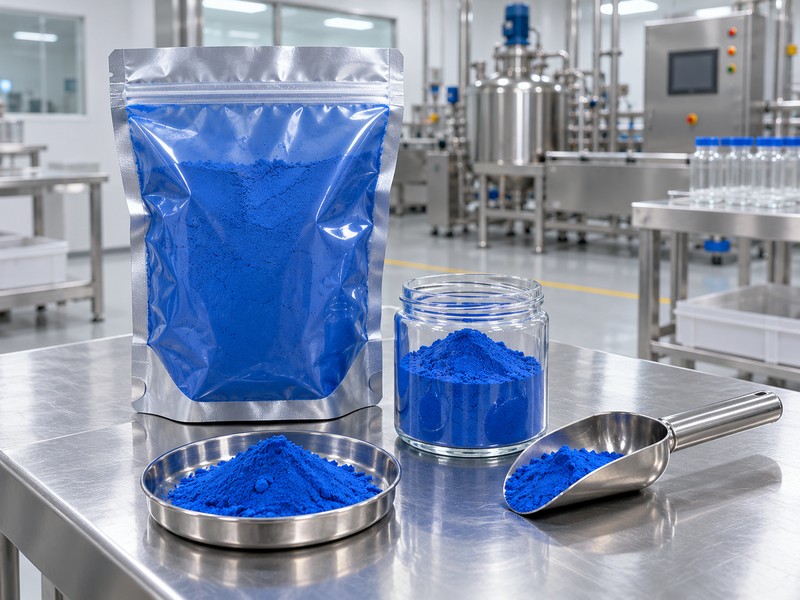
Blue spirulina powder is commonly produced from an aqueous extract of cultivated spirulina, with phycocyanins providing the blue color. It is different from whole green spirulina biomass that has simply been dried and ground. The exact powder you buy may include a carrier or processing aid, so the market name alone is incomplete. Ask the supplier to identify the source organism, extract type, carrier, and intended food use on the specification.
What should the ingredient declaration say?
The declaration should let your label team identify every ingredient in the purchased powder. A statement such as “blue spirulina” without a carrier breakdown may be too vague for a commercial label review. If the product is sold for use as a color, check the food-color identity and permitted applications in the destination market. The current U.S. rule for spirulina extract is a useful example of a market-specific definition, not permission for every country or food category.
| Term on an offer | Clarifying question |
|---|---|
| Blue spirulina powder | Is it an extract or whole biomass? |
| Phycocyanin powder | How is concentration measured? |
| Spirulina extract | Which carriers and uses are declared? |
The right specification starts with identity, not a color swatch.
2. How do color grades differ?
Color grades differ in measured color strength under a supplier’s defined method, but the grade name is not a universal phycocyanin purity percentage. You may see offers described as E3, E6, E18, E25, or E35. Those codes can help organize a supplier’s range; they cannot replace its test method or lot-specific result. Compare grades using the same dilution, base, lighting, and measurement conditions as your finished product.
Which grade should you sample first?
Start with the shade, dose, taste, and cost targets in your recipe. A stronger grade can sometimes reach the target at a lower use level, but it may not be the least expensive per finished serving. Order two or three adjacent grades from the blue spirulina range and test them side by side. If the powder includes a carrier, compare the full ingredient statements before concluding that a higher E number is better for your label.
Keep the sample lot number in your trial record. Otherwise, a later production batch with a similar marketing name may be hard to compare with the approved sample.
3. What should a certificate of analysis confirm?
A COA should confirm that the offered blue spirulina powder lot meets agreed identity, quality, and safety specifications. Request the document for the specific lot you will receive, not a sample certificate from another date. The exact test panel depends on market, use, and supplier, but buyers commonly review color value, microbiology, heavy metals, and any contaminants required by the applicable specification. A result without a method or limit can be hard to interpret.
How can you spot a weak COA?
Check for a lot number, production or test date, test method, unit, acceptance limit, actual result, and issuing laboratory or quality function. Then compare those details with the written specification and purchase order. If a limit says “complies” without an underlying numerical result where one is needed, request clarification. For a U.S. food-color application, compare the proposed panel with the current regulation and have your regulatory team confirm the intended use.
| COA field | Why you need it |
|---|---|
| Lot identifier | Connects results to delivered material |
| Method and unit | Makes the number interpretable |
| Limit and measured result | Shows pass or fail against a defined standard |
| Date and issuer | Supports traceability and review |
A clean document format is helpful; traceable data is the real test.
4. How should you test solubility and dispersion?
Test blue spirulina powder in the actual base because dispersion in plain water may not predict behavior in a smoothie, syrup, or dairy alternative. Some powders dissolve readily; others form specks, foam, or sediment when added too quickly. Temperature, order of addition, mixing energy, and other ingredients affect the result. A bench trial should reproduce the scale-up process closely enough to catch those issues.
What mixing sequence is worth trying?
Prepare a measured premix in a small volume of compatible liquid, then add it to the full batch under controlled mixing. Compare that with direct addition if the production line favors it. Record time to full dispersion, visible particles, foam, and sediment after holding. If the base is acidic or high in minerals, test those conditions rather than assuming a clear water solution predicts success.
The OEM service page can be a starting point for discussing a process brief. Approval still belongs to the trials in your own formula and equipment.
5. What changes the blue shade during processing?
Heat, pH, light, and the surrounding food matrix can change the blue shade during processing or storage. Phycocyanin is a protein pigment, so the behavior of blue spirulina powder is sensitive to conditions that differ between recipes. A pale smoothie prepared cold may retain a pleasing color, while a hot, acidic drink or a clear bottle on a bright shelf may need more careful evaluation. Do not promise a shelf-life shade from a freshly mixed cup.
Which trial conditions matter most?
Run the hardest combination your product will actually experience: peak process temperature, lowest expected pH, intended package, and realistic storage light. Test the filled product at several time points. Record shade, hue shift, sediment, and taste, then compare with a control without the color. Published reviews describe phycocyanin’s sensitivity to heat, acid, and light, but your finished matrix determines the practical limit.
| Variable | Trial record |
|---|---|
| Heat | Peak temperature and time at temperature |
| Acidity | Measured pH before and after processing |
| Light | Package type and exposure condition |
| Storage | Color and flavor at planned checkpoints |
These records let you compare grades without guessing why one faded.
6. Can the powder change flavor or texture?
Yes, blue spirulina powder can change flavor or texture at some doses, although food-grade extracts often taste milder than whole green spirulina. Carriers may add sweetness or body, and poorly dispersed powder can feel chalky. A stronger color grade may allow a lower dose, but that does not guarantee a neutral taste. Compare products in the finished recipe at the shade customers will see.
How should a sensory panel score it?
Use a blind control and at least two measured doses. Ask tasters to describe first impression, aftertaste, mouthfeel, and any changes after storage. Keep the base formula, serving temperature, and lighting consistent. A simple note such as “slightly earthy after ice melt” gives R&D something to act on; “tastes fine” does not. If the extract seems to alter sweetness, check whether the color itself is shaping expectations by comparing blind and visible tastings.
For a clean comparison, include one grade that reaches the color target at a low dose and another that needs more powder. Cost per kilogram alone misses this difference.
7. How do you store blue spirulina powder?
Store blue spirulina powder according to the supplier’s tested recommendations, usually in a tightly closed package protected from moisture, heat, and light. The exact shelf life should come from the specific product specification, not a generic blog claim. Once a package is opened, repeated exposure can change handling and quality. A large purchase may be cheaper on paper but wasteful if the team cannot use it within the validated period.
What should your warehouse record?
Record receiving date, lot number, package integrity, storage location, opening date, and the condition of any remainder. Use a clean, dry scoop and reseal promptly. Keep a retain sample under controlled conditions so an unexpected shade change can be investigated against the original lot. If shipping passes through hot or humid conditions, check the supplier’s packaging and transport guidance before agreeing to a long route.
| Storage control | Problem it helps prevent |
|---|---|
| Sealed moisture barrier | Clumping and handling variation |
| Light protection | Color change during storage |
| Lot segregation | Mixing approved and unapproved material |
| Opening-date record | Uncontrolled use of old stock |
An inventory system can only help if the package and lot details are recorded.
8. What documents are needed for an organic claim?
An organic claim needs documentation for the exact blue spirulina powder, production site, transaction, and target market. A supplier’s general certificate or a photo of an organic label on another SKU does not establish that the offered extract qualifies. The same caution applies to claims about non-GMO status, allergens, or special food standards. Ask your regulatory team to compare the actual documents with the planned package statement.
What should you request before artwork approval?
Ask for the current product certificate, scope, site information, chain-of-custody or transaction records where required, and the exact ingredient declaration. Match names and lot identifiers across documents. If the paperwork does not cover the product you intend to buy, use neutral wording until the gap is resolved. Spirulina CN’s standard offering should be treated as conventional unless the relevant organic chain is verified for that specific order.
This check protects a brand from printing a claim that later cannot be backed by its purchase file. It is much cheaper to resolve the issue before packaging is ordered.
9. How do you compare blue spirulina powder quotes?
Compare quotes by the cost of a successful finished serving, not only by price per kilogram. Two powders can differ in color strength, carrier, yield, freight, minimum order, and amount needed to pass stability. A more expensive powder may still be the cheaper choice if it works at a lower dose and reduces rework. Calculate costs using the exact grade and measured dose from your pilot.
Which commercial terms change the decision?
Request the quoted grade, packaging size, minimum order, lead time, shelf life at delivery, shipping terms, and replacement process for a failed lot. Ask whether the sample and production order will use the same specification. If a supplier cannot state how it controls lot-to-lot color, that uncertainty belongs in your costing. A short supply interruption can cost more than a small difference in ingredient price.
| Quote field | Compare on a common basis |
|---|---|
| Price per kilogram | Delivered cost, including freight |
| Use level | Cost per finished serving |
| Stability | Expected loss and rework risk |
| Minimum order | Stock life and cash tied up |
The comparison is fair only after every sample passes the same product brief.
10. What is the best approval process before scale-up?
The best approval process links a named blue spirulina powder lot to its documents, sample trial, and finished-product performance. A beautiful color test in water is not enough. Procurement, R&D, quality, and regulatory reviewers each need a clear decision record. After approval, the purchase order should reference the same grade and specification so a substitution is visible before production.
What belongs in the handover file?
Keep the signed specification, lot-specific COA, carrier statement, market review, approved dose, sensory notes, process settings, stability results, and a retained sample. Set a rule for what triggers requalification, such as a new carrier, grade, supplier site, or material process change. Then verify incoming lots against the agreed criteria. This is a practical way to prevent a successful pilot from turning into an inconsistent launch.
If you are comparing Spirulina CN blue extract options, send the intended recipe and market with the inquiry. The response can then address a concrete specification rather than a generic request for “the bluest powder.”
Frequently Asked Questions
Can I substitute green spirulina powder for blue spirulina powder?
Usually not without reformulation. Whole green biomass differs in color, flavor, and composition, so it should be tested as a separate ingredient.
What is the best first sample size for a trial?
Use enough for at least a dose ladder and a short stability test. Confirm the quantity with the supplier after you specify batch size and planned uses.
How do I know if an E-grade means high purity?
Do not infer purity from the code alone. Request the supplier’s grade method and lot-specific assay or color data, then compare those with your specification.
Can I use the same powder in every food market?
No universal approval should be assumed. Have a regulatory reviewer check the extract identity, proposed use, and labeling in each destination market.
What is the best way to approve a new supplier?
Qualify the specific lot in your finished recipe. Pair a document review with sensory, process, stability, and commercial checks.
Conclusion
Blue spirulina powder is a useful color ingredient when its identity, quality, and performance are known. You now have a framework for comparing grades, checking COAs, testing color stability, and calculating real use cost. If you are planning a food or beverage launch, contact us with your target shade, formula, and market so we can discuss appropriate samples and documents. A repeatable specification makes a vivid color commercially useful.