
Make blue spirulina water by dispersing a measured food-grade blue extract in a suitable water base, then checking clarity, taste, color stability, and the rules for the intended market. A glass can turn blue in seconds, but a bottled water must stay appealing through processing and storage. If blue spirulina water is a product concept rather than a quick café drink, the water itself, pigment grade, package, and label all need a plan. This guide starts with what the customer will actually pour.
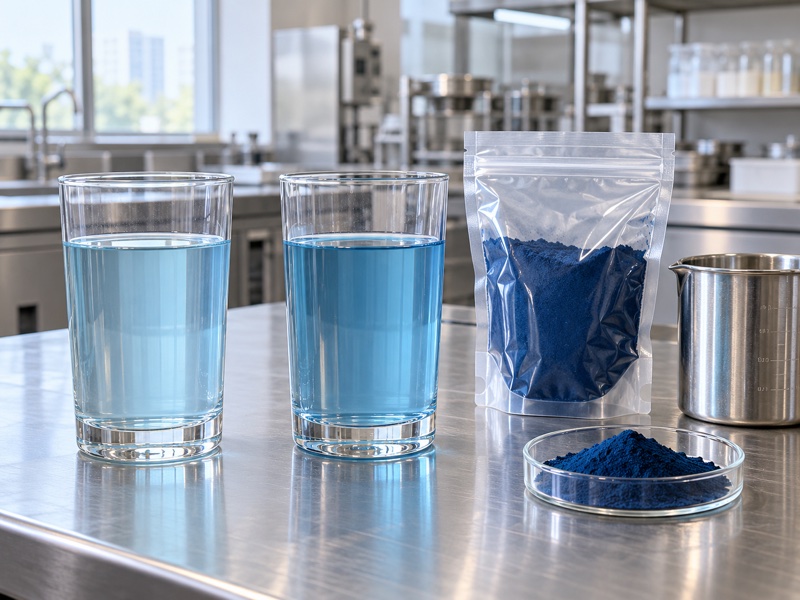
1. What is blue spirulina water?
Blue spirulina water is water colored with a spirulina-derived, phycocyanin-rich extract. It may be served plain, lightly flavored, or carbonated, but each version has a different formula and stability profile. The extract is distinct from whole green spirulina powder, which can give a greenish shade and stronger flavor. “Water” on a package may also have legal meaning in the destination market. Decide whether the finished item is bottled water, a flavored water, or another beverage category before creating claims.
What should the product brief name?
Record the water source, pigment grade, carrier, optional flavors, sweeteners, acid, carbonation, package, and serving format. A blue glass at a café may be mixed to order; a retail bottle faces months of light and temperature changes. The blue drink guide covers the broader beverage issues, while ingredient composition explains why the extract’s carrier matters. Keep these details in the same brief so procurement and R&D discuss the same product.
| Format | Main question |
|---|---|
| Made-to-order glass | Does it taste and look right now? |
| Chilled bottle | Will color and clarity last? |
| Sparkling water | What do CO2 and pH change? |
The format determines the trial, not the other way around.
2. Which water base gives the clearest blue?
A clear, neutral-tasting water base makes the blue easiest to see and evaluate. Mineral content can affect taste, haze, and interaction with the extract, while a naturally tinted base changes the perceived shade. Filtered, spring, and mineral waters are not interchangeable in a finished product. Compare the waters your operation can actually source at scale. Check pH, mineral profile, and visual clarity before adding pigment.
How can you run a water comparison?
Use the same blue extract lot and measured dose in each candidate water. Mix at a fixed temperature and agitation time, then assess color, haze, sediment, and flavor immediately and after holding. Keep plain-water controls. If a mineral-rich version clouds, do not blame the blue powder until you compare the base alone. The juice article shows why a colored fruit matrix is another problem entirely.
| Water property | Possible finished effect |
|---|---|
| Mineral level | Flavor or haze |
| pH | Pigment stability |
| Native color | Blue hue shift |
| Microbiological quality | Product safety |
Choose a water that supports both the color and the label.
3. How much blue powder should a serving use?
Use the lowest weighed amount that reaches an approved shade in the finished serving. A teaspoon is too imprecise for production, and a powder grade can change the required weight. More extract may deepen the fresh blue but also add cost, sediment, or a faint taste. A transparent beverage exposes small defects more than an opaque smoothie does. Set the target using a filled glass or bottle under consistent light.
What does a dose ladder show?
Prepare a control and several measured blue levels in the same water. Compare fresh shade, clarity, flavor, and stability after the intended hold. Record grams per liter and per retail serving, then repeat with a production lot. If the blue fades during storage, investigate light, pH, and package before raising the dose. The blue powder guide explains why color grade and carrier belong in the cost calculation.
| Dose observation | Likely next step |
|---|---|
| Too pale but stable | Modest dose or grade trial |
| Bright but cloudy | Dispersion or compatibility check |
| Bright then fades | Package and stability review |
The saleable bottle should set the dose.
4. What mixing sequence prevents blue specks?
A small premix and controlled addition often prevent blue specks in water. Dry powder dumped into a large tank can float, clump, or stick to equipment before dispersing. Mix the weighed extract in a compatible portion of water, then add it under a documented agitation condition. The actual sequence should fit the plant’s hygienic process. A clear bottle makes any sediment or undissolved particle easy to see.
What should the pilot line record?
Note premix volume, water temperature, mixing speed, time, addition point, and any filtration step. Sample the first, middle, and last filled units to check even distribution. Compare color after a still hold and a gentle shake. If a powder disperses in a bench beaker but not a production tank, mixing energy or sequence may be the cause. A recipe development guide can inspire applications, but the bottling line needs its own operating instruction.
Repeatable mixing is more valuable than a dramatic swirl on camera.
5. Does acidity change the color?
Yes, acidity can change phycocyanin’s visible shade and stability. Plain water and lemon-flavored water can behave differently even when the blue dose is identical. Acid may be needed for taste or preservation, so the formula must balance those needs under qualified food-safety review. A fresh sample is not enough to approve a shelf-life claim. Test the final acid source and level in the intended package.
How should an acid trial be designed?
Keep all variables except the acid system constant. Measure pH after mixing, after processing, and at storage checkpoints. Record hue, clarity, sediment, and taste. If a low-pH sample loses blue, consider a different concept or ingredient grade before adding more powder. The lemonade article examines the more acidic end of this problem.
| Trial point | Why it matters |
|---|---|
| pH at fill | Starting condition |
| pH after storage | Formula drift |
| Color and haze | Shelf appearance |
| Taste | Customer acceptance |
Color and preservation must be approved together.
6. Can blue spirulina water be carbonated?
It can be tested as a sparkling drink, but carbonation changes the formulation decision. Dissolved CO2 affects acidity and mouthfeel; bubbles and foam change how the blue looks in the bottle and glass. A still-water prototype does not establish the result under pressure. Use the intended carbonation level, closure, and filling process in the pilot. Check color after opening as well as before.
What should a sparkling trial measure?
Record CO2 level, pH, pressure, foaming during fill, sediment, and flavor after opening. Compare a still control with the same blue dose. Assess the poured glass at the expected serving temperature. If foam masks the hue, the pack may communicate the color differently from the glass. A package and recipe decision should follow that observation, not a still-photo concept.
The drink article has a wider carbonation checklist for bottled formulations.
7. How do light and packaging affect the water?
Light exposure can weaken the blue, making packaging part of the ingredient system. A clear bottle showcases the color but may leave the pigment exposed on a bright shelf. Tinted or opaque packaging can protect it while reducing visual impact. The right choice depends on shelf life, distribution, display light, and the formula. Test realistic exposure rather than relying on a storage claim for the dry powder.
What should a package comparison include?
Fill the same batch into clear and protective options. Store them under dark and retail-light conditions selected by quality. Measure color and clarity at planned points, and keep unopened controls. Note whether label adhesive or bottle material alters the view of the blue. If clear packaging fails, a stronger grade may only make the starting sample darker. The ice cream article illustrates another case where serving appearance depends on storage conditions.
| Package | Benefit | Risk to test |
|---|---|---|
| Clear bottle | Displays blue | Light exposure |
| Tinted bottle | Some protection | Altered apparent shade |
| Opaque pack | Strong protection | Hidden color |
Choose the pack that keeps the promise on shelf.
8. What processing steps need validation?
Every processing step that affects safety or color needs validation for the finished water. Heat treatment, filtration, hygienic filling, and post-process addition can change the result. Adding pigment after a kill step may preserve color but create a new contamination route if the process is not controlled. A cold-mixed café drink and a shelf-stable bottle have different evidence requirements. The manufacturer should define a safe process first, then test the pigment within it.
What should a production trial capture?
Record water treatment, blue addition point, peak temperature, hold time, filtration, fill method, and package closure. Compare color before and after processing. Sample across the run to find dose or mixing drift. Repeat storage tests if any critical step changes. A supplier can advise on extract handling, but the brand and manufacturer own the finished product’s safety plan.
| Process detail | Possible effect |
|---|---|
| Heat | Blue loss |
| Filtration | Pigment removal or clarity change |
| Addition point | Hygiene and dispersion |
| Fill sequence | Unit-to-unit variation |
The process must be safe and repeatable before it is photogenic.
9. Which claims should the label avoid?
The label should avoid implying that blue water treats disease or provides broad nutrition benefits without evidence for the finished serving. A color-use dose is not proof of meaningful protein or micronutrient intake. “Natural,” “organic,” “caffeine-free,” and “water” claims each need their own market-specific review. In the United States, 21 CFR 73.530 defines specified uses and conditions for spirulina extract as a color additive. Check the exact beverage category and current rule before printing.
What evidence should be on file?
Keep the full formula, ingredient declaration, color-grade specification, lot COA, nutrition data where claimed, and approved market label. If a flavor or carrier changes, recheck the copy. The natural-label article explains why origin and organic status are separate questions. A simple product description can be compelling when it is accurate: clear blue color, flavor, and serving format.
Claims should follow the bottle, not the excitement around its color.
10. When is blue spirulina water ready to launch?
It is ready when the commercial formula passes appearance, taste, safety, stability, and label review under intended production conditions. A blue beaker is an idea; a consistent bottle is a product. Approve a shade standard, dose, package, shelf-life plan, and lot release criteria. Check that purchasing can obtain the same grade in repeat orders. Give customer service a clear ingredient and claim sheet.
What belongs in the launch file?
Store the trial formula, extract lot, water specification, process record, filled-pack photos, stability results, and regulatory approval. Record who can authorize a material or label change. Our team can discuss suitable extract samples and documents for a proposed water concept. Production, not the supplier alone, must validate the finished drink. A careful file makes the second batch easier than the first.
| Decision | Proof to retain |
|---|---|
| Shade | Approved filled-bottle sample |
| Safety | Validated process |
| Shelf life | Realistic stability data |
| Label | Market review |
Launch when the tested bottle matches the product promise.
Frequently Asked Questions
Can I stir blue spirulina into plain water?
Yes, if the powder is food-grade and used according to its directions. A commercial bottled version needs additional safety and stability testing.
What’s the best water base for a clear blue drink?
Use a clear, neutral-tasting base as a starting point. Compare mineral profile, pH, clarity, and taste with the actual extract.
How do I know if the blue will last in a bottle?
Test the finished formula in its intended package under realistic light and storage conditions. Fresh color alone cannot answer that question.
Can blue spirulina water contain caffeine?
It can if tea, coffee, guarana, or another caffeine source is added. Pure blue extract is not naturally caffeinated.
Can I call it organic blue water?
Only with valid certification and market-compliant labeling for the exact ingredients and supply chain. A blue color does not establish organic status.
Conclusion
Blue spirulina water begins with a measured extract in a clear base, then succeeds or fails through mixing, acidity, processing, light exposure, and honest labeling. You now have the checks needed to move from a striking glass to a stable commercial drink. If you are developing a beverage, contact us with your water base, process, package, and market so we can discuss appropriate samples and documents. The best blue is the one customers still see when they open the bottle.