
Blue spirulina food coloring works by adding a phycocyanin-rich spirulina extract to a compatible food at a dose that gives the desired blue shade. A bright sample cup is only the beginning: the color still has to survive mixing, processing, packaging, and the time before a customer opens it. If you are replacing a synthetic blue or launching a naturally colored product, the main risk is assuming equal-looking powders perform equally. This guide shows how to test blue spirulina food coloring in the finished food rather than relying on a supplier photograph.
1. What is blue spirulina food coloring?
Blue spirulina food coloring is a spirulina-derived extract used to give foods and drinks a blue hue. Its principal coloring components are phycocyanins, according to the US definition of spirulina extract in 21 CFR 73.530. Commercial powders can vary in grade and carrier, so the ingredient is not identical to whole green spirulina powder. It is usually bought for color performance, not as a meaningful protein serving. Check the exact grade’s specification before choosing a formula dose.
What should a buyer ask for first?
Request ingredient identity, carrier composition, color or pigment method, recommended use range, storage instructions, and a current lot COA. The composition guide explains how the blue fraction differs from whole biomass. If the quotation lists a code such as E6 or E18, ask what the supplier’s code measures; it is not a universal percentage of purity. A technical file should tell quality and R&D what is actually being tested. Color alone cannot do that.
| Specification item | Practical use |
|---|---|
| Grade method | Compare lots and quotes |
| Carrier | Label and solubility review |
| Moisture | Handling and storage |
| Lot COA | Release decision |
Define the material before defining the shade.
2. Which foods show the blue most clearly?
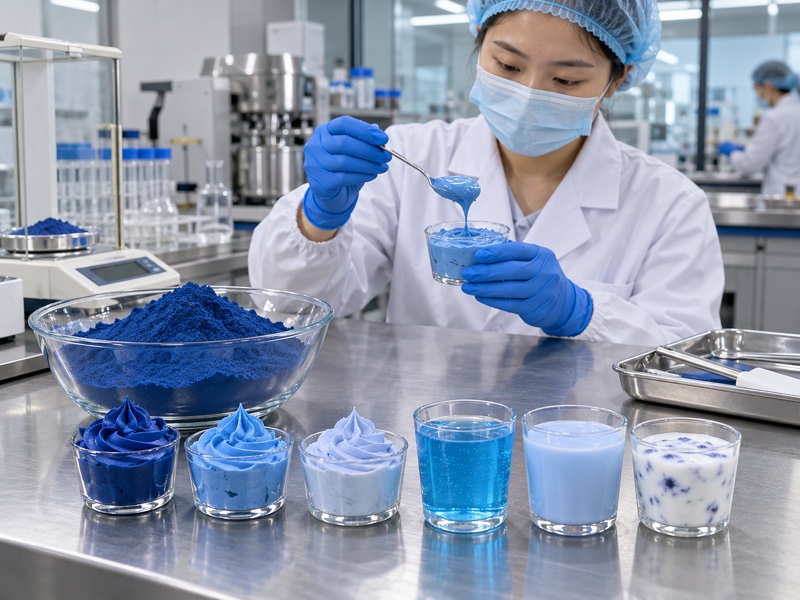
Pale, mild foods generally show the blue most clearly. White frosting, vanilla yogurt, clear water, and light frozen desserts reveal the pigment more readily than chocolate, berry purée, or a yellow base. Opacity changes the appearance too: a clear beverage may look cyan, while dairy can make the same extract look pastel. Choose the finished food and its target hue before comparing grades. A blue that is ideal in frosting may be wrong for a transparent bottle.
How should an application screen be set up?
Prepare a control and several weighed blue doses in the real matrix. Use the final sweetener, flavor, pH, and fat system. The recipe guide and blue drink guide show how different those two applications can be. Photograph the samples under consistent light and ask tasters to evaluate flavor separately. Do not judge color in a white beaker if the sold package is tinted.
| Matrix | Main color check |
|---|---|
| Clear drink | Clarity and sediment |
| Frosting | Hue and specks |
| Yogurt | Pastel shade and acid |
| Frozen dessert | Color after freezing |
The food base is part of the color system.
3. How much color should a recipe use?
Use the lowest weighed amount that reaches an approved shade after the product’s full process. A stronger grade may need less powder, while a weaker grade may cost more per finished unit even when its kilogram price is lower. A spoon measure is too imprecise for a production recipe. Test a dose ladder and note the ingredient’s impact on taste, texture, and cost. The dose must also fit any legal conditions for the exact market and food category.
What should a dose ladder capture?
Keep every ingredient and process step constant except the blue dose. Compare color immediately, after processing, and near the end of intended shelf life. The powder buying guide shows why cost should be calculated at equal finished performance. If color fades, first investigate heat, acid, light, and packaging instead of increasing dose by instinct. A darker starting sample may still fail later.
| Dose observation | Likely action |
|---|---|
| Pale but stable | Increase dose or grade |
| Bright but cloudy | Check dispersion |
| Bright then faded | Check process and package |
| Strong off-note | Reduce dose or change base |
Target the saleable product, not the mixing bowl.
4. What happens when the formula is acidic?
Acidity can shift or weaken phycocyanin color, so acidic foods need their own stability trial. Lemonade, fruit yogurt, sour gummies, and neutral frosting are different environments. The finished pH, acid source, and storage conditions matter more than a generic claim that an ingredient is “acid stable.” Food safety requirements may also demand a pH or process that limits color options. Do not change a safe formula solely to protect blue.
How do you separate acid effects from other changes?
Prepare matched samples across a controlled pH range while keeping the color dose and base consistent. Record hue, haze, and flavor at realistic storage points. The lemonade article shows how a citrus product forces the question early. If the blue fails at the required pH, consider another color system or product concept. The best color choice supports the safe finished food.
| Acid trial | What it answers |
|---|---|
| Base pH | Starting shade |
| Planned pH | Target-formula shade |
| Lower pH | Sensitivity margin |
| Shelf-end pH | Long-term drift |
Acid is a formulation variable, not a footnote.
5. Does heat damage blue spirulina color?
Heat can reduce blue color, with the extent depending on temperature, time, pH, and grade. A cold-mixed frosting and a baked cake should not share one stability conclusion. Processing can also expose the pigment to oxygen or filtration. Test the exact production sequence at pilot scale, including the intended point of color addition. Food safety validation takes priority over preserving a shade.
What should a process trial record?
Record the temperature curve, hold time, mixing stage, pH, and color before and after each step. Keep an unheated control. A phycocyanin stability review explains why heat and formulation are material to performance. If post-process addition is considered, quality must assess whether it introduces a contamination risk. A better color result is not a reason to bypass hygienic controls.
| Process | What to compare |
|---|---|
| Cold mix | Initial dispersion |
| Pasteurization | Heat loss |
| Baking | Finished crumb shade |
| Post-addition | Hygiene and distribution |
The safe process defines the color challenge.
6. How do light and packaging affect the blue?
Light exposure can fade blue spirulina color, making packaging and retail display part of the formulation. A clear bottle showcases a bright drink but may also expose it to shelf lighting. Opaque or protective packaging can help retain color while hiding it from shoppers. The right answer depends on product life, display conditions, and customer expectations. Test the exact package rather than extrapolating from dry-powder storage data.
What should a package test include?
Fill the same product into clear and protective packs, then hold them under dark and realistic retail-light conditions. Compare color, flavor, and package appearance at planned checkpoints. The blue drink guide gives a clear-bottle example. If protective packaging is needed, consider how the product will communicate its blue color on the label without promising a shade it cannot deliver. A shelf-end sample is more persuasive than a launch-day photo.
| Package | Benefit | Risk |
|---|---|---|
| Clear | Shows color | Light exposure |
| Tinted | Some protection | Apparent hue shift |
| Opaque | Stronger protection | Color hidden |
Packaging should protect the color the customer expects.
7. Can blue spirulina replace synthetic blue dye?
It can be considered as a replacement in some products, but it is not a drop-in substitute across every recipe. Pigment strength, solubility, heat response, acid tolerance, flavor, and legal use may differ. A replacement project should define the desired finished shade and acceptable variation. It may require changes to process or packaging. Cost comparisons should include shelf-life failures and waste, not just raw-material price.
How should a reformulation project begin?
List the current color’s role, the food’s pH and process, shelf life, package, and markets. Screen blue extract grades in the real product, then evaluate sensory and label effects. The natural blue comparison helps frame origin and claim questions. Do not claim “dye-free” or another marketing phrase until regulatory and legal teams review the actual ingredient and jurisdiction. A technically successful color swap can still require a label change.
| Reformulation question | Evidence needed |
|---|---|
| Same shade? | Finished-product color standard |
| Same shelf life? | Stability study |
| Same taste? | Sensory test |
| Lawful label? | Market review |
Replace a performance profile, not just a name on the formula.
8. Where is spirulina extract legally permitted?
Permitted uses depend on the destination market and food category. The US regulation in 21 CFR 73.530 lists identity, specifications, and specific uses for spirulina extract; a 2026 amendment was delayed indefinitely. Other jurisdictions have their own rules. A supplier’s general “food-grade” statement does not grant permission in every product. Check the current text and exact application before approving a commercial formula.
What information does regulatory review need?
Provide the ingredient grade, full formula, intended dose, food category, process, countries, and proposed label. Confirm any color declaration and purity requirement. If the product will be exported, review each market separately. Our team can help provide ingredient documents for the review, while the brand and manufacturer own final product compliance. Keep the decision on file so future recipe changes trigger another review.
| Review item | Reason |
|---|---|
| Market | Different rules |
| Food category | Use permission |
| Grade and dose | Identity and conditions |
| Label | Declaration and claims |
Regulatory fit is part of product fit.
9. What quality risks should a buyer check?
Check identity, relevant contaminants, microbiology, moisture, color strength, and lot consistency against agreed specifications. Spirulina-derived materials require controlled sourcing and production; a vivid shade is not a quality certificate. Ask for batch-specific COAs and traceability. Verify certification claims for the exact product, site, and transaction. Conventional non-organic status is the default unless the relevant organic chain is documented.
What should a release file contain?
Keep the approved specification, lot COA, test methods, traceability documents, storage instructions, and any market-specific statements. The factory page may provide background, but a particular batch and certification claim need their own evidence. Compare samples from more than one production lot when color variation would be costly. If a supplier changes carrier or grade method, repeat the application test. Release should depend on both ingredient data and finished-product performance.
| Quality record | Purpose |
|---|---|
| Specification | Agreed limits |
| COA | Lot result |
| Traceability | Source and recall support |
| Application standard | Finished color consistency |
Quality control keeps a good trial from becoming a one-off.
10. When is the blue color ready to launch?
It is ready when the exact grade meets the finished product’s shade, taste, safety, stability, label, and supply targets in repeatable production. Approve the use level and processing instructions, then retain a color reference made under normal factory conditions. A bench sample is not a launch standard. Set rules for lot substitution and color drift. The product team should know what to do when a shipment or batch falls outside the approved range.
What belongs in the launch handoff?
Include the signed formula, ingredient specification, trial results, shelf-life data, package decision, regulatory review, and purchasing plan. A blue powder guide can help new team members understand the material, but the handoff should state the exact grade and supplier. Train operators on the premix and addition method. A stable blue is the result of many small controls working together.
| Decision | Proof |
|---|---|
| Shade | Finished-product standard |
| Stability | Shelf-life results |
| Safety | Validated process and quality |
| Supply | Approved lot and terms |
Launch the color customers will actually see.
Frequently Asked Questions
Can I use blue spirulina as food coloring?
Yes, where the exact use is permitted and the grade is suitable. Check the current rules for the food category and market.
What’s the best food for a bright blue shade?
A pale, mild, low-acid base is an easy starting point. The best commercial application is the one that passes your process and shelf-life tests.
How do I know if a blue extract is strong enough?
Run a dose ladder in the finished food and compare color after processing and storage. Grade names alone are insufficient.
Can blue spirulina color a baked cake?
It can be tested, but heat and browning may weaken the blue. Frosting often provides a simpler first trial.
Can I call a product naturally colored?
Only after checking the full formula and relevant market wording. Natural origin does not automatically approve every claim.
Conclusion
Blue spirulina food coloring can give foods a distinctive blue when the ingredient, formula, process, package, and legal use fit together. You now know how to test shade, dose, acidity, heat, light, and batch quality before launching. If you need grade samples or technical documents for a commercial formula, contact us with your food category and market. We believe a natural color earns trust when it stays true in the product customers open.