
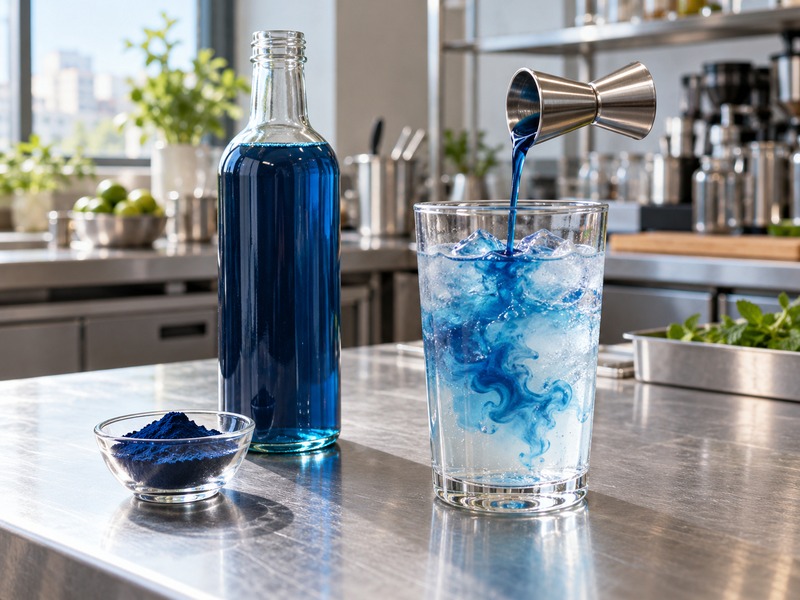
Make blue spirulina syrup by preparing a food-safe sugar syrup, cooling it, and mixing in a measured blue extract before testing the concentrate in the drinks or desserts where it will be used. A bright bottle can disappoint when the syrup separates, tastes too sweet, or turns green in lemonade. The usable recipe is the one that pours consistently and produces the intended color after dilution. This guide shows how to design a syrup for café service or a packaged-food trial without guessing at shelf life.
1. What is blue spirulina syrup?
Blue spirulina syrup is a sweet liquid concentrate colored with a phycocyanin-rich spirulina extract. Its main jobs are to deliver repeatable sweetness and color at a measured dose; it is not a nutritional shortcut. The ingredient guide separates blue extract from whole green biomass, which can produce a different taste and hue. Read the exact powder’s composition because a carrier or added sugar affects the syrup’s recipe and label.
What should the syrup brief specify?
Choose the end use before setting a formula. A latte syrup, mocktail color base, and bakery drizzle will be diluted or held differently. Define the serving dose, target shade after dilution, sweetness, viscosity, package, and use period. Make a plain syrup control so you can identify changes caused by the blue ingredient rather than by the sugar base.
- Name the intended drink or food.
- Set a dose per serving.
- Define the color in the finished application.
| End use | Critical check |
|---|---|
| Café drink | Dispersion after ice dilution |
| Dessert drizzle | Pourability when chilled |
| Bottled mixer | Shelf color and safety |
The bottle color is a poor substitute for a finished-drink test.
Key Takeaway: Write the application brief before choosing sugar level or pigment dose.
2. Which sweetener makes the best base?
A clear sucrose syrup is often the easiest starting base for blue spirulina syrup because it adds little competing color. Honey, dark agave, and caramelized sugar may shift blue toward green or gray. Alternative sweeteners can work, but they change viscosity, taste, preservation, and labeling. The mocktail guide shows why the syrup must be judged after it enters an actual drink, not only as a concentrate.
How do you compare syrup bases?
Prepare each candidate to a documented concentration using the same equipment. Cool it to the same temperature, add the same extract lot and weight, then compare pourability and color. Finally, dose each into an identical drink. A dark base may be acceptable in a teal concept but wrong for a clear cyan beverage.
- Keep concentration and temperature recorded.
- Compare the same dilution ratio.
- Taste syrup and finished drink separately.
| Base | Main tradeoff |
|---|---|
| Clear sucrose | Simple color, familiar sweetness |
| Honey | Flavor and amber tint |
| Alternative sweetener | Different body and label |
A syrup that looks good neat may behave differently once it is diluted tenfold.
Key Takeaway: Choose the sweetener from a matched application trial.
3. When should the blue extract be added?
Add blue extract after the strongest heating step in blue spirulina syrup when the validated process allows it. Phycocyanin can lose color with heat, but a post-heat addition requires hygienic handling and a suitable shelf-life plan. A home recipe can be mixed fresh; a commercial concentrate must account for microbes, filling conditions, and distribution. The food-color application guide gives context for heat sensitivity across foods.
What should an addition-point trial compare?
Compare extract added to hot syrup with extract blended into cooled syrup under controlled conditions. Measure visible shade and dispersion, then review microbiology under the site’s program. If the cooler route gives better color but an unsafe process, redesign the process rather than dropping the safety step. Record the exact temperature at addition for the formula sheet.
- Log time and temperature.
- Check dissolution and sediment.
- Validate hygiene after any late addition.
| Stage | Question |
|---|---|
| Hot addition | How much blue remains? |
| Cool addition | Is handling safe and uniform? |
| Filling | Does color hold in the package? |
Color retention and food safety must pass together.
Key Takeaway: Set the addition point from both visual and safety evidence.
4. How concentrated should the syrup be?
Set blue spirulina syrup concentration according to sweetness, pourability, and the intended serving dose, not by copying a generic ratio. Soluble solids influence viscosity and microbial behavior, but a Brix reading by itself does not prove a safe shelf life. A thick syrup may cling to pump lines or mix poorly into cold drinks.
A thin one can dilute a recipe and carry too little color. Test concentration with the actual pump or measuring tool.
Which measurements make concentration repeatable?
Record ingredient weights, soluble solids by the site’s method, temperature, viscosity or pour time, and finished yield. Test the syrup chilled and at service temperature, because flow can change. Compare a target pump stroke with a weighed dose. If two pumps deliver different amounts, recalibrate the tool before changing the formula.
- Weigh sugar and water.
- Measure Brix with a calibrated instrument.
- Check pump output by weight.
| Property | Practical reason |
|---|---|
| Brix | Batch consistency |
| Viscosity | Pump and mixing behavior |
| Dose weight | Drink sweetness and color |
The useful concentration is the one staff can portion accurately.
Key Takeaway: Specify concentration and dose together, then test the dispensing equipment.
5. How much blue powder belongs in the concentrate?
Use the lowest weighed extract level that gives blue spirulina syrup its target color after normal dilution. A very dark bottle may be unnecessary if the finished drink is already blue. Grade names are supplier-specific; they are not interchangeable purity claims.
The powder guide explains why the extract needs its own specification and method. Make a dose ladder in the exact syrup base, then test every level in the final drink.
What should the color trial cost?
Put grams of extract per kilogram of syrup beside syrup dose per drink and finished ingredient cost. Taste at each level, including any bitter or marine note. Recheck after the concentrate has stood for the planned use period; sediment can change the effective dose at the top and bottom of the bottle. A small amount of pigment saved per glass can be material over a busy season.
- Compare low, target, and high extract levels.
- Measure color after dilution.
- Record cost per serving.
| Dose level | Decision |
|---|---|
| Low | First useful blue |
| Target | Best shade and taste |
| High | Diminishing return |
There is no value in paying for pigment that the customer cannot see.
Key Takeaway: Set pigment dose in the finished application, then back-calculate the syrup recipe.
6. Will citrus change the syrup’s color?
Citrus can weaken or shift blue spirulina syrup color once the concentrate enters an acidic drink. The syrup may stay blue in its bottle and still turn turquoise or dull in lemonade. The lemonade formulation guide covers that application in detail.
Test the final drink’s pH, fruit color, and holding time rather than relying on a visual check of the concentrate. A layered pour may be an option if a uniformly blue sour drink is not stable enough.
How do you test acid exposure?
Use a fixed syrup dose in a series of otherwise identical drinks with measured citrus additions. Record pH, flavor, and shade at pouring and after the expected service delay. A lower-acid drink may remain blue yet taste flat, so appearance cannot be the only pass criterion. Avoid promising a blue result in every mixer when the syrup has been tested only in water.
- Keep syrup dose constant.
- Measure acid instead of squeezing by eye.
- Photograph under consistent light.
| Test drink | What it shows |
|---|---|
| Water | Baseline color |
| Mild citrus | Usable flavor-color balance |
| Strong citrus | Stress condition |
Acidity belongs in the usage directions for any syrup sold to cafés.
Key Takeaway: Validate the syrup in the most acidic drink you plan to serve.
7. How do you prevent settling and uneven pours?
Prevent uneven blue spirulina syrup by fully dispersing the extract and checking stability over the actual holding period. Some blends contain insoluble carriers or form visible specks; a smooth first pour does not guarantee the last pour will match. The syrup’s viscosity, storage temperature, and agitation all affect how a powder behaves. A product intended for a pump bottle needs a different practical test from one stirred before every use.
What should a bottle trial show?
Fill several bottles from one batch and compare the first, middle, and final doses after storage. Look for rings, sediment, clumps, and changes in pump output. If shaking is necessary, specify how and verify that staff actually can do it consistently. Do not hide a settling problem behind an attractive opaque package.
- Inspect the neck and base of the bottle.
- Weigh repeated pump strokes.
- Compare color across pours.
| Observation | Likely next action |
|---|---|
| Specks | Improve preblend or grade choice |
| Bottom layer | Review dispersion and hold time |
| Variable pump dose | Check viscosity and dispenser |
Uniformity is a serving-level property, not just a mixing-tank property.
Key Takeaway: Approve the last pour as carefully as the first.
8. What shelf life can a blue syrup have?
Blue spirulina syrup has no universal shelf life; it depends on its formula, processing, packaging, and storage. Sugar concentration, acidity, and preservatives may influence microbial stability, while light and heat can affect color. The blue spirulina shelf-life guide is about the dry ingredient and cannot substitute for syrup testing. A homemade syrup kept cold for short service use and a sealed retail bottle require different validation programs.
Which end-of-life checks matter?
Hold real packages under the intended conditions and assess microbiology, color, flavor, sediment, cap integrity, and pourability at planned intervals. Include any period after opening if the label will make such a claim. If a product is safe but visibly faded, shorten the quality life or redesign the package. Do not infer safety from a high Brix reading alone.
- Validate sealed-pack life.
- Set an after-opening instruction if needed.
- Test normal and foreseeable storage conditions.
| Check | Purpose |
|---|---|
| Microbiology | Safety and spoilage |
| Color | Customer expectation |
| Pourability | Service performance |
A shelf date is a conclusion from testing, not a feature of the ingredient name.
Key Takeaway: Set the syrup’s life from finished-product evidence.
9. What should a commercial syrup label say?
A commercial blue spirulina syrup label should identify the full ingredient blend and give nutrition and use directions appropriate to its market. The blue extract’s carrier, sugar base, flavors, and any preservatives all matter. The nutrition facts guide explains why a small color dose does not justify broad nutrition claims. Check the applicable color-additive rules for the specific food and jurisdiction before printing labels or menus.
Which claims need review?
Calculate sugar and calories for the stated serving size, not only per bottle. If marketing calls the syrup “natural” or “organic,” verify the exact formulation and certification scope. Keep the supplier specification and batch formula in the label file. A café using a pump may need a practical dosage instruction as much as a retail buyer needs a nutrition panel.
- List every ingredient and carrier.
- State a measurable serving dose.
- Review claims with the target-market rules.
| Label element | Evidence |
|---|---|
| Sugar and calories | Complete formula |
| Color declaration | Exact SKU and market |
| Use direction | Tested dilution range |
The label should describe the syrup customers actually receive.
Key Takeaway: Match serving instructions and claims to the validated concentrate.
10. How do you buy the right blue ingredient?
Buy an extract for blue spirulina syrup only after testing the proposed grade in your sugar base and reviewing its lot documents. Request a current specification, certificate of analysis, ingredient composition, and storage guidance. The manufacturer selection guide can help separate a seller’s marketing from verifiable production and quality evidence. A high color grade may reduce dosage, but total cost and stability in syrup decide the purchase.
What should a sample request include?
Send the supplier your syrup Brix target, process temperature, intended mixers, pack, market, and estimated volume. Ask for enough of one lot to run storage and dispensing trials. Retain the approved sample so later lots can be compared. If the supplier cannot document composition or support a repeat order, a beautiful first bottle is not enough.
- Confirm exact SKU and carrier.
- Review batch-specific test results.
- Compare delivered cost per serving.
| Buyer check | Decision |
|---|---|
| Specification | Formula and label fit |
| Lot certificate | Quality release |
| Syrup trial | Color and handling |
The right supplier supports repeatable syrup, not just a vivid sample jar.
Key Takeaway: Approve the blue ingredient against the final syrup process and use.
Conclusion
A reliable blue syrup needs a clear base, a controlled addition point, a measured extract dose, and proof that every pour works in the finished drink. You now have a way to test acidity, settling, shelf life, labeling, and supplier fit before offering a concentrate to customers. For a sample suited to your formulation, contact us. We believe natural blue should be specified as carefully as sweetness or flow, because all three shape the drink in the glass.
FAQ
Can I boil blue spirulina with the sugar?
Test it before choosing that process. Heat can reduce the blue, and a cooler addition requires validated hygiene.
What’s the best sugar for a clean blue syrup?
Start with a clear sucrose base. Compare other sweeteners in the finished drink for color, taste, and pourability.
How do I know if the syrup is concentrated enough?
Measure it. Check Brix, pump dose, sweetness, and color after the intended dilution.
Can I store homemade blue syrup at room temperature?
Do not assume so. Storage depends on the exact formulation and safety validation; follow a tested procedure.
How do I know if the powder is suitable for foodservice?
Review its exact specification and lot certificate. Then test dispersion, taste, and color in your syrup and target drinks.