
Blue spirulina shelf life is the period during which a specific packaged extract meets its approved quality limits under stated storage conditions; there is no reliable date that applies to every powder or finished food. A sealed sample can look vivid on day one and fade after a humid storeroom, a clear jar, or repeated opening. The practical answer comes from the supplier’s stability data and your own application trial. This guide shows what to check before setting a purchasing, production, or label date.
1. What is blue spirulina shelf life?
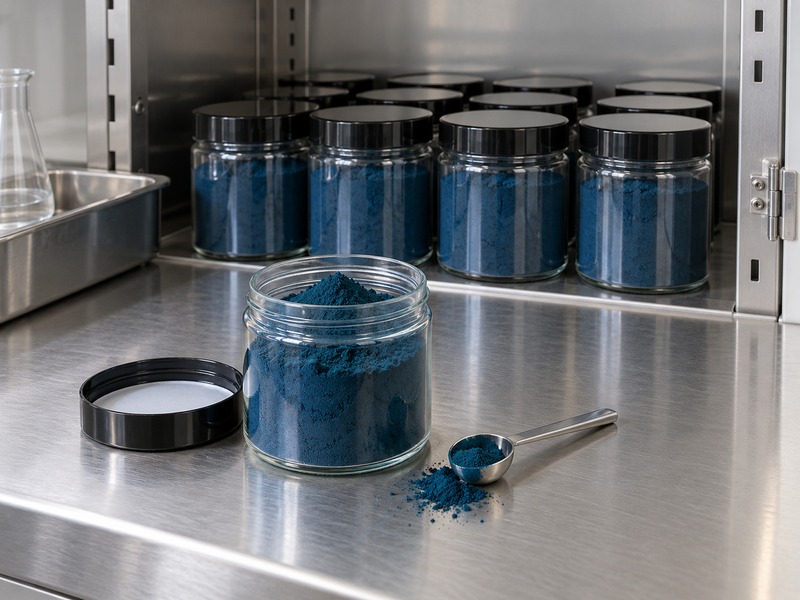
Blue spirulina shelf life depends on its formulation, moisture, packaging, light exposure, temperature, and the limits used to define acceptable quality. A supplier may state a period for unopened powder in the original package, but that period does not automatically cover an opened bag or a colored beverage. The powder guide helps identify the exact grade and carrier. Ask for a dated specification and the stability evidence behind the proposed period.
What should a shelf-life statement include?
It should name the SKU, package, storage conditions, test criteria, and start point, such as manufacture date. Check whether the period is based on real-time data, accelerated work, or a provisional estimate. A number without those conditions cannot guide a warehouse or product developer. Keep the lot code and receiving date so the remaining usable time can be calculated when material arrives.
- Confirm the exact SKU and package.
- Record the stated storage conditions.
- Check the evidence basis and manufacture date.
| Statement part | Buyer question |
|---|---|
| Period | From which date? |
| Conditions | At what temperature and light? |
| Criteria | What must still pass? |
Shelf life is a documented condition, not a generic property of “spirulina.”
Key Takeaway: Request the full shelf-life basis before accepting an expiry date.
2. Why does the blue color fade?
Blue spirulina shelf life can be limited by changes to phycocyanin color under heat, light, and unsuitable pH. A published stability review describes these sensitivities, while actual products vary by grade and formulation. Fading does not by itself prove a food is unsafe, but it can make it unacceptable to customers.
The phycocyanin guide explains the pigment’s role. Avoid treating a powder’s color in water as proof of performance in every food.
How do you separate color change from other failures?
Define visual and measured color limits alongside moisture, odor, dispersion, and microbiological criteria. Compare an aged sample with an approved retained control under identical lighting. If color drops while all other tests pass, the ingredient may still fail your application brief. If odor, caking, or microbiology changes, the review must go beyond appearance.
- Use a retained color standard.
- Check more than hue alone.
- Record package and storage history.
| Change | Possible concern |
|---|---|
| Pale blue | Pigment loss or dilution |
| Caking | Moisture uptake |
| Off-odor | Broader quality change |
A useful specification says which changes are acceptable for the intended product.
Key Takeaway: Judge aged material against several defined quality limits.
3. How should unopened powder be stored?
To preserve blue spirulina shelf life, store unopened powder as the supplier specifies, usually protected from moisture, heat, and strong light in its original sealed package. Exact temperature and humidity limits should come from the approved SKU specification. The blue food-color guide explains why preservation of color matters before the ingredient even reaches a recipe. Do not move powder into a clear jar for convenience unless that container has been validated for the same period.
What belongs in a warehouse check?
Log storage conditions, package integrity, lot, receipt date, and rotation status. Inspect seals and any evidence of condensation or damage. Use first-expiry-first-out where the quality system calls for it. If a shipment spent time in unusually hot conditions, contact the supplier and quality team rather than assuming the printed date still describes the material.
- Keep original protective packaging intact.
- Monitor temperature and humidity.
- Escalate damaged or heat-exposed lots.
| Warehouse item | Reason |
|---|---|
| Seal | Limits moisture and oxygen exposure |
| Location | Controls heat and light |
| Lot record | Supports rotation and traceability |
Storage is part of the shelf-life claim, not an afterthought.
Key Takeaway: Preserve the supplier’s tested conditions from receipt to use.
4. What changes after the bag is opened?
An opened bag may have a shorter practical blue spirulina shelf life because air, humidity, light, and repeated handling reach the powder. The supplier’s unopened period should not be copied as an after-opening instruction without evidence. A production site also needs contamination controls for scoops and containers. The wholesale guide covers how lot and pack size affect routine use.
How should an opened-pack rule be set?
Record the opening date, reseal method, storage location, and maximum use period validated by the site or supplier. Consider buying smaller packs if a large bag remains open for weeks. Do not top up an old container with a new lot; that destroys traceability and makes expiry ambiguous. Retain the original label information when transferring material to a working container.
- Date every opened pack.
- Use clean, dry tools.
- Keep lots separate and traceable.
| Practice | Risk it controls |
|---|---|
| Tight reseal | Moisture and light |
| Small packs | Long open exposure |
| Lot separation | Traceability loss |
The right pack size can do more for quality than a complicated storage rule.
Key Takeaway: Set a separate, documented after-opening period.
5. Does refrigeration extend the powder’s life?
Refrigeration may help preserve blue spirulina shelf life for some powders, but it is not a universal way to extend it. Temperature changes can create condensation when a cold pack is opened in a warm room, and moisture can cause caking. Follow the exact supplier’s instructions and validate any change in storage conditions. A cold room is useful only if the package stays protected and the handling procedure prevents water from reaching the powder.
What should a cold-storage trial consider?
Compare sealed and repeatedly opened packs under realistic conditions. Monitor temperature, relative humidity, package surface condensation, color, caking, and dispersion. If operators must warm a bag before opening, write that step into the procedure and test it. Do not claim a longer date from refrigeration unless the supporting stability data cover that practice.
- Check condensation at opening.
- Compare actual usage patterns.
- Keep the package sealed between uses.
| Condition | Main question |
|---|---|
| Room storage | Does the specified period hold? |
| Cold sealed storage | Does color improve? |
| Cold repeated opening | Does condensation appear? |
Cooler is not automatically safer when moisture enters the pack.
Key Takeaway: Use refrigeration only under a validated handling plan.
6. Can you use powder past its date?
Do not extend blue spirulina shelf life past the approved date based on appearance alone. A powder may still look blue while other criteria have changed, or it may be safe but too pale for your product. Some quality systems allow formal re-evaluation and re-test, but that decision requires procedures, data, and authorized approval. A kitchen smell test is not a substitute for a controlled release decision.
What should a re-evaluation include?
Quarantine the lot until quality has reviewed its history, package condition, specification, and relevant tests. Ask the supplier whether its data support an extension for that SKU and storage history. Test performance in the intended food if color matters. Document the outcome and new date under your system; do not relabel a pack informally.
- Quarantine before use.
- Review storage and test records.
- Require authorized release.
| Evidence | Why it matters |
|---|---|
| Storage log | Conditions actually experienced |
| Laboratory results | Specification compliance |
| Application trial | Color performance |
A date extension is a quality decision with records behind it.
Key Takeaway: Treat expired material as on hold until a formal decision is made.
7. Is the shelf life of a blue drink the same?
No; blue spirulina shelf life in a finished drink is separate from the dry powder’s date. Water, sugar, fruit acid, heat processing, oxygen, and packaging create a new microbiological and color environment. The blue spirulina lemonade guide shows why an acidic beverage needs a finished-drink trial. A powder that has months of life remaining can still produce a drink that fades within hours.
What should beverage trials measure?
Use the actual processing method and bottle, then test color, pH, flavor, sediment, package integrity, and microbiology through the proposed distribution period. Include light exposure if the bottle is clear. If the safe process weakens the blue, redesign the formula or appearance; do not omit the safety control to keep a prettier color.
- Test the finished bottle or glass.
- Include realistic light and temperature.
- Keep safety and appearance criteria separate.
| Ingredient | Shelf-life question |
|---|---|
| Dry extract | Does the powder meet its spec? |
| Prepared syrup | Is the concentrate stable and safe? |
| Finished drink | Does the consumer product hold? |
Each stage needs its own evidence.
Key Takeaway: Never transfer a powder expiry date to a beverage label.
8. What about yogurt, frosting, and ice cream?
Yogurt, frosting, and ice cream each create different blue spirulina shelf life conditions. Yogurt’s acidity and whey separation can alter appearance; frosting faces display light and warmth; frozen desserts change visually as ice crystals and air scatter light. The blue spirulina yogurt guide covers one example.
Test the complete product in its real package or display case. The powder’s stability data can guide trial design but cannot replace finished-food results.
Which samples should be retained?
Keep control and colored products from the same production run. Inspect them at planned checkpoints under consistent lighting and serving temperature. Record texture, flavor, moisture movement, and visible color, plus microbiology under the product’s safety program. A frozen scoop should be compared after the same tempering time; a yogurt should be opened and stirred as a consumer would use it.
- Retain matched controls.
- Assess at actual serving conditions.
- Include product-specific quality tests.
| Product | Color risk |
|---|---|
| Yogurt | Acid and whey |
| Frosting | Light and warmth |
| Ice cream | Opaque frozen appearance |
Shelf-life design starts with how the customer sees and eats the food.
Key Takeaway: Validate each application separately, even with the same pigment lot.
9. How can packaging protect the blue?
Packaging can help blue spirulina shelf life by limiting light, moisture, oxygen, and temperature abuse, but it cannot correct a poorly matched formula. Opaque or barrier packs may preserve color better than a clear display container, while still needing food-contact and seal validation. The blue spirulina manufacturer guide helps buyers ask about the supplier’s original pack. For finished foods, test the actual commercial package rather than a laboratory jar.
What should a pack comparison include?
Fill the same product into candidate packs and hold them under equivalent conditions. Check seal integrity, headspace, color, moisture or oxygen measures where relevant, and ease of use. A pack that protects the blue but makes the product hard to dispense may not be commercially suitable. If a clear pack is important for sales, evaluate its real shelf exposure before setting a long date.
- Compare light-protected and clear packs.
- Check seals and handling.
- Inspect color at end of life.
| Package feature | Possible benefit |
|---|---|
| Opaque wall | Less light exposure |
| Moisture barrier | Less caking |
| Good closure | Better after-opening control |
Packaging should be part of the stability study, not chosen after it.
Key Takeaway: Test the pack that will actually reach the customer.
10. What should a buyer ask the supplier?
Ask a supplier about blue spirulina shelf life using the exact grade, package, storage conditions, test criteria, and lot history. Request the current specification and certificate of analysis for the material offered. The where-to-buy guide explains why supplier selection affects documentation and repeat supply. Ask how the supplier handles transport excursions, opened packs, and changes in carrier or packaging.
What belongs in the purchasing brief?
State expected monthly use, pack size, warehouse conditions, shipping route, and target applications. Ask for the manufacture date and remaining shelf life at dispatch, not just a generic maximum period. Agree on how short-dated material will be handled. Keep a retained lot sample and compare future deliveries under the same method.
- Set minimum remaining life at receipt.
- Confirm storage and transport instructions.
- Ask for change notification.
| Purchase term | Why include it? |
|---|---|
| Remaining life | Production planning |
| Pack size | Open-pack exposure |
| Lot documents | Release and traceability |
The best shelf-life policy begins before the powder arrives.
Key Takeaway: Put shelf-life conditions into the buying agreement and receiving check.
Conclusion
Blue extract lasts only as long as its tested package, storage, and quality limits allow, and each finished food needs its own shelf study. You now have a way to separate sealed powder from opened packs, evaluate fading, handle short-dated lots, and design application tests. For a current specification and sample matched to your product, contact us. We believe color quality should be measured at the moment a customer uses the product, not only when it leaves the factory.
FAQ
Can I use blue spirulina after its printed date?
Not without a formal quality decision. Appearance alone cannot confirm that the lot still meets specification.
What’s the best way to store unopened powder?
Follow the exact supplier specification. Protect the sealed package from moisture, excessive heat, and light.
How do I know if refrigeration helps?
Check supplier data and test the handling method. Condensation after opening can undo the benefit of cooler storage.
Can a blue drink use the powder’s expiry date?
No. The finished drink needs its own safety and color stability study.
How do I know if a fading sample is still usable?
Compare it with approved color limits and other quality tests. The intended food application may reject it even if some tests pass.