
Choose a blue spirulina manufacturer by confirming who actually produces the proposed grade, testing it in your food, and checking lot-specific quality and repeat-supply evidence. A glossy sample can look perfect while the contracting company, production site, and material on the invoice turn out to be different from what your team assumed. That gap causes label, quality, and scheduling problems after launch. This guide gives buyers a practical way to verify the supply chain before an ingredient becomes part of a product specification.
1. What does a blue spirulina manufacturer do?
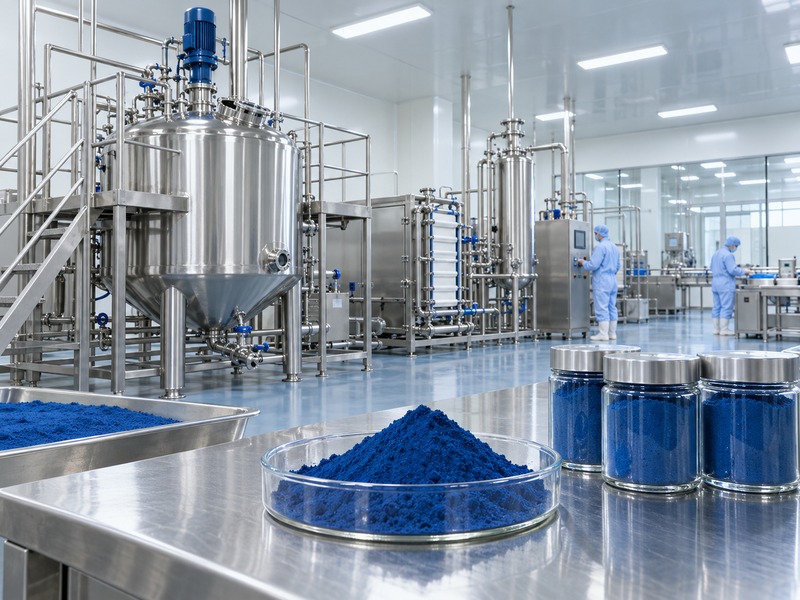
A blue spirulina manufacturer is the operation responsible for producing a specified spirulina-derived blue ingredient, while a trader, distributor, or sales company may contract with the buyer. The roles can be legitimate but need to be clear. The ingredient-form guide shows why a blue extract needs different processing from whole green biomass. Ask which entity cultivates, extracts, dries, blends, tests, and releases the material you plan to buy.
Which names belong in the supplier file?
Record the legal seller, invoicing entity, production site, testing laboratory, and any repacker or exporter. Match each entity to the documentation it issues. A company may support customers well without owning every stage, but buyers should know the chain and change controls. Do not assume the company name on a website is the same as the facility name on the certificate of analysis.
- Identify each operating role.
- Match documents to the relevant entity.
- Confirm who approves product changes.
| Role | Key question |
|---|---|
| Seller | Who signs the contract? |
| Production site | Who makes this SKU? |
| Quality unit | Who releases each lot? |
Clear roles make accountability possible when a lot needs investigation.
Key Takeaway: Verify the production chain before judging a quote or sample.
2. How do you verify the exact blue grade?
Verify a blue spirulina manufacturer by asking for the exact SKU specification and the test method behind its color grade. Terms such as E3, E6, E18, E25, or E35 may be supplier-specific and should not be treated as universal purity percentages. The blue spirulina powder guide explains how grade and carrier affect use. Compare the proposed material by performance in your own formula, not by the biggest number in a catalog.
What should a specification show?
Look for ingredient identity, composition, color-strength method, moisture or other relevant physical measures, microbiological criteria, packaging, and storage instructions. Ask how those limits are applied to released lots. A vague page that says “premium blue” gives the receiving team nothing measurable. Keep the approved specification revision with the purchase order so later substitutions are visible.
- Confirm SKU and version.
- Review the grade method and units.
- Check carrier and storage requirements.
| Specification item | Buyer use |
|---|---|
| Identity | Label and legal review |
| Grade method | Fair comparison |
| Release limits | Lot acceptance |
A measurable specification is more useful than a color adjective.
Key Takeaway: Approve the material by exact SKU and method, not by an unqualified grade name.
3. What should a certificate of analysis prove?
A certificate of analysis from a blue spirulina manufacturer should show whether the specific lot meets the agreed specification. It should identify the lot, test results, units, methods where relevant, and release authority. A generic “sample COA” is useful for learning the format but cannot release a shipment. The wholesale buying guide explains why lot documents matter when supply becomes routine.
How should quality review a COA?
Compare every reported result with the current approved limits. Confirm that the lot on the bag, invoice, and COA matches. Ask about out-of-specification handling and retain a sample if your program requires it. If a test is important to your food but absent from the standard COA, agree on it before purchasing rather than assuming it will be supplied later.
- Match lot codes across records.
- Check units and limits.
- Resolve missing tests before release.
| COA field | Why it matters |
|---|---|
| Lot code | Traceability |
| Result and limit | Acceptance decision |
| Approval | Release responsibility |
The COA should support an actual receiving decision.
Key Takeaway: Review each lot against the agreed specification, not a past sample.
4. How do you assess food safety controls?
Assess a blue spirulina manufacturer through its documented controls for source material, water, equipment, sanitation, microbiology, relevant contaminants, and traceability. The exact program should fit the product and destination market. A certificate logo alone does not describe how the proposed grade is made or released. Ask for a current site questionnaire, relevant audit evidence, and a clear process for deviations and recalls.
What should an audit or questionnaire test?
Trace one example lot backward to source and forward to customers under controlled conditions. Ask how equipment is cleaned, how cross-contact is handled, and how environmental or product test failures are investigated. Review whether external laboratories are qualified for the tests they perform. The goal is to understand whether the system will catch a problem before the material reaches your line.
- Review process flow and critical controls.
- Ask for traceability and recall procedures.
- Check change and deviation records.
| Control | Buyer concern |
|---|---|
| Source traceability | Where material came from |
| Sanitation | Cross-contact and contamination |
| Release testing | Lot suitability |
Paperwork is valuable when it reflects an operating system the plant can demonstrate.
Key Takeaway: Verify the site’s controls as well as its finished-powder test results.
5. Can one sample predict production performance?
One attractive sample cannot prove that a blue spirulina manufacturer will supply the same performance across future lots. Test the grade in the actual food, then ask for a second lot or retained production sample if the project is large enough. The food-color application guide explains why heat, pH, light, and base color change the result. A blue in water may fail in a sour beverage or baked batter.
What should the application trial include?
Use the intended process, dose ladder, package, and shelf conditions. Measure color at production and at the end of the proposed shelf period. Taste at the working dose and record any dispersion issue. If your production line uses heat, do not replace it with a room-temperature bench stir merely because that sample looks brighter.
- Test the real formula and process.
- Compare at least two dose levels.
- Inspect through the proposed shelf life.
| Trial stage | What to record |
|---|---|
| Mixing | Dispersion and dose |
| Processing | Heat or pH effect |
| Storage | Color and flavor retention |
The manufacturing claim matters only if the ingredient works in your product.
Key Takeaway: Approve a supplier after a production-relevant application trial.
6. What about regulatory and label support?
A blue spirulina manufacturer should provide enough composition and process information for a buyer to assess color-use and labeling rules in each sales market. Permitted uses can differ by food category and country. The natural blue food-color guide gives the formulation context, but the regulatory team must review the current rules for the exact application. Do not assume “food grade” automatically means allowed in every infant food, beverage, or supplement.
Which documents should be requested?
Ask for the full ingredient statement, source identity, processing description, intended-use information, and any relevant regulatory opinions or market statements the supplier can substantiate. Check them against the finished food category. If a seller claims organic status, verify the exact SKU and trade route separately. Keep final label approval with the brand or importer responsible for the market.
- Request composition and use information.
- Review market and food category.
- Separate food-grade quality from legal permission.
| Buyer question | Evidence source |
|---|---|
| What is it? | Product specification |
| Where may it be used? | Current market rules |
| What goes on the label? | Formula and regulatory review |
Legal fit should be decided before artwork and launch dates are locked.
Key Takeaway: Treat regulatory support as part of supplier qualification.
7. How should price, MOQ, and lead time be compared?
Compare blue spirulina manufacturers by cost per finished serving, minimum order quantity, lead time, and supply reliability, not just price per kilogram. A stronger grade may use less powder; a cheaper lot may create more rejects if it disperses poorly. The where-to-buy guide distinguishes retail, distribution, and direct-supply options. Model the cost with the working dose that passed your application trial.
What belongs in a landed-cost sheet?
Include quoted price, freight, customs, testing, wastage, storage, and any certification handling. Ask whether lead time is for a stocked lot or a future production run. Consider what happens if demand doubles or a batch is rejected. A low MOQ can be valuable for development, while a stable supply agreement matters more at commercial scale.
- Calculate cost per finished unit.
- Confirm MOQ and stock status.
- Ask for a disruption plan.
| Term | Commercial effect |
|---|---|
| Working dose | Actual ingredient cost |
| MOQ | Inventory commitment |
| Lead time | Launch and replenishment risk |
The best quote is one the business can execute repeatedly.
Key Takeaway: Compare full operating cost and supply terms, not bag price alone.
8. How do you verify organic or sustainability claims?
Verify a blue spirulina manufacturer’s organic or sustainability claims using current, claim-specific evidence for the exact product and facility. A clean-looking cultivation photo is not certification. The organic blue powder guide explains why product scope, processing, carriers, and trade records matter. Sustainability claims also need defined metrics and boundaries, not a general appeal to algae as a category.
What should a buyer ask for?
For organic status, request the relevant certificate and check SKU, operator, and route. For environmental statements, ask what was measured, over what period, and by whom. Do not repeat a supplier claim in consumer copy until the brand can substantiate it for the finished product. A conventional extract can still be a suitable choice when the brief does not require organic positioning.
- Check the claim’s exact scope.
- Request current supporting records.
- Review consumer copy separately.
| Claim | Minimum question |
|---|---|
| Organic | Is this SKU covered? |
| Low impact | What metric and boundary? |
| Traceable | Can this lot be followed? |
Specific evidence makes a claim useful; a broad story does not.
Key Takeaway: Approve only the claims that the proposed lot and operation support.
9. What should a supply agreement control?
A supply agreement with a blue spirulina manufacturer should control the exact grade, specification, document set, change notification, and treatment of nonconforming lots. A buyer who approves a sample but leaves the contract vague may receive a different carrier or color strength later. The blue spirulina ingredients guide shows why apparently small composition changes matter. Discuss notification timing before the first commercial order.
Which clauses are operationally useful?
Define approved manufacturing site and SKU, acceptance limits, COA delivery, retain-sample process, packaging, shelf-life basis, and change-control procedure. Agree on how disputes and rejected lots will be handled. Avoid using the agreement to promise a universal color result in every possible recipe; attach the tested application brief where helpful. Legal teams can set the formal language from these practical needs.
- Lock the approved grade and site.
- Require notice of material changes.
- Define receiving and rejection steps.
| Agreement item | Prevents |
|---|---|
| Specification | Silent grade substitution |
| Change notice | Unreviewed carrier or site change |
| COA | Undocumented lot release |
The agreement should preserve the material that passed your trial.
Key Takeaway: Turn the approved sample into enforceable supply expectations.
10. When is a manufacturer ready for approval?
A blue spirulina manufacturer is ready for approval when its exact material passes your application and quality tests, its documents are complete, and its supply terms fit the launch. No single certificate, cheap quote, or vivid photograph is enough. The blue spirulina shelf-life guide helps define ingredient storage checks after qualification. Make the final decision with procurement, quality, regulatory, and product development using one shared record.
What should the final approval sheet say?
List the SKU, production site, seller, approved specification revision, working dose, applications, COA requirements, shelf-life and storage conditions, and change-notification route. Note any open conditions and who owns them. A conditional approval should not be mistaken for permission to make unsupported label claims. Review the file periodically and after any material change.
- Close quality and regulatory gaps.
- Record the tested formula and dose.
- Set periodic requalification triggers.
| Gate | Pass condition |
|---|---|
| Quality | Lot and system evidence accepted |
| Application | Finished food meets target |
| Supply | Terms and continuity agreed |
A supplier is approved for a specific use, not for every future product automatically.
Key Takeaway: Make the purchasing decision traceable to the grade and product you tested.
Conclusion
Choosing a blue spirulina supplier means verifying the manufacturing chain, exact grade, lot evidence, application performance, and terms for repeat supply. You now have a checklist that connects a colorful sample to a material your plant can buy, test, and label responsibly. For specifications or a sample matched to your product brief, contact us. We believe trust in an ingredient starts with knowing precisely what was made, where, and to which standard.
FAQ
Can I buy directly from a blue spirulina manufacturer?
Often, yes, but confirm the contracting and production entities. Direct supply still needs specifications and lot documents.
What’s the best first document to request?
Start with the exact SKU specification. It defines the material your sample and future lots must match.
How do I know if a COA is useful?
Check its lot code, results, units, and limits. It should support an acceptance decision for the shipment received.
Can one blue grade work in every food?
No. Test pH, heat, base color, dose, and shelf life in each intended application.
How do I know if an organic claim is valid?
Verify current certification and trade records for the exact SKU and route before using the claim.