
Make blue spirulina icing by blending a measured blue extract into a pale frosting or glaze after any heating step, then checking the shade after piping and storage. A bowl can look beautifully blue while the finished cupcake turns dull under warm lights or the icing softens on the counter. The useful recipe holds both color and structure. This guide helps you choose an icing type, set a dose, and test the result in a bakery or packaged-dessert workflow.
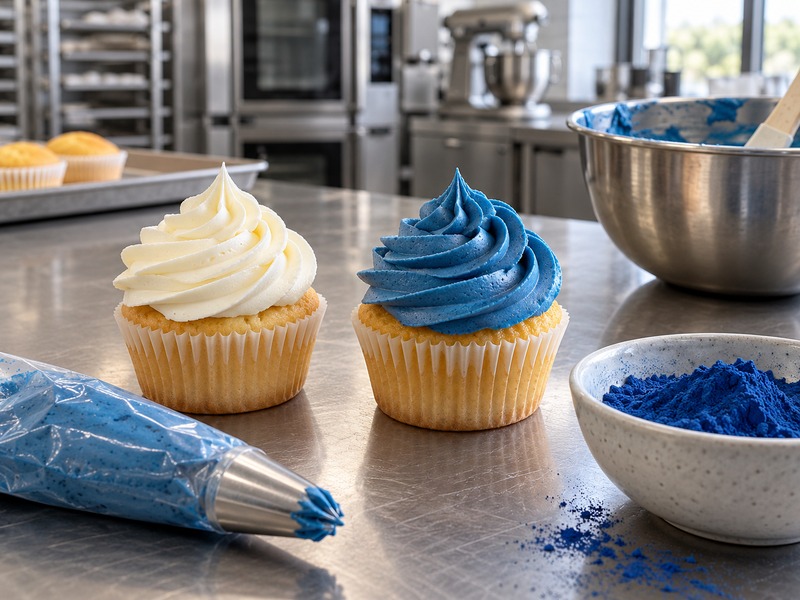
1. What gives blue spirulina icing its color?
Blue spirulina icing gets its color from a phycocyanin-rich extract rather than whole green spirulina powder. A small amount can color a pale base, but the exact dose depends on the extract grade and the icing’s own color. The ingredient-form guide explains the distinction. Check the proposed SKU for carriers, sugar, or other ingredients; those components may change texture and labeling even when the pigment itself is present at a low level.
What should a bakery brief say?
Specify whether the target is buttercream, cream-cheese frosting, royal icing, glaze, or a filling. Each has different water content, acidity, and handling. Record the desired blue on the finished cake under display lighting, along with storage temperature and service period. Keep an uncolored control to show whether the base is white, ivory, or yellow before any pigment is added.
- Name the icing system and flavor.
- Set the target after piping or setting.
- Identify display and packaging conditions.
| Icing type | Initial concern |
|---|---|
| Buttercream | Fat and warmth |
| Cream-cheese frosting | Acidity and refrigeration |
| Royal icing | Drying and surface color |
The base determines much of the blue you can achieve.
Key Takeaway: Select the icing style before choosing a color dose.
2. Which base gives the cleanest shade?
A white or nearly white base generally gives blue spirulina icing the cleanest shade. Butter and egg-rich frostings can pull it toward green, while cocoa or dark flavorings can overwhelm the pigment. A white vegetable-fat frosting may look bluer but still needs a flavor and label review. The blue-versus-green guide explains why whole spirulina is unlikely to be a drop-in replacement for a sky-blue brief.
How do you compare bases?
Make small equal-weight batches with one extract lot and dose. Pipe each through the same tip onto a pale cake, then assess under the actual display light. Taste plain frosting as well as the finished dessert. A clean blue that tastes waxy or overly sweet will not earn a repeat order.
- Keep pigment and batch weights identical.
- Compare piped shapes, not only bowls.
- Taste after the expected hold time.
| Base | Watch for |
|---|---|
| Dairy buttercream | Yellow cast |
| Pale vegan frosting | Fat mouthfeel |
| Cream cheese | Acid-related color shift |
The best base has to carry the cake’s flavor as well as its color.
Key Takeaway: Choose the icing after a finished-dessert comparison.
3. When should the extract be mixed in?
Mix blue extract into blue spirulina icing after the strongest heat step, provided the process and food-safety plan allow it. Phycocyanin can lose color with heat, but a late addition must still use clean equipment and controlled ingredients. The food-color application guide explains why a bakery glaze and a baked batter behave differently. A hot syrup glaze may need a separate process from a cold buttercream.
What does an addition trial compare?
Make one sample with extract added while warm and another after cooling to the process’s safe mixing point. Hold dose and base weight constant. Check shade, distribution, texture, and food-safety implications. If a later addition gives brighter color but introduces contamination risk, redesign the step rather than ignoring the risk.
- Record temperature when color enters.
- Check for streaks after mixing.
- Confirm the site’s hygiene controls.
| Stage | Main question |
|---|---|
| Warm mix | Does blue survive? |
| Cool mix | Is dispersion uniform? |
| Post-pipe | Does shade hold? |
The approved process must work in the bakery, not only in a test bowl.
Key Takeaway: Choose the addition point after checking color and process safety together.
4. How much blue powder should you use?
Use the lowest weighed dose that gives blue spirulina icing the required color after piping or drying. Teaspoons are poor controls because a fine powder’s bulk density varies. More extract may add cost or taste without fixing a yellow base.
The blue powder guide explains why supplier grade labels are not universal strength measures. Build a three-level dose ladder in the exact icing formula.
What should the dose sheet include?
Record grams per kilogram of icing, shade after finishing, flavor, and cost per decorated unit. Photograph all samples under the same lighting and check them again at the proposed end of display. If a strong grade uses less powder, confirm that the lower dose does not alter spreading or piping behavior. Keep an approved control sample for the next batch.
- Weigh low, target, and high doses.
- Assess the finished cupcake or cookie.
- Compare color after storage.
| Dose | Decision |
|---|---|
| Low | First visible blue |
| Target | Best shade and taste |
| High | Extra cost or off-note |
A color standard is useful only when the recipe states how to reproduce it.
Key Takeaway: Specify pigment by weight and verify it on the finished dessert.
5. Will acid in cream-cheese frosting affect color?
Acid can shift or weaken the blue in blue spirulina icing, so cream-cheese and citrus frostings need their own tests. The exact outcome depends on pH, extract grade, dose, and holding time. A pale blue at mixing may fade or change along a lemon-curd layer.
Test the complete cake, not just isolated frosting. If tart flavor is essential, a separate blue layer or different design may work better than raising pigment dose.
How do you test an acidic recipe?
Make a control buttercream and an acidic version at equal extract dose. Record pH where appropriate, then inspect immediately and after refrigeration or display. Taste both; reducing acid to preserve blue may make the frosting flat. If fruit filling contacts the icing, inspect the boundary after storage for a colored ring or moisture bleed.
- Compare matched doses.
- Check the filling-icing boundary.
- Measure flavor and color over time.
| Observation | Next question |
|---|---|
| Fading throughout | Is pH too low? |
| Colored edge | Is filling migrating? |
| Texture loss | Did formula water change? |
The customer’s slice reveals problems a mixing-bowl photo can miss.
Key Takeaway: Validate the exact acidic dessert before approving the blue.
6. Can the icing be piped and held?
Blue spirulina icing can be piped and held if the base maintains its structure and the color remains acceptable under the real display conditions. Heat from a warm room can soften buttercream; refrigeration can cause condensation after removal. Neither problem is fixed by adding more blue extract. The blue spirulina cheesecake guide shows a related cold dessert where surface color and storage also matter.
What belongs in a display test?
Pipe the standard design on the actual cake or cupcake. Hold samples in the intended case, including the planned lighting and door openings, then measure shape loss and color change. Check packaging contact if desserts travel. A frosting that looks fine on a tray may smear against a clear clamshell.
- Use the real piping tip and portion.
- Inspect at start and end of display.
- Test packaging contact and condensation.
| Condition | Check |
|---|---|
| Warm display | Shape and shade |
| Refrigeration | Firmness and color |
| Delivery pack | Smearing and condensation |
The acceptable hold time is the shortest period in which shape, taste, or color fails.
Key Takeaway: Set display life from the decorated product, not the icing bowl.
7. Does blue icing work on baked cookies?
Blue spirulina icing is often more reliable as a cool finish on cookies than blue extract mixed into dough that must be baked. Oven heat and a golden cookie base can hide the pigment. The blue spirulina cookies guide covers the tradeoff in more detail. A pale glaze or royal icing can show blue on the surface, but it still needs drying, stacking, and humidity checks.
What should a cookie trial compare?
Decorate cooled cookies with equal amounts of two icing styles. Assess flow, edge control, drying time, tackiness, and color after packaging. A thick buttercream may suit bakery counter cookies but not sealed shipping. A thin glaze may dry well yet look transparent over a brown cookie; use a white base layer if the design allows.
- Cool cookies fully before icing.
- Check dry-to-touch and stacking times.
- Test the actual pack for transfer.
| Finish | Likely use |
|---|---|
| Buttercream | Same-day counter sale |
| Royal icing | Detailed dry decoration |
| Glaze | Thin, quick coating |
The decoration method should fit how the cookie will be sold.
Key Takeaway: Choose an icing format that survives the cookie’s handling route.
8. What should the label and claims say?
The label for blue spirulina icing should describe the complete frosting formula, including the extract blend’s carrier and the dessert’s allergens. A small color dose does not make a cupcake a meaningful spirulina-protein source. The nutrition facts guide explains the difference between blue extract and whole biomass. Claims such as “natural color,” “vegan,” or “organic” need review for the exact ingredients and sales market.
How do you calculate a decorated serving?
Weigh the cake and the real amount of icing applied by staff. Include fillings, sprinkles, and decorations in the nutrition calculation and allergen review. If a vegan frosting contains a carrier from the blue blend, verify that carrier rather than relying on the pigment’s origin alone. Keep ingredient documents with the approved recipe.
- Weigh icing per serving.
- Include every carrier and decoration.
- Review color and claims rules by market.
| Claim or label item | Evidence |
|---|---|
| Calories | Entire decorated serving |
| Allergens | Formula and cross-contact |
| Vegan | All ingredients and aids |
The color is visible; the rest of the formulation must be just as clear on paper.
Key Takeaway: Build the label from the finished dessert, not from the blue powder alone.
9. How do you scale a small recipe for a bakery line?
Scaling blue spirulina icing requires controlled mixing, temperature, portioning, and a visual acceptance range. A large mixer may incorporate more air or leave blue streaks around the bowl. The same recipe can appear lighter when piped in a thin layer. The wholesale ingredient guide helps when you need consistent supply and lot records for repeated runs.
What should a pilot batch record?
Document ingredient weights, order of addition, mixing time and speed, temperature, yield, and piping weight. Sample the beginning, middle, and end of the batch. Inspect decorations after storage and transport, not just on the line. When one batch looks different, these records let you distinguish dosing error from a changed base or extract lot.
- Retain a color standard.
- Check bowl scrape-down and uniformity.
- Measure portion weight across operators.
| Control | Why it matters |
|---|---|
| Extract lot | Traceability |
| Mix time | Even shade |
| Piping weight | Cost and appearance |
A batch is ready when several decorators can reproduce the approved result.
Key Takeaway: Turn the successful bench bowl into a measured production procedure.
10. How should you choose a blue extract supplier?
Choose a blue extract supplier for blue spirulina icing by testing its exact grade in your frosting and reviewing current quality documents. Request a specification, certificate of analysis, composition, storage guidance, and repeat-order terms. The manufacturer guide helps separate product claims from verifiable production evidence. Do not assume a color grade or organic status applies across an entire catalog.
What should the sample request contain?
Share the icing base, approximate pH, mixing temperature, target shade, display conditions, market, and expected volume. Ask for enough of one lot to run both color and storage trials. Compare candidates at equal finished-dessert color, not simply equal powder weight. Retain the approved lot sample as a reference for future deliveries.
- Identify the exact SKU and carrier.
- Review batch-level test results.
- Check landed cost at the working dose.
| Supplier document | Buyer use |
|---|---|
| Specification | Formula and label fit |
| Lot certificate | Quality release |
| Application trial | Decoration performance |
The best sample is one the bakery can buy again at the same agreed standard.
Key Takeaway: Approve the tested grade and supplier documents together.
Conclusion
Blue icing works when the base is pale, the extract is measured, and the finished decoration survives piping, display, and packaging. You now have a way to assess acidity, dose, labels, production, and supplier fit before a blue dessert goes on sale. For a sample suited to your icing system, contact us. Our standard is simple: natural color should make a dessert more appealing without weakening the recipe that holds it together.
FAQ
Can I put blue extract into hot icing?
Test it first. Heat can weaken phycocyanin color, and a cooler addition needs suitable hygiene controls.
What’s the best frosting for a sky-blue shade?
Start with a pale base. Compare buttercream and other options after piping and storage, not just in the bowl.
How do I know if lemon frosting will stay blue?
Run a shelf test. Check pH, flavor, and the finished cake’s color over the planned display period.
Can I use blue icing on shipping cookies?
Yes, if it dries and packs well. Test stacking, humidity, and color transfer in the actual package.
How do I know if the supplier’s grade is right?
Test the exact SKU in your icing. Review the composition and lot certificate before purchasing at scale.