
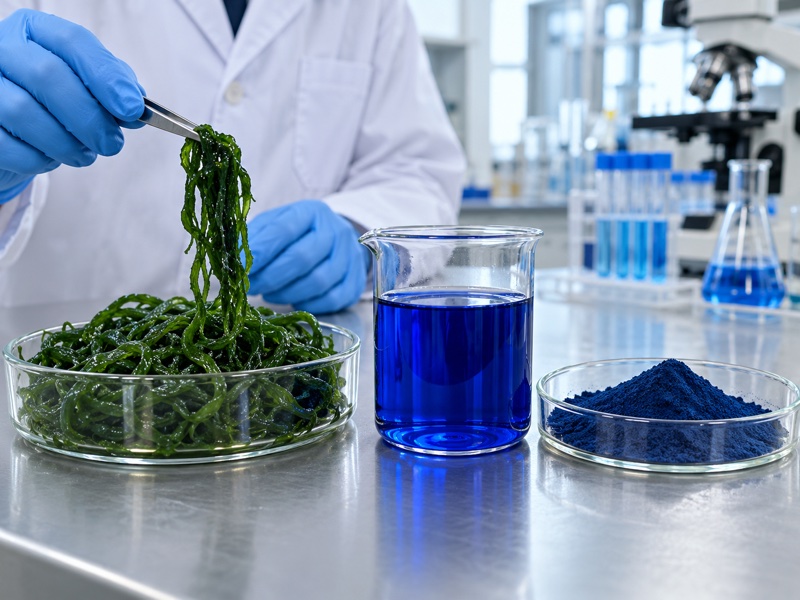
Spirulina can look blue because it contains phycocyanin, a blue pigment-protein complex that can be extracted from its green biomass. Why is spirulina blue in a jar when the biomass looks green? Extraction can separate the blue fraction. Whole dried spirulina often looks green because it also contains chlorophyll and other pigments. If you are choosing an ingredient for a food, this distinction explains why two products sold as spirulina can give different colors and tastes. This guide answers why spirulina is blue and how the answer affects a real formula.
1. What pigment makes spirulina blue?
Phycocyanin makes the extracted blue color possible. It is a water-soluble pigment-protein complex present in cultivated Arthrospira, commonly marketed as spirulina. In the US rule for spirulina extract, phycocyanins are named as the principal coloring components. A commercial powder can contain carriers and other soluble material, so the phrase does not mean the jar holds pure phycocyanin. The exact grade determines how much material a recipe needs.
What does pigment-protein mean here?
The colored group is associated with a protein structure, which helps explain both the hue and its sensitivity to processing conditions. The blue pigment guide covers the ingredient science and grading. A scientific review of extraction and stability provides context for why different methods produce different products. This chemistry should not be confused with a high-protein nutrition claim. A color-use serving may contribute very little protein.
| Term | Meaning |
|---|---|
| Phycocyanin | Blue pigment-protein complex |
| Spirulina extract | Color ingredient rich in blue fraction |
| Whole spirulina | Biomass with several pigments |
The blue molecule is only part of the product story.
2. Why is whole spirulina usually green?
Whole spirulina is usually green because its biomass contains chlorophyll and other pigments alongside phycocyanin. Grinding and drying the whole material do not separate the blue fraction. A spoonful in water may therefore make a drink green, teal, or cloudy rather than bright cyan. This is a material difference, not proof that one product is fake. Choose whole biomass when its broader composition is desired and extract when a cleaner blue is the goal.
How can you see the distinction?
Compare small weighed samples of whole powder and blue extract in the same clear water. Note hue, clarity, sediment, and flavor. The blue versus green guide details the application implications. Do not compare equal spoonfuls if the aim is cost or color strength; compare at an approved finished shade. Keep the ingredient labels with the samples so the distinction does not get lost after the trial.
| Material | Typical appearance | Role |
|---|---|---|
| Whole biomass | Green | Nutrition or green color |
| Extract | Blue | Color |
| Mixed blend | Variable | Check full formula |
Green spirulina and blue extract are not interchangeable recipe steps.
3. How does a green biomass become a blue extract?
Processors extract and separate water-soluble blue components from prepared spirulina biomass, then concentrate and formulate or dry the result. The US identity definition specifies a filtered aqueous extraction of dried Arthrospira platensis biomass for its regulated color additive. The exact commercial process and carriers vary by maker. Different choices can affect color strength, flavor, microbiology, and shelf life. Ask for a product specification rather than assuming every blue powder is made identically.
What should a buyer ask about the process?
Request source identity, a process flow description, carrier disclosure, quality controls, and change-notice terms. The composition guide turns that into a procurement checklist. A supplier may protect proprietary steps while still providing enough information to support food use and traceability. If the source or drying method changes, the finished shade may change too. The process is part of the ingredient’s identity for a buyer.
| Stage | Why it matters |
|---|---|
| Biomass source | Identity and quality |
| Extraction | Blue fraction recovered |
| Concentration | Grade strength |
| Drying | Handling and stability |
The blue result depends on a controlled sequence.
4. Why do blue powders have different shades?
Different shades can come from grade strength, carriers, moisture, particle size, and the mix of remaining components. Lighting and camera settings can exaggerate differences in product photographs. A darker dry powder is not a reliable measure of phycocyanin content or final-food performance. Test in the actual recipe. The same extract can look cyan in water, pastel in yogurt, and teal in a yellow fruit base.
What is a fair color comparison?
Use a consistent base, lighting, vessel, and target shade. Ask for lot COAs with a defined color or phycocyanin method. The blue powder article explains how grade names can confuse buyers. Compare dose, flavor, clarity, and color after storage. A supplier code such as E6 or E18 is not a universal percentage of pigment. Make the finished product the reference.
| Variable | Visible effect |
|---|---|
| Grade | Dose to shade |
| Base color | Cyan versus teal |
| Opacity | Bright versus pastel |
| Light | Apparent hue |
Color names are useful only when the viewing conditions match.
5. Does water make the pigment look bluer?
Clear, neutral water usually makes the blue easy to see because few other pigments compete with it. Water-soluble phycocyanin can color a glass quickly, although dispersion and clarity depend on the commercial preparation. Minerals and pH may affect the finished appearance. A water sample is a useful screen, but it is not a substitute for testing a smoothie or bottled drink. The actual base determines the customer’s view.
What should a water test record?
Measure extract and water, note mixing method, photograph against a neutral background, and inspect for haze after holding. The blue drink guide adds packaging and shelf-life questions. If a powder looks blue in water but green in a fruit drink, the fruit may be changing perceived hue. Do not assume the ingredient is defective until the base is tested separately. A plain-water control helps diagnose the difference.
| Observation | Possible cause |
|---|---|
| Clear cyan | Compatible base |
| Greenish hue | Yellow base or other pigments |
| Haze | Carrier or mineral interaction |
Water reveals the pigment, but food tests the product.
6. Why can acid or heat weaken the blue?
Acid and heat can change phycocyanin’s structure and visible color, depending on time, temperature, pH, and grade. A vivid cold glass may fade in lemonade or after a heat process. Light and oxygen can add further stress during storage. Food safety requirements should not be weakened merely to preserve shade. Instead, test whether the ingredient suits the process or whether another color system is needed.
How should a stability trial be designed?
Use the intended pH, heat step, package, and shelf conditions, with an unprocessed control. Record color immediately and at realistic storage points. The lemonade article shows the acid case, and the natural blue guide covers broader application testing. If color fails, find the dominant cause before raising dose. More pigment may only create a darker starting point.
| Stress | Product question |
|---|---|
| Acid | Does the hue shift? |
| Heat | What survives processing? |
| Light | Does display fade it? |
| Time | Is shelf-end blue acceptable? |
The saleable product defines color stability.
7. Is blue spirulina a plant?
No, spirulina is a common market name for cultivated cyanobacteria, not a leafy plant that grows blue leaves. Arthrospira grows as microscopic filaments in suitable water systems. Its biomass contains several pigments, which can be processed to obtain the blue fraction. Calling it an “algae” is common in food marketing, but the biological classification is more specific. Product identity should be based on the actual source organism and extract specification.
Why does source terminology matter?
It helps buyers distinguish cultivated Arthrospira from unrelated wild-harvested blue-green algae products. Cultivation and source claims should be checked against the actual organism. One category’s contaminant findings should not automatically be applied to every other source, though all ingredients need quality controls. Ask for traceability to the specific biomass and production site. Accurate source language makes labeling and quality review clearer.
| Term | Practical meaning |
|---|---|
| Spirulina | Common food-market name |
| Arthrospira | Source genus often used |
| Cyanobacteria | Biological group |
| “Blue plant” | Marketing shorthand, not botany |
Know the organism behind the color.
8. Does blue color mean more nutrition?
No, a stronger blue does not establish more protein, iron, or health benefit per serving. It may indicate color strength under one test, but the powder’s carrier and use level change the nutrition calculation. Whole biomass nutrient data cannot be copied onto an extract. A food-color dose can be visually strong and nutritionally small. If a finished product claims a nutrient, test the serving and apply the market’s claim rules.
What should a buyer calculate?
Multiply the tested nutrient amount per gram by the actual grams of extract in the finished serving. The nutrition overview shows why a pigment-protein complex is not automatically a high-protein drink. Check the rest of the formula, which may supply most nutrients. A blue smoothie can be a good food because of its whole recipe, not because the pigment is dark. Let color and nutrition be evaluated separately.
| Statement | Better evidence |
|---|---|
| “More blue” | Color measurement |
| “More protein” | Serving-level nutrition |
| “Healthier” | Defined outcome and evidence |
Color intensity is not a health score.
9. Is the blue extract permitted in food?
Permitted use depends on the destination market and food category. In the United States, 21 CFR 73.530 defines spirulina extract’s identity, specifications, and listed uses; a 2026 amendment was delayed indefinitely. Other jurisdictions have their own rules and declarations. The source being natural does not create universal permission. Review the exact grade, formula, and label before launch.
What should regulatory review include?
Provide the specification, carrier, dose, full recipe, process, food category, and destination markets. The natural-label guide separates natural origin from organic status. Ask how the color additive should be declared. Keep current rule checks in the product file because permissions can change. Marketing should not promise a broad application before the reviewer sees the actual one.
| Review item | Why it matters |
|---|---|
| Identity | Correct regulated material |
| Category | Permitted use |
| Grade and carrier | Composition |
| Label | Accurate declaration |
Biology and law answer different questions.
10. When should a buyer choose blue extract?
Choose blue extract when the desired finished food needs its particular hue and the grade passes taste, stability, quality, and legal review. Whole spirulina may be a better fit when the goal is broader biomass nutrition rather than a clean blue. A sample in plain water is a useful first step, but the final recipe and package should decide. Keep an approved shade standard and lot documentation. Revalidate after ingredient or process changes.
What should the final brief state?
State the exact grade, target shade, use level, process, package, markets, and required quality documents. Our team can discuss extract samples for a specific application. If the blue fades or tastes wrong, share the tested conditions with the supplier. A precise brief helps identify whether the grade or the recipe needs adjustment. It also protects repeat orders from drifting away from the first successful sample.
| Approval gate | Proof |
|---|---|
| Shade | Finished-product sample |
| Stability | Realistic hold |
| Quality | Lot COA |
| Compliance | Market review |
The right blue is one you can make again.
Frequently Asked Questions
Can whole spirulina turn a smoothie bright blue?
Usually it tends greener because whole biomass retains several pigments. Use a tested blue extract if cyan is the goal.
What’s the blue pigment called?
Phycocyanin is the principal blue coloring component of spirulina extract. Commercial preparations may contain other components too.
How do I know if a blue powder is strong?
Ask for a defined color or phycocyanin method and run a dose trial in the finished food. Dry powder darkness is not enough.
Can acid make spirulina blue turn purple?
Acid can change or weaken the shade, but do not assume a predictable butterfly-pea-style color shift. Test the exact formula.
Is a darker blue powder healthier?
No. Color intensity does not establish nutritional or health benefits at a serving dose.
Conclusion
Spirulina’s blue comes from phycocyanin separated from biomass that often looks green as a whole. You now know why extract, base color, processing, and grade change the shade a customer sees. If your food needs a dependable blue, contact us with your recipe and market for grade information. We believe a color story is strongest when the science matches the finished product.