
Blue spirulina gives food and drinks a vivid blue color, while its proposed health benefits still need stronger human evidence. If you are planning a blue beverage or supplement, a supplier may offer a beautiful sample alongside claims about immunity, inflammation, or energy. The color is easy to see; the claims take much more work to check. This guide explains what blue spirulina benefits are supported, what remains uncertain, and how to evaluate a food-grade extract before you put it in a product.
1. What is blue spirulina, and what does it contain?
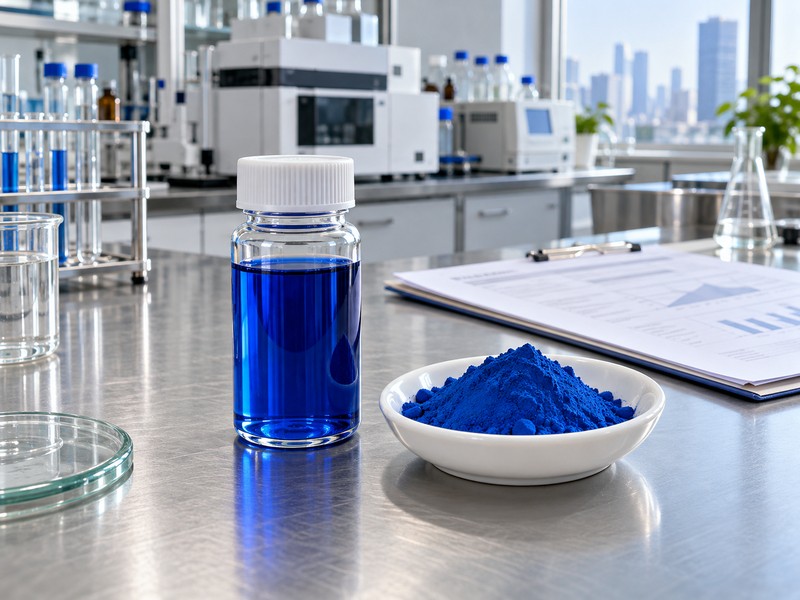
Blue spirulina is generally a phycocyanin-rich extract made from cultivated spirulina, rather than the whole green organism ground into powder. That difference is the starting point for judging blue spirulina benefits: a clinical finding about whole spirulina cannot automatically be assigned to its blue extract. The extract’s main visible function is color. Its full composition depends on the source material, extraction process, and any carrier added to make a stable, usable powder.
How can you tell an extract from whole spirulina?
Read the ingredient specification before the marketing name. A green whole-biomass powder contains a broader mix of components and usually tastes and colors food differently. A blue spirulina powder may be sold by color grade, but the grade name alone does not reveal an exact phycocyanin percentage. Ask for the actual ingredient declaration and a lot-specific certificate of analysis (COA).
| Material | Main purchasing question |
|---|---|
| Blue extract | What is the carrier and measured color specification? |
| Whole green spirulina | What is the full nutrient and contaminant specification? |
| Purified phycocyanin | How is its purity measured for this lot? |
The category determines which evidence and quality limits are relevant to your product.
2. What is the clearest practical benefit for food makers?
The clearest practical benefit is blue color from a spirulina-derived ingredient. For a beverage developer, that is a measurable function: the product either reaches the target shade after processing and storage, or it does not. Blue spirulina benefits a formula when its shade suits the recipe, its ingredient declaration fits the market, and its supply stays consistent across production lots. Color performance is a more defensible starting claim than a broad wellness promise.
Where does the color work best?
The answer depends on the full food matrix. Smoothies, frostings, dry blends, and some frozen desserts are common starting points, but you should test the actual formula. Acidity, heat, light, oxygen exposure, and packaging can change the shade over time. Ask a supplier for a sample, then run the same process and shelf-life conditions you intend to use at scale. A photograph of a fresh drink cannot substitute for that test.
You can use the food-grade extract range as a starting point for samples, then choose the grade that reaches your target color at an acceptable cost. Record the dose by weight, not by an informal scoop size.
| Test | Useful observation |
|---|---|
| Fresh product | Shade, dispersion, flavor impact |
| After processing | Color loss, sediment, texture |
| During storage | Fading, hue shift, package effects |
Those observations turn a promising color sample into a repeatable specification.
3. Are antioxidant claims supported by human studies?
Antioxidant activity has been measured in laboratory studies of phycocyanin, but that does not prove a health benefit from eating a blue spirulina product. Blue spirulina benefits are often described with one word, “antioxidant,” as though an in-vitro assay were a clinical outcome. It is not. The amount that survives digestion, the dose in a serving, and the outcome measured in people all matter.
What should you check in an antioxidant study?
Start with the tested material. Was it isolated phycocyanin, a phycocyanin-rich extract, whole spirulina, or a finished food? Then check whether the result came from a test tube, an animal, or a controlled human trial. A result in one material or model can suggest a research question, but it should not be rewritten as a promise about your drink. If a brand wants an antioxidant claim, it needs evidence and label review for its exact market.
The practical move is to keep product copy close to what can be verified. A COA may support an ingredient-composition statement; it does not establish that a consumer will experience less oxidative damage. You can still tell a useful product story about natural-origin color and thoughtful formulation without stretching the science.
4. Can blue spirulina reduce inflammation?
There is no sound basis for promising that a typical serving of blue spirulina reduces inflammation in people. Blue spirulina benefits sometimes get inferred from phycocyanin experiments involving inflammatory pathways. Such experiments help researchers decide what to test next. They do not establish the size of a clinical effect, the appropriate serving, or whether the same effect occurs after the extract is mixed into a food.
Why does the study design change the answer?
A cell can be exposed directly to a compound at a controlled concentration. A person digests a food, absorbs only some of its components, and has many other variables affecting inflammatory markers. Even a small human trial would need a defined extract, a comparison group, and a meaningful outcome. If the study used whole spirulina, do not relabel its result as evidence for a blue extract.
| Evidence type | What it can support |
|---|---|
| Cell assay | A possible mechanism |
| Animal study | A question for human research |
| Controlled human trial on the same extract | A claim limited to its tested dose and outcome |
This distinction protects both your customer and your label review process.
5. Does blue spirulina help immune health?
Blue spirulina has not been shown to prevent infections or reliably improve immune health in consumers. Claims about blue spirulina benefits often move too quickly from immune-marker studies to language that sounds like disease prevention. If a study reports a change in a laboratory marker, it still may not show fewer infections, shorter illness, or any outcome a customer would notice. The exact tested ingredient also matters.
How should a buyer review immune-language proposals?
Ask the marketer to attach the underlying study to each proposed sentence. Confirm the ingredient, dose, study population, comparator, and measured outcome. If any of those differ from the finished product, narrow the sentence or remove it. A supplier’s composition document is important, but it is not clinical evidence. For cross-border sales, have the relevant market’s regulatory reviewer approve claims before packaging is printed.
You can build a stronger product around repeatable color and ingredient transparency. For sourcing, contact the team with the intended formula and destination market so sample selection reflects the real application.
6. Can blue spirulina improve exercise performance?
Exercise-performance benefits from blue spirulina extract are unproven for ordinary food servings. Blue spirulina benefits are sometimes grouped with studies of whole spirulina and athletic outcomes, but the two materials are not interchangeable. A serving used mainly to color a smoothie may also contain far less active material than the doses studied in supplements. Without matched human evidence, a sports-performance claim would be a leap.
What matters more in a sports drink?
If you are developing a sports beverage, first test its total formulation: fluid, carbohydrate, electrolytes, taste, and storage stability. The blue extract can provide a visual cue, but the finished beverage must still meet its actual nutrition and safety brief. A brightly colored bottle does not become an endurance product because the pigment came from spirulina.
For procurement, ask for a product specification and test the color under your processing conditions. If you later want to study performance, define the ingredient and dose before designing the claim. That sequence keeps the research question tied to a real product.
7. Is blue spirulina useful for skin health?
Skin benefits from consuming blue spirulina powder are not established by good direct human evidence. Blue spirulina benefits for skin may appear plausible because some spirulina-derived materials are studied for antioxidant or topical effects. But a topical extract applied to skin, an isolated compound in cells, and a food-grade powder swallowed in a smoothie follow different paths. A result from one cannot be sold as proof for another.
What would a credible skin claim require?
Look for a controlled human study on the same ingredient and route of use, with outcomes that matter to consumers and a dose close to your product. Check whether the research assessed hydration, appearance, irritation, or another defined endpoint. If it used an unrelated extract, the finding is background research only. For a beverage, the safest product narrative is its color and recipe experience, unless direct evidence supports more.
| Question | Why it matters |
|---|---|
| Oral or topical use? | Exposure differs greatly. |
| Same extract and carrier? | Product identity affects comparisons. |
| Human outcome measured? | Cell findings do not prove visible skin change. |
Use the study methods, rather than the headline, to decide whether a claim fits.
8. Are there nutrition benefits in blue spirulina powder?
Blue spirulina powder should not be assumed to have the same nutrition profile as whole spirulina. Blue spirulina benefits on a nutrition panel depend on the extract’s composition, its carrier, and how much you use per serving. The blue pigment can be a protein complex, but that fact alone does not make a small color dose a meaningful protein source. Nutrient statements should come from measured values in the finished formula.
Which numbers belong on the specification?
Request the ingredient’s declared composition and, where relevant, nutrient data from an appropriate testing method. Check whether the powder includes maltodextrin or another carrier. Calculate the contribution at your actual use level, then verify the finished product’s labeling rules in its destination market. For a smoothie bar, a broad “superfood” label can distract from more concrete questions about sugar, protein, and serving size.
The whole-spirulina product category is separate from a blue extract. Compare them on the same basis before choosing an ingredient for nutrition rather than color.
9. What safety and quality checks support responsible use?
Safety depends on the specific product, dose, manufacturing controls, and consumer context. Blue spirulina benefits do not cancel the need to examine contaminants, microbiology, ingredient identity, and labeling. A buyer should request a current COA for the offered lot, then check that its tests and limits fit the intended use. The seller’s general brochure is not a substitute for lot-level evidence.
What should your supplier file contain?
Ask for the ingredient specification, carrier declaration, source and production details, allergen information, storage advice, and relevant microbiological and contaminant results. If organic status matters, request documentation that covers the exact product, site, transaction, and destination market. For U.S. food-color use, the current federal rule gives a defined identity and specifications for spirulina extract; other markets need their own review.
| Document | Decision it supports |
|---|---|
| Lot-specific COA | Whether the delivered lot meets agreed limits |
| Ingredient statement | Whether carriers and other ingredients fit your label |
| Stability test | Whether the color survives your finished product |
| Market review | Whether the planned use and claims fit local rules |
Keep these records linked to the sample you approved, not only to a generic grade name.
10. How should a brand evaluate blue spirulina benefits?
A brand should separate verifiable product performance from health claims, then test each on its own evidence. Blue spirulina benefits as a color ingredient can be measured in your formula. Health claims need direct research on the relevant material, serving, and outcome. This two-part review helps procurement, R&D, and marketing work from the same facts instead of passing an attractive sample around with different assumptions.
What does a practical pilot look like?
Choose two or three candidate grades and set a target shade, acceptable taste, unit cost, and storage period. Test each at measured doses in the real formula, including the hardest processing and packaging conditions. Keep the COA and sample lot together. After the technical trial, review proposed claims against the actual ingredient and the rules for each sales market. If the first grade fades, change one formulation variable at a time so you know what solved it.
A supplier can help with samples and documentation. Spirulina CN’s sourcing and service information provides a starting point for that conversation, while your pilot determines whether a specific lot meets the brief.
Frequently Asked Questions
Can I use blue spirulina in an acidic drink?
Yes, but test the finished drink. Acid level, heat, light, and storage can all affect the blue shade, so a small fresh sample is only the first check.
What is the best way to compare blue spirulina powders?
Compare them in the same formula at measured doses. Use the COA, carrier declaration, color result, stability, taste, and cost per serving together.
How do I know if a powder is an extract or whole spirulina?
Read its ingredient declaration and specification. Blue extract and whole green biomass can share a marketing word while differing in composition and use.
Can I claim that blue spirulina supports immunity?
Only if adequate evidence and the rules in your market support the exact wording. General studies of phycocyanin or whole spirulina do not establish a benefit from your finished product.
What is the best first document to request from a supplier?
Start with the current specification and a lot-specific COA. Then request the carrier declaration and any other documents your market and application require.
Conclusion
Blue spirulina can give a product a striking color, and its proposed health benefits need a much tighter evidence check. You now have a way to separate extract from whole spirulina, test color performance, and challenge claims that outrun the research. If you are planning a beverage, dessert, or powder, contact us with your formula and market so we can help you choose samples and assemble the right product documents. Clear specifications are the starting point for honest color and credible products.