
Blue spirulina calories depend on the exact extract and amount used, but the calories in a blue drink or dessert usually come mostly from its milk, fruit, sugar, fat, and toppings. A vivid blue latte can look light while carrying a full serving of sweetened milk; a blue powder’s per-100-gram panel can look substantial even when the recipe uses very little. You need the actual formula to answer the question honestly. This guide shows how to read an ingredient panel and calculate a finished serving without giving the color more nutritional credit than it deserves.
1. How many blue spirulina calories are in a serving?
Blue spirulina calories have no universal figure because products sold under that name differ in extraction, carriers, moisture, and serving size. A supplier may report energy per 100 grams of powder, while a recipe uses a small fraction of that amount for color. The ingredient-form guide explains why blue extract is not the same as whole green spirulina. Ask for the exact SKU’s nutrition data, then calculate the quantity in one serving.
What number should you request?
Obtain energy values with units and basis, such as per 100 grams of product as sold. Confirm whether the powder contains a sugar or other carrier. Then record grams of blue material added per batch and the actual batch yield. A number without a serving calculation can be technically correct yet practically useless to the person drinking the product.
- Confirm exact SKU and composition.
- Check whether values are per 100 grams or serving.
- Record the color dose by weight.
| Number | What it describes |
|---|---|
| Per 100 g of powder | Ingredient concentration |
| Grams per drink | Usage level |
| Calories per drink | Consumer portion |
The last line is usually what a customer is asking about.
Key Takeaway: Convert supplier data into the real amount served.
2. Is blue extract the same as green powder?
No; blue spirulina calories for a phycocyanin-rich extract should not be copied from a whole spirulina powder panel. Extraction changes the balance of proteins and other components, and formulated blue powders may include carriers. The blue-versus-green comparison sets out the different uses. A health article that describes the nutrients in several grams of whole spirulina does not establish the calories or benefits of a tiny color dose of blue extract.
How do you compare products fairly?
Put product form, serving weight, and energy basis in the same row. Ask the supplier whether its value is calculated or tested. If two blue products require different doses to reach the same shade, compare calories at the working dose, not only per kilogram of powder. Include their carriers in the label review.
- Match the exact ingredient form.
- Compare at equal finished-food color.
- Include carrier energy when present.
| Form | Common use |
|---|---|
| Whole spirulina | Food ingredient or supplement |
| Blue extract | Color component |
| Blue blend | Color plus carrier |
An equal-weight comparison may not reflect how either product is actually used.
Key Takeaway: Compare ingredient energy only after matching the real dose and application.
3. How do you calculate calories from the extract?
Calculate blue spirulina calories from the extract by multiplying its energy per gram by the grams added to one serving. If the supplier reports energy per 100 grams, divide that value by 100 before multiplying by the dose. This is straightforward arithmetic, but the inputs must describe the exact product as sold. The nutrition facts guide shows why product identity matters for every nutrient on the panel.
What does a usable calculation sheet contain?
List the supplier energy value, product code, batch dose, number of actual servings, and rounding rule required by the sales market. If a batch yields fewer servings than planned, the extract amount per serving rises. Keep the calculation versioned with the recipe; a change in color grade or carrier can change the answer. Avoid labeling the extract “zero calorie” without reviewing the applicable threshold and data.
- Convert the supplier value to energy per gram.
- Divide batch dose by actual yield.
- Apply local serving and rounding rules.
| Step | Calculation |
|---|---|
| Energy per gram | Per-100-g value ÷ 100 |
| Extract per serving | Batch grams ÷ actual servings |
| Energy per serving | Energy per gram × serving grams |
Clear math is more useful than a memorable but unsupported number.
Key Takeaway: Save the inputs and formula so the calculation can be checked later.
4. Why can a blue latte still be high in calories?
Blue spirulina calories in a latte usually come mainly from milk, syrups, cream, or foam rather than the blue extract. Calling the drink “light” because of its color can mislead customers. The blue spirulina latte guide shows how base and syrup choices affect the recipe.
Calculate the exact cup size and include every topping. A large sweetened plant-milk drink and a small unsweetened dairy drink can differ greatly even at the same blue dose.
What should a café put on the recipe card?
Weigh the standard milk, syrup, color slurry, ice, and foam portion. Record normal substitutions separately because they may change energy and allergens. If the café publishes nutrition values, use the portion staff actually pour during service. A low-calorie option should be a designed recipe, not a verbal promise made after a customer asks.
- Include syrups and cold foam.
- Set a standard cup and pour weight.
- Recalculate common substitutions.
| Latte component | Calorie question |
|---|---|
| Milk base | What volume and composition? |
| Syrup | How many measured pumps? |
| Blue extract | What exact dose and carrier? |
Color has no power to offset the rest of the cup.
Key Takeaway: Treat the blue latte as a complete drink when discussing calories.
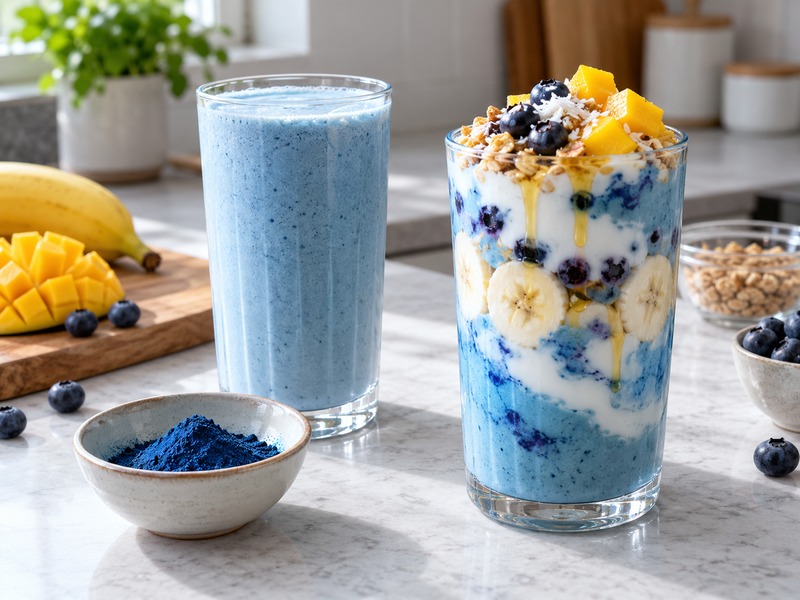
5. Do smoothie bowls get calories from the blue?
Blue spirulina calories in a smoothie bowl usually come mainly from fruit, milk, yogurt, nut butter, granola, or seeds, not the color dose. The bowl can be a satisfying meal, but that depends on the complete composition and portion. The smoothie bowl guide explains why toppings and thickness belong in the formula. A nutrition calculation that excludes a generous topping bar is not a calculation for the bowl customers receive.
How do you measure a real bowl?
Prepare several bowls at normal service pace and weigh each component, including toppings. Calculate the average and check variation between workers. If customers choose toppings, provide values for a standard bowl and clear additions where the market requires or the brand chooses to publish them. Keep color dose separate from the main ingredients so its contribution can be assessed honestly.
- Weigh fruit and liquid after portioning.
- Include the typical topping set.
- Check variation across staff.
| Component | Why include it? |
|---|---|
| Fruit base | Main carbohydrate source |
| Nut butter | Fat and protein contribution |
| Granola | Often a sizable addition |
A bowl’s visual simplicity can hide a complex nutrition calculation.
Key Takeaway: Count the toppings if they are part of what you sell.
6. What about blue ice cream and frosting?
Blue spirulina calories in ice cream or frosting are driven largely by sugar, fat, and serving weight, while the extract is primarily a color component. An ingredient can be naturally derived without making the dessert low calorie. The blue spirulina ice cream guide shows why frozen color tests and nutrition are separate tasks. Calculate the served scoop or decorated cake slice, including inclusions and toppings, instead of reporting only the blue powder’s energy.
How should dessert portions be checked?
Weigh several real scoops or iced units from the production line. Compare that weight with the serving used for nutrition calculation. Record any recipe changes that alter sugar, fat, or overrun. If the scoop size grows during service, the printed value may no longer describe the actual portion even though the extract dose per batch stayed the same.
- Include cones, sauces, or decorations where relevant.
- Verify real portion weights.
- Update calculations after formula changes.
| Dessert | Major energy sources |
|---|---|
| Ice cream | Sugar and fat in the base |
| Frosted cake | Cake plus frosting |
| Blue cookie | Flour, sugar, and fat |
Natural color and calorie content answer different questions.
Key Takeaway: Use the served dessert, not the powder, as the nutrition unit.
7. Can a product be labeled zero calorie?
Whether blue spirulina calories can be rounded to zero on a label depends on the complete product, serving size, and the market’s rules. A very small color dose may round to zero in some contexts, but that is a regulatory conclusion, not a property of the pigment. A blue syrup may contain significant sugar even if the extract dose is tiny. The blue spirulina syrup guide illustrates this difference.
What should regulatory reviewers verify?
Check the complete formula and legal serving definition. Apply the correct rounding convention and ensure the consumer-facing claim is not misleading in context. A bottle labeled zero for one tiny serving can still supply energy when used heavily. Keep the calculation and rule citation in the label approval file, especially if the front of pack makes a prominent statement.
- Review the exact serving size.
- Include carriers and sweeteners.
- Check rounding and claim rules.
| Claim | Question |
|---|---|
| Zero calorie | Does the full serving qualify? |
| Low calorie | Is the threshold met? |
| No added sugar | Are all sources reviewed? |
Rounding should explain a label value, not disguise a recipe.
Key Takeaway: Treat “zero” as a regulated claim to verify, not a marketing shortcut.
8. Does organic blue spirulina have fewer calories?
Organic status does not automatically lower blue spirulina calories. Certification concerns production and chain of custody; energy depends on the material’s composition and dose. The organic powder guide explains why an organic claim needs exact-SKU evidence.
An organic blue syrup can still contain sugar, and a conventional unsweetened extract may contribute little energy at a color dose. Compare actual panels and recipes rather than treating a certification logo as a nutrition metric.
Which documents answer which question?
Use a valid certification scope and transaction records for organic status, and product-specific nutrition data for calories. If a product contains a carrier, check whether it is covered by the organic claim and include its energy in the calculation. Keep these review tracks separate. A failed nutrition claim cannot be repaired by a production certificate.
- Verify organic scope for the exact SKU.
- Obtain energy values for that SKU.
- Calculate the finished serving.
| Question | Evidence |
|---|---|
| Is it organic? | Certification and chain records |
| How much energy? | Product data and recipe |
| Is the claim allowed? | Market rules |
One attractive word on a package does not answer all three questions.
Key Takeaway: Evaluate organic status and calorie content independently.
9. How should buyers compare two blue powders?
Buyers should compare blue spirulina calories at the dose needed for equal finished-food color, while also reviewing composition, taste, and cost. Per-100-gram values can mislead when one grade requires much less powder than another. The blue powder guide explains how grade names and carriers vary. Ask both suppliers for the same data basis, then run a matched application trial before recalculating the label.
What belongs in a comparison sheet?
Include SKU, ingredient statement, energy per gram, color strength under the supplier method, dose per serving, and delivered cost. Document the color target so the comparison is fair. A product with a lower energy value per kilogram might need a higher dose and offer no meaningful serving-level advantage. The decision should be driven by the finished product’s performance.
- Match shade in the same recipe.
- Compare energy per finished serving.
- Review carrier and price together.
| Comparison | Reason |
|---|---|
| Working dose | Determines actual contribution |
| Carrier | Affects nutrition and label |
| Cost per serving | Shows commercial effect |
A fair comparison starts at the plate or glass, not at the bag.
Key Takeaway: Compare blue materials on finished-food use, not headline panel numbers.
10. How should a brand answer calorie questions?
A brand should answer blue spirulina calories questions with the exact product, serving size, and calculation method. Say plainly when the blue ingredient is used mainly for color and when the rest of the recipe drives energy. The blue spirulina nutrition facts guide can support a fuller explanation. Avoid claiming “guilt-free” or “healthy because blue,” which tells the customer little about the food they will actually consume.
What makes the answer useful?
Give a current value for the standard served portion if it has been verified, and explain how substitutions alter it. If the business has not calculated a particular made-to-order combination, say so and provide the ingredient list. Keep customer-service scripts aligned with the approved formula and label. When a supplier changes, recheck the data before repeating the old number.
- Name the serving and recipe version.
- Separate color dose from the base.
- Recalculate after changes.
| Customer asks | Useful response |
|---|---|
| Is the blue powder calorie-free? | Check the exact SKU and dose |
| Is the drink low calorie? | Give the full serving value |
| Does a topping count? | Include it in the total |
Customers can make their own choice when the answer describes the whole food.
Key Takeaway: Communicate calories with a serving number and recipe context.
Conclusion
The calorie contribution of a blue extract is only one part of a blue food’s energy total, and it must be calculated from the exact product and dose. You now have a way to read supplier panels, count milk, fruit, sugar, and toppings, and review zero-calorie or organic claims without guesswork. For product data suited to your formula, contact us. We believe transparent nutrition starts with the portion a customer actually receives.
FAQ
Can I assume blue spirulina powder has zero calories?
No. Check product-specific data and the amount used; label rounding rules may differ by market.
What’s the best way to calculate a blue latte’s calories?
Use the full weighed recipe. Include milk, syrup, foam, and the exact blue blend.
How do I know if a blue smoothie bowl is low calorie?
Calculate the served bowl. Toppings and portion size often matter more than the pigment.
Can an organic blue dessert still be high calorie?
Yes. Organic status does not remove sugar or fat from the recipe.
How do I know if a supplier’s calorie number applies?
Match the SKU and units. Then convert its per-100-gram value to the grams used in one serving.