
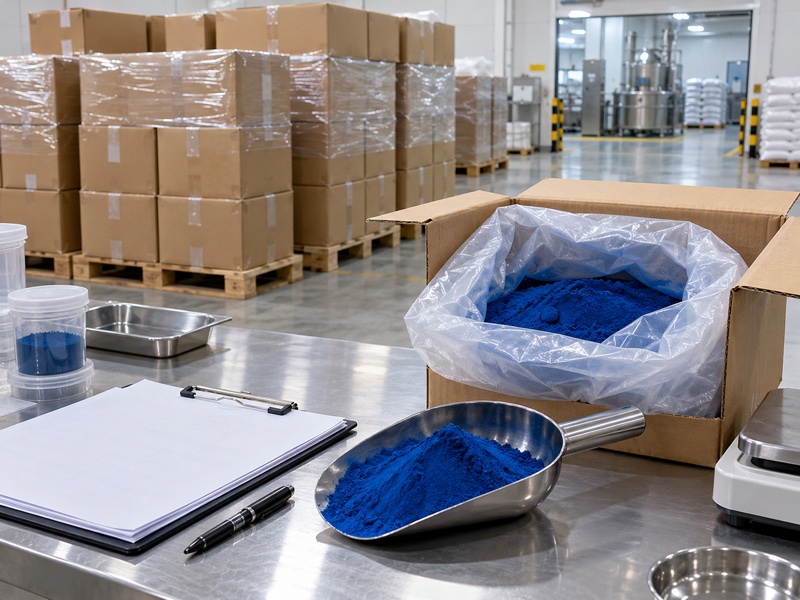
Buy blue spirulina in bulk by approving an exact ingredient grade, lot specification, finished-product dose, and supply agreement before you compare kilogram prices. A bright sample can be attractive, yet a pallet of the wrong carrier or a shade that drifts between lots can erase the apparent savings. If blue spirulina bulk purchasing is on your roadmap, the first order should be built from a tested formula and traceable documents. This guide walks through the practical checks that keep a promising sample from becoming a production problem.
1. What exactly are you buying in bulk?
You are buying a defined blue spirulina extract grade, not a generic shade. Products can differ in phycocyanin color strength, carrier, solubility, moisture, particle behavior, and intended use. Whole green spirulina powder is a different ingredient. A quote that says only “blue spirulina” does not tell the production team what will arrive. Begin with a specification for the material that succeeded in your finished product.
Which identity details belong on the purchase file?
Record the source organism, extract type, carrier, grade method, manufacturing site, pack size, and lot traceability. Ask whether the sample was made at the same plant as commercial supply. An E-code is a supplier color measure, not a universal purity percentage. The ingredient composition guide and blue powder guide help separate identity from marketing language. Match the quote to those technical details before negotiating a price.
| Quote line | Clarification to request |
|---|---|
| “Blue spirulina” | Extract or whole biomass? |
| “E25” | Which method defines E25? |
| “Pure” | Is a carrier present? |
| “Food grade” | Which product and destination market? |
An accurate name reduces every later sourcing question.
2. How should a supplier be qualified?
Qualify the supplier against the actual product, facility, and market you intend to use. A company may operate several sites or trade material produced elsewhere. Ask who manufactures the blue extract, who issues the COA, and who exports the lot. Check relevant certifications and their scopes rather than collecting logos. A factory photograph does not establish that a particular batch came from that line. Procurement and quality should review the same evidence.
What should be requested before a pilot order?
Ask for current specifications, ingredient statement, sample COA, manufacturing and packing site details, relevant audit or certification scope, and a change-notification process. Confirm whether the documents apply to the exact SKU and grade. The factory overview provides starting context; lot and site records make it verifiable. If your brand requires organic material, ask for certification covering the product, site, transaction, and market, rather than assuming conventional stock qualifies.
The supplier’s ability to answer precisely is part of the qualification.
3. Which sample should be approved?
Approve a sample from the commercial specification and, where possible, the production process that will supply future orders. A small laboratory batch can look different from an industrial lot. Test the sample in the intended food at the target dose, process, package, and shelf life. A plain-water demonstration is insufficient for an acidic beverage, frozen dessert, or heated confection. Keep an approved retain sample for later lot comparisons.
How can a sample trial avoid false confidence?
Use measured doses and a control formula. Record initial shade, solubility, taste, sediment, processing loss, and storage changes. Repeat with a second lot if production will depend on tight color consistency. Tell the supplier the target pH, heat step, and package. The drink formulation guide shows why a color that works in one beverage may fail in another. Write acceptance criteria before you receive the first pallet.
| Trial item | Why it matters |
|---|---|
| Real base | Reveals matrix effects |
| Commercial process | Exposes heat and mixing loss |
| Intended package | Tests light and oxygen exposure |
| Storage checks | Shows saleable color |
The approved sample should represent the saleable product, not the easiest test.
4. How do you compare bulk prices fairly?
Compare cost per approved finished serving or kilogram of food, not only cost per kilogram of powder. A stronger grade may need less powder; a cheaper grade may require a higher dose or produce more rejected batches. Include carrier effects, yield, freight, duties, storage losses, and quality testing. Price quotes should be normalized to the same currency, incoterm, pack size, and shipment date. A small unit-price advantage can disappear in the landed-cost calculation.
What should a costing sheet contain?
Enter the measured powder dose, powder price, exchange rate, freight, duties, lab costs, pack loss, and expected waste. Use the grade and lot that passed the product trial. If an alternative grade changes flavor or label wording, record the cost of reformulation too. The daily amount article explains why dose comparisons need the exact material. Recalculate when a supplier changes carrier or color strength.
| Cost line | Calculation basis |
|---|---|
| Ingredient | Price × measured dose |
| Freight and duty | Landed cost per kilogram |
| Quality checks | Tests per lot or shipment |
| Waste | Failed or expired material |
The cheapest drum is not always the cheapest product.
5. What minimum order quantity makes sense?
The right minimum order quantity is the volume you can use within the validated shelf life and forecast demand. Buying more can lower price per kilogram but increase expiry, storage, and cash-flow risk. A new beverage or dessert line may need a smaller first order while sell-through is uncertain. Ask for pack sizes that suit your batching operation and opening-frequency controls. Order quantity should follow a realistic production plan, not only a discount tier.
How can a buyer set the first order?
Calculate expected production batches, pigment dose, safety stock, and lead time. Add a sensible allowance for trials and process variation, then compare that total with shelf life remaining at delivery. Ask whether the supplier can split shipments under one agreement. Record who bears the cost if a lot fails the specification. A smaller, traceable first order often provides better learning than a warehouse full of powder with an untested market.
| Forecast input | Decision affected |
|---|---|
| Monthly finished output | Powder consumption |
| Dose per unit | Required kilograms |
| Lead time | Reorder point |
| Shelf life on arrival | Maximum safe stock |
The order size should be defensible even if sales start slowly.
6. What packaging protects a bulk shipment?
Bulk packaging should protect the pigment from moisture, light, contamination, and avoidable handling damage. The right inner liner, closure, carton or drum, and pallet protection depend on shipment length and climate. A bulk pack should also be practical for your plant to open and reseal. Poor packaging can turn a technically sound powder into a clumped, faded, or difficult ingredient. Agree on packaging before the purchase order is placed.
What should receiving inspect?
Check outer condition, seal integrity, inner liner, label, lot, quantity, and temperature or humidity concerns noted in the supply agreement. Photograph damage and quarantine suspect material. Compare package type with the approved specification. If the product arrives in a different pack, ask whether the change was authorized. The warehouse should follow the supplier’s tested storage and handling directions after receipt.
An intact pallet does not guarantee intact inner bags.
7. Which COA results should be checked at receipt?
Check the lot-specific COA against the purchase specification and delivered package. Relevant fields can include color value, identity, moisture, microbiology, heavy metals, and other agreed contaminants. Methods, units, limits, and results should be legible and comparable. A certificate from a sample lot is not the commercial lot’s release record. If a critical result is missing or out of specification, hold the shipment for quality review.
How can a team make COA review repeatable?
Create a short receiving checklist with the product code, lot number, required tests, acceptance limits, and sign-off authority. Keep an approved retain sample and record any visual difference. Decide in advance which results require independent confirmation. The origin article helps connect cultivation, extraction, drying, and packing records when provenance is important. A repeatable review is faster than arguing about each delivery from scratch.
| COA field | Common failure to catch |
|---|---|
| Lot ID | Certificate for another batch |
| Method and unit | Incomparable numbers |
| Limit and result | Missing pass criterion |
| Issuer and date | Unclear release authority |
The COA is a decision document, not a decorative attachment.
8. What should the supply agreement cover?
The agreement should define the grade, specification, packaging, delivery terms, change notice, and response to nonconforming lots. Include who owns testing decisions and how disputes will be resolved. A supplier change of carrier or production site can affect both color and label, even when the price remains unchanged. Define a process for sample approval before substitutions. Commercial terms need enough precision to protect the finished product.
Which changes require written notice?
At minimum, consider changes in raw-material source, extraction process, carrier, color method, manufacturing site, packaging, and shelf-life basis. Agree on notice timing and whether a bridge trial is needed. Ask for a retained sample of the prior grade when a change occurs. The natural-label discussion shows why a change can also alter a certification or claim. Keep marketing and regulatory teams in the loop.
| Change | Possible consequence |
|---|---|
| Carrier | Label and dose |
| Site | Certification scope |
| Grade method | Color comparison |
| Packaging | Storage performance |
Change control is cheaper than a surprise reformulation.
9. How should a business plan repeat orders?
Plan repeat orders around actual consumption, lead time, lot qualification, and seasonality. A color used in summer beverages may have a different demand curve from one used in year-round confectionery. Keep forecasts updated with sales and waste data rather than relying on the launch estimate. Reassess the dose if a new base or process changes color performance. Preserve traceability between each ingredient lot and finished-food batch.
What should be monitored each month?
Track stock on hand, remaining shelf life, forecast use, supplier lead time, lot rejections, and color complaints. Compare actual powder use with the approved recipe to catch dose drift. If production uses two grades, label and segregate them clearly. A recipe development overview can show how multiple applications may compete for the same inventory. Purchasing should know when one shared lot is being used in several products.
Better forecasts reduce both expiry and urgent freight.
10. When is a bulk order ready to place?
A bulk order is ready when the exact grade has passed a finished-product trial, documents match the intended market, and commercial terms are written clearly. Quality, regulatory, R&D, and purchasing should approve the same version of the specification. Confirm price basis, MOQ, lead time, shelf life at arrival, packaging, and release process. Keep a contingency if the first commercial lot differs from the sample. The goal is a reliable blue ingredient, not just a signed purchase order.
What belongs in a final approval meeting?
Show the retained sample, trial record, shade standard, cost calculation, COA checklist, label assessment, and supply agreement. Name the person who can release or reject a lot. If one item is unresolved, record the decision and owner before ordering. The contact team can discuss samples and product-specific documents for a proposed application. A clear file lets production move fast without guessing.
| Approval owner | Required decision |
|---|---|
| R&D | Finished-product performance |
| Quality | Specification and lot release |
| Regulatory | Market use and label |
| Purchasing | Landed cost and contract |
The first order should be ordinary because the hard questions were answered earlier.
Frequently Asked Questions
Can I buy one grade for several products?
Possibly, if it passes each finished-product trial and market review. A grade that works in ice cream may fail in an acidic drink.
What’s the best way to compare two bulk quotes?
Calculate landed cost per approved finished serving. Include dose, freight, testing, and waste rather than comparing kilogram prices alone.
How do I know if the bulk lot matches my sample?
Match product code, grade, specification, lot COA, and appearance against a retained sample. Run a bridge trial when needed.
Can a supplier’s organic certificate cover every grade?
No. Verify certification for the exact product, site, transaction, and destination market before making the claim.
Can I place a large order after a water test?
It is risky. Test the ingredient in your actual formula, process, package, and storage conditions first.
Conclusion
Bulk blue spirulina purchasing succeeds when the approved sample, commercial lot, finished-food performance, and contract all describe the same ingredient. You can now compare quotes using real dose and landed cost, qualify a supplier, inspect receipt records, and plan repeat orders. If you are preparing a commercial brief, contact us with your application, volume, and destination market so we can discuss grade samples and documentation. Good sourcing turns a striking color into a repeatable product.