
There is no single evidence-based daily amount of blue spirulina that fits every product and person. A blue extract used to color a smoothie is not the same as whole green spirulina sold as a supplement, and a spoonful is not a useful measurement when grades vary. If you are asking how much blue spirulina per day, start with the exact product label and your reason for using it. For food developers, the practical question is the smallest measured amount that gives the desired color in a safe, compliant serving.
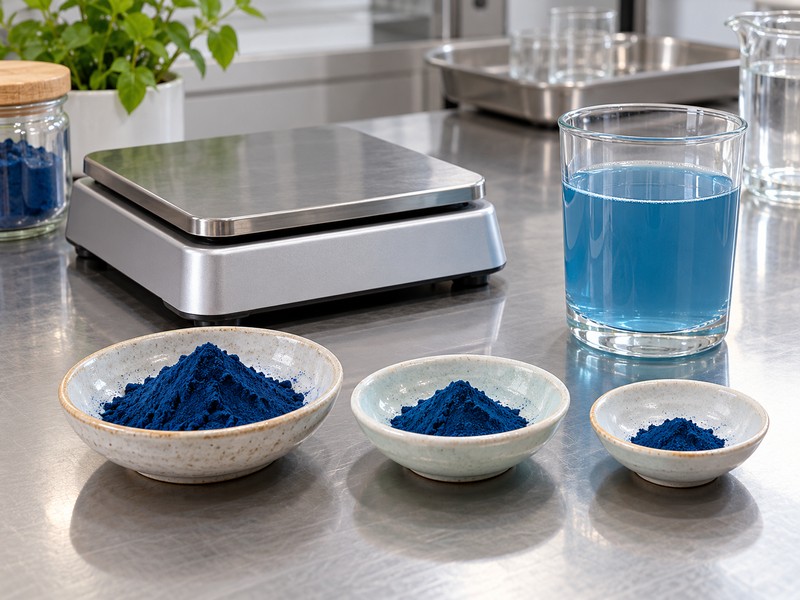
1. Is there a standard daily dose for blue spirulina?
No universal daily dose has been established for all blue spirulina powders and uses. Products differ in phycocyanin concentration, carriers, serving size, and whether they are sold as color ingredients or supplements. Published work on whole spirulina cannot simply be converted into an amount of blue extract. Even studies of a particular aqueous extract describe that tested material, population, and period, not every powder on a retail shelf. Follow the directions for your exact product and seek individual medical advice where it matters.
Why do online numbers conflict?
Many articles combine teaspoons of blue color powder, grams of whole green biomass, and milligrams of isolated phycocyanin as if they were equivalent. They are not. A supplier’s E-grade may describe color strength by its own method; it does not create a standard serving size. A small human safety trial of one phycocyanin-rich extract assessed specified markers over two weeks in 24 adults. That result cannot define a general daily recommendation for children, pregnancy, other formulations, or long-term use.
| Number you may see | Material it might describe | What to confirm |
|---|---|---|
| Teaspoons | Retail powder volume | Powder weight and grade |
| Grams | Whole spirulina or extract | Exact ingredient identity |
| Phycocyanin milligrams | A measured component | Validated assay and serving |
Compare like with like before using any number.
2. How much should color a drink serving?
Use the lowest weighed amount that reaches your approved shade in the finished drink. The dose depends on extract grade, liquid color, acidity, temperature, package, and storage time. A vivid blue water sample may need a different amount than an oat smoothie, while an acidic juice may not retain the intended blue at any practical dose. Begin with small controlled trials and record grams of powder per serving, not scoop counts. The result is a formulation dose, not a health recommendation.
How do you run a simple dose ladder?
Make a control with no blue extract and several samples with measured increases while every other ingredient stays constant. Photograph them under consistent light, then assess taste and appearance after the intended hold. Choose the lowest level that still meets your target at serving time. Repeat with the commercial lot and process. If you need an unusually high dose, review the base and pigment grade before adding more powder. Overdosing can increase cost or leave an unwanted note without fixing instability.
The blue spirulina product range is a starting point for grade selection, while your finished formula sets the dose.
3. Should teaspoons be used for dosing?
Teaspoons are too imprecise for comparing blue spirulina products or reproducing a commercial recipe. A powder’s density changes with particle size, carrier, moisture, and how firmly it is packed. Two visually similar spoonfuls can weigh differently. A consumer following a retail label can use the included measure if the maker provides one, but the label should still state the serving in a meaningful unit. Product developers should use a calibrated scale and record the exact weight.
What should a recipe card record?
Write the powder lot and grade, powder weight, batch size, number of servings, mixing order, and final shade reference. Note whether the extract was added directly or premixed in liquid. A photograph can support the color target but should not replace the weighed formula. If staff swap a supplier or reformulate the base, the old spoon instruction may no longer work. A short recipe card prevents that drift.
| Measurement | Risk in a production recipe | Better record |
|---|---|---|
| “One scoop” | Scoop size changes | Grams per batch |
| “Until blue” | Subjective endpoint | Approved shade at set time |
| Powder weight alone | Yield may change | Grams per serving and yield |
Precision is useful because it reduces waste and inconsistent color.
4. Does extract grade change the amount needed?
Yes, a stronger-color extract may need less powder to reach the same visual target. But supplier grade names are not universal purity measures, and a stronger grade does not automatically make a better finished product. Carriers and processing also affect solubility, taste, texture, and cost. Compare grades at equal finished color, not equal powder weight. The lowest-cost kilogram may require more material or create more rejected batches.
What should the supplier document?
Ask for the color specification method, ingredient declaration, carrier, lot-specific certificate of analysis, recommended application conditions, and storage guidance. Tie these documents to the exact material sent for trial. If the seller offers E3, E6, E18, E25, or E35, ask how those grades are defined within its system. Do not convert the code into a phycocyanin percentage without a validated assay. Once a grade is selected, keep a retained sample to compare later lots.
You can ask the contact team for product-specific documents before setting a commercial serving amount.
5. Can whole spirulina doses guide blue extract use?
No, whole spirulina doses are not a direct guide to blue extract use. Whole biomass contains many components, including protein, pigments, and other constituents, while blue extract is enriched for water-soluble color compounds and may contain a carrier. Their composition, purpose, and labeling can differ. A study of whole spirulina intake should be cited for whole spirulina, not used to claim the same effect or dose for a food color. Identify the material first, then read the evidence that actually applies to it.
What should you compare on two labels?
Check whether each label says whole spirulina powder, spirulina extract, phycocyanin, or a blend. Compare the ingredient statement and serving weight, then note the intended use and any active-content data. A green powder promoted as a nutrient ingredient may have an entirely different serving direction from a blue pigment used to color a dessert. If the label is ambiguous, request clarification from the maker rather than estimating a conversion. A small difference in wording can signal a large difference in composition.
| Material | Main buying question | Dose basis |
|---|---|---|
| Whole green spirulina | Nutrient and sensory fit | Product label and evidence |
| Blue extract | Color and stability | Measured finished-food trial |
| Beverage premix | Full formula and claims | Complete ingredient declaration |
The ingredient identity is the first dose decision.
6. Is taking more blue spirulina better?
No evidence supports a general rule that more blue spirulina is better. In a food, extra extract may deepen color only to a point, then add cost, sediment, or flavor. It may also push the product beyond the intended formulation or a jurisdiction’s permitted use conditions. For an individual consumer, taking more than the product directions does not establish greater benefit and can complicate tolerance or interactions. A measured purpose is more defensible than a “more is healthier” slogan.
Where should a trial stop?
Stop raising the dose once the desired color is met or a negative sensory effect appears. Evaluate the result at the end of the intended shelf life, not just at mixing. If the pigment fades in an acidic or hot formula, investigate stability rather than masking the loss with an excessive starting dose. Record any upper formulation boundary set by regulation, supplier guidance, or internal safety review. A commercial recipe needs a justified range, not a dramatic scoop photograph.
For processing questions, the factory overview can help frame what manufacturing and lot information to request.
7. Who should ask a clinician before regular use?
People with relevant allergies, medical conditions, medication use, pregnancy, or breastfeeding should ask a qualified clinician about regular use of a specific product. That advice is especially relevant when the powder is marketed for supplementation rather than a small amount of food color. A person can react to a product despite broad claims that an ingredient is “natural.” Rare allergic reactions to spirulina-related products have been reported; the exact risk for an individual cannot be predicted from a general article. Keep the package information available for the conversation.
What information helps the discussion?
Bring the complete label, serving direction, manufacturer, lot, and any other supplements or medicines you take. Explain whether you want it for food color, a daily supplement routine, or another reason. If symptoms occur after use, stop using the product and seek appropriate medical attention. A supplier can explain ingredient identity and quality records but should not make a personal dosing decision. Clear boundaries protect both the consumer and the seller.
The whole spirulina page helps distinguish a separate product category when comparing labels.
8. What safety checks matter before choosing a dose?
Product identity and quality checks matter before any dose is chosen. A dose recommendation is meaningless if the material differs from the label or lacks adequate contaminant controls. Ask for lot-specific testing and documentation relevant to the source and intended market. Review microbiological quality, heavy metals, and other contaminants as appropriate to the product and supply chain. A certificate should name the actual lot and manufacturing entity, not a similar item sold by a related company.
How should a buyer assess a supplier record?
Match the certificate of analysis to the invoice, grade, and sample in hand. Check methods, limits, dates, and whether the tested material is whole biomass or blue extract. Request clarification on any missing carrier or ingredient statement. For a packaged food, verify the supplier’s change-notification process so a formulation change does not silently alter the label. These steps are routine procurement work, but they are the foundation for a reliable serving amount.
| Document | Dose-related question |
|---|---|
| Specification | What exactly is the material? |
| Lot COA | Does this batch meet agreed limits? |
| Ingredient declaration | What else is in the powder? |
| Change notice | Has the formulation shifted? |
Only then does the measured serving mean what you think it means.
9. Do regulations set the same amount everywhere?
No, permitted uses and labeling rules differ by market and product category. A food color application, a beverage, and a supplement may face different requirements. In the United States, 21 CFR 73.530 specifies certain uses and conditions for spirulina extract as a color additive. That regulation should be checked against the exact food, intended use, and current rules; it is not a universal daily intake instruction. Review the destination market before fixing a formula or a serving claim.
What should regulatory review cover?
Record the ingredient name, intended category, maximum use where applicable, label declaration, and evidence supporting any claim. Check whether a blended powder introduces other ingredients with their own rules. If you sell internationally, keep separate approved specifications and labels where requirements differ. A “global” dose printed before market review can cause rework. Ask a qualified regulatory professional to review the finished formula rather than relying on a supplier’s marketing sheet.
The OEM services page is relevant when a concept needs market-specific formulation and packaging work.
10. How can a business set a defensible serving amount?
A business can set a defensible amount by combining a measured color trial, quality review, market rules, and a documented finished-product specification. Begin with a target shade and realistic conditions: pH, heat, light, package, and shelf life. Compare grades at matched final color and check flavor and texture. Then confirm that the selected amount fits the applicable regulatory category. The approved dose should be expressed per batch and per serving, with tolerances staff can follow.
What belongs in the approval record?
Keep the trial formula, sample photos under controlled light, powder lot, final shade decision, sensory notes, stability results, and label review. Record why the chosen dose was preferred over a lower or higher one. Recheck after a supplier, carrier, base, or process change. This is more work than copying a teaspoon recommendation, but it gives production and purchasing a common reference. It also lets customer service answer questions without inventing a health claim.
| Decision | Evidence to retain |
|---|---|
| Color target | Final-product photos and panel notes |
| Serving amount | Weighed recipe and yield |
| Safety and compliance | Lot data and market review |
| Release | Stability and quality sign-off |
A good dose is one the business can explain and repeat.
FAQ
Can I use blue spirulina every day?
Possibly, if the exact product is appropriate for you and you follow its directions. Daily use is an individual decision; check the label and ask a clinician if you have a relevant condition, allergy, pregnancy, or medication concern.
What’s the best amount for one smoothie?
Use the smallest weighed amount that gives the color you like in that smoothie and follows the product directions. There is no universal teaspoon measure across grades and bases.
How do I know if a dose is too high?
The label direction and your individual circumstances are the first checks. For a food formula, excess may show up as off-flavor, sediment, unnecessary cost, or a conflict with permitted use conditions.
Can I substitute a whole spirulina dose for blue powder?
No. Whole green biomass and blue extract have different composition and uses, so their serving amounts should not be treated as interchangeable.
Can I give the same serving to a child?
Do not assume an adult direction applies to a child. Check the exact product label and ask a pediatric clinician before regular use or supplementation.
Conclusion
There is no one-size-fits-all daily amount for blue spirulina. You now have a practical way to separate whole biomass from extract, measure a color dose, check the supplier record, and review a finished product for its market. If you are formulating a food or beverage, contact us with your base, process, target color, and destination market so we can discuss suitable samples and documentation. A useful dose is the one your product can justify, not the one that looks impressive in a scoop.