
Blue spirulina comes from cultivated spirulina biomass, commonly Arthrospira platensis, whose blue phycocyanin pigments are extracted for food use. If you are sourcing a blue powder, the more useful question is where each part of the supply chain happens: cultivation, extraction, drying, testing, and packing. A bright sample does not answer those questions. This guide answers “where does blue spirulina come from?” by tracing the records a buyer can request for a specific product and lot.
1. What organism is the starting material?
The starting material is cultivated spirulina, often identified scientifically as Arthrospira platensis. The name “spirulina” persists in commerce even though taxonomy can be more specific in technical documents. For U.S. use as a color, the current federal spirulina extract rule defines a filtered aqueous extract from dried Arthrospira platensis. Other products or markets may have different definitions, so the offered ingredient needs its own identity record.
What should the specification name?
Ask for the organism, the form of incoming biomass, the extraction method, and the ingredient declaration. A supplier may call a powder blue spirulina even when it includes a carrier. That can be acceptable for a formula, but it must be clear to your label and quality teams. Do not infer identity from color alone; unrelated blue colorants can make similar-looking samples.
| Record | What it answers |
|---|---|
| Organism identification | Which biomass entered the process? |
| Process description | Was it extracted or sold whole? |
| Ingredient statement | What else is in the final powder? |
The source organism is the first link in traceability, not the last.
2. How is spirulina biomass cultivated?
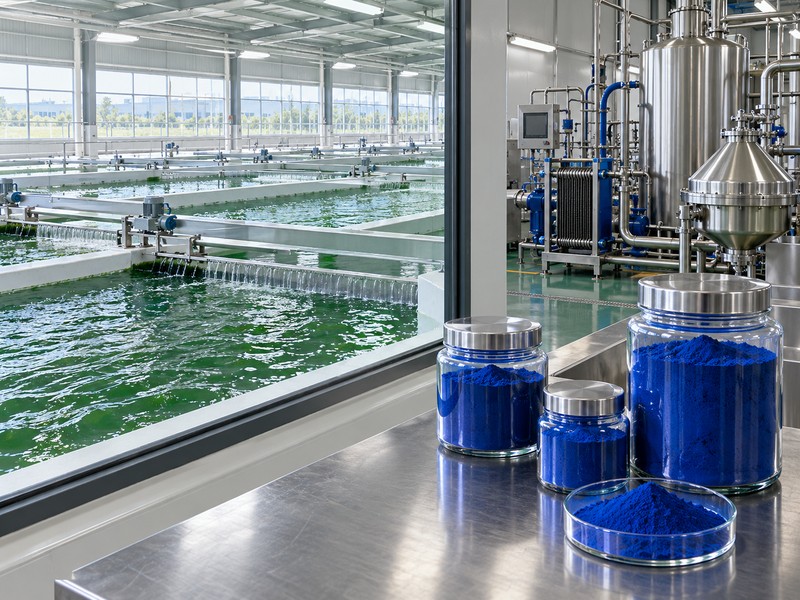
Spirulina biomass is grown under controlled cultivation conditions and harvested when it meets the producer’s process requirements. The exact site, water source, growing system, and operating controls vary by producer. Buyers should avoid assuming every blue extract comes from an open pond, a photobioreactor, or one country because a marketing photo showed that setting. Ask the supplier to state the source for the offered lot.
What cultivation questions matter to quality?
Request the production-site identity, biomass traceability, water and environmental controls relevant to the process, and the producer’s contaminant monitoring program. For a food ingredient, the key concern is not whether the farm looks picturesque; it is whether the harvested material can be traced and tested before extraction. If a brand wants a specific origin claim, it needs records for the actual lot and a review of how the market defines origin.
| Cultivation record | Why it matters |
|---|---|
| Site identity | Links the claim to a real operation |
| Biomass lot | Connects harvest to extract batch |
| Water and process controls | Explains how quality is managed |
These records make an origin statement verifiable.
The factory information can help start a supplier conversation, but product and site claims should be matched to the actual manufacturing route for the SKU you buy.
3. How does the biomass become blue extract?
The biomass becomes blue extract when water is used to release phycocyanin-rich material, followed by separation and filtration steps. The precise process can differ by manufacturer and desired grade. Removing much of the whole biomass changes the ingredient’s color, taste, and composition. That is why a blue extract should not be treated as ground green spirulina.
What process details should a buyer request?
Ask whether the extract is aqueous, what separation and filtration steps are used, and whether any additives or carriers enter before drying. You may not receive proprietary operating settings, but you should receive enough information to assess identity, label wording, and quality controls. If a supplier uses terms such as “pure” or “natural,” ask exactly what they mean for the offered SKU. A high color grade does not by itself prove the absence of a carrier.
| Process stage | Buyer question |
|---|---|
| Biomass preparation | How is the raw material identified? |
| Extraction | What is the extraction medium? |
| Separation | How is residual biomass removed? |
| Drying | Which ingredients are present in the final powder? |
The process map should match the final ingredient statement.
4. Why is phycocyanin blue?
Phycocyanin is a blue pigment-protein complex within spirulina, and it gives the extract its characteristic color. Its color can change under heat, acidity, and light, so the ingredient’s origin does not guarantee stability in every food. The amount and behavior of pigment depend on the specific extract and matrix. For a buyer, the useful measurement is how the offered lot performs in the intended finished product.
How do you compare two pigment grades?
Request the supplier’s color measurement method and a lot-specific result. Then prepare both samples in the same base at measured doses under the same lighting. Record initial shade and changes after processing and storage. Grade labels such as E3, E6, E18, E25, and E35 help navigate one supplier’s range, but they should not be converted into a universal phycocyanin percentage without the underlying test method.
A blue extract product discussion can identify suitable starting samples. The comparison becomes meaningful only after you define the food application.
5. What happens during drying and packing?
Drying converts a liquid extract into a powder that is easier to store, ship, and dose. A carrier may help with handling or stability, depending on the formulation. Packing then protects the powder from moisture and light during storage and transport. The final package should have a lot number that links back to the biomass and process records.
Why can two blue powders behave differently?
They may differ in color grade, carrier, moisture, particle behavior, or process history. One can disperse quickly in cold water while another forms specks in a syrup. Compare the exact ingredient declarations and specifications, then run a mixing test under your production conditions. A trial in plain water is useful but does not replace testing in acidic juice, dairy, or a frozen dessert.
| Powder property | Possible product effect |
|---|---|
| Carrier | Label wording, sweetness, mouthfeel |
| Moisture | Clumping and shelf handling |
| Particle behavior | Dispersion and sediment |
| Packaging barrier | Stability during storage |
The powder form is part of the product design, not only a shipping convenience.
6. Is blue spirulina the same as green spirulina?
No. Green spirulina is generally the whole dried biomass, while blue spirulina is usually an extract selected for phycocyanins. Their color, flavor, and nutrient profiles can differ substantially. A study on one material does not establish a health benefit for the other. A recipe designed around a vivid blue shade will usually need an extract rather than a spoonful of whole green powder.
How should a brand write the difference on a brief?
State whether the objective is color, whole-biomass nutrition, or both. If it is color, specify hue, stability, taste, and permitted market use. If it is nutrition, ask for measured nutrient values at the actual serving dose. The green spirulina product category and blue extract category should have separate qualification files. This prevents an ingredient swap that changes the product or label without review.
The same distinction applies to marketing claims. Ingredient names are not evidence of clinical effect.
7. Does geographic origin tell you enough?
Geographic origin can be relevant for sourcing, but it does not tell you enough about quality by itself. A country name cannot replace a lot-specific COA, documented manufacturing route, or finished-product stability test. The biomass might be cultivated in one place and extracted or packed elsewhere. If the label or customer contract requires origin information, ask the supplier to map each stage accurately.
What should an origin statement cover?
Clarify the place of biomass cultivation, extraction, drying, and final packing. Ask which stage the supplier means by “made in” or “sourced from.” Keep the records with the lot number and review them against the destination market’s labeling rules. If a contract requires a particular region or production site, put that requirement into the purchase specification before ordering. An attractive factory photo does not resolve an origin claim.
| Supply-chain step | Origin question |
|---|---|
| Cultivation | Where was the biomass grown? |
| Extraction | Where was blue pigment separated? |
| Drying | Where did powder production occur? |
| Packing | Who packed the saleable lot? |
One word, “origin,” can hide four different answers.
8. Which safety tests matter after extraction?
Safety testing should address the hazards relevant to the source material, process, product, and destination market. A buyer commonly reviews microbiology, heavy metals, identity, and any required contaminant tests. The current U.S. spirulina extract rule includes specific limits and a microcystin requirement for its regulated food-color use. Do not assume those are the only tests needed for every market or application.
How do you read a COA against the lot?
Check that the lot number on the COA matches the package and purchase order. Review the method, unit, limit, result, date, and issuer for each test. If an important item is absent, ask whether it was tested elsewhere or omitted from the panel. Verify that any certification or organic claim covers the exact product, site, and transaction. A certificate from a different factory cannot establish this lot’s status.
For a new supplier, ask quality staff to compare at least one production lot with the approved development sample. Traceability should remain intact through that comparison.
9. How should a buyer verify a supplier’s story?
Verify a supplier’s story by matching its claims to documents for the actual SKU and lot. A company profile can explain capabilities, but it cannot replace the specification, COA, origin records, and relevant certificates. If the seller and manufacturer are different legal entities, identify each one in the purchasing file. That distinction matters when you audit a site or resolve a quality issue.
Which questions make the review concrete?
Ask who sells the product, who manufactures it, where each production step occurs, and which entity holds the certificates. Ask how lot numbers connect incoming biomass to finished powder. Confirm the planned use and market before accepting a regulatory statement. If answers conflict, pause the claim until the records agree. This is a routine sourcing check, not an accusation against a supplier.
Match any supplied certificate or contract to the exact entity and product before using it in customer-facing claims.
10. How does origin information improve a product launch?
Origin information improves a launch when it supports a traceable, reproducible ingredient specification. The buyer can then investigate a color change, verify an organic or country claim, and compare future deliveries against the approved lot. For R&D, knowing the exact extract and carrier also narrows the causes of a failed stability trial. The value is practical: fewer unanswered questions after a product reaches market.
What belongs in the final sourcing file?
Keep the organism and ingredient identity, cultivation and production map, carrier statement, signed specification, lot-specific COA, relevant certificates, approved sample, and finished-formula test results. Add contact details for the seller and manufacturing quality team. Set a rule for changes that trigger a new qualification, including source site or carrier changes. Then link the file to the purchase order and finished-product batch record.
If you are evaluating Spirulina CN sourcing, start with the specific application and destination market. That lets the supplier return relevant product information rather than a generic origin claim.
Frequently Asked Questions
Can I call blue spirulina an algae powder?
Only if that wording accurately describes the ingredient and fits your market’s rules. A filtered blue extract is different from ground whole biomass, so check the specification first.
What is the best proof of where it was made?
Use lot-linked production and transaction records. A website country claim or factory photograph is not enough for a product-specific origin statement.
How do I know whether the powder has a carrier?
Read the full ingredient declaration and technical specification. Ask the supplier to confirm the composition of the exact offered grade.
Can I assume a higher E-grade is purer?
No. Request the supplier’s grade method and lot result; E codes are not universal phycocyanin percentages.
What is the best first question for a new supplier?
Ask for the exact SKU specification and a lot-specific COA. Those documents let you check identity, composition, quality, and traceability.
Conclusion
Blue spirulina begins with cultivated spirulina, but a saleable powder reflects several additional production and quality decisions. You now know which stages to trace and which records to request before using an origin, purity, or organic claim. If you are sourcing an extract for food or drinks, contact us with the formula and sales market so we can discuss the right product file and samples. A credible blue ingredient has a traceable path behind its color.