
Blue spirulina extract can be a useful food color in a suitable product, but there is not enough evidence to call a typical color-use serving a health booster. The blue pigment has interesting biology, yet a finished smoothie may contain too little extract to provide the benefits suggested by a supplement advertisement. Whether a blue food is good for you depends more on its full recipe, dose, quality, and your individual needs. This guide answers “is blue spirulina good for you?” by separating those practical questions from the color itself.
1. What is blue spirulina in food?
Blue spirulina in food is usually a phycocyanin-rich extract from cultivated spirulina biomass, used primarily for color. Whole green spirulina powder is a different material with more of the original biomass. Commercial blue powders may have carriers or other ingredients. The exact product determines its composition and suitable use. A blue drink’s appearance cannot tell you how much extract or nutrition it contains.
Why does the form matter for health claims?
Studies may use whole spirulina, concentrated phycocyanin, or another preparation, each at a different dose. The what-is-it-made-of article explains those distinctions. If the sold smoothie contains a small color dose, a whole-spirulina supplement study does not directly describe it. Ask for the exact ingredient and serving weight. Evidence should travel with the material, not with a shared nickname.
| Form | Main question |
|---|---|
| Whole spirulina | What nutrients does the serving supply? |
| Blue extract | What is the color-use dose? |
| Supplement blend | What else is included? |
Identify the product before judging a benefit.
2. Does the blue pigment have biological activity?
Phycocyanin has been studied for biological activity in laboratory, animal, and some human contexts, but that does not establish a broad benefit from every blue food. Results depend on dose, preparation, route, and outcome. An in-vitro antioxidant result is not the same as a person feeling better or preventing disease. A review can suggest research directions, not validate a particular smoothie claim. The finished product needs its own evidence for a specific promised effect.
How should you read a study headline?
Check whether people were studied, what product they consumed, the amount, the duration, and what changed. The general benefits guide examines common claims, while a phycocyanin research review provides scientific context. If the study does not resemble the product you are buying, treat the conclusion as indirect. The phrase “contains antioxidants” should not become “prevents disease.” Ask for the bridge from molecule to serving to outcome.
| Evidence | What it shows |
|---|---|
| Lab assay | Chemical behavior |
| Animal study | Further research question |
| Human study | Potential benefit in studied context |
| Finished-product trial | Closest to the sold item |
Interesting science is not a universal health promise.
3. Does blue spirulina provide protein or vitamins?
A typical color-use amount should not be assumed to provide meaningful protein or vitamins. Phycocyanin is a protein-bound pigment, but a small serving of extract may contribute very little. Whole spirulina’s per-100-g nutrition cannot be transferred to blue extract. The rest of a smoothie often supplies most nutrients. Read the actual serving panel and calculate from the exact recipe before calling the blue ingredient nutritious.
What number matters most?
Multiply the measured nutrient per gram by grams of extract in one serving, then consider the complete product. The nutrition overview illustrates the difference. A drink may be high protein because it contains yogurt, soy, or an added isolate. It can be low protein despite a deep blue shade. Nutrition follows the formula, not the photograph.
| Label claim | Evidence |
|---|---|
| Protein source | Finished-serving grams |
| Vitamin claim | Tested amount and rule |
| Low sugar | Full recipe |
The whole food determines nutritional value.
4. Can a blue smoothie be a healthy choice?
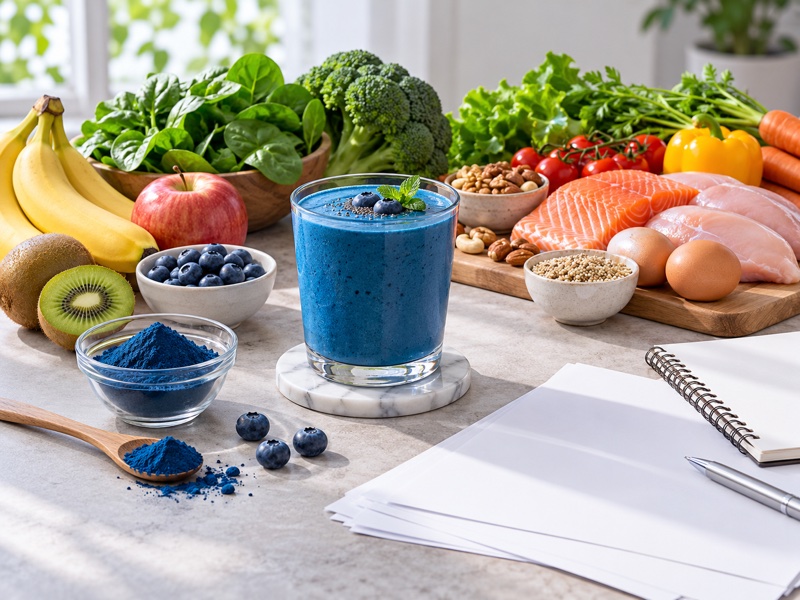
Yes, a blue smoothie can fit a balanced diet if its complete ingredients and portion suit you. Fruit, yogurt, milk, or another base can contribute nutrients, while sugar syrups and large portions can change the picture. The blue extract mostly affects appearance at a typical color dose. A visually appealing drink may help someone choose fruit or yogurt, but the color does not make an otherwise poor recipe healthy. Compare nutrition panels and ingredients, not shades.
What should you check before ordering?
Ask about the base, serving size, added sugar, protein sources, allergens, caffeine, and exact blue ingredient. The smoothie guide shows how a plain base can be built. A café may use a sweetened blue blend or a pure extract; the two produce different drinks. If you have a dietary restriction, the blue color is a poor clue. Read or ask for the full recipe.
| Smoothie component | Main effect |
|---|---|
| Fruit | Flavor, sugar, fiber |
| Yogurt or milk | Protein and allergens |
| Syrup | Added sugar |
| Blue extract | Color |
Choose the drink, not just the blue.
5. Are there side effects or safety risks?
Individual reactions and quality concerns are possible, as with other food ingredients, and the risk depends on the exact product and dose. A blend may contain other active ingredients, allergens, or caffeine. Spirulina-derived products should have controlled identity, microbiology, and relevant contaminant testing. The FDA’s microcystin information focuses heavily on wild-harvested AFA products and should not be generalized automatically to cultivated Arthrospira extract. It reinforces the value of source and batch controls.
What should a buyer verify?
Ask for the full ingredient list, grade, lot information, specification, and appropriate COA. The side-effects article discusses symptoms and product differences. A “natural” label is not a lab test. If a product smells wrong or causes concerning symptoms, stop using it and seek appropriate medical advice. Do not hide a questionable lot in a strongly flavored recipe.
| Quality question | Why it matters |
|---|---|
| Correct identity? | Avoid material mix-up |
| Batch tested? | Contaminant control |
| Full formula known? | Other actives and allergens |
| Dose stated? | Exposure assessment |
Quality is a prerequisite for any possible benefit.
6. Is blue spirulina safe for daily use?
There is no universal daily-use answer for every blue extract, supplement, and person. A little food color in a varied diet is a different situation from a daily high-dose powder. Follow the product’s directions and consider your medical conditions, medicines, and life stage. The available evidence does not support making a medical recommendation from color alone. If you plan to take a concentrated product every day, discuss the exact label with a clinician.
Which groups need extra care?
Pregnant or breastfeeding people, children, and people with significant medical concerns should get product-specific advice rather than a generic internet dose. The safety guide and child-safety guidance discuss those limits. A food manufacturer should not market a single dose as safe for everyone. A clinician needs the exact product, amount, and other ingredients to offer useful guidance.
| Use pattern | Decision |
|---|---|
| Occasional colored food | Check ingredients and suitability |
| Daily extract powder | Review exact dose and purpose |
| Sensitive life stage | Individual professional advice |
Frequency and purpose change the question.
7. Is blue spirulina better than green spirulina?
Neither is universally better; they serve different goals. Blue extract can give a cleaner blue with a milder flavor in some foods. Whole green spirulina contains more of the biomass and may be used for nutrition, though its taste and color differ. A buyer should compare exact products and serving amounts rather than declaring one form healthier. The right choice depends on whether the job is color, nutrients, or both.
How can you compare them fairly?
Use the same finished-food brief and obtain product-specific composition, dose, flavor, color, and quality data. The blue versus green article goes through the material differences. If the blue extract’s dose is tiny, it cannot inherit the nutrient claims of a much larger whole-powder serving. If whole powder makes the food unpalatable, its nutrient profile may not help the product. Choose based on the actual consumer experience and label.
| Goal | Likely starting material |
|---|---|
| Bright blue | Blue extract |
| Whole-biomass nutrition | Whole green spirulina |
| High protein grams | Dedicated protein ingredient |
The best ingredient is the one that fulfills the product brief.
8. Can blue spirulina improve skin or energy?
Specific skin or energy benefits from a typical blue color dose are not established. Laboratory antioxidant activity does not show that a person will see clearer skin or feel more energetic after a smoothie. A drink’s calories or caffeine may affect how someone feels, but that is a different explanation. Any health claim should be supported for the exact finished product and dose. If fatigue or skin symptoms persist, seek appropriate care rather than relying on color.
What should a claim reviewer ask?
Ask which human outcome was measured, in whom, with which material and dose, and whether the effect was clinically meaningful. The skin article examines that narrower claim. A brand can accurately describe a natural-source blue without saying it treats a condition. If a product contains other actives, disclose them and avoid assigning their effects to the pigment. Precise claims protect customers and the brand.
| Claim | Required bridge |
|---|---|
| Skin glow | Relevant human outcome |
| Energy boost | Product-specific effect |
| Antioxidant benefit | Beyond a lab assay |
Color can be beautiful without being therapeutic.
9. What should a food brand prove before selling it?
A brand should prove the exact blue grade is lawful and suitable for its food, meets quality specifications, and stays attractive through the product’s shelf life. In the United States, 21 CFR 73.530 defines spirulina extract’s identity, specifications, and listed uses; a 2026 amendment was delayed indefinitely. Other markets require separate review. A safe process and accurate label come before a wellness story. The supplier and finished-product maker have different responsibilities.
What belongs in the product file?
Keep the ingredient specification, lot COA, full recipe, process validation, stability results, nutrition data for claims, and market review. The natural blue guide explains application tests. If a blue grade or carrier changes, retest the product. A batch that looks vivid at fill may fade on shelf. Product quality is a repeatable result, not a launch-day picture.
| File item | Purpose |
|---|---|
| Ingredient COA | Batch quality |
| Process record | Safety and consistency |
| Shelf test | Color and flavor |
| Label review | Lawful, accurate claims |
The finished food must keep its promise.
10. How should you decide whether to use it?
Use blue spirulina when you want its color, the exact product is suitable and tested, and the complete food fits your needs. Do not buy it to treat a condition on the strength of a generic health claim. Read the label, consider serving size and other ingredients, and ask for quality information when buying a concentrated powder. A business should set a target shade and test the recipe; a consumer can simply choose a drink they enjoy. The right decision does not require believing that blue equals better health.
What is the short buying checklist?
Identify extract versus whole powder, check the full formula, confirm a food-grade source, compare the intended dose, and look for sensible quality controls. Seller verification also matters. For a business project, our team can discuss samples and documents, while the manufacturer validates the finished food. If the product’s claim is bigger than its evidence, choose a clearer alternative. A modest, accurate reason to use the ingredient is enough.
| Question | If yes |
|---|---|
| Do I want the blue color? | Test the exact grade |
| Is the formula suitable? | Check taste and nutrition |
| Is quality documented? | Review lot records |
| Is the claim supported? | Approve the wording |
Choose for the job the ingredient can do.
Frequently Asked Questions
Can I call blue spirulina a superfood?
That label is vague and does not prove a benefit. Look at the exact serving, nutrition, quality, and evidence.
What’s the best reason to use blue spirulina?
Its reliable role is to color compatible foods blue. A health claim needs separate product-specific support.
How do I know if a blue smoothie is healthy?
Check the full recipe and serving size, including sugar, protein, and allergens. The color alone cannot answer.
Can I take blue spirulina every day?
There is no universal answer for every powder and person. Follow the label and seek individual advice for regular supplements or medical concerns.
Can children or pregnant people use it?
Do not assume adult product guidance applies to sensitive groups. Ask a qualified clinician about the exact product and dose.
Conclusion
Blue spirulina can be a good color ingredient, but its health value cannot be read from its shade or borrowed from a different spirulina product. You now know how to check evidence, nutrition, safety, and the complete recipe before deciding. If you are formulating a commercial blue food, contact us with your market and process for extract information. We believe the best ingredient story is the one the finished product can support.