
Blue spirulina is not a leafy plant; the blue ingredient comes from cultivated Arthrospira, a cyanobacterium commonly marketed as spirulina. Whole biomass often looks green, while its blue phycocyanin-rich fraction can be extracted for food color. If you are buying a powder, the word “plant” can hide that material difference and the quality questions that come with it. This guide explains the blue spirulina plant search in plain terms and shows what a food buyer should verify about source, cultivation, processing, and labeling.
1. Is blue spirulina really a plant?
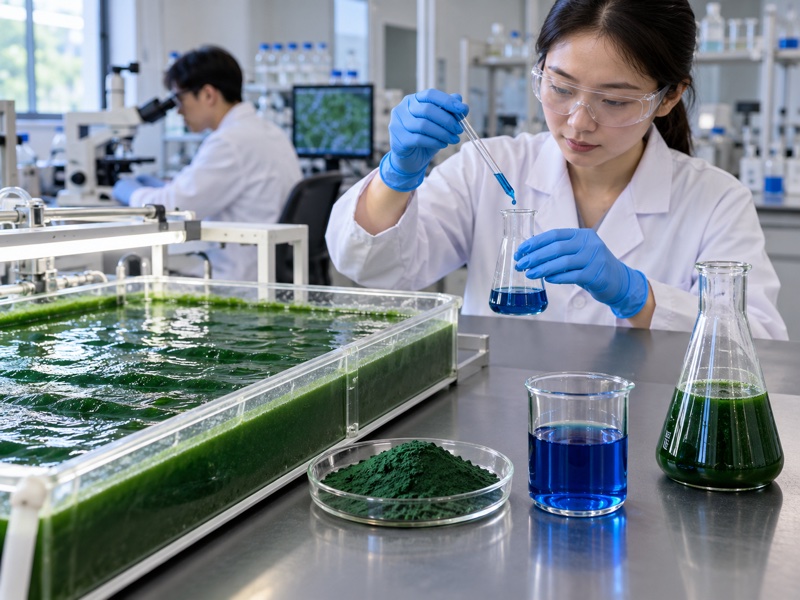
No, blue spirulina is not a botanical plant with stems and leaves. Spirulina is the common food-market name for cultivated Arthrospira, a type of cyanobacterium. It grows as microscopic filaments in water under controlled conditions. The blue powder sold for food color is usually an extract from that biomass, not a naturally blue leaf. The distinction matters when a label or sales sheet makes claims about origin.
Why does the name confuse buyers?
Food marketing often uses “algae” or “plant-based” for ingredients from aquatic sources. A review of Arthrospira cultivation gives the biological context. The what-is-blue-spirulina article explains the commercial blue ingredient. A plant-based diet may still include spirulina-derived food under a brand’s definition, but biological classification should be stated accurately. Ask the supplier to name the organism and form in its specification.
| Term | More precise meaning |
|---|---|
| “Blue spirulina plant” | Search shorthand |
| Arthrospira | Cultivated cyanobacterial source |
| Blue extract | Processed color fraction |
The source is microscopic, not a blue garden plant.
2. Why is the living biomass green?
The biomass looks green because it contains several pigments, including chlorophyll, alongside blue phycocyanin. Drying the whole material keeps these components together. That is why whole spirulina powder often makes a drink green or teal rather than bright blue. Processing can separate a blue-rich fraction. A buyer should decide whether the product needs whole biomass or a clean blue color before ordering.
How can you compare the two forms?
Place measured samples of whole powder and blue extract in the same clear base, then compare hue, clarity, flavor, and sediment. The blue versus green guide covers the differences. Do not use equal spoonfuls as a cost comparison because the intended use levels differ. A whole-powder nutrition claim cannot be copied onto the extract. Keep separate item codes in a food factory.
| Product | Typical role |
|---|---|
| Whole dried biomass | Nutrition or green color |
| Blue extract | Blue food color |
| Flavored blend | Consumer preparation |
The two products start at the same source but do different jobs.
3. How is Arthrospira cultivated?
Arthrospira is cultivated in controlled water systems where the producer manages the growing environment and harvests biomass. Specific methods differ by facility, and a brochure cannot prove conditions for every lot. Water quality, culture identity, hygiene, and harvesting controls all affect the ingredient that enters processing. Ask for source and site information appropriate to your quality program. The finished blue extract’s quality begins before extraction.
What should a business buyer ask?
Request the source organism, production site, cultivation controls, biomass identity checks, and traceability from harvest to finished lot. The factory page provides background, while a transaction requires documents for the exact product and site. If the seller is an exporter rather than the actual cultivator, map the chain. Do not assume a company-wide certificate covers all facilities. The questions should produce a traceable lot, not a scenic pond photo.
| Cultivation question | Why it matters |
|---|---|
| Source identity | Correct organism |
| Water and hygiene | Quality control |
| Harvest record | Traceability |
| Site documents | Claim verification |
Good source control makes extraction more dependable because a processor can trace each blue lot back to the culture, investigate a deviation quickly, and show a food customer which source records support the finished ingredient.
4. How does a green culture become a blue powder?
Producers separate the water-soluble phycocyanin-rich fraction from prepared biomass, then concentrate and dry or formulate it. The US definition of spirulina extract specifies filtered aqueous extraction of dried Arthrospira platensis biomass. Commercial methods can differ in steps, carriers, and grade. These differences can affect color strength, flavor, solubility, and stability. A sample jar alone cannot tell you how it was made.
What documents explain the transformation?
Ask for a process flow description, ingredient declaration, carrier statement, grade method, and lot COA. The composition guide details the buying implications. A phycocyanin research review explains why extraction and purification choices affect the pigment. Keep the original biomass source linked to the extract lot in traceability records. A clean blue shade is the result of processing, not a separate blue species.
| Stage | Output |
|---|---|
| Cultivation | Biomass |
| Extraction | Soluble blue fraction |
| Concentration | Stronger color system |
| Drying or formulation | Saleable ingredient |
The product specification should describe the final stage.
5. Is blue spirulina the same as wild blue-green algae?
No, cultivated Arthrospira extract should not be treated as identical to every wild-harvested blue-green algae product. They can differ by organism, source, process, and contamination profile. The FDA’s microcystin information discusses risks in products that prominently include wild-harvested AFA. Those findings should not be copied onto every spirulina lot, but they underline the need for appropriate testing. A buyer should verify the exact source and results.
What should the safety file show?
Request identity, lot-specific relevant contaminant and microbiology results, traceability, and agreed limits. The side-effects guide discusses consumer questions without generalizing across all species. A seller’s statement that a product is “natural” is not a safety test. If a lot fails specifications, do not blend it away or hide it in a colored food. The correct response is a quality decision and investigation.
| Source question | Evidence |
|---|---|
| Which organism? | Identity record |
| Where grown? | Traceability |
| Which contaminants? | Lot COA |
| Who processed it? | Site record |
The precise source is more useful than the broad color category.
6. Can spirulina be grown sustainably?
Cultivation may offer sustainability opportunities, but a specific environmental claim needs measured evidence from the actual operation. Water use, energy, drying, packaging, and transport all affect the footprint. A shallow culture photograph does not establish a low-carbon ingredient. Buyers should ask for documented metrics and boundaries if sustainability is part of the brand promise. Compare claims on a consistent basis per kilogram of usable ingredient or per finished serving.
What should a sustainability claim include?
Define the site, time period, life-cycle boundary, calculation method, and whether data were independently checked. The about page can introduce a supplier, but product-level claims need product-level evidence. A blue extract may require additional processing after biomass cultivation. Include that step in any footprint calculation. If evidence is not ready, describe the source and process factually without a numerical environmental promise.
| Claim | Needed boundary |
|---|---|
| Water saving | Source and method |
| Low carbon | Cultivation through delivery |
| Sustainable | Defined measurable criteria |
Sustainability should be measured, not inferred from green color.
7. Does the source determine nutrition?
The source organism does not determine the nutrients in a finished blue product by itself. Whole biomass and extract have different compositions, and an extract used for color may be present at a very small dose. A smoothie may get most of its protein and vitamins from other ingredients. To support a nutrition claim, use product-specific composition and serving-level math. A vivid blue powder should not inherit every nutrient value from whole spirulina.
What should a label reviewer calculate?
Check the exact material, carrier, grams per serving, tested nutrient data, and complete formula. The nutrition overview explains the common confusion. If the blue is added only for shade, say so. A buyer may still value the natural-source color without a nutrient story. Honest role descriptions make labels easier to defend.
| Form | Nutrition question |
|---|---|
| Whole biomass | What does this serving contribute? |
| Blue extract | What remains after extraction and at dose? |
| Finished food | Which ingredients supply nutrients? |
Source is not a shortcut to a nutrition panel.
8. What quality documents should a source claim have?
A source claim should be backed by identity, traceability, product specification, lot COA, and any relevant site or certification records. The legal entity selling the ingredient may differ from the factory that cultivates or extracts it. A claim about one site should not be applied to another site without evidence. Organic status requires valid product and transaction documents, not just a natural source. Agree on these records before approving a label.
How do you read a certificate correctly?
Check the named entity, location, product scope, dates, and shipment link. The natural-label guide separates organic certification from natural origin. If the certificate covers whole biomass but the order is for blue extract, ask whether the extract is included. If a claim cannot be traced to the shipped lot, remove it or wait for evidence. A simple accurate origin statement is better than an unsupported badge.
| Record | What it supports |
|---|---|
| Identity | Organism and material |
| Lot traceability | Source chain |
| Site document | Facility claim |
| Organic transaction | Certified product status |
Every source claim should point to a record.
9. How does the source affect legal labeling?
Legal labeling depends on the actual ingredient and destination market, not a casual “plant” description. In the United States, 21 CFR 73.530 names spirulina extract and lists identity, specifications, and permitted uses. A 2026 amendment noted there was delayed indefinitely. Other markets may use different categories and declaration wording. Give regulatory staff the exact organism, product form, carrier, food category, and use level.
What should the product brief avoid?
Avoid calling a blue extract a leafy vegetable or claiming it is “chemical-free.” The composition guide explains why commercial preparations may contain carriers. Do not imply that a natural source guarantees health benefit or permission in every food. Keep consumer wording clear but technically true. The source story should survive a regulatory review and a customer question.
| Label idea | Check |
|---|---|
| “Spirulina extract” | Exact material and rule |
| “Organic” | Certification chain |
| “Plant-based” | Market and consumer meaning |
| “High protein” | Finished-serving data |
Accurate source language protects the product story.
10. What should a buyer do with this information?
A buyer should specify the cultivated source, distinguish whole biomass from blue extract, and test the exact grade in the finished food. Ask for traceability and quality records, then confirm legal fit in the market. Compare the blue after processing and shelf life, not only in a plain-water sample. If the supplier’s source story is vague, clarify it before placing a production order. A precise source brief helps every later decision.
What belongs in the approval file?
Keep the source identity, supplier and site map, extract specification, lot COA, application trial, and label review. Our team can discuss source and grade details for a commercial project. If a site, carrier, or organism claim changes, reopen the approval. A source story is most useful when quality and production can repeat it. That is how a blue ingredient becomes a reliable part of a food brand.
| Approval item | Evidence |
|---|---|
| Source | Identity and traceability |
| Blue grade | Specification and trial |
| Safety | Lot testing |
| Label | Market review |
Buy the documented source, not the shorthand name.
Frequently Asked Questions
Can I grow a blue spirulina plant at home?
Not like a houseplant. Arthrospira is cultivated as a microscopic water culture under controlled conditions.
What’s the difference between blue and green spirulina?
Green usually describes whole biomass; blue is a separated phycocyanin-rich fraction. They differ in color, flavor, and use.
How do I know where a powder came from?
Ask for organism identity, manufacturer, production site, and lot traceability. A scenic photo is not enough.
Can a blue extract be organic?
Yes, if valid certification covers the exact product and transaction in the relevant market. Natural origin alone is insufficient.
Does a blue color mean more nutrients?
No. Nutrient contribution depends on composition and serving size, not shade.
Conclusion
Blue spirulina begins with cultivated Arthrospira, a cyanobacterium whose green biomass contains a blue pigment that can be extracted. You now know how to check the source, distinguish the product forms, and ask for evidence behind origin and quality claims. If you are sourcing a blue extract for food, contact us with your application and market. We believe a trustworthy natural color starts with a source you can name and trace.