
Spirulina powder sieve integrity means keeping a screen fit for its assigned powder-processing task throughout a batch. A torn mesh can change particle separation and may itself introduce fragments. Buyers need more than a stated mesh size: screen identity, inspections and response to damage show whether the control worked. 21 CFR 117.80 calls for adequate measures against metal or other extraneous material in covered food manufacturing; the exact screen arrangement follows a facility’s hazard analysis and product design.
Contents
- What job does the sieve perform?
- How is a screen selected?
- What should pre-use inspection cover?
- How is a sieve monitored during production?
- What can damage the mesh?
- How should retained material be handled?
- What happens when a break is found?
- Can a sieve replace a metal detector?
- Which records should a buyer request?
- How are recurring failures prevented?
1. What job does the sieve perform?
Name the control before judging its mesh
A powder sieve may remove oversize agglomerates, screen out extraneous pieces or condition material before filling. These are different purposes. A coarse screen can protect a filler while allowing smaller debris through; a finer screen may improve uniformity but clog or break under a heavy load. Ask where the sieve sits in the process and what hazards or quality defects it is expected to catch. Then identify controls after it, such as magnets, visual inspection or metal detection.
Follow the path. Trace powder from dryer, mill and blend through the sieve to its final pack. Note whether any unscreened rework enters after the sieve. The site’s powder mesh-size guide discusses particle-size expectations; an integrity review asks a different question: did the physical screen remain intact while those lots passed through? An operator should be able to state the screen’s assigned purpose without confusing a product texture requirement with a physical-hazard control.
2. How is a screen selected?
Fit aperture and construction to the product
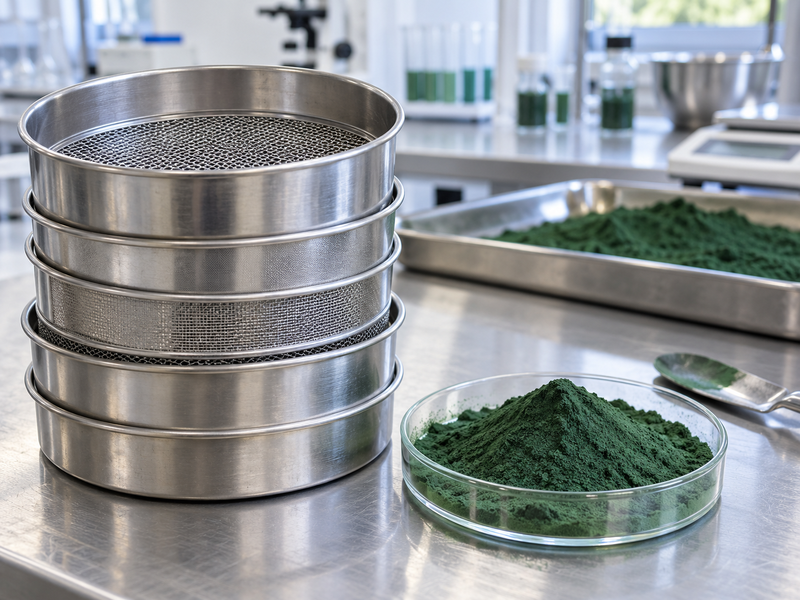
The supplier should specify aperture, wire or perforated-plate material, frame, gasket and equipment position. It should justify the choice against powder flow, clump size, target downstream use and physical-hazard assessment. A screen that chokes at normal throughput invites bypasses and rough cleaning. A loose frame can leak powder around the mesh even when the mesh itself is whole. Equipment touching food must be maintainable and designed to avoid contamination under 21 CFR 117.40 for covered facilities.
Check both routes. Ask how the site proves powder passes through the intended screen rather than around a failed seal. Verify that replacement screens carry a unique identity and approved specification. If the buyer needs a certain particle distribution, request an actual sieve analysis or agreed particle test on the finished lot. Distinguish a quality screen from a safety device in the plant’s documented hazard analysis.
| Selection factor | Evidence | Potential problem |
|---|---|---|
| Aperture | Approved screen specification | Wrong size installed |
| Frame fit | Installation check | Bypass at edge |
| Material | Equipment record | Wear or corrosion |
| Throughput | Trial at normal rate | Blockage and overload |
3. What should pre-use inspection cover?
Inspect the entire assembly
Before a run, inspect mesh or plate for tears, stretched wires, dents and corrosion. Check the frame, clamps, gasket and fasteners for secure fit. Look for retained powder from an earlier lot, missing parts and evidence of unauthorized repair. Use enough light and a method that exposes both sides of the screen. The inspection should be recorded against screen ID and production lot, with an operator and reviewer where the procedure calls for one.
Keep a reference. An approved photograph or physical standard can help staff recognize acceptable wear versus damage requiring replacement. Inspect after cleaning too; a brush or tool can damage fine mesh between runs. If the screen is removed for cleaning, document reinstallation before powder resumes. Do not assume a clean screen is intact, or an intact screen is clean. FDA’s food CGMP overview treats equipment maintenance and sanitation as linked plant practices; both need evidence at the point of use.

4. How is a sieve monitored during production?
Set checks around real failure opportunities
The site should define inspection points based on run length, loading, product behavior and maintenance history. Start-up and end-of-run checks establish useful boundaries. Additional checks may be needed after clearing a blockage, replacing a gasket or changing feed rate. Record production time or batch position alongside each check. If a break appears at the end, that timestamp helps determine which powder requires hold. A vague “checked daily” claim may leave several lots between known-good observations.
Watch throughput. A sudden rise in retained material or a drop in flow can signal a blocked or damaged screen. It is a prompt to stop and inspect, not proof of breakage. Track repeat blockages because they may indicate a mismatch between mesh and powder properties. If the operator opens the housing, document line clearance and restart inspection. Buyers can compare actual logs with the procedure to see whether the intended control operated as written.
| Check point | Record | Scope if failed |
|---|---|---|
| Before start | Screen ID and condition | No product yet processed |
| After blockage | Time and repair | Since last intact check |
| During long run | Batch position | Bounded interval |
| At end | Final integrity | All unbounded output |
5. What can damage the mesh?
Investigate forces and cleaning habits
Overloading, hard agglomerates, loose fasteners, abrasive cleaning tools and incorrect installation can wear or tear a screen. A poorly supported mesh may fatigue during vibration. An unexpected metal piece from upstream equipment can also damage it. Ask whether the supplier records each replacement and investigates unusually short screen life. Replacing a torn mesh without finding its cause may leave the next screen exposed to the same stress. Maintenance records can reveal whether damage clusters after a particular changeover or cleaning shift.
Do not discard evidence. Preserve the broken screen, photograph the defect and check whether any pieces are missing. Compare the damage with retained oversize material and upstream equipment condition. Under 21 CFR 117.40, equipment used for food should be maintained so it does not adulterate food with metal fragments or other contaminants. A buyer can ask for a closure record showing repair, affected-lot evaluation and proof that the cause was addressed, not only a new screen invoice.

6. How should retained material be handled?
Treat rejects as information
Oversize material may be harmless clumps, undissolved agglomerates, screen debris or foreign objects. Operators should collect it in a controlled container, identify its lot and inspect it under a defined procedure. Do not pour it back into a blender simply because most of it looks green. If rework is permitted, document the assessment, treatment and new lot link. A sudden change in reject amount may indicate milling drift or a blocked screen.
Use the evidence. Categorize routine clumps separately from glass, plastic, metal or unknown material. Record location and time if possible. A pattern of gasket fragments in rejects points to equipment wear; repeated hard lumps may point to moisture or handling. The site’s caking-prevention guide gives context for powder agglomeration, but the sieve log must still identify any foreign material. Buyers should ask what was found in an actual reject container and how the plant prevented its return to saleable powder.
| Retained item | Immediate action | Follow-up |
|---|---|---|
| Soft powder lump | Segregate and assess | Review milling or moisture |
| Gasket piece | Hold suspect interval | Inspect assembly |
| Metal fragment | Protect product | Trace source and detectors |
| Unknown object | Preserve sample | Identify before disposition |
7. What happens when a break is found?
Bound the product and account for fragments
Stop feed, isolate the screen and hold powder processed since the last documented intact check. Expand the scope if records cannot show when damage began. Preserve the component and inspect for missing wires or plate pieces. Check retained material, downstream equipment and packed goods before deciding disposition. A metal detector may find some fragments, but its demonstrated sensitivity and product presentation determine what it can detect. Nonmetallic screen or gasket pieces may not register at all.
Reconcile the timeline. Identify every bag, tote and rework stream that passed through the sieve in the suspect interval. If a product was already shipped, involve the supplier’s incident team and buyer quality contact promptly. A new mesh and a passing end test do not establish that earlier powder was free of fragments. Document the investigation, product decision, repair and restart approval. The site’s lot-traceability records should support this forward trace without relying on operator memory.

8. Can a sieve replace a metal detector?
Understand different detection limits
A sieve separates material largely by physical size and its ability to pass through an aperture. A metal detector responds to detectable metal under specified product and package conditions. Either may serve a role in a facility’s hazard-control plan, but neither covers every foreign material. A long thin wire may pass an aperture in some orientations, while a detector’s response depends on metal type, size, position and product effect. The plant should document why its combination of controls addresses the hazards it identified.
Ask for validation. Request evidence that the screen prevents or detects the intended problem under normal throughput and that the detector is challenged using the actual packed product. The FDA’s metal-inclusion guidance for seafood illustrates challenge and verification principles, but its example frequencies are not universal spirulina requirements. A buyer should review the supplier’s own hazard analysis and operating checks. Multiple devices only help if each is maintained, monitored and linked to a product response when it fails.
| Control | Detects or separates | Limitation |
|---|---|---|
| Sieve | Oversize material | Small or aligned pieces may pass |
| Magnet | Magnetic material | Nonmagnetic debris remains |
| Metal detector | Detectable metals | Sensitivity varies with product |
| Visual check | Visible surface defects | Hidden pieces may remain |
9. Which records should a buyer request?
Build a screen-to-lot evidence pack
Request the approved screen specification, asset ID, installation check, pre-use and end checks, retained-material log, maintenance and deviation records. Match those records to a finished powder lot. If several screens operate in parallel, identify which line filled each bag. Ask who can authorize a substitute screen and how a mesh change is evaluated for particle distribution and hazard control.
Test the response. Select one historical breakage or failed inspection and ask which output was held and how it was released or disposed of. If no event is available, walk the site through its written procedure and check whether it can locate bags from an arbitrary production interval. A useful supplier answer states the last good check, affected quantity and authorized disposition. That demonstrates control much more clearly than a blanket assertion that “all powder is sieved.”

10. How are recurring failures prevented?
Fix the load or design that breaks screens
Trend screen life by mesh type, line, product and failure location. Repeated edge tears may suggest frame fit or clamp stress, while central wear may point to feed impact. A supplier should test a specific corrective action against the pattern: revised feed rate, better support, a different approved screen construction or a changed cleaning tool. Recheck product particle requirements and hazard analysis before switching aperture. A stronger screen that silently changes the powder specification is not an acceptable shortcut.
Close with evidence. Compare subsequent screen inspections and reject trends over enough normal runs to see whether the cause recurs. Keep failed parts and the change record where practical. Buyers should ask for the effectiveness check and any affected-lot decision when a supplier reports a screen problem. Spirulina powder sieve integrity is credible when the plant can prove the right screen was installed, remained intact over a bounded lot and triggered a controlled response when it did not.
| Repeated pattern | Candidate cause | Effectiveness check |
|---|---|---|
| Edge tear | Clamp or fit | Inspection after normal runs |
| Central wear | Feed impact | Wear trend at same rate |
| Frequent blockage | Mesh-product mismatch | Throughput and rejects |
| Missing parts | Weak reassembly | Pre-start reconciliation |
FAQ
Q1: Does mesh size prove finished particle size? No. Test the finished powder under an agreed method.
Q2: When should a screen be checked? Set points based on the site’s risk and run pattern, including useful start and end boundaries.
Q3: Can retained clumps be reused? Only after a documented assessment and controlled rework route.
Q4: What if a wire is missing? Hold material since the last intact check and assess possible fragment destinations.
Q5: Is metal detection enough after a tear? No. Assess detector capability, nonmetal parts and the complete affected interval.
Practical next step
Spirulina powder sieve integrity calls for a defined screen purpose, a traceable inspection record and a credible damage response. Ask your supplier to show one shipped lot’s screen ID, start and end checks, and reject log. Review any gap before relying on its particle or foreign-material claims.