
Spirulina powder that leaves the factory free-flowing can arrive as a hard mass that stalls a filling line. Spirulina powder caking prevention starts with moisture condition, then follows humidity exposure through cooling, packing, shipping and use. The FDA’s water-activity guide explains why available moisture and storage conditions matter in dried foods. Buyers need lot-specific evidence rather than a promise that all green powders behave alike.
Contents
- What makes spirulina powder cake?
- How should moisture and water activity be checked?
- What happens between drying and sealing?
- How does the packing-room environment affect powder?
- Which package properties matter most?
- How should seals and liners be verified?
- What should shipping and warehouses control?
- Can flow aids solve the problem?
- How should a buyer test a supplier’s claim?
- What should happen after a caked-lot complaint?
1. What makes spirulina powder cake?
Separate moisture bridges from mechanical compaction
Caking means particles form lumps that resist ordinary flow. For example, moisture uptake can create liquid bridges, change surface behavior or promote stronger bonds during storage. Fine particles may compact under pallet weight and vibration even when a package stays dry. Temperature cycling can move moisture within a package or create local condensation if a warm product is sealed too soon. As a result, these mechanisms require different controls. Ask whether the lump breaks with light pressure, whether the liner is damp and whether caking is strongest near the wall, base or top of a bag.
Start with a map. Then, compare affected and unaffected packs from the same lot, noting pallet position, packaging date and storage route. If only the outermost pallets fail after humid freight, look at package integrity and handling. Uniform failure across bags points toward drying endpoint and powder composition. Dense blocks confined to lower bags may implicate stack pressure and hold time. A study of another algae-based food powder found humidity-dependent caking under its specific conditions; that finding supports testing moisture exposure, not borrowing its numerical limits for spirulina. Build your own mechanism from the actual material and pack evidence.
2. How should moisture and water activity be checked?
Use two measures for different questions
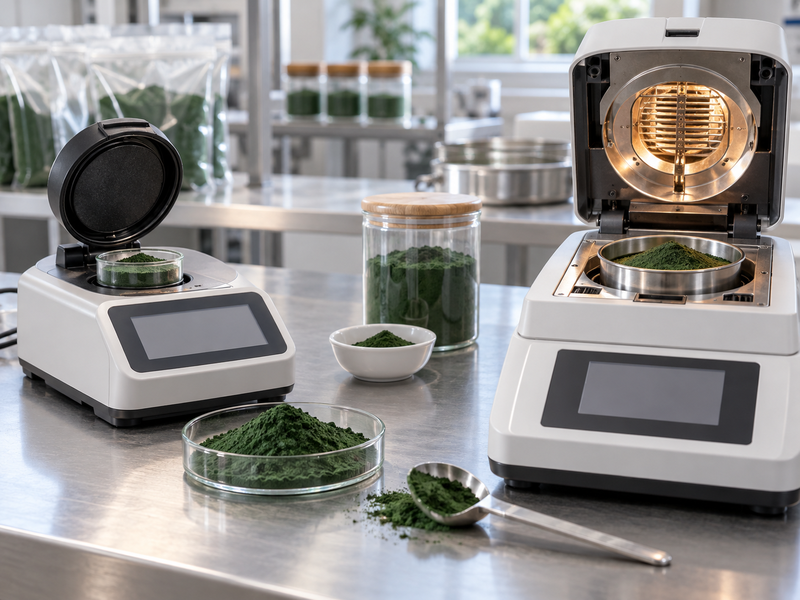
In practice, moisture content measures the amount of water in a sample. Water activity reflects how available that water is at a stated temperature. Even so, two powders with similar moisture percentages can behave differently because composition and particle surfaces bind water differently. As a result, set methods, sample locations and acceptance rules for each measure used in the specification. Compare readings from dryer outlet, packed lot and suspect bags. Calibrate instruments and allow samples to reach the method’s stated temperature before drawing conclusions.
Avoid a universal cutoff. The FDA’s water-activity technical guide explains the relationship between equilibrium humidity and water activity, and notes that drying and storage both matter. It does not give a caking-proof value for every spirulina grade. Develop a sorption and storage profile if the ingredient repeatedly fails. Sample more than one pack; a leaking liner can create a local high value that a batch composite misses. Record whether a result represents product at release or after transit. A supplier COA value from a pre-pack sample cannot by itself describe conditions inside every delivered bag.
| Measurement | Answers | Limitation |
|---|---|---|
| Moisture content | Total water present | Not direct availability |
| Water activity | Moisture availability | Temperature dependent |
| Sieve/flow test | Lump and flow behavior | Method sensitive |
| Pack inspection | Exposure pathway | May miss pinholes |
3. What happens between drying and sealing?
Control the unprotected interval
Next, freshly dried spirulina can enter a cooler, mill, sieve, hold bin and packing hopper before sealing. Record each transfer, equipment condition and time spent exposed. However, a long hold in an open bin may erase the benefit of a well-controlled dryer. If powder is still warm, cooling should occur under controlled conditions so ambient moisture does not condense on product or equipment. Define a maximum hold time or an environmental trigger based on process trials. Protect intermediate containers with properly fitted closures and clear lot labels.
Watch the night shift. A batch may finish drying near the end of a shift and wait for morning packing. That delay should appear in the record with storage conditions and a decision on whether fresh testing is needed. Then, compare bags filled at start and end of the packing run. If caking is limited to early bags, a hopper heel or uncooled powder may be involved. If later bags fail, rising humidity or prolonged exposure could matter. The FDA CGMP overview describes sanitary operations and production controls in the U.S. context. A plant should translate those broad duties into a specific, logged powder-handling process.
4. How does the packing-room environment affect powder?
Measure exposure where bags are actually filled
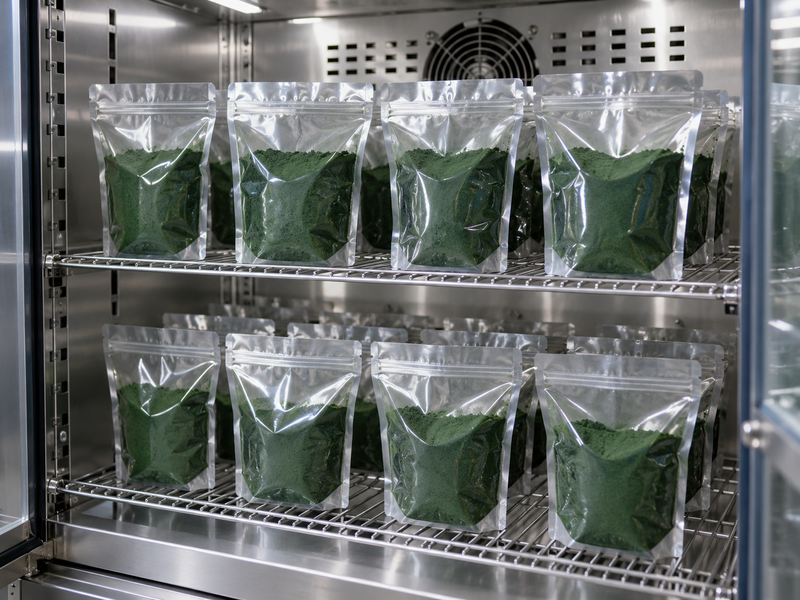
Meanwhile, packing-room humidity, temperature and air movement can change the powder’s condition during filling. For example, a sensor across the room may not reflect air near the hopper or open bags. As a result, log conditions at relevant points and record door openings, cleaning events and downtime. If wet cleaning occurs, allow surfaces to dry under a documented release check before powder work begins. Test an environment limit against product behavior rather than selecting a convenient round number. When weather changes, compare the same powder on different days to identify a handling effect.
Follow the open bag. A slow fill line leaves each bag exposed longer. Staff may pause to change film, adjust weights or clear a jam while powder remains in the feed system. Define how long exposed powder can wait and who decides on recheck after a lengthy stop. Personal protective and sanitation procedures must also prevent contamination; reducing humidity cannot justify unsafe housekeeping. If a supplier reports “air-conditioned packing,” ask for the logged conditions and deviations from actual runs. A controlled room is a measurable process feature, not a photograph of equipment. The buyer can review representative trend data without demanding proprietary HVAC schematics.
| Environment point | Observe | Response trigger |
|---|---|---|
| Hopper opening | Air humidity | Cover or pause |
| Bag mouth | Exposure duration | Recheck held powder |
| Post-clean room | Surface dryness | Release line |
| Film change | Stop duration | Document restart |
5. Which package properties matter most?
Compare barrier, geometry and use
For example, a liner’s moisture-vapor barrier, thickness, fit and closure influence how much humidity reaches powder during storage. However, the outer carton protects against handling damage but may not be the primary moisture barrier. Ask for material specification, test conditions and the finished-pack design, including welds, closures and any reclosure after sampling. A nominally high-barrier film cannot protect a bag with a small unsealed channel. Powder packed in large bulk sacks may also compact under its own weight more than small retail pouches.
Test the actual shipment. A supplier can show film data from a flat sheet, but performance in filled, folded and palletized packs may differ. Then, include simulated handling or real transport in a package trial. Inspect corners, seam intersections and puncture points after the trial. Confirm that the liner material is suitable for food contact in the sales market. If a desiccant is proposed, check its lawful use, containment and effect across the full pack; it is not a substitute for an intact barrier. State the intended storage life and opening pattern. A buyer that repeatedly opens a bulk bag should evaluate in-use protection as well as sealed transit.
6. How should seals and liners be verified?
Sample across starts, stops and changes
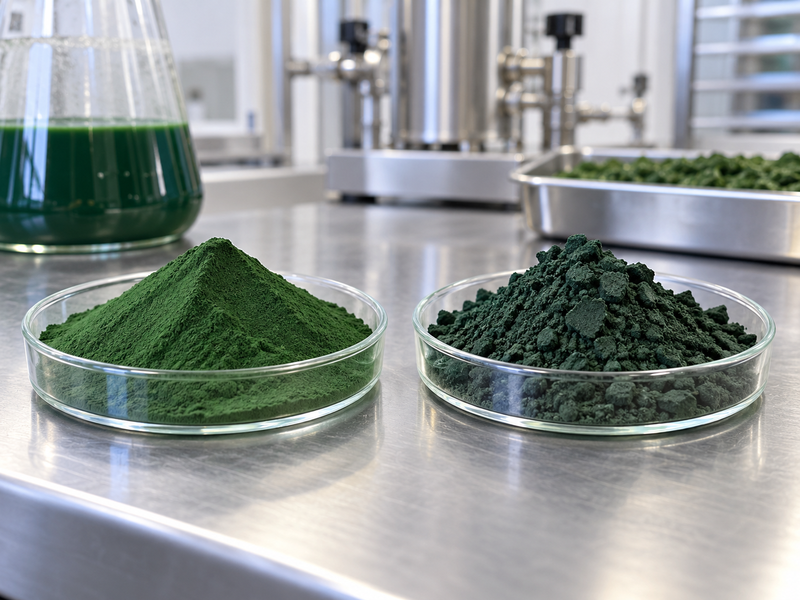
Next, define seal width, appearance and an appropriate integrity test for the liner. Also, check at line start, after film changes, after setting changes and at regular intervals. A heated sealer can drift as parts wear or material thickness changes. Record settings and rejected packs. Inspect seals without relying solely on a distant camera view. A colored powder trace near a seal might indicate product trapped in the weld and warrants investigation. Keep sample packs from a qualification run for transport testing.
A tiny leak can affect one bag. That is why a batch-average moisture result cannot rule out package failure in a particular complaint. Then, test suspect and unaffected bags, then compare seam condition and water activity. If a liner was opened for sampling and resealed manually, record that operation and do not confuse it with original line quality. Maintain lot identity on both inner and outer packaging. The FDA’s food CGMP resources place packaging and process controls within a wider food-safety system. For caking control, translate that into a tested closure procedure and a clear response whenever a check fails.
| Seal check | Timing | Evidence |
|---|---|---|
| Visual inspection | Start and routine | Signed log |
| Integrity test | Qualified frequency | Result by pack lot |
| Film change check | After changeover | New sample |
| Complaint comparison | Suspect and control | Photographs and test |
7. What should shipping and warehouses control?
Keep dry goods dry after release
Also, the supplier and buyer should agree storage temperature, relative humidity, pallet configuration, stack height and protection from wet floors. Monitor conditions in warehouses and consider condensation risk during transitions between hot and cool environments. Next, inspect containers before loading for water damage, odor and puncture hazards. Use intact pallets and protect liners from sharp edges. Record dispatch date and lot so a weather-related or route-specific complaint can be scoped quickly. A dry COA on the factory date does not describe a damp container weeks later.
Look beyond arrival. For example, a buyer might hold powder near a washdown area or open bulk bags without reclosure. Define in-use controls: keep the bag sealed between withdrawals, use dry tools and return it to a suitable location. Check whether powder spends hours in a humid filling room before use. Compare samples from unopened and repeatedly opened bags if caking begins only after receipt. The FDA water-activity guide notes that a dried product’s water activity must be maintained during storage. That principle applies throughout custody, not only inside the original factory.
8. Can flow aids solve the problem?
Evaluate any additive as a formula change
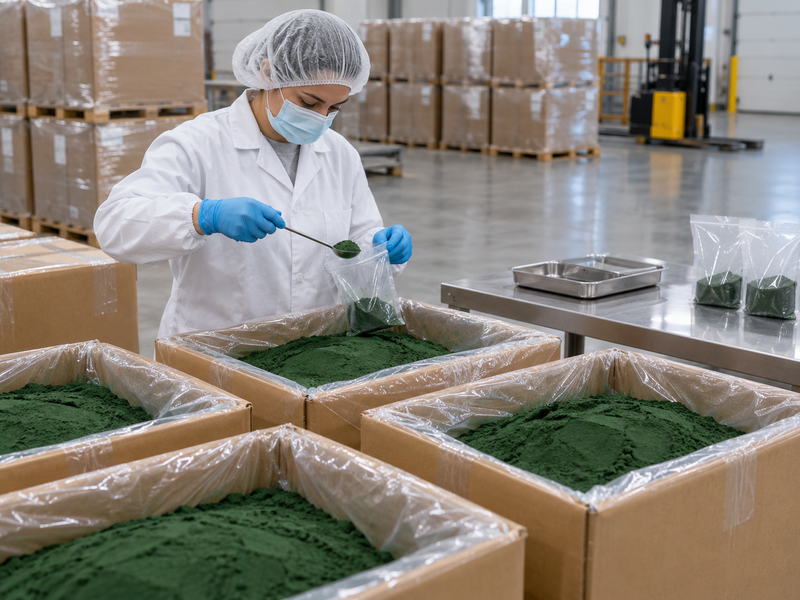
However, an anti-caking agent changes ingredient composition, label declaration and possibly the buyer’s product claims. Check market permission, food grade, dosing accuracy and effect in the final application. It cannot repair a leaking liner or wet intermediate. Then, run paired trials using the same spirulina lot and packaging, then compare flow, color, flavor and storage behavior. If the buyer requested pure spirulina powder, obtain approval before adding a carrier or flow aid. Do not hide it inside a vague “processing” description.
Try process controls before additives. Drying endpoint, protected cooling, shorter open hold and sound barrier packaging may address the actual cause. A research article on algae-food powder storage discusses humidity and caking for a different algae species; it does not prove a particular additive works in spirulina. If a flow aid is selected, set its own specification and uniformity checks. Test the material in the buyer’s real equipment, because a powder that pours from a jar may still bridge in a production hopper. Evaluate whether the intervention stays effective after transport and repeated bag opening.
| Option | Best question | Caution |
|---|---|---|
| Better drying control | Is product too wet? | Avoid heat damage |
| Barrier liner | Is moisture entering? | Check real seals |
| Lower humidity | Is open exposure high? | Log actual location |
| Flow aid | Is formula change acceptable? | Label and legal review |
9. How should a buyer test a supplier’s claim?
Ask for a matched-lot storage trial
Next, request the supplier’s water-activity and moisture method, release data, packaging specification and complaint history for the offered grade. Then run a trial with commercial packs, representative pallet stacking and intended storage conditions. Include a control pack held in stable laboratory conditions and a shipment sample. Then, measure flow or caking using a stated method, such as a defined sieve or force-to-break test. Photographs can supplement results if lighting and sample handling stay consistent. Compare more than one bag because localized seal defects will not appear in a single retained sample.
Make acceptance usable. Agree whether the powder must pour freely, break under a defined gentle action or feed a specific hopper without blockage. Record the opening procedure and number of handling cycles. Test through the proposed storage period; an immediate post-pack check is not enough. Also, a pilot at your own plant can expose issues with local humidity or equipment that a supplier trial misses. If the product cakes, isolate whether the cause sits in powder condition, pack integrity or receiving practice. The best supplier claim is supported by records for the actual grade, pack and shipping route, not a general statement about dry algae.
10. What should happen after a caked-lot complaint?
Hold stock and reconstruct exposure
Next, record supplier lot, pack code, pallet position, receipt date, warehouse conditions and date of opening. Keep suspect bags with their liners and photograph the lump pattern before breaking it. Then, compare moisture, water activity and seal integrity against unopened control packs. Review dryer, cooling, packing-room, film and shipment records. If food safety might be affected, follow the relevant hazard and disposition procedure rather than treating the issue only as poor flow. Preserve original lab results and any retests in the investigation file.
Close the loop with evidence. Still, a supplier may replace stock, but the buyer still needs a cause and a preventive change if recurrence is possible. Trial the revised drying, handling or packaging control on later lots and monitor complaints. Do not widen the shelf-life claim until the corrected package has completed a suitable storage test. Spirulina powder caking prevention depends on a chain of controlled moisture exposures. Ask your supplier to show that chain, then test a commercial pack under the conditions your own operation will impose.
| Complaint evidence | Interpretation question | Next step |
|---|---|---|
| Wet liner | Did seal leak? | Package investigation |
| Uniform hard mass | Was powder too wet? | Process review |
| Bottom-only block | Did pressure contribute? | Stack trial |
| Open-bag failure | Was in-use storage controlled? | Buyer handling review |
FAQ
Q1: Is low moisture content enough to prevent caking? No. Water activity, exposure, particle properties and pack integrity also matter.
Q2: Can a passing factory COA rule out a transit problem? No. It describes a tested sample at a particular time, not every bag after shipping.
Q3: Should a supplier add an anti-caking agent without notice? No. It is a formulation and label change requiring buyer and regulatory review.
Q4: Can humidity alone explain every hard lump? No. Compaction, temperature cycles and particle properties may contribute.
Q5: What should a buyer send with a complaint? Lot and pack codes, photos, storage history, unopened samples and a clear description of the failure.