
A spirulina powder mesh size guide should help buyers translate sieve claims into manufacturing performance. “Fine” and “80 mesh” can sound precise while hiding test method, particle distribution and agglomerates.
A useful specification states the aperture and fraction that passes under a defined procedure, then checks flow, dust and dispersion in the intended process. ISO 3310-1 defines technical requirements for metal-wire test sieves; the standard does not tell a food brand which spirulina grade will work in its recipe.
Contents: 1 · 2 · 3 · 4 · 5 · 6 · 7 · 8 · 9 · 10
1. What does a mesh claim actually describe?
Ask for aperture and pass criterion
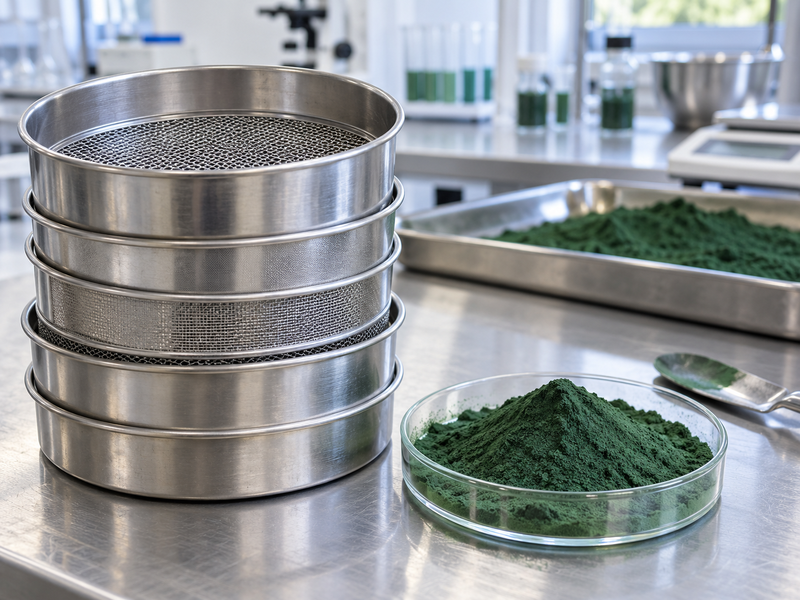
Mesh numbering refers to a screen arrangement, while the practical opening depends on the sieve standard and wire construction. A claim such as “passes 80 mesh” is incomplete unless the supplier states the actual aperture, test method and percentage passing.
The NIST particle-size guide explains how sieving reports retained or cumulative mass across screens. Start here: request the physical aperture in micrometers rather than guessing what a sales label means.
Also ask whether the result was measured before or after milling, blending or transport. A powder can clump during humid storage and fail a later sieve even if primary particles are fine. A sieve result tells you about material passing a defined opening under specific conditions; it does not describe every particle or its shape.
Your purchase specification should carry a measurable pass fraction and a sample-handling procedure. Without those details, two suppliers can both claim the same mesh yet deliver powders that behave differently.
| Claim | Missing detail to request | Why it changes meaning |
|---|---|---|
| 80 mesh | Aperture standard | Different openings |
| Fine powder | Measured distribution | Subjective description |
| Passes sieve | Percent and method | No clear limit |
| No lumps | Storage condition | Clumps can reform |
2. Why is a particle-size distribution better than one number?
See fines and coarse tails
Most powders contain a range of particle sizes. A single maximum pass figure can hide many fines, while a mean diameter can hide a small coarse fraction that causes visible specks. Ask for a sieve profile or a suitable instrument-based distribution with method, sample preparation and reporting basis.
The NIST guide describes why distribution rather than one size is useful for powder characterization.
If a supplier reports D10, D50 and D90, ask whether measurement was dry or dispersed and how agglomerates were handled. Those values are not directly equivalent to a sieve pass fraction. Here is the buyer’s choice: define the method that corresponds to your failure mode. A coarse tail matters when a drink looks gritty.
Excessive fines matter when a filling line generates dust or powder sticks. Keep a reference sample and compare several lots before writing narrow limits that the production process cannot consistently hold.
3. How does size affect wetting and dispersion?
Test the powder in your liquid
Small particles offer more surface area but can form stubborn floating rafts when added poorly. Larger agglomerates may wet quickly because liquid penetrates their porous structure, even though their measured median size is greater.
A primary Spirulina agglomeration study measured particle size, flow and wetting after fluidized-bed processing; its outcomes show that process history influences dispersion. It does not provide a universal target size for beverages.
Run a simple timed test at the intended dose, liquid temperature and mixer speed. Record time to wet, visible lumps, sediment and color uniformity. Do not confuse terms: whole spirulina biomass disperses as particles; it need not dissolve like a soluble extract.
If the label promises a smooth drink, the final texture test matters more than a mesh number. Compare samples after shipping and storage, because clumping can change performance. A supplier may improve wetting by agglomeration or formulation, so verify ingredient composition before assuming a whole-biomass powder is unchanged.

| End use | Observe | Possible size concern |
|---|---|---|
| Drink mix | Wetting and sediment | Rafts or grit |
| Smoothie | Texture after blending | Coarse specks |
| Dry premix | Distribution | Segregation |
| Tablet | Die fill | Poor flow |
4. What changes in dry blending when powder gets finer?
Compare the entire blend
Fine particles may adhere to equipment or behave differently from larger ingredients in a premix. Coarse particles can segregate during vibration, filling or transport. The result depends on density, shape, moisture and mixing order as well as size. Ask for a trial in the actual blend rather than relying on a generic “fine powder mixes well” claim.
A useful pilot: sample from several points in the mixer and at the start, middle and end of filling.
Use a measurable marker if the spirulina fraction cannot be assessed visually. Record blend time, fill-weight variation, dust generation and cleaning burden. If another ingredient is granular, a very fine spirulina powder may coat its surface rather than distribute as expected. Conversely, matched particle ranges may improve consistency in some systems. Avoid inventing a universal relation.
A primary agglomeration study found process-linked changes in flow, reinforcing that particle engineering can matter more than the nominal sieve label.
5. Does finer spirulina create more dust?
Treat dust as a handling outcome
Fines can increase airborne material during bag opening, transfer and filling, but equipment enclosure, humidity and powder cohesion also affect exposure. Ask the manufacturer how it measures or controls fines and whether its packaging minimizes breakage in transit. On your own line, observe dust at the receiving hopper and filler under normal operation.
The cost may be hidden: airborne powder means loss, cleaning time and potential cross-contact, even if the purchase price looks favorable.
Do not equate a coarse sieve cut with low dust automatically. A broad distribution may contain many fines while still passing a coarse screen. Request a distribution or a controlled handling trial. If the powder is agglomerated, verify whether agglomerates survive shipping.
A delivery shaken through several handling steps can produce a different fines profile from a fresh factory sample. Define acceptable performance in the actual pack and route. A packaging specification should record closure, fill weight and lot code alongside any dust-related requirement.
| Dust checkpoint | What to record | Buyer action |
|---|---|---|
| Bag opening | Visible release | Compare pack formats |
| Hopper loading | Loss and cleaning | Review enclosure |
| Filling | Weight variation | Adjust feed settings |
| Delivery | Fines after transit | Retest received pack |
6. How does particle size affect tablet production?
Watch flow and compression together
Tablet lines need consistent die filling and adequate compact strength. Very fine, cohesive powder may flow poorly; larger agglomerates may fill more predictably but change compression or disintegration. Particle size alone cannot predict all of these outcomes. Ask for bulk density, flow data and a pilot run with your formulation and tooling. The decision is on the tablet: check weight variation, appearance, hardness, friability and disintegration under the relevant product protocol.
The USP analytical sieving notice confirms that sieving has a defined analytical procedure; it does not turn a sieve pass into a tablet performance guarantee. Record whether the proposed grade contains processing aids or whether granulation will be added later.
A change in milling or drying can alter flow even if the species and advertised mesh remain constant. Compare lot trends and require change notification before commercial scale-up.
7. What should a mesh-size test method specify?
Make the measurement repeatable
Specify sieve standard, nominal aperture, sample mass, conditioning, test duration, shaking method, endpoint and how retained fractions are weighed. If powder sticks to the screen, document whether brushing is allowed. The ISO test-sieve standard addresses sieve construction, while a laboratory procedure must describe how the supplier uses it. A result without method is a label: it cannot resolve a dispute between two labs.
For laser diffraction or another instrument, specify dispersion conditions and whether values are volume or number based. State the report units. Sampling matters just as much as measurement: draw from representative packs, seal material promptly and avoid moisture exposure. An average from a single top scoop may miss segregation.
Ask for individual replicate results and a rule for outliers. Keep the method identifier on each COA so later changes are visible to receiving quality staff.

| Method item | Required entry |
|---|---|
| Sieve | Standard and aperture in micrometers |
| Sample | Mass, source and conditioning |
| Procedure | Motion, time and endpoint |
| Result | Retained or passing percentage |
8. How should a buyer sample a bulk lot?
Capture variation across packages
Define the lot before sampling. Select packages across the shipment according to a written plan and preserve individual observations if variability is a concern. A composite can estimate an average but may hide one badly clumped bag. Ask whether supplier and buyer will test the same retained reference if results disagree. Keep the chain clear: sample code, package number, date, method and analyst should travel with the result.
Transport and humidity may change apparent size through agglomeration. Test an unopened received pack when evaluating a complaint, not only a laboratory sample sent separately by the supplier. Record seal condition and storage history.
If a sieve test fails but the product works in the formula, the parties still need a documented disposition; change the specification prospectively rather than ignoring the failure. A purchase agreement should name the controlling method and retest procedure before the initial large order.
Add a receiving simulation before setting the final particle limit. Hold sealed sample packs under the planned transport conditions, then compare their sieve profiles with freshly packed references using the same analyst and procedure. Open several packs rather than one, because bag position and vibration can create different fines levels within a shipment.
Record how much powder adheres to the test container and whether the operator must brush a sieve; both actions can change the reported fraction. If results shift after shipping but product performance remains acceptable, discuss a received-goods limit that reflects that reality. If flow or dispersibility also worsens, ask the supplier to review milling, agglomeration and pack cushioning.
The goal is a specification that governs material arriving at your line, not only material leaving the supplier’s laboratory.
9. How can two supplier grades be compared fairly?
Standardize tests before ranking
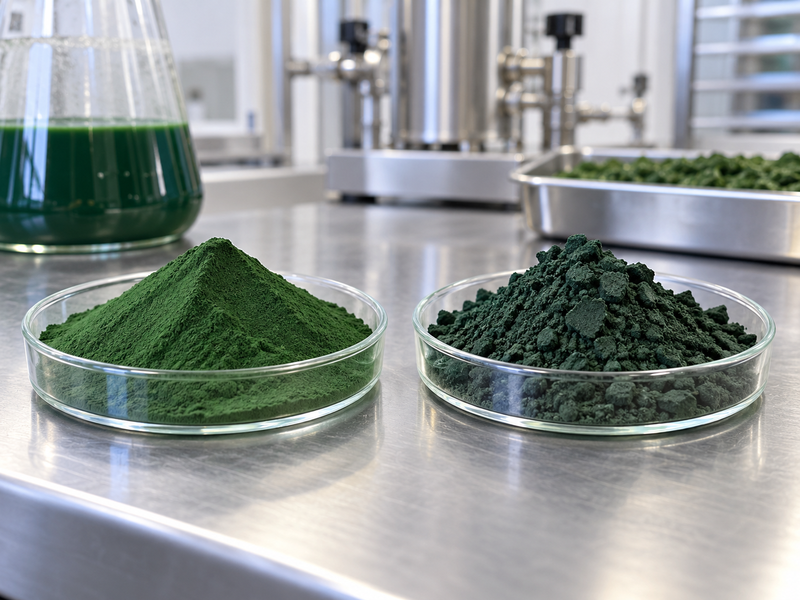
Ask each supplier for a current specification, actual lot distribution, processing history and sealed sample. Retest both in one laboratory if their methods differ. Then run matched trials for flow, dust and product appearance. A key distinction: a numerical distribution may explain a trial result, but the trial determines whether the material fits your process. Keep formulation and handling constant during comparison.
The Spirulina CN site may describe powder grades; treat such descriptions as site claims until current batch documents establish the offered grade’s size and composition. Do not state a universal commercial mesh range without evidence.
A supplier using a larger agglomerated powder may outperform a finer grade in wetting, as the primary agglomeration work illustrates under its conditions. Compare cost per acceptable finished unit after yield loss and additional handling.
| Comparison | Same for both samples | Output |
|---|---|---|
| Lab test | Method and conditioning | Comparable distribution |
| Dry handling | Transfer route | Flow and dust |
| Formula | Dose and mixer | Dispersion and texture |
| Storage | Pack and conditions | Clump stability |
10. When is a mesh specification ready for purchase?
Write limits around verified performance
After pilot trials, choose a method and range that distinguish acceptable material without excluding normal, useful variation. The specification may use a pass fraction, selected distribution percentiles and a functional test. Include sample handling and dispute rules. Finish the loop: check that the supplier’s production lots can meet the proposed limits repeatedly, not just one hand-selected sample.
Notify quality and manufacturing teams that mesh size is only one powder attribute. Moisture, bulk density, odor, color and microbiology also belong in the approval plan. Require notification for milling, sieving, agglomeration or packaging changes.
A good mesh clause allows the receiving team to test a future lot and gives production a powder that behaves like the approved sample. That practical fit is the reason to measure size at all.
FAQ
Q1: Does 80 mesh mean every particle is the same size? No. It describes a sieve condition and needs an aperture, method and passing fraction.
Q2: Is a finer powder always smoother in drinks? Not necessarily; wetting, clumps and sediment depend on processing and formula conditions.
Q3: Can agglomerated powder be larger yet wet faster? Yes, some structures improve liquid penetration; verify the offered grade.
Q4: Should tablets use the finest available powder? Choose from die-fill, compression and finished-tablet results instead.
Q5: What should appear on a COA? The test method, aperture or distribution measure, units, actual lot result and acceptance range.
Specify behavior as well as size
Ask suppliers for the actual particle distribution, run matched handling and application trials, then write a method-bound limit. This gives procurement a measurable clause and gives manufacturing a powder it can use with confidence.