
A green gummy that looks convincing at the bench can feel gritty or bleed moisture after a week in its pouch. Spirulina powder gummy manufacturing trials solve that gap through controlled comparisons of biomass dose, dispersion, gel setting and storage. This guide gives food developers a trial plan and a release conversation for their manufacturing partners. Published spirulina chewing-candy research measured texture and sensory properties across different formulas; those findings support structured testing, not a universal recipe.
Contents
- What belongs in a manufacturing trial brief?
- Which spirulina powder should enter the trial?
- How should powder be added without gritty pockets?
- What dose range should a team screen?
- How do gel systems change the result?
- Where should color and flavor be judged?
- Which process readings matter during a plant run?
- How should finished gummies be sampled?
- What belongs in the stability study?
- What evidence supports commercial approval?
1. What belongs in a manufacturing trial brief?
Name the decision before making samples
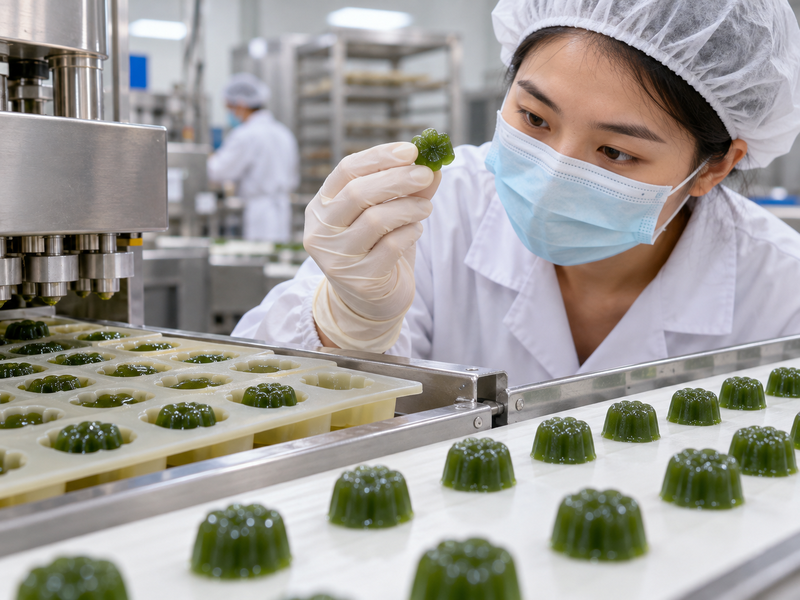
Write a brief that specifies product positioning, target piece mass, intended pack, sensory target and distribution conditions. Say whether spirulina supplies green color, an ingredient declaration or a measurable nutrient contribution. Those aims can pull a formula in different directions. A color-led concept may use less biomass than a nutrition-led concept and cannot be judged with the same sensory expectation. Record the starting recipe as a control.
Set a short list of outcomes: piece-weight variation, texture, visible specks, flavor acceptance, moisture behavior and color after storage. The useful question: which result would make the team reject a formula? Decide that before tasting attractive prototypes. The supplier should send a current specification and representative lot; production should document its kettle, depositing head and curing setup. Trial notes then explain any difference between the bench method and factory conditions.
2. Which spirulina powder should enter the trial?
Match the sample to purchasable supply
Use an approved food-grade whole-biomass powder, not a blue phycocyanin extract. Ask for species identification, particle-size description, moisture or water-activity result, microbiological data, contaminant testing and packaging details appropriate for the intended market. Different drying and milling histories can affect odor, hue and how quickly particles wet. An exceptionally fresh laboratory sample may misrepresent normal commercial inventory. Pull material from a traceable lot and reserve enough for repeat trials. Compare its certificate and appearance against the supplier’s powder color and odor specification approach.
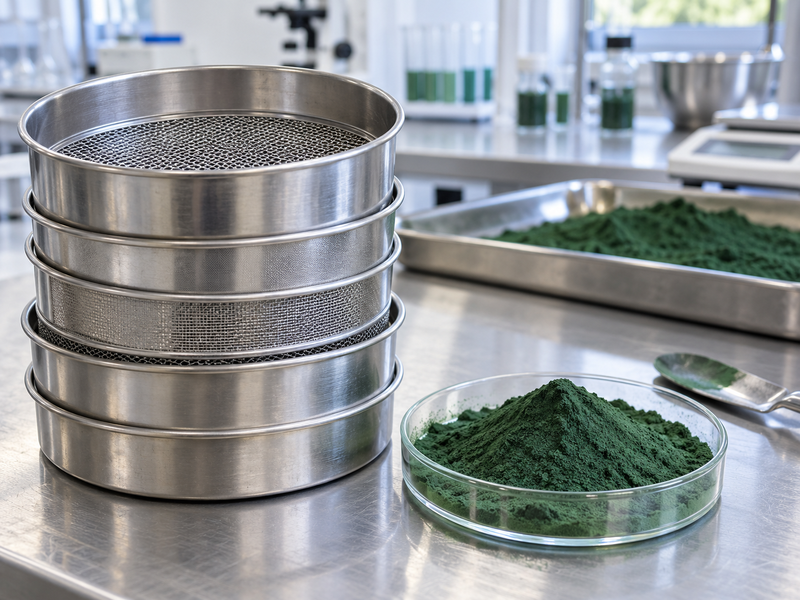
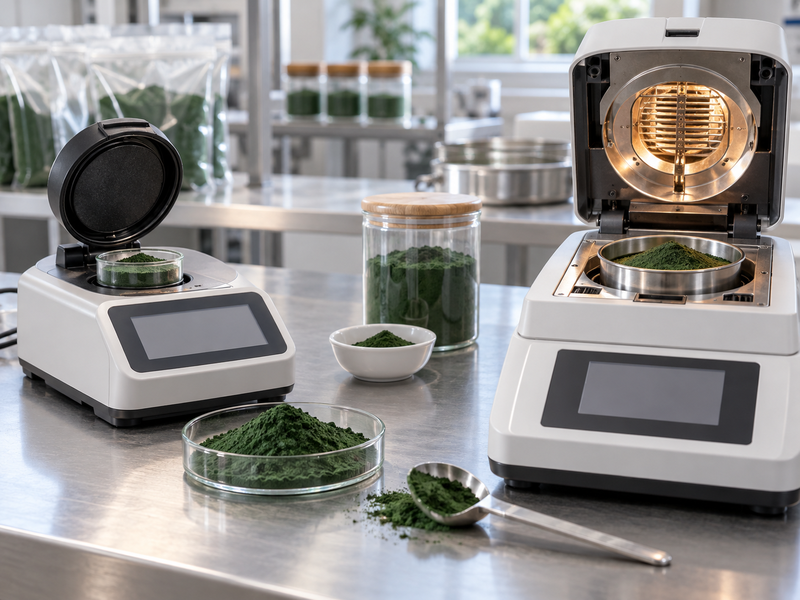
Keep one boundary clear: an incoming certificate describes powder, not finished gummy performance. Log storage after opening, sieve condition and pre-weighing time because warm or humid handling can change flow. If a second supplier is under evaluation, run its powder in the same base formula and processing window.
| Incoming attribute | Trial record | Why it matters |
|---|---|---|
| Lot and pack | Seal, date, lot code | Links results to supply |
| Particle size | Supplier method and sieve check | Helps interpret specking |
| Color and odor | Standardized comparison | Detects obvious drift |
| Moisture status | COA and storage log | Supports flow and stability review |
For repeat orders, ask the supplier to identify which changes require notice: drying site, milling method, target particle distribution, carrier addition or packaging material. Record this in the approved ingredient specification, then compare each new receipt with a retained reference under the same light and sampling method. A material can meet broad safety and composition limits while giving a visibly different gummy. If a second lot behaves differently, repeat the same small dispersion test before changing the recipe.
Record whether the difference appears in dry powder, preblend or cured piece; that sequence makes a supplier discussion much more precise.
3. How should powder be added without gritty pockets?
Test the wetting step separately
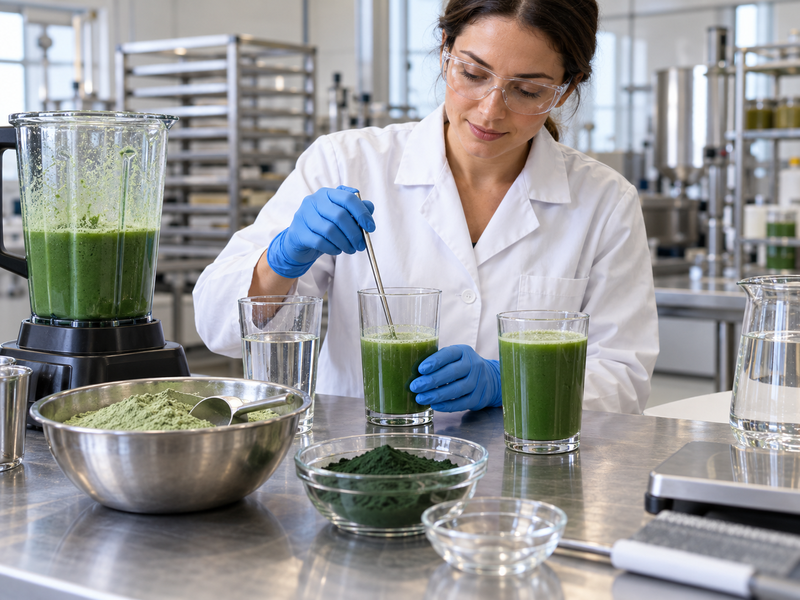
Dry powder dumped onto a viscous syrup may form surface-wet agglomerates with dry centers. Screen a measured preblend in a small portion of compatible liquid or syrup, then introduce it under a defined mixing speed. Record liquid ratio, mixing time, temperature and hold time; inspect a thin smear for unwetted particles. A high-shear pass may improve dispersion but can also entrain air or shift viscosity, so compare the depositability of each method.
Watch the transfer: uniformity in a bench beaker does not prove uniformity at the depositor. Take samples from the kettle top, bottom and final deposited pieces. For a more systematic wetting screen, the site’s smoothie powder premix guide describes similar powder-handling questions, though gummy syrup requires its own validation. Keep water additions in the mass balance; extra liquid can prolong curing or change texture.
4. What dose range should a team screen?
Build a dose ladder around a control
Select several practical doses that span the desired color or declaration target, with a no-spirulina control. Do not borrow a percentage from a different gummy recipe as a production limit. Sugar system, acidity, fruit solids, piece size and flavor all alter perception. Weigh powder against total batch mass and record any replacement of other dry solids; otherwise solids and texture move with dose. Normalize the comparison by finished piece mass, not kettle input alone.
Here is the decision point: if the lowest dose misses the brand objective while the highest brings grassy flavor, an intermediate formula or different flavor system may be more useful than simply increasing pigment. Research on spirulina gummy reformulation discusses matrix interactions and sensory effects; treat its formulations as examples, not a specification for your line. Retain coded samples for a blind internal review.
| Trial arm | Variable held steady | Decision to record |
|---|---|---|
| Control | Base recipe and process | Baseline color and texture |
| Low dose | Same base solids | Minimum visible contribution |
| Mid dose | Same base solids | Sensory tradeoff |
| High dose | Same base solids | Upper practical boundary |
5. How do gel systems change the result?
Compare set behavior in the chosen matrix
Gelatin, pectin and agar create different processing windows and bite profiles. Spirulina powder also contributes solid particles and proteins, so a change in gel recipe can hide or expose its effects. Evaluate the ingredient in the exact gel system the brand plans to sell. With pectin, document acid addition and deposit timing. In gelatin systems, track cooling and bloom-related handling. For agar, follow heating and setting behavior. Avoid presenting one method as universally superior.
The practical trap: a formula can deposit smoothly but set too hard after moisture equilibrates. Measure texture after the usual cure and again after packaging. The published chewing-candy study compared agar and gelatin systems and measured hardness. Its result is a prompt to test both when commercially relevant, not proof that either will behave identically in your sugar and fruit matrix.
6. Where should color and flavor be judged?
Judge a cross-section and a full serving
Inspect whole pieces, cut faces and a serving portion under consistent lighting. A dark surface can conceal pale centers, while an attractive single piece may become visually heavy in a pouch. Use controlled photographs or instrumental color readings with a defined background and illuminant. For flavor, blind-code samples and ask panelists about algae note, fruit balance, aftertaste and chew; record both scores and free comments. Do not skip timing: taste at demolding, after cure and at planned shelf-life points.
Heating, acidity and oxygen may change pigment appearance and aroma over time. Distinguish whole green biomass from purified blue extract when selecting research. A blue extract stability result does not describe the full chlorophyll and carotenoid profile of green powder. If color changes, compare ingredients, batch conditions and package exposure before blaming only the powder lot.
| Observation | Sampling location | Interpretation question |
|---|---|---|
| Surface hue | Whole piece | Is the display color acceptable? |
| Core hue | Cut face | Was dispersion even? |
| Speck count | Thin slice | Are particles or clumps visible? |
| Flavor note | Full serving | Does aftertaste limit dose? |
7. Which process readings matter during a plant run?
Connect each number to a quality outcome
Record the powder-addition point, syrup temperature at addition, kettle residence time, mixer setting, solids or Brix where applicable, pH, depositor temperature and piece weight trend. These numbers reveal whether a successful bench batch survived factory timing. A high temperature reading without its duration gives little insight; a pH reading without sampling location may describe an unblended zone. Keep a material balance for powder, slurry and finished pieces. A useful handoff test: take three intervals across the run and compare their color, specking and weight.
If early pieces differ from late pieces, investigate settling, recirculation, evaporative concentration or changing hold time. Document line stops and rework separately. The acceptance window should reflect your process capability and finished specification, not an invented universal spirulina tolerance.
8. How should finished gummies be sampled?
Preserve time and location in the sample code
Collect pieces at startup, steady state and end of run, plus any period after a stop or ingredient refill. Store each set in its intended packaging and a clearly identified evaluation container. Record how many pieces entered each test; a vague “random sample” cannot support a later investigation. Check piece weight, dimensions, surface dryness, texture, visible particles and sensory properties. For color, use the same preparation and lighting each time.
Look beyond the average: a good mean weight can conceal a run of light pieces, while an acceptable mean color can conceal streaks. Photograph outliers with scale and lot code. When a co-packer runs the trial, request raw data and sample locations, not only a pass/fail slide. Reserve a sealed set from the approved run as a comparison standard for the first commercial batch.
| Run phase | Sample set | Main question |
|---|---|---|
| Startup | Initial deposited pieces | Did dosing stabilize? |
| Steady state | Mid-run pieces | Is variation controlled? |
| Restart | After line stop | Did hold time affect color? |
| End | Last pieces | Did settling or concentration occur? |
Treat sampling as a map of possible variation, not a box of random pieces. For each interval, take enough adjacent pieces to inspect deposit-to-deposit variation and another set across the full conveyor width. A feeder or depositor issue may affect one lane only. Mark cavity position where molds allow it. Let pieces reach the specified cure state before texture comparisons, and preserve a separate set immediately after demolding to diagnose later changes.
If a piece fails an appearance check, keep it with nearby passing pieces and the corresponding process record. This local comparison often distinguishes a brief line event from a formula-wide failure.
9. What belongs in the stability study?
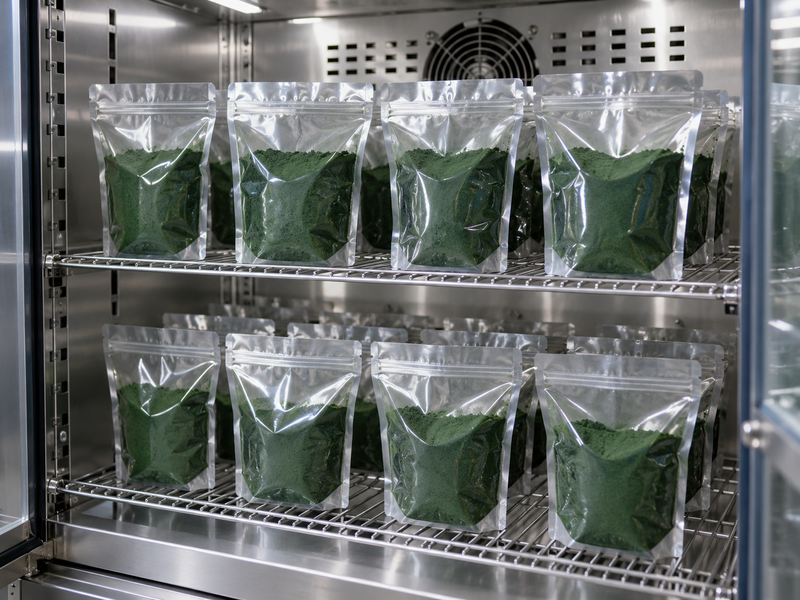
Test the sold pack under realistic exposure
Pack trial pieces in the proposed film or container and evaluate them through the intended distribution period. Include conditions that reflect likely transport and retail exposure, plus an appropriately justified accelerated screen if useful. Monitor moisture movement, sticking, bloom or sweating, texture, color, flavor and microbiological quality under a documented sampling plan. Measure package seal integrity when leakage or humidity exchange could explain drift. The subtle failure: a gummy may pass at day one while losing color or becoming tacky after temperature cycling.
Record exposure history with every sample, not just its age. If a change appears, compare an unopened retained pack with a repeatedly opened evaluation pack. Use the supplier’s powder shelf-life testing discussion for incoming-material questions, but qualify finished-gummy shelf life from the actual formula and pack.
10. What evidence supports commercial approval?
Close the trial with a controlled transfer packet
Approve a formula only after linking its powder lot, full recipe, processing record, finished tests, sensory decision and stability plan. Specify which variables the production team may adjust without a new qualification trial. Name the target dose and permitted manufacturing range based on actual line data. Define who reviews a future powder-source change or unexpected color result. Make approval reproducible: a new operator should be able to follow the addition step, sampling map and hold rules without relying on a developer’s memory.
The packet should include photographs of accepted pieces and a retained sample location. For procurement, connect this work with the site’s bulk lot sampling protocol so future receipts can be compared with the qualified material. Commercial release remains a business decision supported by measured product performance and applicable market requirements.
| Approval item | Owner | Evidence |
|---|---|---|
| Formula and dose | Product development | Signed recipe revision |
| Process window | Manufacturing | Completed batch record |
| Sensory and color | Quality and brand | Coded panel and images |
| Shelf life | Quality | Study protocol and results |
FAQ
Q1: Can blue spirulina extract replace green powder at the same dose? No. Extract and whole biomass have different composition and color behavior. Start a separate formulation trial.
Q2: Does a fine powder eliminate grittiness? It can reduce visible particles, but agglomeration and gel texture still need testing in finished pieces.
Q3: Should spirulina enter before or after cooking? Trial the addition point against dispersion, process hygiene and color retention. The answer depends on the recipe and line.
Q4: Is one successful pilot batch enough? It supports a transfer decision only when its measurements and representative stability plan cover commercial conditions.
Q5: What should procurement request from the supplier? A traceable commercial sample, current specification, lot COA, test methods and change-notification terms.
Next action
Choose one purchasable powder lot, define a dose ladder and run coded samples through the intended line and pack. Use observed texture, color and shelf-life results to set the commercial window, then keep the approved sample and recipe together.