
A spirulina smoothie powder premix must do more than turn a drink green. Brands face uneven flavor, floating particles and different results when consumers use milk, water or fruit. Define the prepared serving and test it under ordinary use, then connect that experience to lot-linked ingredient and production controls. A published spirulina beverage study found formulation-specific sensory effects; it supports bench trials without supplying a universal winning recipe.
Contents: 1 · 2 · 3 · 4 · 5 · 6 · 7 · 8 · 9 · 10
1. Which smoothie experience is the premix meant to create?
Fix the use case before ingredients
Specify serving size, liquid type, preparation tool and desired texture. A smoothie made in a blender with frozen fruit differs from powder stirred into water. If both uses appear on a pack, test both. Decide whether the premix supplies flavor, body and sweetness or simply contributes spirulina to a consumer’s own recipe. This choice determines how much carrier and flavor material belong in the blend.
Write a target prepared profile: color, aroma, sweetness, thickness, sediment and acceptable preparation time. Use a control without spirulina to separate its effect from the rest of the recipe. Ask a relevant panel to follow draft directions, not an R&D demonstration. A fruit-heavy test can hide defects that appear in plain water. The useful brief: describe what a customer will pour, mix and drink before a supplier proposes ingredients.
2. How should the spirulina level be set?
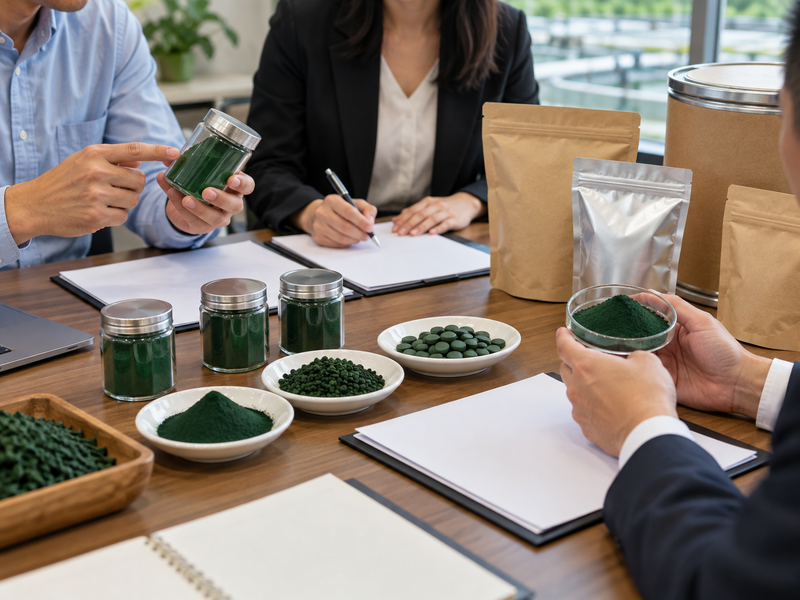
Run a dose ladder in the actual base
Test coded doses with a fixed base formula and serving volume. Evaluate green intensity, odor, flavor aftertaste, mouthfeel and visible settling. Make observations immediately and after the time a consumer might wait before drinking. A study of fermented whey beverages with spirulina reported sensory and structural results at several studied levels. Those values belong to that matrix; a fruit, oat or protein smoothie needs its own trial.
Check whether a proposed nutrient claim is supportable from the finished serving. The amount added to a dry premix is not necessarily the amount consumed when users leave residue in a pouch or blender. When a higher dose harms taste, do not automatically add more sweetener. Consider whether the product concept or serving instruction should change. Estimate ingredient cost per prepared serving using the dose that passes sensory testing. The decision rule: dose follows a defined customer experience and a verified label, not a dramatic sample color.
| Dose outcome | Evidence | Next action |
|---|---|---|
| Good color, harsh flavor | Coded sensory notes | Review base and dose |
| Acceptable taste, weak green | Finished-drink photo | Review visual target |
| Heavy sediment | Timed observation | Review particle system |
| Claim gap | Finished-serving data | Revise claim or serving |
3. Which flavors work with whole spirulina?
Test aroma and taste separately
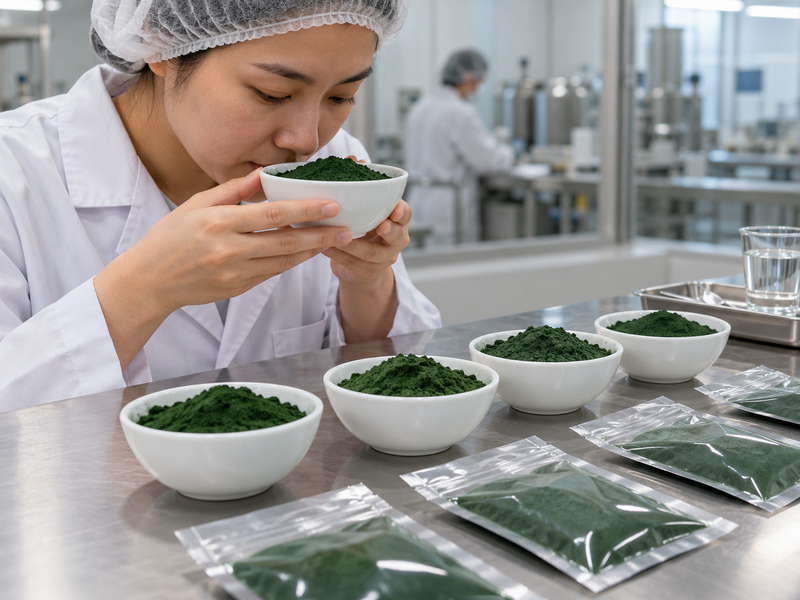
Whole spirulina can bring earthy or marine notes. A sensomics study characterized odor compounds across processing stages, which explains why powder source and process history matter. Fruit acids, cocoa or vanilla may make a balanced drink, but no pairing can be guaranteed from a flavor descriptor alone. Screen flavors with the same spirulina lot and fixed dose. Ask panelists to note immediate taste and the finish after swallowing.
Beware of flavor masking that increases total powder mass or sweetness beyond the product brief. A cocoa route may also darken the drink, changing the role of spirulina color. Berry systems can differ in acidity and background color. Test the premix after storage because aroma from a fresh dry blend can shift. Keep flavor supplier, grade and dosage in trial records. A practical choice: select the profile that stays acceptable in the intended liquid, not the one that wins in a concentrated spoon sample.
4. How do base powders change texture?
Build body without hiding defects
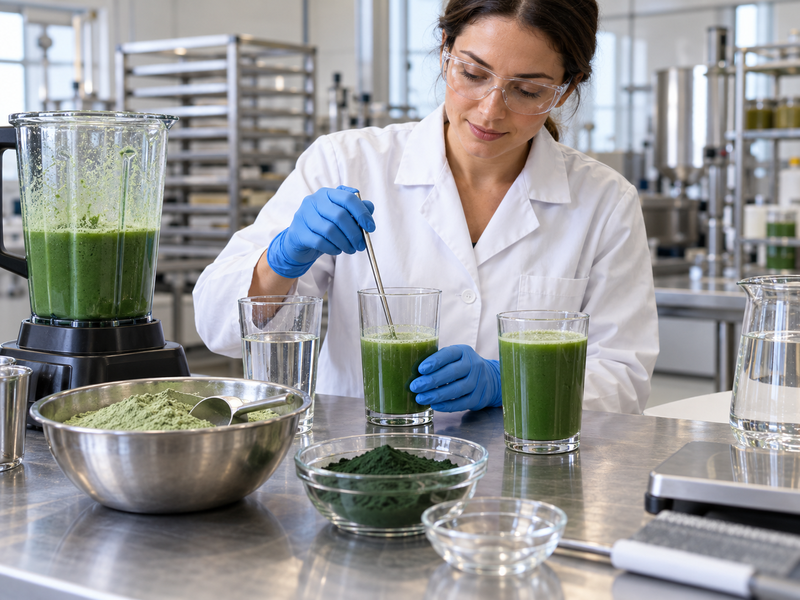
Protein powders, fruit solids, oat ingredients and fibers each affect viscosity, water demand and particle settling. Screen one change at a time, then test promising combinations. A thick drink can suspend spirulina while feeling chalky. A thin drink may taste clean yet leave a green layer at the bottom. Record ingredient particle size and hydration time because two nominally similar powders can behave differently.
Make a standard preparation protocol for R&D: powder mass, liquid mass, liquid temperature, mixing device, mixing duration and reading times. Without it, one panelist’s thick smoothie cannot be compared with another’s diluted sample. Include a commercial ingredient-lot check before freezing the formula. For a US conventional food, 21 CFR Part 117 provides the human-food manufacturing framework, subject to scope and exemptions. The formulation aim: use texture ingredients to meet a measured target, not to cover inconsistent preparation.
| Base material | Possible benefit | Watch for |
|---|---|---|
| Fruit powder | Flavor and color | Moisture pickup |
| Oat material | Body | Thickening over time |
| Protein powder | Nutrition positioning | Chalkiness |
| Fiber | Suspension | Excess viscosity |
5. How should dispersion be tested?
Recreate use rather than claiming solubility
Whole spirulina powder may disperse in a smoothie without dissolving. Measure wetting, surface rafts, lumps, sediment height and appearance at defined times. Test the methods printed on the pack: blender, shaker or spoon. Also test a realistic lower-energy method even if the label prefers a blender, because customers may improvise. Photograph vessels against a fixed background and record the liquid used.
If premix particles separate during dry handling, the drink may vary from scoop to scoop before mixing begins. Check samples from different parts of a retail pouch. Test with cold and room-temperature liquid if both are plausible. Do not solve floaters by simply increasing mixer power if that makes directions unrealistic. Consider powder agglomeration or formula changes only after documenting the failure. What to tell buyers: use “disperses under these directions” only when a repeatable prepared-serving test supports it.
6. What keeps a dry premix uniform in production?
Control mixing and transfer
Set a quantitative formula and a blending order. When spirulina is a small percentage, a reproducible premix can help distribute it before adding the remaining powders. Sample blender zones and the discharge stream, then check finished packs. Visual green color can reveal gross streaking but should not be the only uniformity test. Choose a suitable analytical marker or process-control approach for the formula.
Particle-size and density differences may lead to segregation during conveying or filling. Request bulk and tapped density or other relevant physical measures using stated methods. Compare early and late packs for mass and composition. Track retained powder in equipment and explain any yield loss. A blend that is uniform in the mixing vessel but not in retail units has not met the product goal. The handoff data: mixer loading, time, order, transfer method and sample results belong in one record.
| Stage | Sample | Question |
|---|---|---|
| Premix | Multiple locations | Is spirulina distributed? |
| Final blender | Top and bottom | Are other powders uniform? |
| Transfer | Beginning and end | Does segregation occur? |
| Retail fill | Early and late | Does the consumer get consistency? |
7. How should packaging be chosen?
Match moisture protection and serving style
Single-serve sticks, sachets and multi-serve tubs have different exposure patterns. A tub opens repeatedly and may require a scoop or an instruction based on weight. A stick pack limits repeated opening but adds more seals and package material. Compare clumping, aroma and prepared-drink quality in each intended format. Ask for film or container specifications, closure details and food-contact status for destination markets. FDA describes food-contact substance use conditions for US applications.
Run filled-pack stability, including shipping and consumer opening where relevant. A scoop that picks up moisture can shorten usable life after opening even if an unopened tub passes. Check whether a consumer can remove the full serving from a narrow sachet without residue. Build label instructions from the final pack, not from a laboratory jar. The commercial question: which package preserves the approved drink across ordinary distribution and use?
8. Which shelf-life endpoints should be tracked?
Check both dry powder and prepared drink
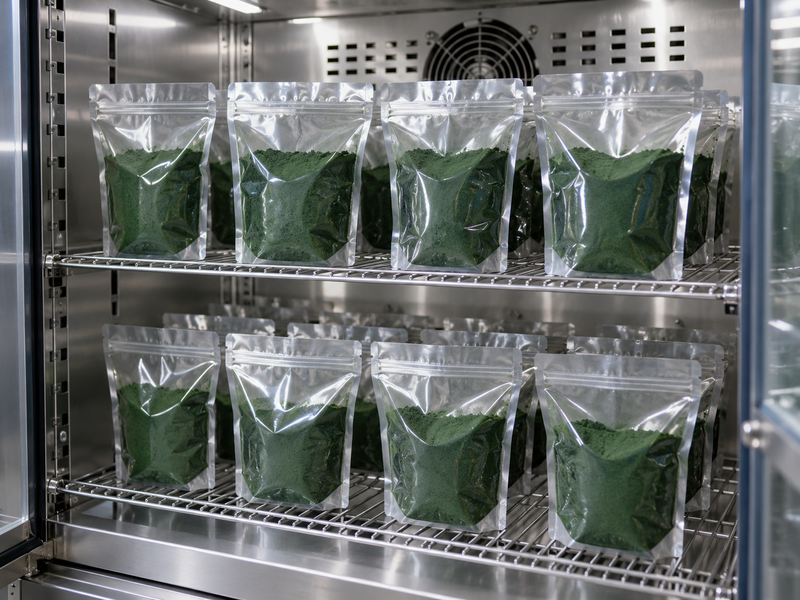
At planned intervals, inspect dry color, odor, clumps, moisture or water activity as relevant, microbial status and any declared nutrients that may change. Then prepare a serving using the standard protocol. Compare taste, thickness, wetting and sediment with the approved retain. Accelerated trials can screen formulas and packs; a market shelf life should rely on suitable evidence for the finished product in its pack.
Include more than one ingredient lot if the supply range is broad. Fruit, protein and flavor powders may dominate shelf-life changes, so do not attribute every defect to spirulina. If a formulation change improves initial taste but causes caking, repeat the pack study. Record storage conditions and panel methods. An overlooked endpoint: a premix can remain microbiologically acceptable while becoming unpleasant or difficult to prepare, which still fails the product brief.
| Endpoint | Dry check | Prepared check |
|---|---|---|
| Color | Powder reference | Finished drink |
| Aroma | Open pack | Drink aroma |
| Texture | Clumps | Viscosity and sediment |
| Claims | Relevant assay | Serving calculation |
9. How should claims and directions be reviewed?
Use finished-serving evidence
Distinguish conventional food from dietary supplement positioning before selecting artwork. Confirm serving, pack count, ingredient list, allergens, nutritional declarations and intended claims for each market. Do not claim a high-protein smoothie merely because spirulina powder contains protein; assess the actual finished serving under applicable criteria. US FDA supplement labeling guidance applies when the product is sold as a dietary supplement, while conventional foods have different labeling rules.
Directions should state powder amount, liquid amount and mixing method. If customers may add banana or milk, make clear whether those are optional ingredients rather than contents of the pack. Avoid implying that a basic smoothie recipe has been clinically validated. Review artwork after formula and sensory trials conclude. The test: a new employee should prepare the same acceptable drink from the printed instructions without help from R&D.
10. What should a brand request before purchase?
Ask for a reproducible product file
Obtain the spirulina lot COA and identity evidence, full formula, ingredient specifications, allergen review, mixing and filling records, prepared-serving protocol, packaging specification and stability plan. Request samples from the intended commercial line, not only a bench jar. Record which formula and lot created every photograph or sensory result. Agree on change notifications for powders, flavors, mesh grades and packaging.
Use a launch scorecard with mandatory gates: acceptable taste in the intended liquid, target spirulina per serving, uniform retail fills, package integrity and approved artwork. Compare supplier quotations only after those gates and pack counts match. A lower ingredient price does not rescue a blend that separates or needs excessive flavor to be usable. The next move: commission a small production trial that gives the brand a drink, a pack and a batch record it can evaluate together.
| File item | Why request it | Approval owner |
|---|---|---|
| Formula version | Repeatable recipe | R&D |
| Blend data | Uniform serving | Quality |
| Prepared protocol | Consistent experience | Product team |
| Pack and stability | Market life | Quality and regulatory |
An illustrative comparison can keep a development team focused. Prepare one approved premix lot in the recommended oat drink and in plain water, using the same powder dose and temperature. The oat version may seem smooth because its base has body, while water may expose floating particles and a stronger spirulina aroma. Do not combine those observations into one vague “mixes well” verdict. If the pack recommends only oat drink, test and print that use clearly. If marketing wants water compatibility too, set separate sensory and dispersion criteria, then adjust the formula and repeat stability checks. Keeping the two use cases distinct prevents a favorable smoothie demonstration from becoming an unsupported claim about every beverage.
FAQ
Q1: Should a smoothie premix dissolve? Whole spirulina can disperse without dissolving; describe tested behavior accurately.
Q2: Can fruit flavor hide every off-note? No. Dose, base, ingredient lot and storage still affect flavor.
Q3: Is one powder scoop a reliable serving? Only if scoop use and bulk density support the labeled amount. Weighed directions may be clearer.
Q4: Can an ingredient COA support a finished-drink claim? It is one input, but finished-serving evidence and market rules govern the claim.
Q5: Must each liquid be tested? Test every liquid and preparation method recommended on the pack.
Next step
Build the spirulina smoothie premix around a defined prepared serving. Then prove flavor, dispersion, blend uniformity and shelf behavior in the chosen pack. Ask a prospective manufacturer for lot-linked pilot samples and records before ordering inventory. A product that performs the same way at home and in the development kitchen gives the brand a stronger launch foundation.