
Spirulina powder shelf life testing checks whether a sealed whole-biomass ingredient stays within agreed quality and safety limits during its labeled storage period. A printed date can look authoritative even when it rests on a different grade or package.
A defensible plan tests real production lots in the actual pack, follows them through time and names the failure criteria in advance.
The FDA guide to water activity explains why a dried food’s water status and storage conditions need attention, while Spirulina research shows that light and moisture can change measured properties.
Contents: 1 · 2 · 3 · 4 · 5 · 6 · 7 · 8 · 9 · 10
1. What exactly does a shelf-life claim cover?
Name the grade, package and condition
A shelf-life claim applies to a defined product stored under defined conditions. It should identify whole-biomass grade, production route, packaging material, closure, fill level and storage instructions. A supplier’s date for tablets or blue extract cannot automatically transfer to green powder. Begin with the label: what will the customer actually receive, and under which conditions is the period valid?
Set day zero at a named event, usually manufacture or packaging, and state whether the date is a best-quality date or another market-specific date type. Ask whether opened-pack life is included; it usually needs a separate use protocol because repeated opening introduces air and humidity.
A supplier may have older data from a similar product, but the buyer should request a bridging rationale and confirm with real-time observations. The FAO review emphasizes processing and food safety as connected, which also applies after packaging. A date without product and pack boundaries is a weak promise.
| Scope item | Define before testing | Risk if omitted |
|---|---|---|
| Grade | Whole powder and process | Wrong comparison |
| Pack | Material and seal | Different protection |
| Day zero | Named event | Ambiguous age |
| Storage | Temperature, light and humidity | Misleading date |
2. Which lots should enter the stability program?
Use representative commercial production
Select lots made under the approved production process, including normal variation in harvest and drying. A hand-prepared laboratory sample may age differently from powder filled on a commercial line. Record manufacture date, batch size, raw source, dryer, moisture, water activity and initial analytical results. A useful question: would the tested lots resemble the shipment you intend to buy next year?
One lot can flag a problem but gives little view of variability. Multiple independent lots give stronger evidence, especially if the product is made across seasons or equipment. Retain enough sealed units for each planned time point so repeated opening does not confound results.
A supplier should identify which lot generated every data row; an undated “stability passed” summary is insufficient. If the process or pack changes, assess whether existing data still apply. Do not quietly extend a claimed period based on a sample from a different grade.
3. How should real-time storage be designed?
Test under intended conditions
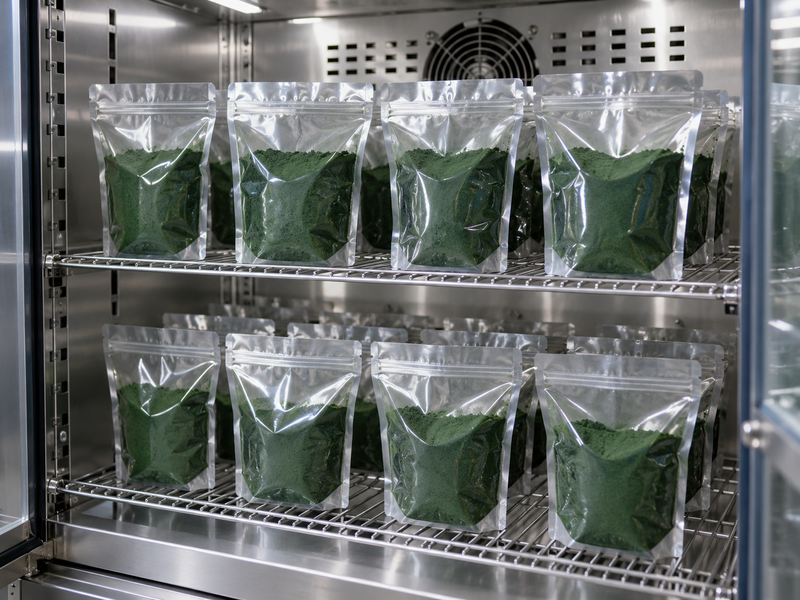
Real-time studies place sealed commercial packs under stated conditions and test at planned intervals through the proposed shelf life. The plan should include baseline, intermediate points and the end date, with enough units for confirmatory work. Monitor the chamber or warehouse environment, not merely its set point.
Keep the test honest: if the label says “store cool and dry,” define what the company means and assess foreseeable shipping or retail conditions separately.
At each interval, inspect package integrity, caking, color, odor and relevant composition or microbiological attributes. The exact panel depends on the grade’s intended use. A study of Spirulina water adsorption measured moisture behavior across temperature and water-activity conditions, supporting attention to humidity exposure.
Its sorption curve cannot replace the supplier’s own package study. Retain raw results and a documented disposition for any failed point. A final passing sample alone may hide temporary failures or method changes.
| Time point | Core record | Decision |
|---|---|---|
| Baseline | Full release profile | Establish starting condition |
| Interim | Trend and pack check | Detect drift |
| End | All critical criteria | Support proposed period |
| Beyond end | Optional margin | Inform future review |
4. What can accelerated testing contribute?
Use stress to investigate failure modes
Accelerated conditions can reveal likely sensitivity to heat, humidity or light before a real-time study finishes. They are useful for package screening and for choosing which attributes need close monitoring. A primary study of Spirulina powder under heat and light observed changes in antioxidant behavior under defined experimental exposure. Its numerical outcomes should not be converted into a universal shelf life for commercial powder.
Do not assume that doubling temperature gives a simple conversion from weeks to months. Different failure mechanisms may dominate under severe stress; a package can also behave differently at high humidity. The sound approach: use accelerated observations as supporting evidence, then continue real-time testing under labeled conditions.
Record rationale for stress levels and avoid conditions that cause an irrelevant failure. If accelerated and real-time trends disagree, investigate instead of choosing whichever result supports a longer date. Keep provisional claims conservative and aligned with destination-market requirements.
5. Why test both moisture and water activity?
Measure quantity and availability separately
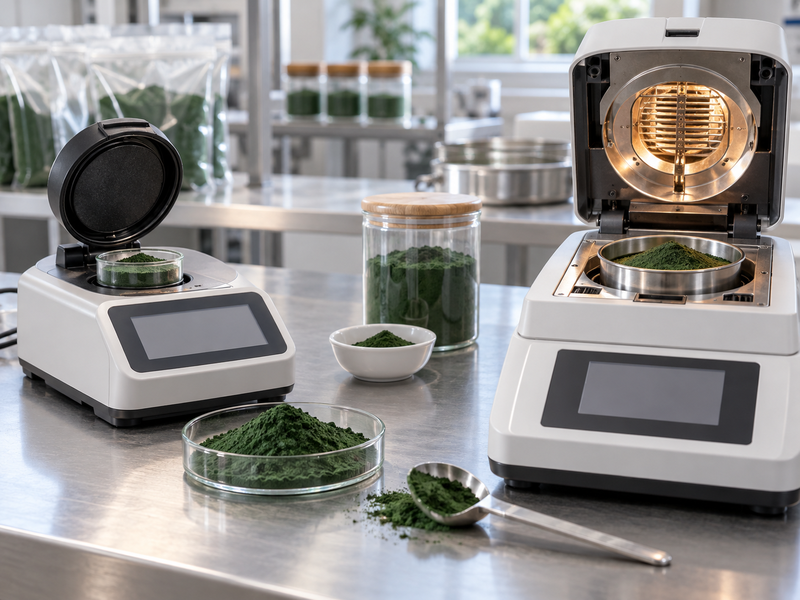
Moisture measures water content under a named analytical method. Water activity describes how available that water is for chemical and microbial processes. The FDA water-activity guide explains how water activity relates to food stability and why drying and storage controls matter.
A powder can gain moisture through a weak seal or permeable bag, leading to clumping or changed activity. Check both trends: a baseline result cannot reveal what happens after months in the final pack.
Define acceptance limits from product behavior and the applicable safety assessment. A low water-activity reading does not prove that powder is free of pathogens; organisms can survive without growing. Pair the measure with appropriate microbiological release controls. The Spirulina sorption study shows that temperature and surrounding humidity influence water uptake.
Packaging performance should be tested under conditions relevant to your supply chain rather than inferred from film marketing claims.
| Attribute | Why track it | Related observation |
|---|---|---|
| Moisture | Water uptake | Caking |
| Water activity | Water availability | Stability risk |
| Seal integrity | Barrier continuity | Pack failure |
| Microbiology | Lot safety profile | Release and trend |
6. How should color and odor be monitored?
Use the same reference throughout
Set a controlled visual or instrument color method and a sensory procedure before storage begins. Compare aged powder with baseline and a sealed reference under fixed light.
Define acceptable shift in terms relevant to the finished product. Primary research on Spirulina powder under light exposure supports examining light as a stressor, while odor research across processing stages supports treating aroma as a measurable product attribute. Neither study supplies a limit for your specific grade.
Odor should be assessed by trained people using coded samples and consistent containers. A rancid or musty note can appear even when color looks acceptable. Do the application check: test aged powder at the intended dose in the finished formula, especially when heating or hydration changes perception.
Record whether a shift affects customers or only a dry-powder instrument reading. A shelf-life limit should represent actual usability and safety, not merely the easiest laboratory number to generate.
7. What microbiological checks belong in the plan?
Separate initial contamination from storage behavior
A stability program should include the food-safety attributes relevant to the product and market, with release results at baseline. Later tests can detect changes associated with moisture ingress or package failures, though low-water-activity powder may not support growth under proper storage. FDA notes that blue-green algae foods require applicable manufacturing controls.
Do not make a false inference: stable counts over time do not prove that initial contamination was acceptable.
Define methods, sample units, detection limits and action thresholds. Investigate a failed pack separately from the wider lot, then assess whether the cause could affect other packs. If a product is later rehydrated or used in a high-moisture food, the finished manufacturer must evaluate its own process and shelf life.
The dry ingredient’s date cannot be copied onto a drink or snack. Keep testing proportionate to risk and avoid unsupported claims of sterility.

| Question | Ingredient study | Finished-food study |
|---|---|---|
| Initial status | Release tests | Formula and process release |
| Moisture exposure | Pack integrity | Finished package |
| Storage period | Dry powder | Actual food matrix |
| Failure response | Hold affected lots | Product-specific action |
8. How should packaging be evaluated?
Test the pack that will ship
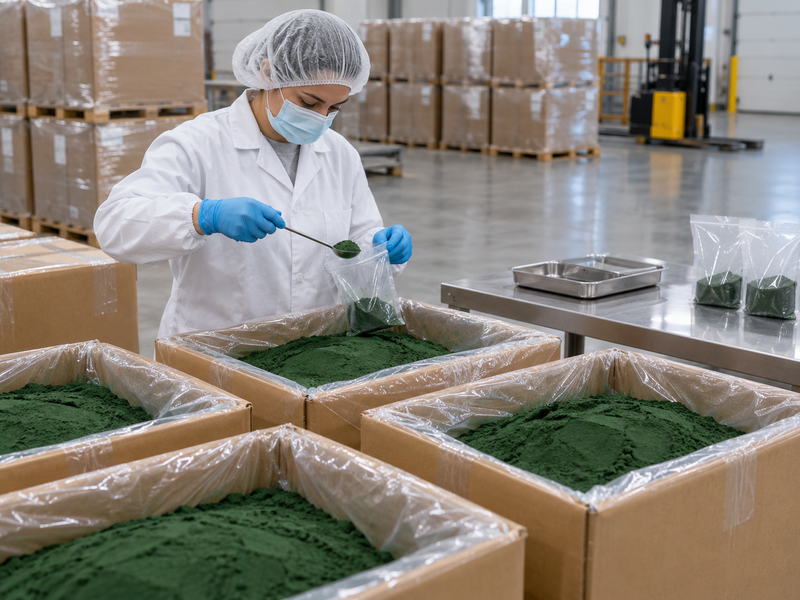
Packaging protects against moisture, oxygen, light and handling damage to different degrees. Specify film or container, liner, closure, seal method, fill level and secondary carton. Store stability samples in commercial units, not convenient laboratory jars unless the actual product ships in jars. Inspect the weak point: a high-barrier film cannot help if heat seals are inconsistent or closures leak.
Use incoming pack specifications, seal checks and transport observations alongside stability data. Ask whether samples were stacked, moved or exposed to humid conditions resembling distribution. A pack change can require a new or bridged study even if the powder itself remains unchanged.
The Spirulina water-adsorption research reinforces why humidity protection is a meaningful design choice, but only a test of the chosen package can show its performance. Retain photographs and pack IDs at each time point.
9. How should a buyer read a supplier’s shelf-life dossier?
Look for protocol, results and decision rule
Request the approved protocol, actual lot identities, package description, storage logs, methods, time-point results and deviations. A single sentence saying “24 months stable” does not disclose which attributes were tested or how failures were handled. A useful check: can you locate every value supporting the proposed date and confirm that it came from the offered grade in the current pack?
If the Spirulina CN site presents a shelf-life or storage statement, treat it as a site claim until current SKU and batch documents support it. Verify the destination-market label and storage language separately. Ask whether the period starts at manufacturing or packaging and what happens after repacking.
A distributor who opens bulk bags and fills small pouches creates a new package system; the original supplier’s data may not carry over unchanged. Record unresolved gaps before approval.
Ask the supplier to show how a failed stability point changes its commercial decisions. A useful dossier includes the criterion that failed, the raw observation, an investigation into package or powder causes and a list of lots that might share the same weakness.
Quality staff should explain whether stock was held, whether a stated date was shortened and how customers would be informed if distributed material were affected. Review one historical deviation, or use a documented mock case if the program has had no failures.
Check that the response connects manufacturing dates, packaging materials and customer shipments, not merely a laboratory chart. This exercise tests whether stability work is an active control for inventory and customers rather than a report prepared only for a sales file.

| Dossier part | Evidence to inspect |
|---|---|
| Protocol | Product, pack, conditions and limits |
| Raw data | Dates, methods and lot IDs |
| Deviations | Cause and disposition |
| Claim | Rationale for stated period |
10. When can a shelf-life period be approved?
Approve a period the evidence can support
Approve when representative lots in commercial packaging meet defined safety and quality criteria through the proposed period under labeled conditions. Use accelerated data to identify risk while real-time work confirms performance. If the real-time program has not reached the proposed end date, document the provisional basis and a review trigger; do not present an extrapolation as completed observation.
The business decision: a shorter supported period can be preferable to a longer claim that causes complaints or write-offs.
Write change control for dryer, formulation, particle processing and packaging. Confirm that the buyer’s storage and transport practices match the tested conditions. Keep retained samples and review trend data as commercial lots age. Shelf life is not a permanent property of the word “spirulina”; it belongs to a specific product, process, package and use. Ask for the evidence package before committing inventory or printing a date.
FAQ
Q1: Can accelerated testing alone prove two years? It can support a hypothesis, but real-time evidence and a justified model are needed for a defensible claim.
Q2: Is low water activity enough for safety? No. It limits growth under defined conditions but does not establish absence of contaminants.
Q3: Can a bulk-bag date apply after repacking? Repacking changes the container system and needs a documented assessment.
Q4: Must every time point repeat every test? Choose a risk-based schedule, with critical criteria at baseline and proposed end.
Q5: What should a buyer request at the outset? The protocol and lot-level time-point data for the actual grade and pack.
Put dates behind real evidence
Choose a proposed period, test representative lots in final packaging and keep following them under stated storage conditions. Review moisture, water activity, sensory quality and relevant microbiology together. A date backed by those records gives buyers and customers a dependable expectation.