
Phycocyanin vs synthetic blue dye in food is a reformulation decision, not a one-for-one powder swap. A manufacturer replacing a certified color must match the finished shade while protecting the product’s safety, process, shelf life, label, and cost target. Spirulina-derived phycocyanin offers a natural-source blue, but its protein character changes how it responds to heat, acid, and light. A controlled trial can show whether it fits the specific food.
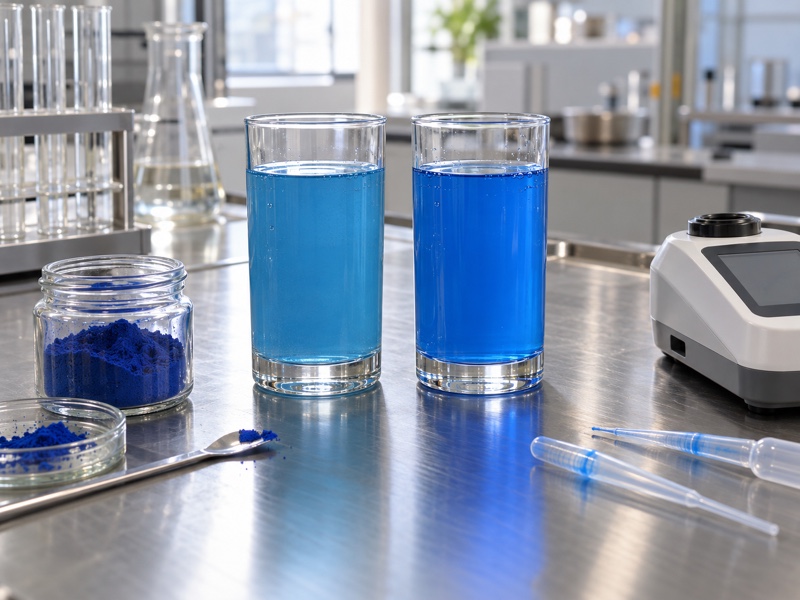
A ranked industry article frames the substitution question. Use it as evidence of search intent, then check technical and regulatory claims against original sources. The FDA color-additive page describes current U.S. policy and the regulatory process; a voluntary industry transition is not itself a blanket legal ban on every certified dye. Product teams should review the rule in force when they approve a formula.
1. What exactly is being replaced?
Identify the current color system
A blue finished food may contain FD&C Blue No. 1, Blue No. 2, another color, or a blend that creates a target green or purple. The starting material may be a dry dye, a liquid preparation, or a premix with carriers. Write down the actual ingredient declaration, concentration, supplier product code, and how it enters the process. “Artificial blue” is too vague to define a replacement trial.
Phycocyanin is a protein pigment from spirulina extract. It is not chemically identical to either certified blue dye. Even when the initial hue is close, the color can behave differently in a beverage, icing, dairy system, or candy. Whole spirulina powder is not interchangeable with an extracted blue powder; it adds green pigments and a different sensory profile. Our current catalog offers blue spirulina/phycocyanin powders E3, E6, E18, E25, E35, and E40. Those codes identify products; they do not by themselves state phycocyanin content, color strength, or use authorization.
2. Which requirements belong in a replacement brief?
Make R&D and purchasing work from one target
Define the finished-food color target after processing and at end of life. Record the permitted sales markets, product category, pH, temperature history, exposure to light, pack, expected shelf life, sensory limits, and customer label requirements. Set the quality limits that matter, including color tolerance, sediment, and lot consistency. A supplier sample that looks excellent in water may fail one of these gates.
| Brief item | Why it changes the decision | Required evidence |
|---|---|---|
| Food category | Color permissions differ | Regulatory review |
| Color target | Equal mass rarely gives equal shade | Finished-food measurement |
| Process | Heat and addition order matter | Pilot log |
| Package | Light exposure varies | Packaged shelf-life trial |
| Label | Ingredient name changes | Approved label copy |
| Commercial target | Dose and waste matter | Cost-in-use model |
Prioritize gates. A color that does not have a permissible use in the intended market should leave the shortlist before a lengthy formulation trial. A color that passes the rule but fails the product’s heat step needs a technical plan before a quote can be compared.
3. How does the pigment chemistry affect manufacturing?
Plan around a protein colorant
Certified synthetic blue dyes and phycocyanin do not share the same molecular structure. Phycocyanin’s blue appearance is tied to a protein-pigment complex. Heat, acidity, light, and ingredients that interact with proteins can change its structure or visible color. A scientific review of phycocyanin stability describes these vulnerabilities and stabilization approaches. It does not establish a universal safe process window for every commercial extract.
A replacement trial should capture the color at addition, after each major process step, after filling, and across storage. If a product is pasteurized after color addition, measure the actual time-temperature path. If color can be added after a heat step, test whether the proposed change fits the validated food-safety and hygiene program. A color reformulation must not weaken the safety process.
Do not assume a synthetic dye’s historical stability predicts the phycocyanin dose. The finished food may need a different pack or process sequence. Those changes belong in cost and quality review, not in a footnote after the color has been approved.
4. What do U.S. regulations say about the two choices?
Check official listings and current status
The FDA lists spirulina extract as a color additive under 21 CFR 73.530. Certified dyes appear in separate listings with their own conditions. The FDA summary of color additives is a starting point, not a substitute for reading the applicable rule. The agency’s color-additive updates should be checked before publication or product approval because policy and effective dates can change.
| Regulatory question | Phycocyanin route | Certified dye route |
|---|---|---|
| Legal identity | Is the sold material spirulina extract under the listing? | Which FD&C color and batch? |
| Food category | Is the intended use covered? | Is the intended use covered? |
| Specification | Does the material meet the rule? | Does certified lot meet requirements? |
| Label name | What declaration is required? | What declaration is required? |
| Export market | What does local law require? | What does local law require? |
Do not write that all synthetic blue dyes are currently forbidden in U.S. food. FDA and industry have discussed transitions and specific regulatory actions, but a buyer needs a date-stamped legal review of the relevant dye and product. Likewise, “naturally derived” does not exempt spirulina extract from additive rules, specifications, or permitted-use limits.
5. How should you build color-matched samples?
Compare the saleable food, not beakers of water
Make a no-color control, the current color formula, and one or more phycocyanin trials in the same product base. Adjust the phycocyanin dose to match the approved color target after processing. Use a defined color instrument setup and blind visual review under the relevant retail lighting. Record the initial dose and the dose needed after storage if a fade margin is required.
The same pigment may appear different in a clear drink, cloudy protein beverage, or opaque frosting because scattering and background color differ. Target a finished-food result, not a vendor’s photograph. If a blue dye is part of a green or purple blend, test the whole blend, including interactions with yellow or red components. One replacement can shift the blend even if the standalone blue looks close.
Keep a retained sample from each lot. If the first phycocyanin grade does not work, a different powder grade or formula might be worth testing, but do not assume our E-codes form a simple strength ladder. Request the technical sheet and COA for each specific grade before comparing dose or price.
6. Which failure modes should the pilot measure?
Track physical defects as well as hue
Assess color coordinates, visible shade, sediment, haze, foam, staining, flavor, and line handling. A pigment that stays blue but precipitates in a clear bottle has failed. A color that matches at fill but fades under store light has also failed. Define acceptance limits before the team sees the trial outcome.
| Failure mode | What to inspect | Likely next test |
|---|---|---|
| Heat loss | Before and after process | Addition timing, heat profile |
| Acid shift | During pH adjustment | Matrix and pH screen |
| Haze or sediment | Undisturbed pack | Dispersion, particle and protein interaction |
| Light fade | Intended display pack | Packaging and exposure |
| Sensory difference | Blind tasting | Dose and full formula |
| Lot drift | Multiple production lots | Supplier specification and release method |
The blue spirulina dispersion guide and light-stability packaging guide address two common mechanisms. Use them to set trial questions, then decide with data from the actual food and pack.
7. How can a team compare cost fairly?
Use accepted color per finished unit
A kilogram of one color cannot be compared directly with a kilogram of another if their doses and process losses differ. Calculate the approved dose per unit, delivered ingredient price, additional processing, package changes, analytical testing, and expected waste. Include any color overage needed to reach end-of-life acceptance, but do not add an arbitrary margin before shelf-life data exists.
A transition may also change ingredient handling. Powder predispersion can consume labor or equipment time. A shortened production window could affect capacity. Conversely, meeting a customer’s ingredient standard may have commercial value beyond ingredient cost. State that value as a concrete customer requirement rather than inventing a marketing premium.
| Cost component | Measure on the accepted formula | Owner |
|---|---|---|
| Pigment | Dose per finished unit | R&D |
| Process loss | Difference before and after line | Operations |
| Packaging | Any added light protection | Packaging |
| Testing | Qualification and release methods | Quality |
| Supply | Delivered price and minimum order | Purchasing |
Use at least two suppliers or lots if continuity matters. Cost in use only helps when the product can be supplied under a consistent specification. The separate landed-cost guide covers shipping components; here the key is measuring color delivered through the process.
8. What evidence should a phycocyanin supplier provide?
Connect the sample to the purchase specification
Ask for the exact blue spirulina powder code, composition and carrier declaration, lot COA, current specification, manufacturing site, storage guidance, and sample identifier. Request the test method for any claimed color value and the conditions behind application examples. Ask whether the proposed material will be made at the same site and by the same process as the sample. A generic “food grade” statement is not enough to approve a color additive for a particular market.
| Supplier record | Buyer use | Red flag |
|---|---|---|
| Grade specification | Defines product | Code or revision mismatch |
| Lot COA | Shows release result | Missing lot or method |
| Composition statement | Label and formula review | Undeclared carrier |
| Stability data | Trial design | Unstated matrix or temperature |
| Change notice | Requalification plan | No site/process notification |
Our catalog’s E3, E6, E18, E25, E35, and E40 powders require individual technical review. No E-code alone proves a percentage, an absorbance value, or a permitted market. Whole spirulina and chlorella powders or tablets are separate products. This distinction should appear in the approved purchase file.
9. How should a pilot handle the real production line?
Run the sequence that manufacturing will use
A bench trial often uses small volumes and gentle mixing; a plant line adds transfer pumps, larger vessels, hold tanks, and varying shear. Document where the color enters, how it is pre-mixed, how long it waits, and what temperatures it sees. Collect samples at the point of addition, after processing, at filling, and after storage. Compare each to the current color formula under the same process.
If the new pigment leaves residue or causes cleaning difficulty, record it. If the powder needs a dispersion aid, assess its label and cost. Check filter losses and line hold-up before concluding that the lab dose is the plant dose. A failed pilot can be useful if it points to a controllable step, but only a repeat pilot with the revised process should support commercial approval.
Keep regulatory, quality, and operations in the same sign-off. A color that works technically but requires a new ingredient declaration or a changed thermal step may need additional validation before launch.
10. When is the replacement ready for approval?
Require a finished-product decision record
Approval should name the exact phycocyanin grade and lot, formula revision, process profile, pack, intended market, color target, acceptance limits, and shelf-life result. Include the current official rule used for the regulatory conclusion. Keep the old dye formula as a control until the new one passes all gates. A supplier claim or a favorable first-day sample cannot substitute for that file.
If the replacement works, set incoming checks and a change-notification trigger so future lots stay within the approved window. If it does not, identify the failure: category restriction, shade mismatch, heat loss, acid aggregation, light fade, sensory effect, or cost. Each requires a different response. Some teams may decide a different natural blue, altered pack, or redesigned process is the appropriate route.
Ask the supplier for a production-representative sample and technical file for the exact E-grade under consideration. The commercial decision belongs to the finished food, not to an attractive pigment label.
FAQ
Q1: Is phycocyanin a direct one-for-one replacement for Blue No. 1?
No. Match the approved finished-food shade and test process and storage. Equal mass of two different color products is not a meaningful commercial comparison.
Q2: Are synthetic blue dyes already banned in every U.S. food?
No. Check the current FDA rule and effective dates for the specific color and product. A policy initiative or voluntary pledge is not the same as a universal legal prohibition.
Q3: Does natural-source blue remove the need for regulatory review?
No. Spirulina extract has a specific U.S. color-additive listing with conditions. Export markets need separate review.
Q4: Can I use an E-code to predict color strength?
No. E3 through E40 are product identifiers in our catalog. Use each grade’s current specification and batch COA, then test the finished food.
Q5: What is the fastest useful first trial?
Make a color-matched sample in the actual food, process it as planned, and compare it with the current formula at fill and after a defined storage period.