
Spirulina powder flowability matters when a bulk ingredient must leave a sack, move through a hopper, and enter a mixer at a steady rate. A fine green powder can look uniform in a sample jar yet bridge above a feeder or produce wide weight variation in production. The buying question is not whether the powder “flows well” in general. It is whether the exact grade and lot can be handled by the customer's equipment under the customer's humidity, fill level, and cycle time.
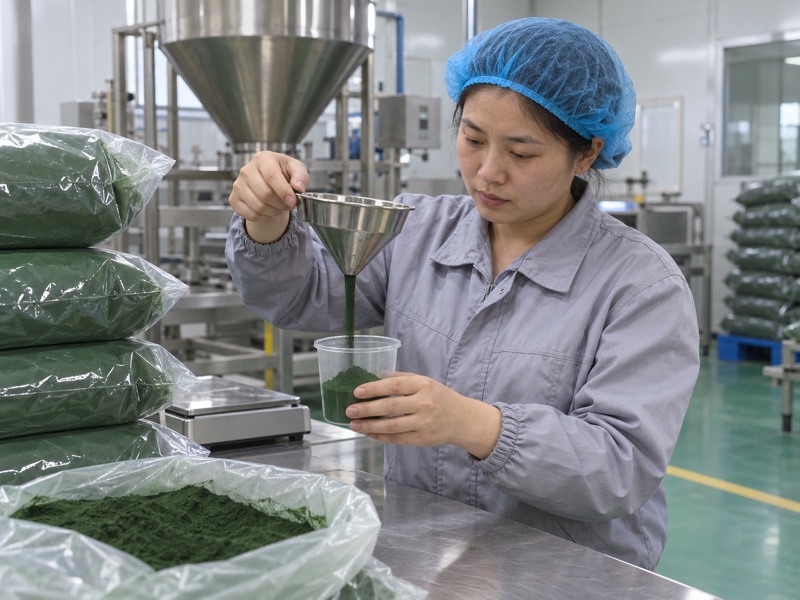
Our catalog confirms whole spirulina powder and tablets. It does not claim a particular agglomeration process, flow index, carrier, or dosing performance. This guide gives food and supplement buyers a practical way to compare lots and agree on a measurable handling specification. It complements our spirulina powder mesh-size guide; particle size alone cannot predict flow in every plant.
1. What does spirulina powder flowability mean in a factory?
Define performance at the feeder
Define the operation first. Free discharge from a bag, sliding down a chute, feeding through an auger, or filling a tablet die involve different stresses and failure modes. Flowability is therefore a set of behaviors under specified conditions, not one universal property. A powder that pours from a scoop may compact after a pallet journey and fail to refill a narrow hopper. Conversely, a powder that looks cohesive in a lab funnel may feed acceptably under vibration and a wide outlet.
Ask the production team for the smallest opening, hopper geometry, feeder type, target throughput, batch size, and acceptable weight variation. Note whether workers tip bags by hand or use a vacuum conveyor. These details turn a vague supplier claim into a trial plan. Keep the definition tied to the final commercial pack, because handling after opening can change moisture exposure and clump formation.
| Factory step | Useful performance question | Possible failure |
|---|---|---|
| Bag emptying | How much powder remains without manual scraping? | Caking or slow discharge |
| Hopper refill | Is flow continuous at low fill levels? | Bridging or rat-holing |
| Metering | Is delivered mass consistent over time? | Pulsing, underfill, overfill |
| Mixing | Does the powder enter and disperse evenly? | Lumps or localized green streaks |
The buyer should test the step that limits its line, rather than asking for a “good flow” label without a method.
2. Why can two spirulina lots feed differently?
Identify lot-level causes
Powder behavior depends on particle size distribution, shape, surface texture, moisture, electrostatic effects, and the way a pack was filled and transported. Small particles can make more contact points, increasing cohesion. A broader size distribution can allow fines to fill spaces between larger particles. Moisture may form liquid bridges or hard clumps, while handling pressure can consolidate the bed. These are mechanisms to investigate, not claims that every spirulina lot will behave the same way.
The material itself can also vary. Biomass composition, drying, milling, and post-processing may affect the final particle surface and size. Our catalog does not identify the exact process for a given spirulina grade, so a buyer should ask for the lot specification and a representative sample. Compare several lots rather than drawing a procurement rule from one jar. If a supplier changes a dryer, mill, sieve, or packaging method, ask whether it reassessed flow and dosing performance.
Transport history matters. A sample mailed in a small pouch may not experience the compression of a full pallet. For a scale-up decision, test material taken from commercial packs after realistic shipping and storage.
3. Which lab measurements are useful but incomplete?
Use measurements as screening tools
Bulk density and tapped density can reveal how a powder packs. The Hausner ratio and Carr index are calculated from those densities; they are screening indicators, not guarantees that a hopper will work. An angle-of-repose test gives another view of heap behavior. Sieve or laser particle-size data helps interpret changes. Moisture content and water activity may help explain caking risk, but neither tells the complete story alone. Use consistent conditioning and a documented method for every compared lot.
| Measurement | What it helps reveal | What it cannot prove |
|---|---|---|
| Loose and tapped bulk density | Packing and consolidation tendency | Flow through your actual outlet |
| Hausner ratio or Carr index | Cohesion screening from density change | Universal pass/fail threshold |
| Angle of repose | Behavior of a poured heap | Feeder repeatability under load |
| Particle-size distribution | Fine fraction and lot shifts | Moisture-driven caking by itself |
| Moisture and water activity | Storage-related risk context | Full transport performance |
Report the actual values and method, not just “passes flow test.” The number of taps, funnel dimensions, sample mass, conditioning humidity, and operator technique can shift results. A supplier value measured on fresh powder should not be compared directly with a buyer value measured after an open bag sat on a humid line.
4. How should samples be conditioned before comparison?
Standardize sample history
Start with material from a sealed commercial pack. Record lot, production date, pack type, shipping history, and opening time. Allow samples to reach the same test-room temperature while still sealed to limit condensation. Then draw representative portions with a consistent method. Do not shake one sample aggressively while leaving another compacted; that can erase the shipping history the trial is meant to test.
Run at least two conditions if the plant has meaningful humidity swings: a controlled baseline and a realistic worst case within the plant's operating limits. Measure moisture or water activity before and after exposure. Record how quickly a scoop, funnel, or feeder changes behavior after the bag is opened. For recurring supply, the buyer may need an opened-pack handling time and resealing procedure rather than only an unopened shelf life.
Use replicate samples. A single funnel discharge can be distorted by a minor lump or a small difference in how powder was poured. If results vary widely, that variation itself is a finding. Investigate pack-to-pack and lot-to-lot differences before choosing an acceptance limit.
5. What should a hopper and feeder trial record?
Record equipment behavior
Test the product on the equipment that will meter it, or on a pilot rig that reproduces the key geometry and loading. Fill the hopper to a defined level, run at the intended throughput, and measure output in timed intervals. Repeat at low fill level, when bridging or pulsing may become more visible. Record any manual intervention, vibrator setting, auger speed change, or cleaning stop. Averages alone hide interruptions.
| Trial condition | Record | Buying decision it informs |
|---|---|---|
| Full hopper start | Startup delay and initial output | Can the line start predictably? |
| Steady operation | Mass delivered per interval | Is dosing variation acceptable? |
| Low fill level | Bridging, rat-holing, residual mass | Is a minimum refill level needed? |
| Stop and restart | Restart time, compaction | Will shift pauses cause loss? |
| End of bag | Residue and operator action | What is the true yield per pack? |
Run the trial long enough to see steady operation and at least one stop/restart. Use the production team's tolerance for underfill, overfill, and color distribution, rather than a generic supplier threshold. If equipment settings solve the problem, document them as part of the approved process and confirm they remain practical across lots.
6. How does flowability affect weighing and formulation?
Check dose and blend variation
A feeder that surges can change the amount of spirulina entering each batch or individual unit. That may alter color, flavor, label-declared content, or blend uniformity. However, a smoother flow number on a lab sheet does not automatically mean better dispersion in water. Feeding and wetting are separate stages. Measure the actual finished-product attribute the buyer cares about.
For premixes, test whether spirulina segregates from other ingredients during transport and discharge. A difference in particle size or density can affect blend uniformity even if each powder flows on its own. For tablets, flow into the die and compression behavior both matter. For beverages or dry mixes, the powder must enter the process and then wet or disperse at the specified rate. Build the pilot around the final use rather than evaluating the ingredient in isolation.
The trial report should include the dose setpoint, measured mass distribution, mixing sequence, final product results, and any equipment changes. This makes a later supplier comparison fair. Otherwise, a new powder may be blamed for a feeder setting left over from a different material.
7. Can agglomeration improve spirulina powder flowability?
Evaluate the research cautiously
In a peer-reviewed ACS study, researchers examined fluidized-bed agglomeration of *Spirulina platensis* powder and reported improved flowability and wetting capacity under their experimental conditions. Agglomeration can make larger composite particles from fines, but outcomes depend on the binder, process, moisture, and target application. The paper is evidence that the approach can be studied, not evidence that our catalog powder has been agglomerated.
| Option | Possible benefit to test | Tradeoff to check |
|---|---|---|
| Untreated fine powder | Simple ingredient identity | Cohesion or dust in some systems |
| Sieved powder | Narrower size distribution | Yield loss or residual fines |
| Agglomerated powder | Better flow or wetting in a given trial | Added binder, changed density and label |
| Formulated premix | Easier dosing with other solids | Diluted active content and segregation risk |
Ask for the final ingredient list before accepting an agglomerated option. A binder can be useful in a food process, but it changes the formulation and may affect declarations, color per gram, cost in use, and regulatory review. Compare delivered color or nutrient content per unit of final product, not just kilograms of powder purchased.
8. Should a buyer ask for a universal flow specification?
Set an application-based acceptance rule
No single flow cutoff suits every plant. A buyer can set a supplier-facing screen using a defined lab method, then a line-facing criterion using its own equipment. For example, specify a range of loose bulk density under a named method and a maximum permitted dosing variation over a defined trial. Set those limits from approved lots and process capability data, not from a table copied from another powder.
Agree on sampling frequency and what happens when a result is near the limit. A lot can pass a lab screen yet fail the line trial if a humid shipment created clumps. Conversely, a modest lab flow index may be acceptable in a wide-mouth feeder. The specification should tell quality staff when to release, retest, or escalate. It should also state the pack type and storage conditions on which the result depends.
If a supplier cannot provide a flow result, a trial can still proceed as an evaluation. Do not write “good flow” into an approved product specification without a method and acceptance criterion.
9. How should packaging and transport be included?
Test the delivered pack
Seal integrity, moisture barrier, headspace, bag fill, and pallet stacking can affect the condition of a powder at receipt. Request a representative commercial pack and inspect it after transit. Record clumps, free powder, bag residue, and any odor or color change. Compare samples from the top and bottom of a pallet when compression is a concern. Keep pack handling consistent; rough de-lumping during sampling can conceal a genuine problem.
Storage trials should reflect the warehouse and production room, including how long a bag is open and how it is resealed. A desiccant or liner may help only if it is suitable for the pack and used correctly. Do not assume a room-temperature shelf-life statement proves that the powder will meter after repeated humidity exposure. If the supplier proposes a packaging change, run a side-by-side trial with the same powder lot to separate pack effects from material effects.
For a claim, retain the original pack, lot code, receiving photos, and test data. Those records make it possible to investigate whether a flow issue arose before shipping, in transit, or after opening.
10. What belongs in a supplier approval decision?
Record approval and change control
Approve the whole handling package: exact grade, lot testing, commercial pack, equipment trial, and change-notice terms. A good supplier answer includes its test method and data range across recent lots, not only the best result. The buyer should see whether the proposed limits are achievable in normal production. Add a retained sample and a repeat test method for any future dispute.
| Approval item | Minimum useful evidence | Owner |
|---|---|---|
| Product identity | Current specification and lot COA | Supplier quality |
| Lab flow screen | Method, conditioning, recent lot results | Buyer and supplier quality |
| Line performance | Throughput, dosing variation, interventions | Buyer production |
| Pack and storage | Commercial pack trial and handling instructions | Logistics and production |
| Change control | Notice for process, pack, or formula changes | Procurement |
FAQ 1: Is mesh size enough to predict spirulina powder flowability?
No. Particle size is useful, but moisture, shape, consolidation, and equipment design also affect feeding. Test the powder under defined conditions.
FAQ 2: Does high bulk density always mean better flow?
No. Density is one descriptor. A dense powder can still bridge, and a lighter powder may work in a feeder designed for it.
FAQ 3: Is agglomeration always necessary?
No. The need depends on the application and equipment. A published agglomeration result does not show that an untreated commercial powder will fail.
FAQ 4: Can a supplier guarantee our hopper performance from a COA?
A COA can support agreed lab properties. Plant performance requires a representative equipment trial and consistent operating conditions.
FAQ 5: Which sample should be used for final approval?
Use the exact commercial grade from a representative pack and lot. Confirm that the supplier's process and packaging match the sample approved for scale-up.