
Chlorella cultivation methods shape the material a food buyer eventually receives. A green powder made with light and carbon dioxide may differ from a powder grown on sugar in a fermenter, even when both carry the word Chlorella on the label. Neither route deserves automatic approval. The useful question is whether the supplier can connect its strain, cultivation controls, harvest, and finished lot to the properties your product needs.
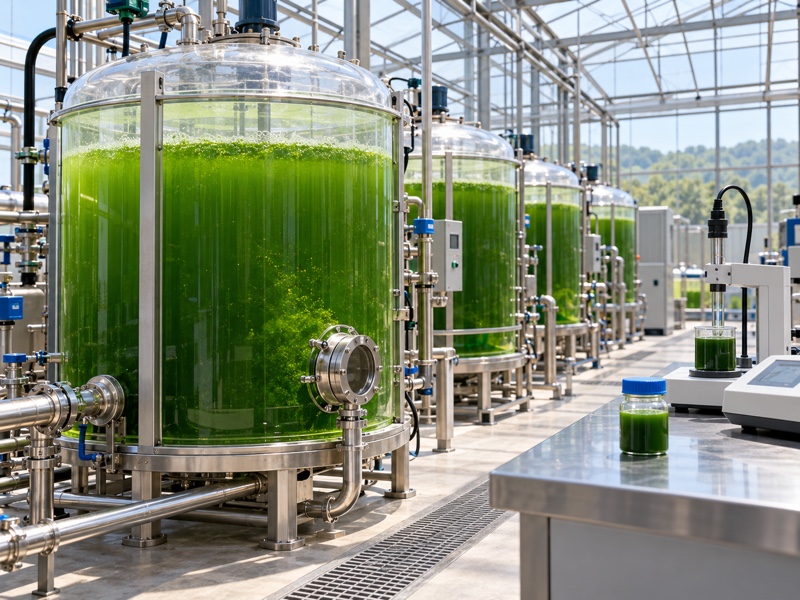
Our current catalog lists Chlorella powder and tablets. It does not identify a cultivation route, strain, or nutrient profile for every offered lot. Chlorella is also a different product from the blue extract described in our blue spirulina versus Chlorella comparison. Ask for the current product specification and batch certificate before treating any process description as a promise about the material you will buy. This guide turns the three main growth modes into questions that purchasing and quality teams can put on a supplier call.
1. What are the main Chlorella cultivation methods?
Start with where energy and carbon come from
Photoautotrophic cultures use light for energy and an inorganic carbon source, commonly supplied as carbon dioxide. Heterotrophic cultures grow without relying on light and receive organic carbon, often sugar. Mixotrophic cultures combine light-driven photosynthesis with an organic carbon feed. These terms describe metabolism. They do not, by themselves, tell you whether a particular site uses an open pond, closed photobioreactor, or fermenter.
A published comparison of three Chlorella strains tested photoautotrophic, mixotrophic, and heterotrophic conditions and measured differences in growth and composition. That result is a reason to ask about the actual strain and process. It is not a universal ranking of commercial powders. Feed concentration, light regime, culture duration, and harvest point can change the comparison.
| Growth mode | Main inputs | Common equipment question | Buyer check |
|---|---|---|---|
| Photoautotrophic | Light, water, inorganic carbon, nutrients | Open or closed illuminated culture? | Light and contamination records |
| Heterotrophic | Organic carbon, nutrients, aeration | Which fermenter and feed controls? | Feed identity and microbial controls |
| Mixotrophic | Light plus organic carbon | How are both inputs controlled? | Combined process and lot records |
Use this table to identify what a supplier means by its marketing term. “Cultivated naturally” is not a process description. Request a simple flow diagram and the critical control records instead.
2. Why does the Chlorella strain matter before the equipment?
A species name is still a broad starting point
Different Chlorella species and strains do not respond identically to light, sugar, temperature, or nutrient limitation. A buyer comparing two powders should request the organism identity used for each, the method used to confirm it, and a statement about whether the production strain has changed since qualification. Do not infer identity from color or particle size. Both can shift during processing and storage.
The industrial applications review indexed by PubMed describes Chlorella as a group capable of different growth modes and commercial uses. That breadth is precisely why a supplier's strain record matters. One trial showing improved pigment under one condition cannot establish the pigment of an unrelated strain. Likewise, a research strain selected for oil production does not represent food-grade powder by default.
Ask who maintains the master culture, how working cultures are identified, and which records connect a production batch back to that culture. Quality teams can then investigate an unexpected change in shade, aroma, or composition. If a seller cannot identify the organism beyond “green algae,” resolve that gap before discussing price.
3. How does photoautotrophic cultivation work in practice?
Light exposure is part of the process specification
In a light-driven system, cells need access to usable light, carbon, water, and nutrients while temperature and pH remain within the chosen operating range. A shallow pond and a closed photobioreactor solve that problem differently. A pond has a large exposed surface and can be economical in some settings, but the site must demonstrate control of outside organisms, weather, water, and airborne material. A closed illuminated vessel offers a different containment approach but still needs cleaning, heat removal, gas management, and monitoring.
The Synoxis article that ranked for this keyword describes fermenter and photobioreactor routes. It is an equipment supplier's perspective, not evidence that one route always yields a better food ingredient. Some of its broad nutritional claims need product-specific testing. Use it to frame questions about equipment, then compare actual lot data.
Ask for a normal operating window, the points where light and temperature are measured, the culture density at harvest, and a recent deviation example. If the answer is “we check the tanks daily,” ask what was recorded, who reviewed it, and how an out-of-range batch was handled. The records matter more than a polished photograph of the reactor.
4. What changes when Chlorella grows in a fermenter?
Organic feed adds a control point
Heterotrophic growth can produce dense cultures without depending on daylight. That can help scheduling, but organic carbon also supports unwanted microbes if sanitation fails. A food buyer should ask about the feedstock, incoming-material approval, sterilization or equivalent control, aeration, cleaning validation, and monitoring during the run. Do not assume a fermenter automatically makes a culture clean; ask how the site proves it.
The feed can also influence the finished biomass. Composition measured in one heterotrophic study reflects its own strain, feed, and process. A supplier should provide lot measurements relevant to your formulation instead of quoting a study as a guaranteed protein or pigment value. Ask for the finished material's color, protein or other agreed composition measures, microbiology, and sensory sample under a defined method.
| Supplier claim | Useful follow-up | Evidence that answers it |
|---|---|---|
| “Closed fermentation” | How is contamination detected during growth? | In-process microbiology and deviation records |
| “Food-grade feed” | What carbon source and supplier were used? | Approved feed specification and traceability |
| “Consistent color” | Across which lots and measurement method? | Retained samples and color data |
| “High protein” | On what dry basis and by which method? | Lot COAs with test method |
Keep the comparison tied to your product. A darker green powder may suit a tablet but change the shade of a light-colored food. The right acceptance range comes from your application trial.
5. When should a buyer consider mixotrophic cultivation?
The combined route needs combined records
Mixotrophy uses both light and organic carbon. The method can change growth and composition, as the three-strain cultivation study demonstrates under its own conditions. It also creates two sets of operating variables to document. Light exposure, carbon feed, culture density, and harvest timing should all be traceable to the batch offered for sale.
Do not treat “mixotrophic” as a synonym for “best of both.” Ask why the supplier chose it for this strain and how the outcome compares with its alternative routes. The answer might concern yield, pigment, flavor, cost, or capacity. Those are different buyer decisions. If a supplier cites an unusually strong result, ask whether it is a pilot figure or routine production performance over multiple food-grade lots.
For a first commercial order, request the same basic evidence from a mixotrophic site as from any other: strain identity, approved feed, cultivation log, contamination monitoring, harvest record, finished specification, and a representative lot sample. The route affects which questions you ask, not the standard of proof.
6. Which product attributes can the growth mode change?
Measure the attributes your formula can notice
Cultivation can affect pigments, proteins, lipids, and other constituents. It can also affect cost and the consistency of supply. Those possibilities are useful for trial design, but no single growth mode guarantees a specific nutrient number. The comparative study found strain- and condition-dependent differences; it did not certify commercial grades.
For a powder sold into a visible food, color and taste may dominate the decision. For a tablet, compressibility, odor, microbiology, and stability may be more important. Ask the supplier to measure the attributes in the current specification and to explain its normal lot-to-lot range. If a claimed property is absent from the COA, define a test before relying on it in a finished-product claim.
| Intended use | Cultivation-linked question | Finished-lot evidence |
|---|---|---|
| Green beverage or blend | Will shade and aroma remain acceptable? | Matrix trial and retained lot samples |
| Powdered mix | Does the powder disperse and taste as expected? | Dispersibility and sensory test |
| Chlorella tablet | Does the biomass support the planned tablet process? | Pilot compression and stability data |
| Nutritional positioning | Is the stated component present at claim-supporting levels? | Current assay with method and basis |
Our catalog confirms powder and tablet forms, not a fixed answer to these questions. Obtain the specific grade and lot documents for each proposal.
7. How should contamination risk be reviewed for each route?
Look at entry points, not route slogans
An open, illuminated culture has different exposure points from a closed fermenter. A closed vessel can still be contaminated through seed transfer, feed, air, water, sampling, cleaning, or a failed seal. A pond needs controls for environmental introduction and careful harvest decisions. In both cases, downstream dewatering, drying, milling, and packaging can add risks after cultivation is over.
Ask the supplier to map its monitoring points. The useful answer names the stage, test, action limit, sampling frequency, and disposition rule when a limit is missed. A generic “tested for microbes” statement omits where the sample came from and whether a failing culture was harvested. The buyer's product specification should also define finished-lot tests and market-specific requirements.
| Process stage | Example risk question | Record to request |
|---|---|---|
| Seed culture | Was the culture identity and cleanliness checked? | Seed batch and release record |
| Water or feed addition | Are incoming inputs approved? | Water/feed specifications and receipt logs |
| Growth | What happens after an out-of-range reading? | Monitoring and deviation file |
| Harvest and drying | Can biomass be mixed between lots? | Batch genealogy and cleaning log |
| Packing | Which lot reached each finished pack? | Label reconciliation and COA |
No table can replace a site-specific hazard review. It can, however, stop a supplier comparison from collapsing into “open is dirty” and “closed is safe.” Neither claim is reliable without records.
8. What happens between the culture and the finished powder?
Cultivation is only the first handoff
Biomass must be separated from culture medium, concentrated, dried, and often milled before it becomes a stable powder. Tablets add blending and compression steps. A cultivation discussion therefore needs a handoff map: which company performs each step, whether material moves to another site, and what batch identifier survives the transfer. A clean photobioreactor image says little about how the later powder was dried or packed.
Ask for the process flow with outsourced steps marked clearly. Record whether the lot is pooled with another harvest, how long wet biomass waits before drying, and whether storage conditions are controlled. These details can affect microbial results, odor, color, and shelf life. Keep the buyer review centered on the supplier's actual drying record, not a generic description of its equipment.
For tablets, ask for the powder lot feeding the tablet batch and the tablet formulation. The catalog's “tablet” entry does not establish the use of a particular binder, cell-wall treatment, or manufacturing method. Keep those questions open until a technical sheet answers them.
9. Which documents let you compare suppliers fairly?
Align the same facts for every quote
Ask each candidate for a current product specification, recent representative lot COA, organism identity, cultivation mode, process flow, food-safety documentation applicable to the site, and a sample from a traceable lot. Then request the same test methods and units across suppliers. A protein number on a dry basis cannot be compared casually with a number reported on an as-sold basis. An attractive green sample may not represent routine output.
Use a simple evidence matrix. Mark “not supplied” rather than converting a missing document into an assumed failure or an assumed pass. For any claim about organic status, food-grade use, or a destination market, request the actual scope and current certificate or legal basis. Site-level paperwork should connect to the offered product.
| Comparison item | Supplier A | Supplier B | Decision owner |
|---|---|---|---|
| Strain and route documented | Record link | Record link | Quality |
| Representative lot COA | Date and method | Date and method | Technical buyer |
| Powder or tablet trial | Result | Result | Product team |
| Change-notice procedure | Terms | Terms | Procurement |
This format exposes gaps without pretending that one cultivation route is always superior. Keep the matrix with the approved grade and update it when the strain, site, feed, or downstream processor changes.
10. How can a buyer choose a method for a real product?
Run the decision against the finished application
Define a use case first: powder in a beverage, powder in a dry blend, or tablets for a specified market. Set measurable acceptance criteria for identity, microbiology, color, aroma, composition, process behavior, and cost in use. Request samples from traceable lots made by the routine route, then trial them under the actual manufacturing conditions. A trial that uses a specially prepared laboratory sample may not predict the next commercial lot.
Score suppliers on demonstrated performance and the quality of their records. If photoautotrophic material meets your color brief but fails the tablet pilot, the tablet decision is still open. If heterotrophic material gives a repeatable powder but the supplier cannot trace its feed or seed culture, resolve that documentation gap before approving an order. If two routes both meet the specification, compare delivered cost, capacity, and change control.
Send the supplier your application, destination market, target form, estimated demand, and critical tests when requesting a quote. Ask it to identify the exact Chlorella powder or tablet grade and provide current lot evidence. A useful first order is one you can trace from culture to the finished pack.
Frequently asked questions
Q1: Is photoautotrophic Chlorella automatically better than heterotrophic Chlorella?
No. Compare the exact strains, finished-lot data, safety controls, application results, and cost. The growth label alone does not rank the powders.
Q2: Does a closed fermenter eliminate contamination risk?
No. Feed, air, sampling, seed transfer, cleaning, and downstream handling all need controls and records.
Q3: Can cultivation method tell me the protein content of a powder?
It can influence composition, but you need a product specification and current batch test using a stated method and reporting basis.
Q4: Are Chlorella tablets in this catalog made from a particular cultivation route?
The catalog confirms tablets as a supply form but does not specify the route. Request the tablet technical sheet and linked powder lot records.
Q5: What should I request before a commercial sample?
Ask for strain identity, growth mode, process flow, a representative lot COA, relevant food-safety evidence, and the lot identifier on the sample.