
A low odor spirulina powder supplier should be able to demonstrate consistency with real lots, not just describe a sample as mild. Processing, storage and application can change the aroma a buyer experiences. This guide turns “low odor” into a sensory specification, lot-screening protocol and supplier agreement for food makers. The spirulina processing-odor study provides the applicable starting point for product review; the commercial decision still needs lot and application evidence.
Contents
- What should “low odor” mean?
- How can a buyer compare suppliers fairly?
- Why might production method matter?
- What sensory method belongs in a specification?
- How does the finished food alter odor?
- What other quality evidence is required?
- Which questions reveal supplier capability?
- How should a mild grade be priced?
- What confirms consistency at scale?
- When is the supplier ready for routine orders?
1. What should “low odor” mean?
Define the reference
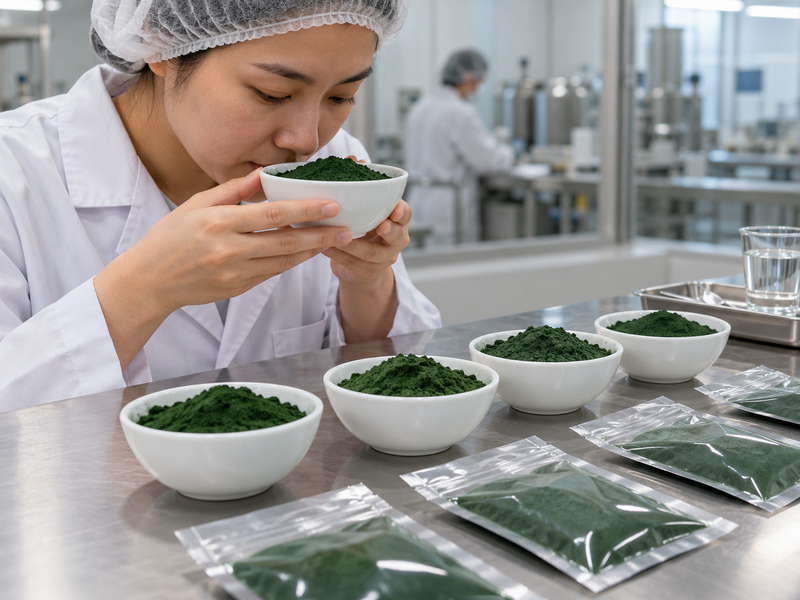
The term has no universal threshold for spirulina powder. Decide which notes matter in the intended food: marine, earthy, grassy, fishy, sulfurous or roasted. Establish an approved reference lot and a sensory intensity band using a repeatable method. A powder that smells mild in its bag can still reveal an aftertaste in a beverage.
Write the proposed ingredient identity and intended technical function on the first line of the trial brief. A sales name alone cannot settle how purchasing, quality and label teams classify it. Keep a retained sample of the first acceptable lot so later comparisons use the same reference, not a memory of its appearance.
Buyer action: Write the application, dose and serving conditions beside the sensory specification.
Before requesting a sample, ask the team to put the intended product, consumer-facing promise and disqualifying conditions in writing. This makes the first supplier conversation specific enough to yield comparable information.
2. How can a buyer compare suppliers fairly?
Blind equal-dose samples
Request commercial-lot samples with age, drying method, pack type and storage history. Code them before the panel sees supplier names or sales descriptions. Test the dry powder and the same dose in a fixed base. Include duplicate samples and the approved reference to distinguish real differences from panel variability.
Ask two candidates to answer the same written request, including test method, units, sample age and package format. Differences in reported numbers can be caused by method or dilution rather than useful performance. When figures are not directly comparable, run the candidates side by side in one laboratory and do not average away a failed criterion.
Buyer action: Ask for more than one lot from the leading supplier before treating a favorable result as routine capability.
If one candidate looks better, repeat the measurement under the same conditions before changing the specification. A small difference can disappear when samples, instruments or operators change.
| Claim | Needed definition | Evidence |
|---|---|---|
| Low odor | Named attributes | Panel method |
| Mild taste | Application and dose | Blind food trial |
| Consistent | Lot range | Multiple lots |
3. Why might production method matter?
Investigate plausible causes
Research on spirulina processing has identified multiple odorants and changes during drying. Cultivation, washing, drying and storage could each affect a lot, but the supplier must show its own control data. Do not assume a named drying technology guarantees a specific odor outcome.
Split the evaluation into ingredient screening and an actual finished-product trial. Prepare both candidates at controlled mass, mixing time and temperature; use coded samples and record the base formula. A favorable jar photograph is only a starting point. The saleable product must survive its real process, packaging and expected storage conditions.
Buyer action: Ask the supplier for process controls and change-notice points, while judging delivered material by measured lot performance.
For a related supplier-side workflow, see the SpirulinaCN guide to spirulina powder color and odor specification. Use its questions alongside this product-specific acceptance plan.
The trial record should identify who prepared each sample and whether the sample represents routine commercial output. Archive the base formula and a dated photograph under controlled lighting.

4. What sensory method belongs in a specification?
Make evaluation repeatable
Specify sample mass, vessel, dilution or food base, water temperature, rest time, serving temperature and scoring scale. Use a trained panel if possible, with defined reference anchors. Set a rule for borderline results and panel disagreement. The goal is a decision method that another quality technician can repeat, not a single expert sniff.
Set a target, an acceptable band and a failure definition before the next formulation round. Include flavor, color, texture and label effect where relevant. Record the uncolored or unfortified control. If a blend changes, document the new ingredient addition and its cost, because an apparently better ingredient can simply be receiving more help from the formula.
Buyer action: Attach the method as a controlled document and review it when the finished formulation changes.
The panel method should specify how a powder sample is opened and whether the assessor smells it immediately or after a fixed wait. Volatile perception can change when a sealed pack is first opened. In an application test, prepare the powder consistently and control serving temperature. A supplier dispute is easier to resolve when both sides can reproduce the exact method and compare against the same retained reference material.
Keep any formulation change small enough to explain. Changing color, flavor, texture and process together prevents the team from learning which adjustment solved the problem.
| Comparison item | Control | Reason |
|---|---|---|
| Dose | Equal mass | Fair intensity |
| Base | Same food | Matrix effect |
| Age | Recorded | Storage influence |
5. How does the finished food alter odor?
Use application trials
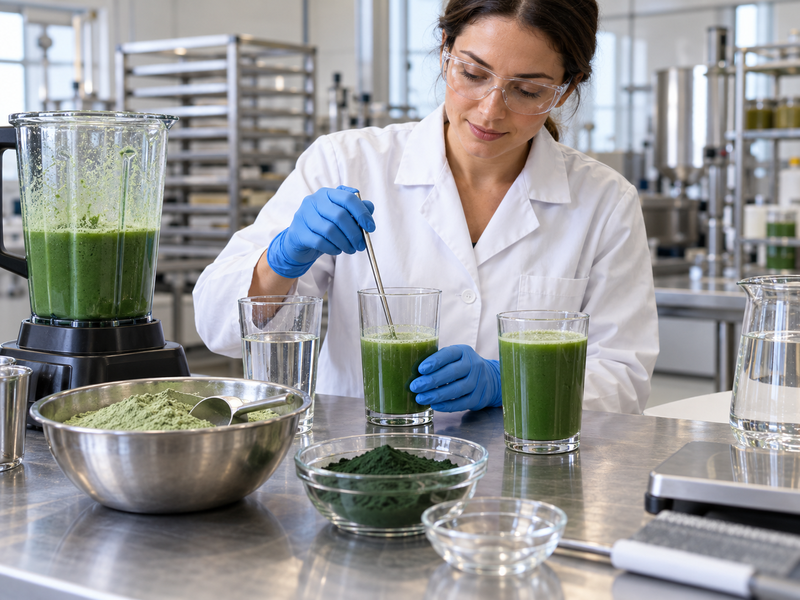
Flavor bases can hide or amplify notes; acid, fat, sweetness and heat change perception. Test the powder in the final food at the intended inclusion rate and process. Evaluate aroma at opening, flavor while eating and aftertaste. A mild dry powder does not guarantee a pleasant finished product.
This technical issue is illustrated by the spirulina odorant analysis. Its conditions are evidence for a risk to test, not a universal prediction for another formula.
Map the ingredient addition to the actual plant sequence: receiving, staging, weighing, premixing, addition, heat treatment, fill and cleaning. Note which steps expose it to water, air, light or temperature. A bench mixture that skips the limiting factory step cannot support a release decision. Preserve process settings with each retained sample.
Buyer action: Keep sensory results linked to both the powder lot and the complete formula version.
Where a process step is difficult to reproduce on the bench, flag the uncertainty explicitly and move that question into the pilot. Do not convert a convenient laboratory shortcut into a production claim.
6. What other quality evidence is required?
Keep safety independent
Low odor is a sensory attribute, not proof of identity, cleanliness or safety. Require the usual risk-based microbiological and contaminant checks, composition, traceability, packaging controls and a current certificate of analysis. An odor change can signal damage, but a normal odor does not clear a failed safety result.
Separate legal permission, identity and contaminant evidence from desirable commercial attributes. Require the lot certificate, agreed analytical methods and an escalation route for results near limits. Build a risk-based incoming check for the actual use and market. A supplier assurance letter can start the conversation but cannot replace product-specific review.
Buyer action: Set separate quality hold rules and sensory rejection rules in the supply agreement.
For a related supplier-side workflow, see the SpirulinaCN guide to spirulina powder supplier onboarding. Use its questions alongside this product-specific acceptance plan.
Quality should set the disposition for missing documents before purchasing creates a shipment commitment. Written acceptance criteria make later discussions with a supplier faster and less subjective.
| Lot stage | Check | Record |
|---|---|---|
| Receipt | Pack and aroma | Inspection |
| Processing | Aroma shift | Line sample |
| Storage | End-of-life note | Retained pack |
7. Which questions reveal supplier capability?
Ask for controlled history
Request lot-to-lot sensory records, complaint trends, retained-sample policy, drying and packaging change controls, and the method used for any “deodorized” claim. Ask whether treatment introduces carriers or processing aids. A supplier should explain how it segregates and traces lots.
Put the buyer, supplier technical contact, formulation lead, quality reviewer and regulatory reviewer on one document register. Record the exact grade, version date and any change notice obligation. If a proposed substitution changes carriers, preservatives, extraction method or source, reopen the relevant approval steps before material goes to the line.
Buyer action: Audit a representative set of records rather than accepting a polished single-lot presentation.
Include substitutes and second-source proposals in the change-control rule. A different trade name can have the same technical function but a different composition or production history.

8. How should a mild grade be priced?
Value usable product
A premium may be justified if the powder needs less masking flavor, causes fewer rejects and supports the intended inclusion rate. Calculate full recipe cost and saleable yield. Conversely, a cheaper standard grade may work in a strongly flavored food. Do not pay for a low-odor label where no sensory advantage appears in the final product.
Normalize every offer to delivered usable output, including preparation labor, line loss, rejected material and storage. Request written assumptions for minimum order, lead time, freight basis, pack size and remaining shelf life at receipt. A lower invoice price is useful only if the accepted finished-product yield and schedule also work.
Buyer action: Compare cost at the same accepted sensory endpoint and record masking ingredients separately.
A low-odor premium is easiest to justify in a delicate product where the alternative requires masking or a lower inclusion rate. In a strong cocoa or savory formulation, the same premium may buy no consumer benefit. Calculate the cost per acceptable finished serving for both grades, including any flavor corrections. Use blind sensory data so the buyer does not mistake a higher price for better performance.
Report the economics as a range when consumption, line loss or demand is uncertain. That is more useful than a single precise-looking number built from assumptions.
| Cost element | Standard grade | Mild grade |
|---|---|---|
| Powder | Quoted price | Quoted price |
| Masking | Formula cost | Formula cost |
| Scrap | Observed | Observed |
9. What confirms consistency at scale?
Trial commercial material
Use a production-size lot on the normal line and retain samples. Measure odor at receipt, after processing and at shelf-life checkpoints. Repeat with a second lot if the launch depends heavily on the mild profile. Record packaging condition and storage temperature on arrival.
Run at least one pilot or production-scale lot with the proposed addition point and normal equipment. Sample early, middle and late output, then review uniformity and retained samples after a defined storage interval. Record line stoppages and cleaning work; these are part of qualification, even when color or flavor meets its target.
Buyer action: Compare results to the locked reference and investigate any drift before approving automatic receipt.
For a related supplier-side workflow, see the SpirulinaCN guide to spirulina powder certificate of analysis. Use its questions alongside this product-specific acceptance plan.
A scale trial is also a training test. Ask operators to record whether the written instructions were usable and which steps required improvised decisions.

10. When is the supplier ready for routine orders?
Lock the sensory agreement
Approve after multiple representative lots pass safety, sensory and application criteria, with documented change notice and complaint investigation procedures. Define what happens if a borderline lot arrives: resample, retest, hold or reject. A clear process protects both sides from subjective arguments.
Close the decision with a signed specification, approved sample reference, conditional market review, change-control contact and first-order acceptance plan. Name the measurements that would trigger a hold, further trial or supplier discussion. A clear no-go outcome is valuable: it prevents an attractive sample from becoming an uncontrolled routine purchase.
Buyer action: Keep the approved retained lot, panel method, range and application trial in one accessible file.
The approved file should be understandable to a colleague who did not attend the trial. Include the rationale for rejection as well as the chosen option.
| Approval item | Required result | Owner |
|---|---|---|
| Sensory | Within reference band | Panel lead |
| Safety | Lot criteria | Quality |
| Supply | Change-control terms | Buyer |
Frequently asked questions
Is “low odor” an official grade?
No. Define it in a buyer-specific method and acceptance band.
Can a single mild sample qualify a supplier?
No. Screen representative lots and repeat in the target food.
Does drying method prove low odor?
It may influence aroma but does not replace lot-specific sensory evidence.
Can masking replace supplier control?
Masking is a formula tool; it should not conceal a lot outside the agreed specification.
What should happen with a borderline lot?
Follow an agreed hold, retest and disposition procedure instead of informal approval.
Conclusion
Buy an observable sensory result, not an adjective. A low odor supplier earns approval through representative lots, a repeatable panel method, finished-food performance and the same independent safety controls required of any ingredient source.