
A spirulina powder certificate of analysis, or COA, summarizes tests reported for a defined lot of dried whole biomass. Buyers can lose time and money when a polished PDF omits sample identity, methods, limits, or release authority. This guide gives a line-by-line review that connects the COA with a purchase specification and the actual bags. It uses FDA dietary supplement CGMP guidance and food testing resources as reference points; legal duties depend on intended product and market.
Contents
- What should be fixed before requesting a COA?
- How do you match the report to delivered bags?
- What identity evidence belongs on the report?
- How should composition be interpreted?
- Which contaminant entries need detail?
- What do microbiology results really say?
- How do methods and reporting limits change meaning?
- What happens when a result is near a limit?
- How should supplier and independent reports be reconciled?
- Who signs the lot release decision?
1. What should be fixed before requesting a COA?
Agree a buyer specification before reading results
A pass needs a rule. Define the ingredient as whole dried Arthrospira biomass and record the grade, intended use, market, required analytes, units, acceptance limits, test methods or equivalents, and sampling unit. Give the specification a revision and effective date. A COA marked “complies” may mean only that the supplier compared its own result with its own unpublished criterion. If your tablet program needs a particular protein basis or your food customer requires a microcystin reporting limit, put those conditions in the purchase file before the sample is drawn.
For U.S. supplement manufacturing, FDA’s Part 111 guide describes component identity and specifications for purity, strength, composition, and contaminant limits. Other food uses may follow different regulatory pathways. A color additive’s spirulina extract rule covers a different material; its numeric limits must not be copied uncritically into a whole-biomass COA. Ask the buyer’s quality and regulatory teams to approve the actual product specification.

| Before the COA | Define | Why |
|---|---|---|
| Product | Whole biomass, form and SKU | Prevent extract substitution |
| Tests | Analytes, methods and units | Enable true comparison |
| Decision | Limits and reviewer | Make release auditable |
2. How do you match the report to delivered bags?
Reconcile identities across every document
The lot number is the hinge. Compare the COA’s product name, lot code, manufacturing date, sample date, pack date, and quantity with carton labels, packing list, invoice, and any retain record. Ask whether a “production lot” was split across multiple packing runs or a “shipping lot” combines several production runs. If the coding system changes during repacking, request a controlled cross-reference. A result from a prior shipment or a pre-drying intermediate cannot establish the result for today’s finished powder without an approved rationale.
Make a receiving check concrete. Open several outer cartons under your site’s procedure, record seal condition, capture label photographs, and document which packed units were sampled. Compare net weights and pack count with the claimed lot quantity. The FDA BAM sampling chapter stresses sample condition, identification, and handling for microbiology. Its official procedures are not an automatic commercial sampling plan, yet the underlying lesson holds: a laboratory number is meaningful only when the tested material is tied to the goods being accepted.
3. What identity evidence belongs on the report?
Distinguish product naming from verification
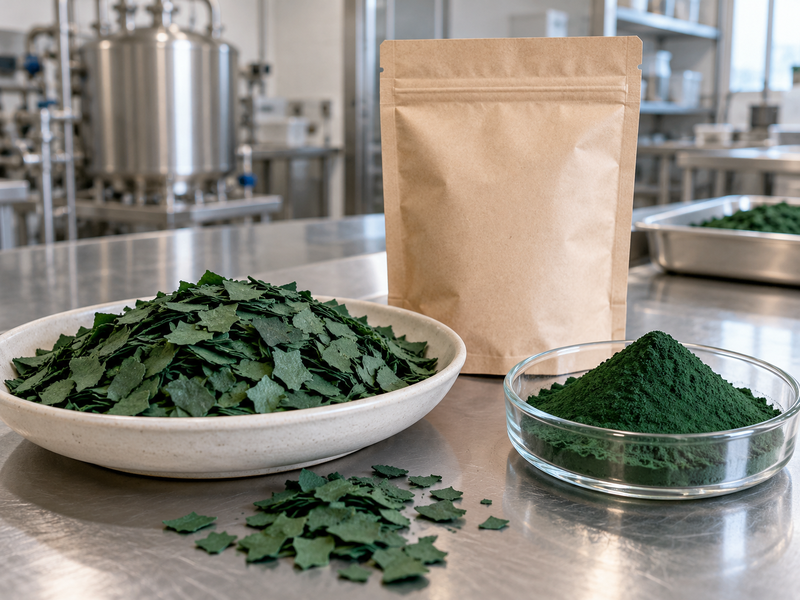
A printed species name is a claim. The COA should identify the commercial grade and whole-biomass form, then state how identity was checked under the supplier’s approved method. Ask whether microscopy, morphology, chemical fingerprint, or another scientifically valid method was used and what reference or acceptance rule supported the decision. The scope of identity testing depends on the intended use and quality system. For U.S. dietary supplement components, FDA describes a scientifically valid identity test or examination in its Part 111 guidance.
Names such as Arthrospira platensis, A. maxima, and “spirulina” can appear across commercial records. Do not rely on a taxonomic name alone to establish a grade’s purity or processing history. A useful supplier dossier includes source culture information, a consistent naming convention, a process flow, and controls that distinguish green biomass from blue extract. If a formulation requires an exact species, agree how that claim will be demonstrated before order placement. Record uncertainty openly rather than treating the phrase “100% spirulina” as an analytical finding.
| COA entry | Better supporting evidence | Weak response |
|---|---|---|
| Species or trade name | Approved identity method | Name only |
| Whole-biomass grade | Ingredient and process declaration | Extract COA |
| Lot | Harvest-to-pack mapping | Undated sample |
4. How should composition be interpreted?
Compare basis and calculation before percentages
Numbers need a denominator. Protein, moisture, ash, and other compositional entries may be reported on an as-sold basis or dry basis. Ask the laboratory which basis it used and which nitrogen-to-protein factor generated a “protein” value. A Kjeldahl or Dumas nitrogen test is not a direct amino-acid measurement. ISO 20483, although scoped to cereals and pulses rather than spirulina, explicitly notes that a Kjeldahl nitrogen method does not distinguish protein nitrogen from nonprotein nitrogen. The principle matters when comparing biomass reports.
Composition also reflects process and storage. Moisture by loss on drying and water activity are different properties. Ask for the named method and conditions instead of treating “dry” as a universal state. A color or odor note may help receiving staff but should not replace objective acceptance criteria where a purchase specification requires them. Compare values across several lots from the same grade to judge consistency, not just the prettiest example PDF. Keep nutrient-label calculations separate from raw-material purchase acceptance because finished serving size and local labeling rules require their own review.
5. Which contaminant entries need detail?
Read analyte, method, limit and matrix together
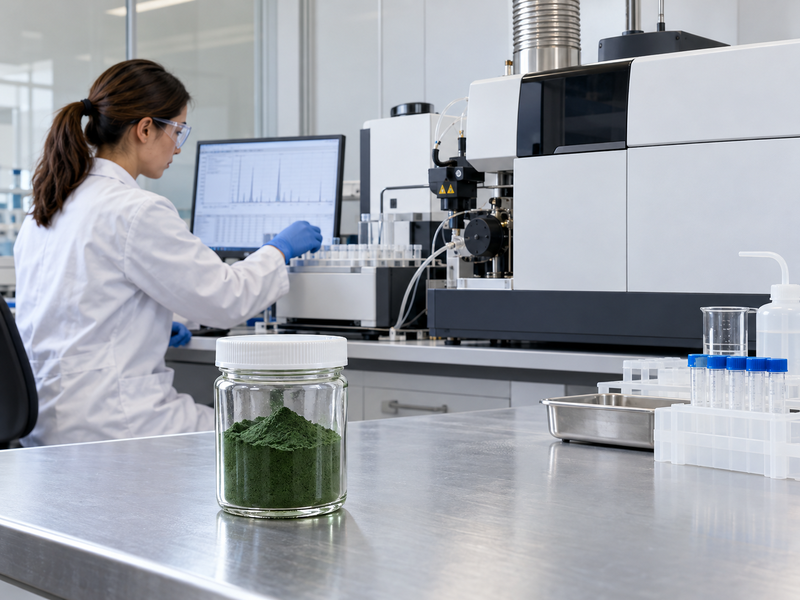
“Heavy metals: pass” is not a result. Request separate values or defensible less-than statements for the specified elements, such as lead, cadmium, arsenic, and mercury where relevant. Record units, detection or quantitation limit, test method, laboratory, and sample basis. FDA’s Elemental Analysis Manual includes ICP-MS method EAM 4.7 for several toxic elements in food. That reference shows the kind of method detail buyers can request; it does not impose a single universal spirulina limit.
Microcystin testing merits its own entry, with analyte scope and reporting limit. FDA’s blue-green algae and microcystin page describes risk assessment for products containing cyanobacteria. Its most prominent market examples involve AFA, so do not imply every spirulina product has that same contamination history. Destination rules and finished-use exposure guide acceptance. For EU sales, check the current contaminants regulation against the correct food category rather than borrowing a limit from another category.
| Entry | Ask to see | Why |
|---|---|---|
| Elemental panel | Individual analytes and units | “Total metals” hides exceptions |
| Microcystins | Method and reporting limit | “Not detected” lacks context |
| Pesticides if relevant | Scope and applicable limits | Screen only named residues |
6. What do microbiology results really say?
Check sample mass, method and release context
A negative finding has boundaries. The COA may list total aerobic count, yeast and mold, coliforms, E. coli, Salmonella, or other organisms chosen through hazard review. For presence-or-absence tests, ask the test portion mass and method. “Absent” without “in 25 g,” or another stated portion, invites misinterpretation. For counts, confirm CFU per gram, sample preparation, detection range, and whether the result was rounded. The FDA Bacteriological Analytical Manual publishes method chapters and revision histories, including a 2026 Salmonella chapter.
Receiving quality staff should ask whether the powder is a ready-to-eat ingredient and whether later processing includes a validated lethality step. A finished-product control cannot be presumed from an ingredient COA. Also ask how the manufacturer controls post-drying contamination, since a low moisture product can still carry organisms even if growth is limited. If a pathogen screen is pending, the lot belongs on hold under the agreed release procedure. A supplier’s “commercial release” and your own “receipt acceptance” may be two distinct decisions.
7. How do methods and reporting limits change meaning?
Make “not detected” and “less than” intelligible
The small print determines the answer. A report stating “<0.1 mg/kg” means the analyte fell below the laboratory’s stated reporting threshold; it does not establish a zero concentration. If the buyer’s limit is lower than that threshold, the test cannot demonstrate compliance. Ask whether a method was validated for whole spirulina biomass, which can behave differently from a clarified blue extract. The laboratory’s accreditation certificate should be paired with its scope for the particular analyte and method. ISO/IEC 17025 establishes a framework for testing-laboratory competence, not a blanket guarantee for every assay.
Units can also mislead. Convert µg/kg to mg/kg carefully, distinguish results on dry basis from as-sold basis, and retain original reports when someone transcribes values into a summary COA. Ask whether a microcystin method measures a named group of congeners or uses a broad screening response and how confirmation works. The supplier and buyer should agree before shipment which test result controls when methods disagree. A short method annex attached to the specification often prevents months of debate over one ambiguous “ND.”

| Report phrase | What it tells you | Next check |
|---|---|---|
| Not detected | Signal below a stated threshold | Find the threshold |
| Complies | Compared with some criterion | Identify the criterion |
| Protein 60% | A calculated or measured result | Find basis and factor |
8. What happens when a result is near a limit?
Avoid automatic retesting until the investigation is defined
Near-limit results require context. Review whether the reported value is above, below, or equal to the written criterion, then examine method uncertainty, sample representativeness, and any transcription error. Do not invent an extra tolerance after seeing the result. If the specification defines retesting, follow that procedure exactly and preserve the original result. Select sealed retain or commercial packs using a documented plan and send them to a laboratory with suitable scope. A new passing number does not erase an earlier failing one.
Ask whether the lot is internally homogeneous. A powder blend made from several harvest batches may vary across containers, particularly for moisture or contaminants associated with source material. Review the supplier’s deviation and investigation record, not simply a replacement COA. For a serious contaminant or pathogen concern, quarantine goods and have quality leadership decide disposition. A pre-agreed approach protects both sides: the supplier knows what evidence can resolve a discrepancy, and the buyer is not tempted to shop among laboratories for a favorable result.
9. How should supplier and independent reports be reconciled?
Compare like with like before judging
Two laboratories can test two different questions. Confirm that both sampled the same finished lot, used comparable composite schemes, reported on the same basis, and measured the same analyte scope. A supplier may test a homogenized production sample while the buyer tests a single bag exposed during shipping. Neither observation can explain the other without a traceable sample history. Check sealed retains, condition on arrival, calibration and quality-control notes when available, and method uncertainty.
For microbiology, different sub-samples may legitimately yield different results when contamination is uneven. Follow the written dispute protocol, including who selects a referee laboratory and how samples remain sealed. For protein, align nitrogen factor and moisture basis before assuming fraud. For metals, confirm digestion and reporting units. Record every finding with source files and dates. The goal is an evidence-based lot decision, not a contest to find the lowest number. Corrective actions may be needed even if the specific shipment can eventually be accepted.
10. Who signs the lot release decision?
Separate document review from commercial authorization
A COA is evidence, not permission to use powder. Assign a qualified reviewer to compare the report with the approved specification, inspect deviations, and record accept, hold, or reject. Purchasing can then act on the signed outcome. Link the decision to receiving checks, sample seals, any independent report, and the exact inventory lot in the warehouse system. If the supplier revised a COA, retain both versions with the reason. Do not let a sales promise override a quality hold or silently edit limits after receipt.
For repeat purchasing, trend a few meaningful measures across lots and note supplier process changes. A steady series is useful but cannot substitute for current-lot review. The Spirulina CN website describes available spirulina products; obtain the offered SKU’s current specification and lot documents rather than treating marketing copy as analytical evidence. Send a buyer-ready request listing form, market, target application, required analytes, methods, and delivery timing. That request helps the supplier provide a report your team can actually review.

| Decision | Record | Physical handling |
|---|---|---|
| Accept | Reviewer, date and specification revision | Release mapped inventory |
| Hold | Open questions and owner | Segregate lot |
| Reject | Failed criterion and disposition | Prevent use and investigate |
FAQ
Q1: Is a supplier COA enough for every buyer? No. Its sufficiency depends on the agreed specification, sample link, laboratory method, and the buyer’s risk controls.
Q2: Can a blue spirulina extract COA cover green whole biomass? No. The materials have different identities, processing, and analytical needs.
Q3: What does “ND” mean? It means below a stated detection or reporting threshold; request that threshold and analyte scope.
Q4: Must every result be independently retested? Set frequency through intended use, hazard analysis, supplier history, and applicable rules rather than assuming one universal schedule.
Q5: Who can release a disputed lot? The buyer’s designated quality authority should apply the written specification and deviation process.
A useful spirulina powder COA identifies one physical lot and lets a reviewer compare real results with rules set in advance. Match labels, methods, units, limits, and signatures before release. Request a current commercial-lot report and a sample trace when discussing the next order; that conversation exposes gaps while there is still time to fix them.