
A tablet can look firm at the press and still chip in transit or take too long to break apart in use. Chlorella tablet manufacturing needs a balanced formulation, controlled compression and finished-unit testing. This guide helps brands ask better questions during supplier qualification and factory trials. One study of commercial C. vulgaris preparations found wide variation in tablet disintegration. Those observations do not set a universal limit, but they show why a brand should test its own tablets.
Contents
- What tablet brief should lead the project?
- Which Chlorella powder properties matter?
- When is direct compression feasible?
- How should binders and excipients be chosen?
- Which press settings need control?
- How are hardness and friability balanced?
- Why test disintegration?
- Which safety and identity checks apply?
- How should tablets be packed and stored?
- What validates a commercial batch?
1. What tablet brief should lead the project?
Define dose, unit count and user experience
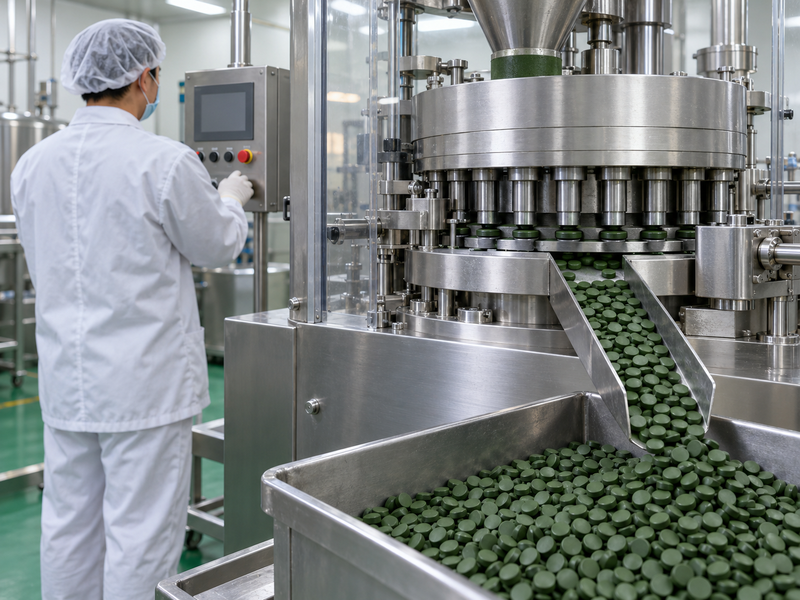
Specify Chlorella mass per tablet, tablets per serving, target diameter and thickness, and whether the tablet will be swallowed or chewed. Those choices determine press tooling, excipient allowance and package count. A small tablet may be easier for consumers but require more units to deliver the intended serving. A large tablet can reduce bottle count while raising swallowing concerns. Decide whether a coating is desired and whether the marketing statement implies “100% Chlorella.”
Do the material calculation. If each tablet must contain 400 mg Chlorella and total tablet mass is 450 mg, only 50 mg remains for all other ingredients. Ask the manufacturer whether that is enough to achieve the required flow and strength. Do not authorize a label dose from theoretical press weight alone. Trial yield, rejected units and tested finished weight determine the delivered amount. The brief should also name the species and grade; Chlorella is not interchangeable with Arthrospira Spirulina. The site’s blue Spirulina and Chlorella comparison helps teams avoid an ingredient-name mix-up.
2. Which Chlorella powder properties matter?
Qualify material for a mechanical process
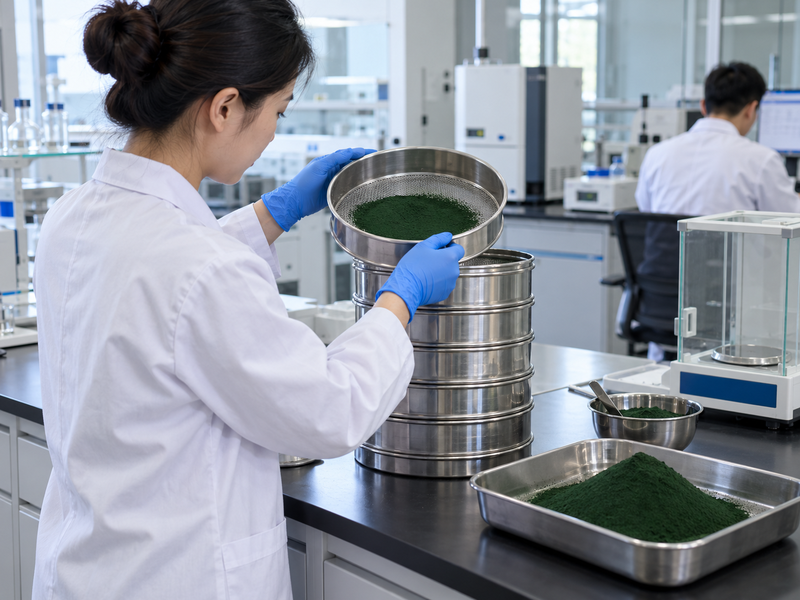
Particle size, moisture, density and flow affect die filling and compression. A fine powder may bridge or dust; a coarse powder may segregate or leave an uneven tablet surface. Moisture can influence binding and sticking. Ask the supplier for methods, limits and data from recent lots. A powder COA may report protein and microbiology but say nothing about compression behavior, so include a practical trial. Retain approved reference material for comparison when lots change.
Look beyond a single number. Two powders with similar bulk density may compress differently because cell-wall treatment or drying changes particle shape. The 2025 study of commercial Chlorella powders supports the broader point that grades differ; it does not predict press behavior for a particular supplier. Test the actual commercial grade and document its source lot. If a supplier changes milling, drying or strain, run a focused bridging trial before the next large order. A stable tablet begins with a controlled raw material, not a press adjustment that compensates for every variation.
| Property | Manufacturing effect | Buyer request |
|---|---|---|
| Particle size | Flow and appearance | Method and range |
| Moisture | Sticking/binding | Lot result |
| Bulk density | Die fill | Multiple-lot trend |
| Compressibility | Tablet strength | Pilot curve |
3. When is direct compression feasible?
Trial the simplest route against actual defects
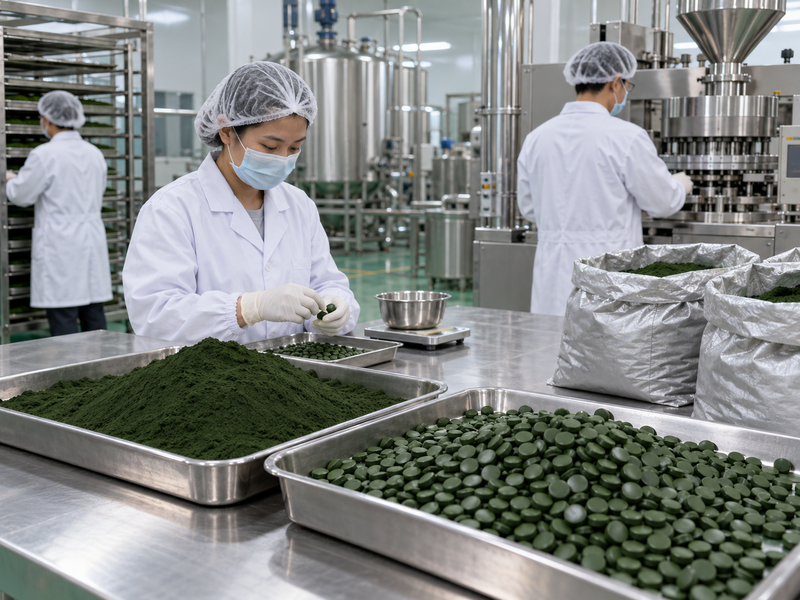
Direct compression feeds a blended powder to a tablet press without a separate granulation stage. It can reduce process steps when Chlorella powder and permitted excipients flow and bind adequately. However, the process may produce capping, lamination, weight variation or excessive dust if material properties are unsuitable. Ask the manufacturer to run a small compression curve across sensible force settings and record rejects. Do not assume that a successful hand-pressed sample will behave the same on a high-speed press.
Compare routes with a clear scorecard. If direct compression fails, dry or wet granulation may improve flow or binding, but adds equipment, yield losses and potentially heat or water exposure. Evaluate those changes against ingredient stability and label restrictions. The site’s Spirulina tablet compression article gives a related process checklist, yet Chlorella requires its own trial. Record press speed, tooling and powder lot with each result. The winning route is the one that repeatedly meets dose, strength, disintegration and cost targets, not the one with the fewest steps on paper.
4. How should binders and excipients be chosen?
Add ingredients for a measured function
A binder may strengthen a tablet, a disintegrant may help it break apart and a lubricant may reduce tooling friction. Each changes the formula, label and Chlorella percentage. Begin with a baseline and record the defect you need to solve. Test a small series rather than adding several ingredients at once. Confirm each material’s grade, supplier, permitted use and compatibility with any organic, vegan or clean-label promise. A processing aid should not be hidden in a “pure algae” statement.
Balance one improvement against another. More binder can raise hardness but may slow disintegration. Excess lubricant can change tablet strength. A coating can reduce dust and improve appearance yet add process cost and a separate stability question. Calculate actual Chlorella mass after every formulation change. FDA’s Part 111 CGMP guide describes master manufacturing records, components and specifications for applicable U.S. dietary supplements. Keep the approved formula and process version linked to every batch. An excipient is justified when it improves a specified outcome without creating a larger failure elsewhere.
| Function | Possible ingredient class | Check |
|---|---|---|
| Binding | Binder | Hardness and breakdown |
| Flow | Glidant | Weight variation |
| Tool release | Lubricant | Strength and label |
| Breakdown | Disintegrant | Validated test |
5. Which press settings need control?
Link machine settings to tablet results
Fill depth affects unit weight, while compression force affects thickness and mechanical strength. Press speed and dwell time can change how the same blend behaves. Record settings, tooling condition, environmental humidity and hopper level during trials. Sample tablets from startup, steady state and near the end of a run. A single acceptable midpoint sample does not prove control throughout the batch. Establish action limits that tell operators when to stop and investigate.
Use measured feedback. Plot hardness, thickness, friability and disintegration against compression force. Look for a workable range rather than one magic setting. If a tablet becomes hard enough for shipping but breaks down too slowly, adjust formulation or geometry instead of simply pressing harder. Watch for capping and edge chipping during ejection and dedusting. Tool wear can alter appearance over time, so maintenance belongs in the batch record. A process window with clear responses is more valuable than a recipe that depends on one experienced operator noticing trouble by eye.
6. How are hardness and friability balanced?
Test survival through handling and transport
Hardness reflects resistance to crushing under a defined test; friability measures tendency to lose material or chip under standardized tumbling. Neither single result describes every transport event, but together they expose weak tablets. Establish product-specific acceptance limits with the manufacturer and applicable standard. Examine chipped edges, dust, breakage and weight loss after a packaging and distribution trial. A tablet can pass a hardness test and still shed powder due to poor surface structure.
Do not optimize strength alone. Increasing compression can reduce breakage while slowing disintegration. The study of six commercial C. vulgaris preparations observed different physical properties and long disintegration times in tested tablets. Its sample size and products do not create a universal Chlorella specification. Instead, use a test panel that reflects your intended use and target market. Compare tablets after storage, since humidity or packaging may change their mechanical behavior. If a lot chips during shipment, investigate tooling, compression and pack together rather than blaming carriers alone.
| Test | What it indicates | Limitation |
|---|---|---|
| Hardness | Crushing resistance | Not full transit simulation |
| Friability | Surface loss/chipping | May miss bottle impact |
| Visual inspection | Capping and defects | Subjective without criteria |
| Pack trial | Real handling | Needs defined conditions |
7. Why test disintegration?
Confirm the finished tablet behaves as intended
Disintegration measures how a tablet breaks apart under a stated method. It is different from proving nutrient absorption or a health outcome. A hard, attractive tablet may remain intact too long under the product’s intended test. Define the applicable standard and medium with a qualified regulatory or quality team, then set a finished-batch limit. Test after manufacture and during stability if the formula or pack might change with time.
Treat the result as a design signal. If disintegration is slow, examine compression force, binder, lubricant, particle properties and tablet geometry. Avoid changing all factors together, since the cause then becomes unclear. The commercial preparation study found broad disintegration variation among the sampled C. vulgaris tablets; it supports direct testing, not a universal legal threshold. Keep raw data and equipment settings with the pilot. If marketing claims special bioavailability, disintegration alone cannot substantiate it. A reliable tablet should survive distribution and still perform under the agreed physical test.
8. Which safety and identity checks apply?
Release the ingredient and finished units
Confirm Chlorella species, supplier, grade and source lot before blending. Review microbiology, relevant elemental contaminants and any other hazards identified for the destination market and daily serving. A manufacturing process that presses powder into tablets is not automatically a microbial kill step. If several powder lots are combined, record all parent lots and quantities. Check that labels and packaging components are the approved versions before the line starts.
Know the regulatory role. U.S. dietary supplement manufacturers operating under 21 CFR Part 111 have specific specifications, batch-record and quality-control obligations. A different destination or product category may require another framework. FDA’s GRN 986 dossier concerns one C. sorokiniana ingredient for its described uses; do not treat it as blanket authorization for Chlorella tablets. Finished batch release should reconcile component identity, in-process results, physical tests and label checks. A COA from the powder supplier is an input, not the whole tablet decision.
| Material | Identity link | Release evidence |
|---|---|---|
| Chlorella powder | Species/lot | COA and receiving check |
| Excipients | Approved grade/lot | Component record |
| Tablets | Finished batch | Physical and safety tests |
| Label | Artwork version | Reconciliation |
9. How should tablets be packed and stored?
Prevent breakage and moisture change
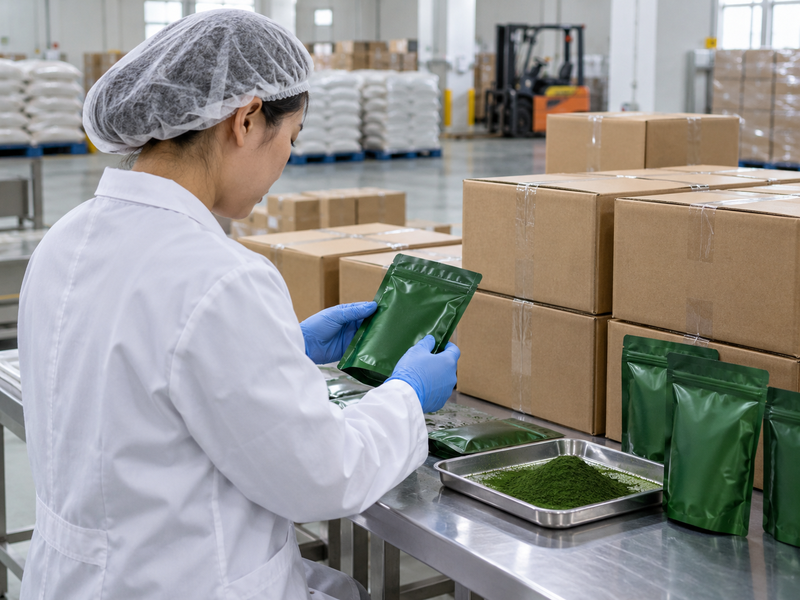
The bottle, pouch or blister must protect tablets through distribution and consumer use. Compare container size, headspace, closure, seal and any moisture-control feature. A large bottle with spare space may allow more impacts; a tight pack can create rubbing or dust. Run a distribution simulation and inspect units after transport. Stability testing should use the final commercial pack, not a laboratory jar. Include tablet appearance, friability, disintegration and relevant composition in the study plan.
Test the worst practical route. If a shipment crosses humid ports or warm warehouses, include exposure that reflects it. Inspect seal integrity and lot readability at receipt. A bulk powder shelf-life claim cannot establish the finished tablet’s expiry because compression and added ingredients can change behavior. If a brand switches from bottle to pouch, reassess both breakage and moisture protection. The site’s Spirulina tablet breakage guide offers a related buyer checklist, but Chlorella tablets need their own validation. The pack should preserve the result achieved at the press.
10. What validates a commercial batch?
Confirm repeatability from raw powder to labeled pack
Use a production-equivalent pilot with the actual Chlorella grade and intended equipment. Set acceptance limits before running. Record raw-material lots, blend uniformity where relevant, press settings, tablet weight, hardness, friability, disintegration, appearance, rejects and yield. Check finished packaging and label reconciliation. A retained sample should represent the released batch. If a new supplier lot creates a different compression curve, assess whether the raw-material specification needs a tighter physical range.
Make disposition explicit. The batch record should show deviations, investigations and the quality decision. FDA’s supplement CGMP guide details such records for applicable U.S. operations. Include cost per accepted tablet, since rejected and broken units can overturn a low powder price. A contract manufacturer should provide a written change-notice path for tooling, process and excipients. After approval, monitor trends across routine batches rather than treating validation as a one-time ceremony. Reproducible physical performance and a clear lot record make the brand’s claim credible.
| Gate | Required evidence | Decision owner |
|---|---|---|
| Ingredient | Approved lot | Quality |
| Compression | Process window | Operations |
| Physical tests | Within limits | Laboratory |
| Pack/label | Reconciled | Quality release |
What to do next. Chlorella tablet manufacturing works when powder properties, formula, press settings and pack are evaluated together. Request a production-equivalent trial and inspect hardness, friability and disintegration alongside dose and safety. A tablet that survives delivery and performs as specified protects both the brand and its customer.
FAQ
Q1: Can Chlorella powder be pressed without excipients? Sometimes; only a compression trial can establish reliable performance for the offered grade.
Q2: Does a harder tablet always perform better? No. Excess strength may slow disintegration.
Q3: Is disintegration the same as absorption? No. It is a physical breakdown test, not proof of absorption.
Q4: Can a powder COA release tablets? No. Finished tablets need their own controlled batch review.
Q5: What should a brand compare in quotes? Cost per accepted, packaged tablet at the required dose and quality.