
A Chlorella powder can pass every release test and still arrive with a torn liner, unreadable lot code or too little usable life. Chlorella bulk packaging is part of the ingredient specification because it protects quality and allows a buyer to receive, trace and dispense each lot. This guide covers inner liners, closures, net weights, pallets, transport and receiving. FDA’s food-contact guidance explains that component authorization depends on intended use and conditions; a generic “food grade” statement deserves review against the actual pack.
Contents
- What belongs in a bulk-pack specification?
- How should the inner liner be selected?
- Which closure details protect powder?
- How are net weight and fill tolerance defined?
- What should every drum or carton label show?
- How should pallets be built and identified?
- Which transport conditions need control?
- What should receiving inspect?
- How are damaged or opened packs handled?
- What packaging trial should buyers request?
1. What belongs in a bulk-pack specification?
Define the complete pack system
Specify the direct-contact liner, outer drum or carton, closure, net weight, label, pallet pattern and storage statement. Also, the pack should match the exact Chlorella grade, destination market and expected transit. Powder moisture, particle size and color sensitivity can influence barrier needs. For example, a bulk pack for a local factory may see a different distribution chain from a pallet moving through ocean freight and several warehouses. Ask which components are approved and who may substitute them during shortages.
Treat the pack as a controlled material. A nominal “25 kg drum” description omits liner resin, film thickness, seal style and permitted fill range. Request a drawing or written pack specification with version control. FDA describes food-contact substances as materials that contact food without a technical effect in it; their regulatory status depends on the component and use. Buyers should ask for supplier declarations appropriate to the actual food or supplement application and market. If the supplier changes liner or closure, require a quality review before assuming the same shelf-life data and receiving method still apply.

2. How should the inner liner be selected?
Match food contact and barrier needs
The inner liner directly contacts Chlorella powder and should be suitable for its intended food-contact use under the conditions of storage and transport. Ask for material identity, supplier, dimensions, thickness, seam construction and any applicable declaration. However, a liner that is compliant for one food type or temperature is not automatically suitable for every use. FDA’s regulatory-status guide stresses intended use and conditions for food-contact components. Then, have your packaging or regulatory team review the actual documentation for your destination market.
Check how it handles on the line. A liner must fit the outer container without deep folds that trap powder or tear during removal. Measure whether the opening supports sampling and dispensing without introducing dust or contamination. If a supplier uses a double liner, clarify whether both layers contact product and how they are closed. Examine sample packs after realistic handling. A strong barrier claim should identify the measured property and method, not simply say “moisture proof.” Liner selection affects recovery too: powder left in folds or seams increases cost per usable kilogram.
| Liner field | Supplier evidence | Buyer check |
|---|---|---|
| Material | Food-contact declaration | Intended use/market |
| Dimensions | Drawing or sample | Fits container |
| Seams | Construction/inspection | No leaks or traps |
| Barrier | Test and method | Storage need |
3. Which closure details protect powder?
Specify what “sealed” means
An inner bag can be heat sealed, tied with an approved closure or closed another validated way. Ask exactly how the supplier closes it, what equipment or settings are controlled and how integrity is checked. For example, a loose twist under a drum lid may appear closed while allowing moisture or dust exchange. Meanwhile, the outer lid, ring, tape or tamper feature should remain intact through distribution. Define whether a break in the outer closure triggers quarantine even if the liner seems untouched.
Try an ordinary opening. Have operators open a sample as they would at the plant. Can they inspect the seal without contaminating powder? Can they reseal a partially used pack under a controlled in-use procedure? Photograph acceptable and unacceptable closure examples in receiving instructions. Ask the supplier how it detects incomplete seals and reconciles rejected packs. A closure change may affect shelf-life evidence, so keep it within change control. The FDA food-contact information page also notes that adhesives and other packaging components can be food-contact substances under relevant conditions. Review the actual construction, not merely the drum exterior.

4. How are net weight and fill tolerance defined?
Separate product mass from packaging mass
State net Chlorella mass per unit and the accepted tolerance. Ask how the supplier tares liners and outer containers, calibrates scales and verifies filled units. However, gross weight includes packaging and cannot be used as the invoice quantity without a defined conversion. For example, a drum filled above design capacity may stress its liner or closure; an underfilled one can create commercial discrepancy and extra headspace. Define how partial packs are labeled and whether they are acceptable at all.
Calculate the received quantity. Count packs, read stated net weight, then reconcile pallet totals against packing list and purchase order. If mixed net sizes are permitted, list each size separately. Sampling can remove a small amount before dispatch; the contract should say whether labeled net mass is before or after that draw. Record scale and label checks in the pack run. A buyer using automatic dosing may prefer a consistent pack size because operators can reconcile consumption more easily. Good weight control makes both inventory and complaint investigations simpler.
| Weight term | Meaning | Receiving action |
|---|---|---|
| Net | Powder only | Compare PO |
| Tare | Empty pack | Check supplier method |
| Gross | Pack plus powder | Freight/pallet planning |
| Tolerance | Allowed deviation | Accept or investigate |
5. What should every drum or carton label show?
Make identity visible without opening the pack
Each bulk unit should carry product name, grade, lot code, net weight, pack or manufacture date and applicable expiry or retest date. Include storage instructions and the manufacturer or responsible seller as agreed. When an outer container is removed from its pallet, its identity must remain clear. So, a pallet label cannot replace unit-level labeling. Ask whether the label is durable against abrasion, moisture and cold or warm conditions in the planned route.
Reconcile label with evidence. The lot code on a drum should match the COA, packing list and warehouse receipt. If a distributor adds a stock code, preserve the original manufacturing lot. A C. vulgaris specification should not be paired with a pack labeled C. sorokiniana. Chlorella is distinct from Arthrospira Spirulina, so an algae category name alone is insufficient. GS1’s global traceability standard describes product, lot and logistics-unit links; a controlled internal code can work if it gives equivalent traceability. Test readability after transport, not only at the packaging line.
6. How should pallets be built and identified?
Protect units while keeping lots separable
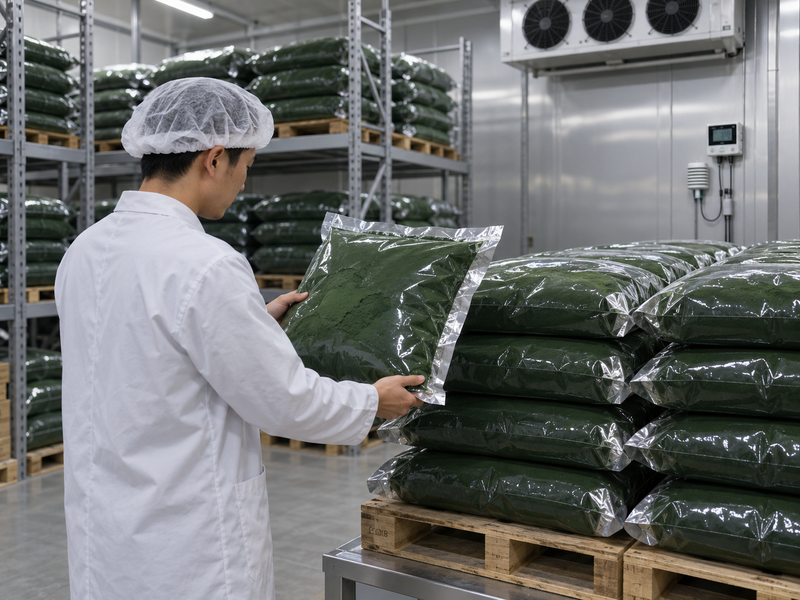
Agree on pallet material, dimensions, maximum height, stacking pattern, wrapping and whether corner protection is used. For example, a heavy upper layer can deform cartons or lids, so check the actual loaded configuration. Also, mixed lots should be segregated or clearly mapped on a pallet manifest. Then, the pallet identifier should link to contained unit IDs and lot quantities. Ask how units are secured against movement without wrapping so tightly that labels become unreadable or packs deform.
Run a warehouse scenario. If a pallet is split across two shipments, can the supplier update the manifest without losing lot identity? If one drum is damaged, can the remaining units be released independently? GS1’s traceability standard supports linking logistic units, products and batch identifiers. A serial shipping container code is useful when partners adopt it; a clear controlled pallet ID can also serve a smaller route. Inspect fork entry and clearance because punctures often occur during handling rather than inside a container. The best pallet plan preserves pack integrity and lets receivers count lots quickly.
| Pallet item | Agreed detail | Risk controlled |
|---|---|---|
| Pattern | Units and layers | Crush/shift |
| Wrap | Type and tension | Movement |
| ID | Pallet-to-unit map | Traceability |
| Mixed lots | Segregation rule | Wrong-lot use |
7. Which transport conditions need control?
Match route risk with pack and storage instructions
Powder may cross humid ports, warm trucks or temporary warehouses. Specify conditions supported by the supplier’s stability evidence and identify which excursions require review. Meanwhile, the outer container should resist normal stacking and handling; the liner should protect against moisture under the planned route. Ask whether a container is inspected for leaks, odors and prior cargo concerns before loading. For a route with long storage, establish minimum remaining life at buyer receipt rather than assuming the printed shelf life begins on arrival.
Follow the handoffs. Record departure, carrier, pallet count, intermediate storage and delivery condition. A temperature log may be useful for a sensitive product, but it is only valuable when someone reviews it against a rule. If condensation appears inside a container, quarantine exposed pallets until the supplier and buyer assess damage. A clean COA issued before shipment cannot prove a liner stayed intact during transit. FDA’s food CGMP overview describes holding controls for applicable food operations. Write practical transport instructions that carriers and receiving teams can follow.

8. What should receiving inspect?
Check physical condition before quality release
At arrival, reconcile vehicle, pallet, unit and lot counts with the packing list. Inspect outer damage, wetness, odor, broken closures, punctures and labels. Then, open only according to a controlled sampling procedure; a casual inspection can create the contamination it was meant to detect. Next, compare lot codes and dates with the COA, purchase specification and minimum remaining-life rule. Record photographs and location for any exception before material moves into available inventory.
Make the decision visible. Mark packs accepted, held or rejected in both physical storage and the inventory system. A dented outer drum may be usable if the liner is intact and a qualified reviewer approves it; a torn liner usually needs a more serious assessment. Define these decisions in advance. If only one unit is damaged, keep its identity so the rest of the lot can be assessed fairly. Do not erase the original supplier label with a warehouse sticker. The receiving record should connect the actual pack, its condition and the quality release signature.
| Receipt check | Evidence | Hold trigger |
|---|---|---|
| Count/weight | Packing list | Shortage |
| Seal/liner | Visual inspection | Open or torn |
| Lot/date | COA and label | Mismatch |
| Pallet state | Photo and notes | Wet/crushed |
9. How are damaged or opened packs handled?
Use a written disposition path
Segregate questionable units and document their original lot, pack number and condition. For example, a damaged outer drum with a sound inner liner may have a different risk from a punctured liner or wet powder. Quality should decide whether additional sampling, repacking, return or destruction is appropriate. When a pack is opened for buyer testing, label it as opened and apply an in-use handling rule. The supplier’s sealed-pack expiry does not automatically apply after exposure to room humidity.
Keep parent-child traceability. Repacking should preserve the source lot and record new pack material, operator, date, net weight and release decision. For U.S. dietary supplements, FDA’s Part 111 guide discusses repackaging and quality release where applicable. Other markets require their own assessment. A verbal instruction to “tape it up” is not enough when the original barrier has failed. Agree with the supplier who pays for testing or replacement and how quickly evidence will be shared. The most useful complaint packet includes photos, shipment data and the affected unit codes.

10. What packaging trial should buyers request?
Test the real pack through a representative route
Request a production-filled sample in the proposed liner and outer container. Then, check net mass, liner fit, seal quality, label readability and powder recovery after dispensing. If orders will ship by sea, include a route or distribution simulation that represents stacking, vibration and likely handling. Next, inspect several units afterward for leaks, punctures, clumping and damage. Also, ask the supplier for three recent shipment examples with complaints or exceptions, not only one perfect demonstration pack. The site’s blue Spirulina bulk-packaging guide offers analogous handoff questions; approve Chlorella’s pack on its own evidence.
Turn results into purchase terms. Approve a specific pack drawing and version, maximum pallet height, unit label fields, remaining-life threshold and procedure for damaged goods. Define change notice for liner, closure, outer container or packer. Link packaging validation to the product’s shelf-life study; a different film can change the evidence base. Compare cost per usable kilogram, including residual powder trapped in liners and any transport loss. A sound pack is one a warehouse can inspect, a production team can dispense and a quality reviewer can trace without uncertainty. That is a concrete value beyond a sturdy-looking drum.
| Trial gate | Test | Pass evidence |
|---|---|---|
| Contact | Liner documentation | Intended-use match |
| Integrity | Seal and transport check | No leaks |
| Identity | Label/lot reconciliation | Exact match |
| Use | Dispense and weigh | Acceptable recovery |
What to do next. Chlorella bulk packaging should protect powder and carry its identity through every handoff. Approve the complete pack system, inspect a filled trial after transport and define receiving dispositions before ordering volume. That gives buyers a usable ingredient, not merely a passing COA inside an uncertain container.
Frequently asked buyer questions
FAQ
Q1: Does a “food-grade drum” prove its liner is suitable? No. Review the actual food-contact material and intended conditions.
Q2: Can a pallet label replace drum labels? No. Each unit needs an identity after the pallet is split.
Q3: Is gross weight the purchased powder quantity? No. Contract and reconcile net powder weight.
Q4: Can a dented drum be accepted? Quality may approve it after assessing the inner liner and documented damage.
Q5: What packaging change needs buyer notice? Changes to liner, closure, outer pack, packer or label system that could affect quality or traceability.