
A spirulina tablet compression process can make attractive green samples yet fail during a commercial run. Powder feeds unevenly, edges chip or tablets become slow to break down. The solution is a staged trial that joins ingredient characterization, formulation, machine settings and finished-unit tests. Research on spirulina and date-based tablets examined hardness, friability and disintegration; its formula is a study example, not a ready-made specification for another plant.
Contents: 1 · 2 · 3 · 4 · 5 · 6 · 7 · 8 · 9 · 10
1. What must be known about incoming spirulina powder?
Characterize the lot before adjusting the press
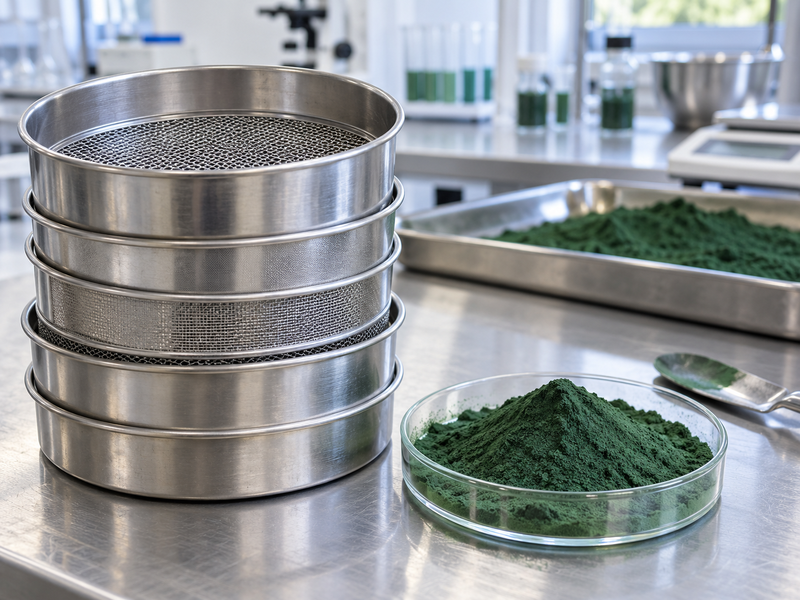
Begin with identity, lot traceability and the approved food or supplement specification. Then measure properties relevant to compaction: moisture, particle-size distribution, bulk and tapped density, flow behavior and visible agglomerates. Record the methods, not only the numbers. USP’s bulk and tapped density chapter notice illustrates why density comparisons depend on method. A change of drying or milling can shift behavior even when a broad COA still passes.
Take samples from more than one commercial lot if launch volumes require recurring supply. Evaluate whether powder segregates during transfer, clings to contact surfaces or develops lumps after storage. A tablet press cannot correct an undefined raw material. Keep a sealed retain and collect its storage history. If R&D starts with a tiny hand-milled sample, tell operations how that material differs from the proposed bulk grade. What matters early: a stable material description makes later compression experiments interpretable.
2. How should a tablet formula be designed?
Assign a purpose to each component
Start with the target spirulina mass per tablet and a realistic size for handling and swallowing. Add only components that solve a measured problem, such as poor flow, inadequate binding, sticking or slow disintegration. Record each material’s grade, supplier, proportion and mixing order. The formula should also preserve label accuracy: a tablet’s total weight includes every processing aid, not only spirulina. Check proposed excipients against intended markets before pilot production.
Test a small matrix rather than changing many ingredients at once. For example, compare two binder levels at a fixed compression setting, then hold the best blend constant while examining press force. That sequence separates ingredient effects from machine effects. A tablet mixture-design study found formula factors changed hardness, friability and disintegration in its particular system. It does not set universal limits. A good formulation record: explain why every aid is present and how its level was selected.
| Formula input | Intended role | Evidence needed |
|---|---|---|
| Spirulina | Declared ingredient | Identity and content basis |
| Binder | Cohesion | Strength versus disintegration |
| Flow aid | Consistent die feed | Weight distribution |
| Lubricant | Release from tooling | Sticking versus strength |
3. When is granulation worth testing?
Let powder behavior drive the route
Direct compression is attractive because it removes a processing stage, but it only works when a blend flows and compacts adequately. If the hopper bridges or individual tablet weights drift, test a controlled granulation route rather than raising machine speed and hoping for stability. Dry granulation may improve feed for some formulas, though it can alter particle distribution and compressibility. Wet granulation introduces liquid, drying and another opportunity for color or odor changes. None is automatically better for every spirulina grade.
Compare candidate routes using the same final targets: unit weight spread, breaking force, friability, disintegration, appearance and retained composition. Record granule size, fines, moisture and yield after milling. A process that makes strong tablets but discards much material may be commercially poor. Assess cleaning and microbial controls before adding water to a formula. The decision point: granulation should answer a documented failure in direct compression and pass the finished-unit checks afterward.
4. Which tooling choices affect tablet quality?
Match shape, size and press capability
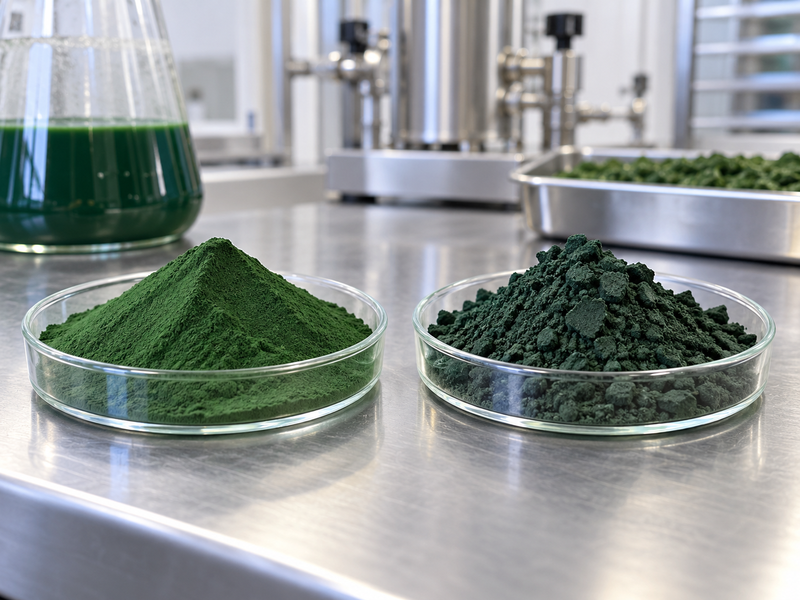
Tablet diameter and thickness set more than appearance. They influence die fill, edge strength, packing count and user handling. Deep embossing can hold powder and produce illegible marks. Sharp corners can chip during dedusting or transport. Discuss punch design, cup profile and target fill depth with a tooling specialist using actual formula samples. A proposed large spirulina dose may need a wider tablet that users reject; revisit daily serving design before buying tooling.
Check how tooling behaves on the plant’s press, not just a small laboratory machine. Ask for inspection of pickup, sticking, capping and variable thickness throughout a run. Record tooling identification in the trial and batch documents so later changes can be traced. FDA’s Part 111 manufacturing guidance calls for master and batch records that identify relevant production controls for US supplements. Practical safeguard: approve the tablet drawing only after the press trial confirms it can be made consistently.
| Tool feature | Possible issue | Pilot observation |
|---|---|---|
| Diameter | Unit size and fill depth | Dose and handling |
| Edge profile | Chipping | Dedusting loss |
| Emboss | Powder pickup | Legibility and rejects |
| Cup depth | Thickness variation | Strength and appearance |
5. How should compression settings be developed?
Establish a working range, not one lucky setting
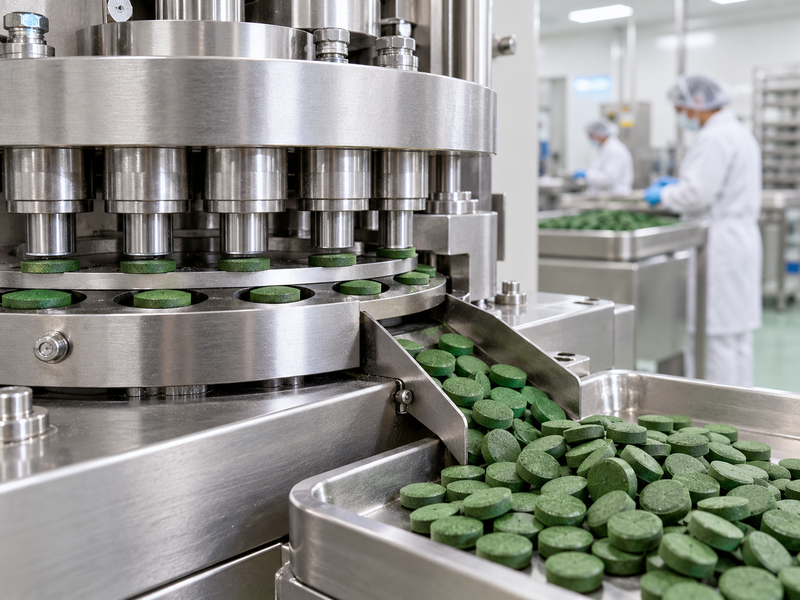
Run a structured trial across relevant precompression, main compression and press-speed settings. Measure unit weight and thickness alongside mechanical strength. A higher force can improve cohesion while slowing disintegration or triggering capping after ejection. Faster running can reduce die-fill time and widen weight variation. Record room conditions and hopper level, since these can move during production. Do not claim a universal force for spirulina; tooling geometry and blend behavior determine the useful range.
Take samples after startup, during steady running, after a short stop and at the end. Compare defects by time and machine setting. If tablets split only after a stop, a static laboratory sample will miss the problem. Record dust and the mass of rejected pieces. A pilot should produce enough units for packaging and stability work, not merely for a photograph. A stronger process window: identify settings that pass all agreed tests across realistic disturbances.
6. What do friability and breaking force tell you?
Interpret two different stress tests
Breaking force shows how a tablet responds to a defined load. Friability assesses abrasion and mechanical loss under a specified test. A high breaking force does not guarantee low friability, especially if corners chip or surfaces shed powder. Test both using a stated method and the actual tablet design. Include appearance and mass loss after handling. A research paper on Moringa-spirulina tablets reported physical outcomes for its own formula; copy its experimental logic, not its acceptance numbers.
Set commercial criteria with quality, packaging and target-market staff. Test units after any coating step and after simulated distribution if bottles will be shaken in transit. Investigate chips: formulation, tooling, excessive dedusting and poor pack fit can all contribute. Reject data should feed back into process design, not disappear as “normal loss.” What a buyer should request: raw test records, methods, sample timing and how failures were dispositioned.
| Measurement | What it shows | What it cannot prove alone |
|---|---|---|
| Breaking force | Resistance to a load | Low abrasion |
| Friability | Loss under tumbling | Rapid disintegration |
| Thickness | Press consistency | Composition |
| Visual defects | Chipping or capping | Full lot uniformity |
7. How should disintegration be assessed?
Test intended use, not a generic promise
A tablet that survives shipment still must behave as the product design requires. Define the intended use and select a suitable disintegration test with quality and regulatory input. A chewable tablet, a swallowed tablet and a tablet intended for dispersion in water have different user expectations. Record test medium, temperature, apparatus, sample count and endpoint. Comparisons without matching methods can mislead, even when each supplier presents a single time value.
Review disintegration alongside binder level, compression force and stored-unit age. A fresh tablet can differ from one held in a humid pack. If the formulation is altered to shorten the test, repeat friability and pack handling checks. Avoid equating disintegration with any promised biological effect. For a dietary supplement, demonstrate that the finished product meets its own approved specifications and lawful presentation. The useful tradeoff: strength must protect the unit without defeating its intended use.
8. Which in-process checks belong on the line?
Catch drift before it becomes a batch failure
Build a frequency plan for unit weight, thickness, visible defects and any other parameter demonstrated to control quality. Define alert and action limits, not only a final release limit. When a check fails, identify the affected time window and place its material on hold. A line operator needs a written response that covers adjustment, resampling and quality review. The schedule should be practical for the press rate and risk of drift.
Log blend identity, equipment, tooling, settings, rejects, yields and each adjustment. For US dietary supplements, 21 CFR 111.260 specifies extensive batch-record content, including monitoring results and quality disposition. Other jurisdictions have their own rules. Do not replace records with a clean final COA. A useful management view: plot weights and defects across the run to see whether trouble correlates with hopper changes or stops.
| Checkpoint | Sample timing | Action if outside limit |
|---|---|---|
| Startup | Before routine release | Hold startup output |
| Running | Defined interval | Segregate affected window |
| Restart | After interruption | Verify settings and weights |
| End | Before lot close | Reconcile yield and rejects |
9. What changes after compression?
Include downstream handling in validation
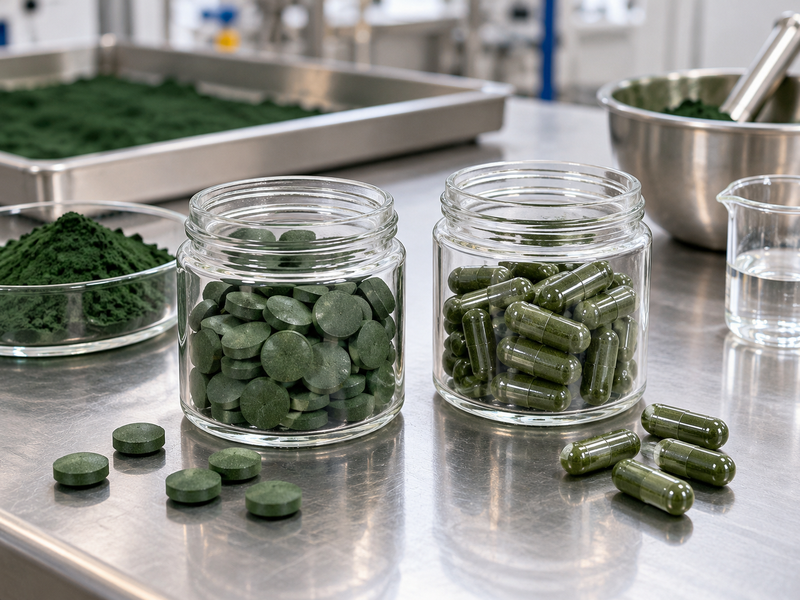
Tablets pass through dedusting, inspection, metal detection where applicable, counting and packaging. Each transfer can create chips, dust or mix-ups. Record defects at each stage to find where loss occurs. If coating is proposed, evaluate weight gain, uniformity, ingredient declaration and whether the added process changes disintegration. Package trials should include the actual count, insert, desiccant and closure or blister tooling that the brand intends to sell.
Pull stability samples from the final packaged lot. Track appearance, odor, physical integrity and any declared assay or other relevant specification across the proposed shelf life. A tablet that passes at press discharge might fail after a transit simulation or weeks in a permeable pack. Ask suppliers for material compatibility and current food-contact evidence where applicable. FDA explains how food-contact substance status depends on authorized use conditions. The complete process: release evidence must cover the tablet customers receive.
10. What should the handoff package contain?
Transfer a controlled process, not a sample jar
The finished package should identify ingredient and excipient specifications, formula version, blending procedure, tooling, settings range, in-process limits, test methods, packaging configuration and change-control triggers. Include pilot yields and defect trends. State which changes require a new trial, such as a different spirulina supplier, particle-size range, lubricant grade or punch design. Attach signed master and batch records as required by the manufacturer’s quality system.
Agree on a commercial-lot acceptance plan before purchase. A single good pilot may not cover raw-material variation, so schedule a check of early production lots against the approved retain. Review deviations with quality staff and retain evidence of disposition. Do not present research-paper values as certified factory results. The purchasing question: can the manufacturer reproduce the approved tablet and show records that explain each lot’s release?
| Handoff item | Purpose | Change trigger |
|---|---|---|
| Ingredient specification | Consistent raw material | New grade or source |
| Formula and process | Reproducible units | Component or setting change |
| Test plan | Defensible release | New method or limit |
| Pack specification | Stable retail unit | New material or count |
An illustrative handoff problem shows why the full file matters. Suppose a pilot uses a very fine green powder and the purchasing team later buys a coarser grade with the same broad protein specification. The press may still make tablets, yet die-fill variation, abrasion and disintegration could all move. A change review should compare the new powder’s measured properties with the qualified range, run representative units and document whether settings or the formula need revision. Until quality accepts that evidence, the earlier pilot does not automatically support the new grade.
FAQ
Q1: Can spirulina powder be directly compressed? Some lots and formulas may work. Confirm flow, compaction and finished-unit results in a representative trial.
Q2: Does greater hardness always mean a better tablet? No. It can change disintegration and may not prevent surface abrasion.
Q3: Why measure friability after packaging trials? Transfers and transport can reveal damage missed at press discharge.
Q4: Is granulation required? Only when a documented problem and comparative trial support that route.
Q5: Can one pilot set every future lot’s settings? No. Establish a justified range and assess raw-material variation.
Next step
Treat spirulina tablet compression as a chain of controlled decisions. Qualify powder, test a lean formula, establish a press window and verify units after packaging. Ask the manufacturer for pilot records with defects and rejects, not only passing averages. That package turns a promising green tablet into a reproducible commercial product.