
A capsule concept can fail after a supplier quote because powder density, flow or shell size cannot deliver the planned serving. Chlorella capsule formulation turns an approved biomass grade into a repeatable filled unit with defined weight and label information. This guide covers ingredient selection, machine trials and quality release. FDA’s dietary supplement CGMP guide describes U.S. Part 111 controls for applicable manufacturers; other markets require their own review.
Contents
- What dose and serving should be specified?
- Which powder attributes affect filling?
- How should capsule size and shell be chosen?
- When are flow aids or carriers justified?
- How can a pilot verify fill weight?
- What should be checked during production?
- How are identity and contaminants controlled?
- What affects capsule stability?
- How should labeling and claims be reviewed?
- What belongs in a manufacturing brief?
1. What dose and serving should be specified?
Work backward from the finished serving
Start with the amount of Chlorella intended per daily serving, number of capsules and target fill weight. For example, a 500 mg claim per capsule is a net ingredient statement only if the formula actually provides that amount after excipients and manufacturing variation. Also, define whether the label states whole Chlorella powder, a standardized component or another fraction. Check that the species and process match the ingredient dossier. Do not copy a competitor’s serving as evidence of suitability for your target market or product concept.
Do the capsule arithmetic. If a proposed serving contains 2 g across four capsules, each unit needs about 500 mg of Chlorella before any added material. Next, ask the contract manufacturer whether that mass fits consistently in the chosen shell using actual powder density. If it does not, options include larger capsules, more units per serving or a reformulated blend. As a result, each option has cost and consumer-use effects. Record the calculation in the product brief so procurement does not buy a grade solely because it passed composition testing. The commercial question is whether the promised dose can be delivered at scale.
2. Which powder attributes affect filling?
Measure density, flow and particle behavior
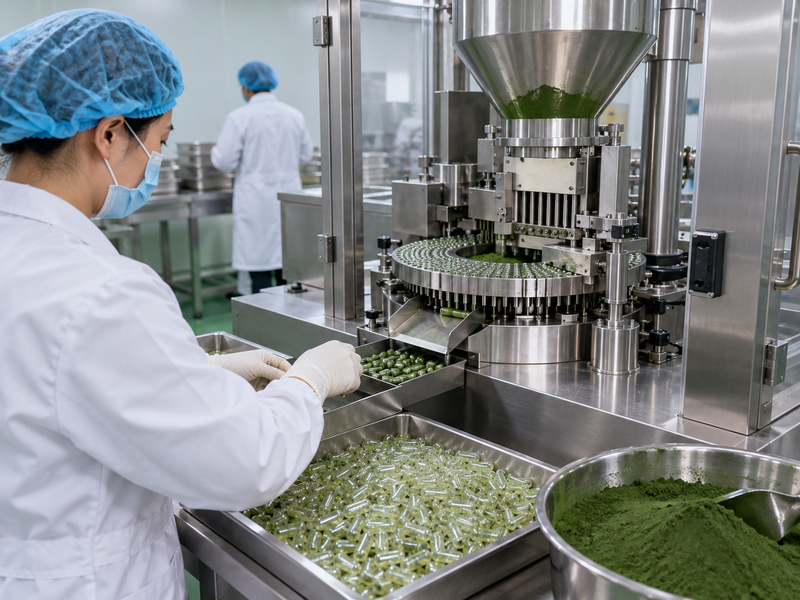
Bulk density determines how much powder occupies a capsule volume. Tapped density shows how material settles under vibration. Meanwhile, flow describes how reliably it moves through equipment. Particle size, moisture, electrostatic behavior and cohesion can change all three. Also, ask for methods and ranges on several commercial lots. However, a COA focused on protein and microbiology may omit physical attributes that drive fill variation. Observe clumping, dust and bridging during a machine trial rather than predicting performance from a product photo.
Match the actual machine. A powder may fill well by hand yet bridge in an automatic hopper. Then, test hopper level at start and near empty, then compare unit weights across run positions. If the supplier mills Chlorella more finely, a sensory benefit for beverages could create a flow challenge for capsules. A comparison of commercial Chlorella powders underscores product variation; it does not replace your equipment trial. Set a physical-property window only after observing more than one production lot.
| Powder property | Method detail | Possible fill effect |
|---|---|---|
| Loose bulk density | Defined cylinder test | Capsule capacity |
| Tapped density | Tap count/method | Settling change |
| Particle size | Sieve or laser | Flow and dust |
| Moisture | Agreed test | Clumping |
3. How should capsule size and shell be chosen?
Balance capacity with consumer use
Capsule size is a volume classification, not a guaranteed milligram capacity. In practice, the fill mass achievable for Chlorella depends on its density and compaction under the selected machine. Shell materials can include gelatin or plant-based alternatives, each with its own sourcing, moisture and label considerations. Ask the manufacturer for approved shell specifications, colorants if used and dimensions of the closed capsule. Trial the actual shell with the actual powder before approving a pack design.
Check the full customer experience. A larger shell may fit the dose but feel less acceptable to consumers. At the same time, more smaller capsules can increase bottle count, packaging cost and daily burden. Vegetarian, organic, allergen or market-specific claims need documentation for both biomass and shell. Also confirm whether the shell tolerates the intended storage humidity. The site’s Spirulina capsule fill-weight guide provides a related process checklist; Chlorella must be measured separately. Keep the selected shell supplier and grade under change control because a seemingly minor substitution can alter fill, closure or label claims.

4. When are flow aids or carriers justified?
Add only what solves a measured process problem
Excipients can improve flow, reduce sticking or adjust fill, but they change the ingredient list and may dilute Chlorella per capsule. For example, run a baseline trial with the selected powder, then document the specific defect before adding a flow aid. Next, compare several technically suitable options at minimal effective levels. Check permitted use and declaration rules in the destination market. A “100% Chlorella” claim cannot coexist with undeclared added carriers, even if the added amount seems small.
Follow the mass balance. If a capsule contains 500 mg total fill and 20 mg excipient, it cannot deliver 500 mg Chlorella. Recalculate serving and label statements. For example, some manufacturers may propose granulation to improve handling; that adds process steps, water or binder exposure and stability questions. Request a clear formulation and batch record. FDA’s Part 111 guidance describes master manufacturing records and component controls for applicable U.S. supplements. Keep the formula simple where it performs, but let measured fill results decide whether an aid is useful.
| Problem | Possible response | Check before adoption |
|---|---|---|
| Bridging | Flow aid or feed adjustment | Dose and label |
| Dust | Containment or granulation | Exposure and yield |
| Low capacity | Shell or density change | Consumer size |
| Variable weight | Machine settings | Repeatability |
5. How can a pilot verify fill weight?
Sample across time, positions and powder level
For a useful pilot, use production-scale equipment or a justified representative setup. Record target fill, shell weight, machine speed, tamping or dosator settings and environmental conditions. Then, weigh empty shells and filled units so powder mass is not confused with gross capsule weight. Sample several positions and time points, including a lower hopper level. Trend mean and spread rather than reporting one favorable unit. Compare with acceptance criteria established before the run.
Watch the adjustment history. If operators continually change machine settings to hold weight, the process may be fragile. Record interventions and inspect caps for poor closure, leakage or powder on the seam. Also, calculate rejected units and actual Chlorella yield, then include them in cost. The site’s Spirulina capsule uniformity article gives an analogous test design, but use Chlorella-specific density and flow measurements. If two raw-material lots behave differently, adjust the approved ingredient range or process window before purchase volume increases. A stable fill process is a distribution, not a single target number.
6. What should be checked during production?
Put controls at points where drift can occur
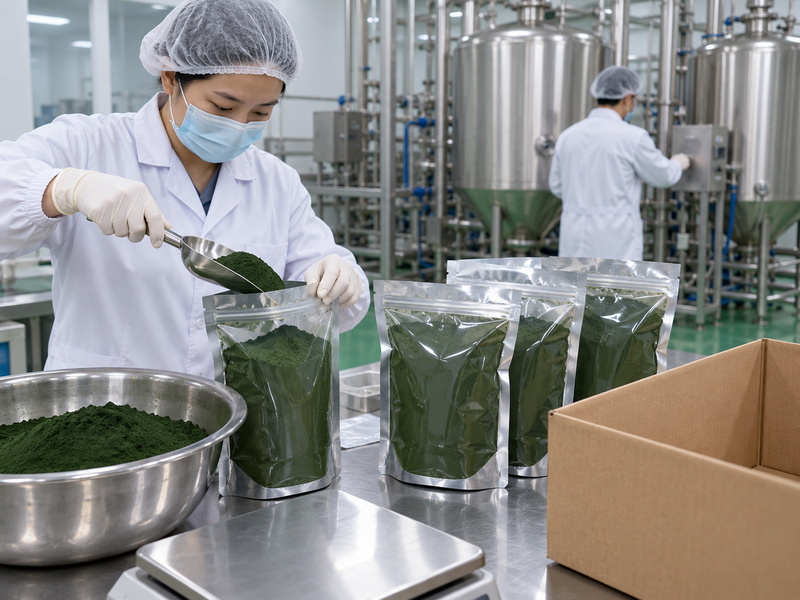
In-process checks often include fill weight, capsule closure, appearance, rejected-unit count and environmental conditions where relevant. Then, define sampling frequency and action limits from process risk. Also, watch hopper segregation if a blend contains multiple powders; early and late capsules may differ even when total weights match. Verify line clearance and correct shell and label issuance before running. Count and reconcile capsules at appropriate stages to detect losses or mixing.
Investigate a trend before it fails. For example, gradual weight drift may reflect a falling hopper, powder conditioning or worn tooling. Establish who can pause the line and what samples are held after a deviation. FDA’s supplement CGMP guide describes batch production records and quality review where Part 111 applies. Keep a record that another quality reviewer can reconstruct: actual inputs, settings, checks, deviations and final yield. A row of “pass” marks without measurements gives little insight when a customer complains about underfilled units.
| Control point | Example observation | Response to drift |
|---|---|---|
| Startup | Shell and fill weight | Adjust before release |
| Run | Mean and variation | Stop/investigate |
| End | Low-hopper behavior | Segregate affected units |
| Pack | Count and seal | Reconcile/rework |
7. How are identity and contaminants controlled?
Qualify the biomass before it reaches the hopper
Specify the Chlorella species, grade, lot identity and current COA. Also, review microbiology, elemental contaminants and any other hazards identified for the intended market and dose. Even though capsules divide powder into small units, a “natural” image does not substitute for analytical release. Check that any alternate supplier uses the approved identity and processing route. If several powder lots feed one capsule batch, record each lot and its quantity.
Use the right legal framework. U.S. dietary supplement manufacturers have specific component identity and specification duties under 21 CFR Part 111. The exact testing plan belongs to the manufacturer and quality team. However, FDA’s GRN 986 dossier concerns a particular C. sorokiniana powder for stated uses, not all Chlorella supplements. Ask regulatory staff to check ingredient status and claims in each destination market. Retain samples and record links between raw powder and finished capsules so a later complaint can be investigated without guesswork.

8. What affects capsule stability?
Study biomass, shell and pack together
Powder moisture, shell moisture and package barrier can interact. For example, a capsule may change shape, crack or stick if stored outside its intended range. Also, color and odor can change as Chlorella is exposed to oxygen or light. A bulk-powder shelf-life study does not automatically validate a bottled capsule. Ask for finished-product stability data under the proposed pack and storage statement. Include appearance, integrity, relevant composition and microbiology endpoints in a justified protocol.
Open-pack use differs from sealed storage. Consumers may open a bottle daily in a humid room. However, a desiccant or induction seal should be evaluated for the actual container, not assumed to fix every issue. Measure capsule count and closure integrity after distribution simulation when breakage is a concern. The supplier’s biomass expiry also limits when it can enter manufacturing. If a brand changes shell material or bottle, reopen the stability assessment. A visible green ingredient needs a pack that preserves both technical quality and a credible customer experience through the labeled life.
| Stability factor | Study question | Possible consequence |
|---|---|---|
| Shell humidity | Does it remain intact? | Brittleness/sticking |
| Powder moisture | Does it trend upward? | Clumping |
| Light | Does shade change? | Appearance claim |
| Bottle seal | Does barrier hold? | Shorter usable life |
9. How should labeling and claims be reviewed?
Reconcile formula, serving and market language
The label should identify the actual Chlorella ingredient and declare the amount accurately. Also, any excipient, shell material or processing aid that requires declaration must be reviewed. The serving instruction must match the validated fill and capsule count. For example, nutrition, organic, vegan and health-related claims need evidence and destination-market review; composition alone does not establish a clinical outcome. A supplier may provide raw-material documents, but the finished-product brand remains responsible for its own artwork and claims.
Print after approval. Verify Latin name if used, ingredient order, allergen statements, lot and expiry placement, and required manufacturer or distributor information. If the capsule shell changes, update the label review before packaging stock is ordered. FDA’s CGMP guide discusses packaging and labeling controls for applicable U.S. supplements. Ask the contract manufacturer for an approved proof and reconciliation process. A technically sound fill run can still become an unusable batch if the label promises more Chlorella than the capsules contain.
10. What belongs in a manufacturing brief?
Give the co-manufacturer a controlled decision file
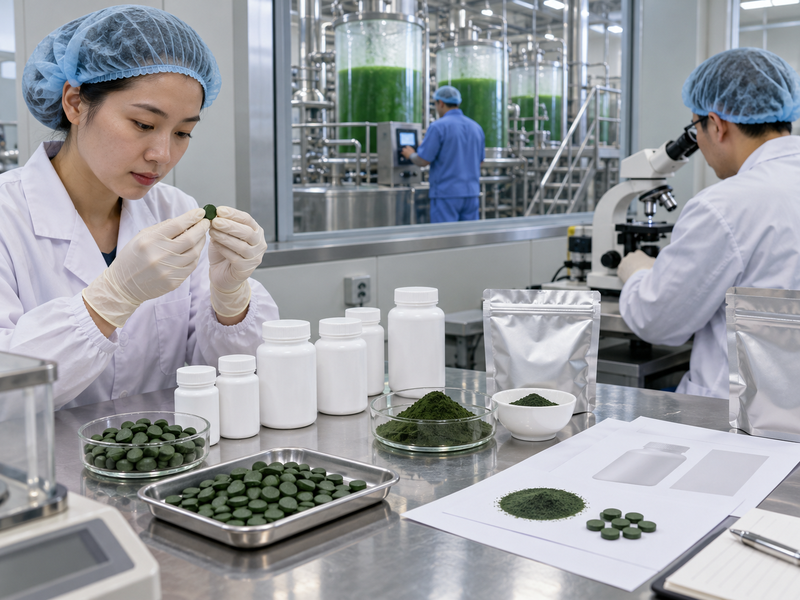
Include species and grade, approved powder supplier, target Chlorella mass per unit, capsule count per serving, shell specification, excipient policy, pack, intended market and label claims. Then, attach the raw-material specification, current COAs and pilot results. Define fill-weight limits, in-process checks, finished testing, batch yield range and release authority. State which changes need written brand approval. Also, commercial terms should cover minimum run, tooling, samples, rejects and leftover ingredients.
Ask for a trial with real material. A co-manufacturer can estimate capacity, but a documented run reveals actual flow and cost. Request a small production-equivalent pilot, inspect its batch record and retain units for stability. Then, compare the cost per compliant daily serving across capsule sizes, not just price per thousand shells. Establish how a failed raw-material or finished batch is handled. The resulting brief turns a sales concept into a repeatable manufacturing agreement. It also makes a later production run easier because operators and quality staff have measured boundaries rather than oral instructions.
| Brief item | Required decision | Evidence |
|---|---|---|
| Dose | Chlorella per capsule | Trial mass balance |
| Shell | Material and size | Approved sample |
| Process | Settings and checks | Pilot record |
| Release | Tests and authority | Signed specification |
What to do next. Chlorella capsule formulation depends on dose arithmetic, powder behavior and a real fill trial. Specify the exact biomass grade, verify weights across a representative run and study the finished pack. That work gives brands a capsule they can label honestly and manufacture reliably.
Frequently asked buyer questions
FAQ
Q1: Does capsule size guarantee a fill weight? No. Powder density and machine settings determine actual capacity.
Q2: Can a flow aid be added without changing the label? Review declaration rules and recalculate Chlorella mass before approval.
Q3: Should a brand use gross or net capsule weight? Use net powder mass for ingredient-dose calculations.
Q4: Can bulk-powder stability support bottled capsules? It helps, but finished-pack stability needs its own rationale.
Q5: What is the most useful pilot output? A fill-weight distribution, defect count, batch yield and retained stability samples.