
A vivid green prototype can fail when moved into a real production line: sediment appears, flavor changes or a new ingredient lot shifts the shade. Chlorella smoothie formulation needs a defined biomass grade, realistic dosage trials and stability work in the final matrix. This guide gives product teams a practical test plan. A study of commercial Chlorella powders documented sensory and composition differences, which is why a brand should validate the actual supplier grade.
Contents
- What product brief should lead the project?
- How should a Chlorella grade be selected?
- What use level should a pilot test?
- How can dispersion and settling be controlled?
- How should flavor fit be evaluated?
- What affects green color in a smoothie?
- How do processing and packaging alter performance?
- Which safety and label checks apply?
- What should a factory pilot measure?
- How can a brand release a repeatable formula?
1. What product brief should lead the project?
Define a drink the factory can actually make
Start with serving size, target consumer, shelf state, package and production route. A refrigerated blended smoothie, a shelf-stable beverage and a dry smoothie premix have different process risks. State whether Chlorella supplies visible green color, a declared ingredient story, protein contribution or several of those. Put a realistic cost and flavor ceiling in the brief. Without that definition, a laboratory team may optimize a bright sample that breaks under heat treatment or exceeds the brand’s dose target.
Write the success test early. Include appearance at fill and expiry, sediment allowance, sensory acceptance, ingredient declaration and manufacturing yield. Ask regulatory staff to review proposed nutrition or health language before design work. Chlorella is a green microalga; Spirulina usually means Arthrospira, and blue Spirulina products often involve a different material. The site’s blue Spirulina versus Chlorella article can orient commercial teams, but the smoothie specification must identify the exact Chlorella species and grade. A precise brief saves repeated bench trials and prevents a color concept from becoming an unsupported claim.
2. How should a Chlorella grade be selected?
Buy for application behavior, not a generic label
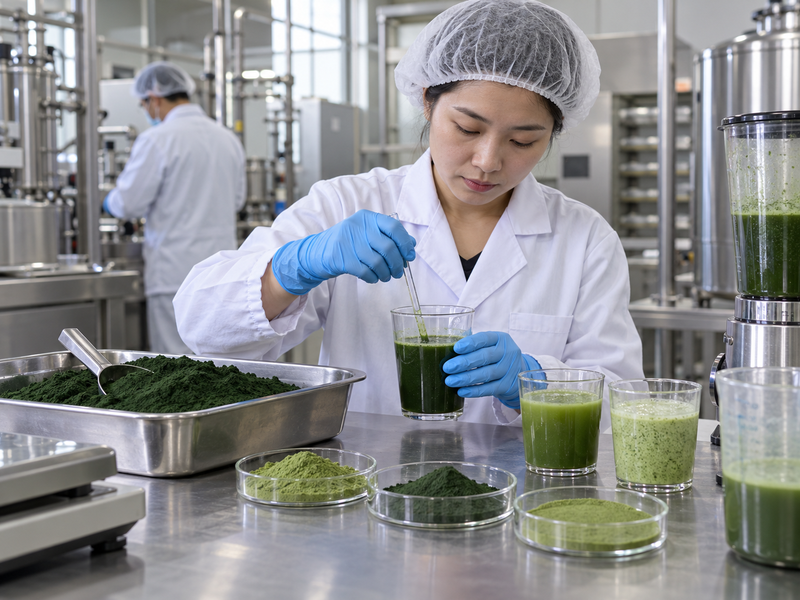
Ask suppliers for species, process, particle size, moisture, microbiology, contaminants and a current lot COA. A fine powder may disperse differently from a coarser grade but can create dust or a different mouthfeel. A broken-cell-wall claim does not guarantee smooth texture or suitable flavor. Request a sample from a commercial lot and obtain at least two additional lot profiles if shade consistency matters. Keep sample preparation constant when comparing suppliers; otherwise differences in mixing can be mistaken for raw-material variation.
Test the ingredient in your base. A powder that looks good in plain water may behave differently in acidic fruit, protein-rich oat or high-fat dairy matrices. Run a small matrix screen before choosing a grade. A 2025 comparison of eight commercial powders found differences across products; it does not rank your current options. For each offered grade, record odor, color, sediment, viscosity and price per accepted serving. Choose a supplier who can hold an approved specification and notify you before process or site changes.
| Grade attribute | Ask supplier | Trial observation |
|---|---|---|
| Species/process | Identity and route | Flavor and shade |
| Particle size | Method and range | Grit and settling |
| Microbiology | Lot method/result | Formula hazard review |
| Bulk density | Typical range | Premix dosing |
3. What use level should a pilot test?
Build a sensory and cost response curve
Select several use levels around the proposed label declaration, including a lower and higher boundary. Do not copy a dose from a supplement pack into a drink without considering serving size, sensory effect and finished-product regulations. Weigh Chlorella precisely and calculate concentration on the same basis for every trial, such as grams per 250 mL. Record total solids and dilution because a thick smoothie can hide particles that become visible in a thinner product. Blind sensory screening can reveal whether increased green intensity justifies flavor cost.
Use literature as a trial example, not a prescription. One experimental soy beverage study used 1.5% w/v C. vulgaris powder under its research conditions. That level is not a general recommendation for commercial smoothies. Create your own low, target and high points based on ingredient purpose, customer acceptance and legal review. If a nutrition claim depends on the amount, calculate it from current lot data and confirm it in the finished drink. The winning level is the lowest one that reliably meets the product brief across expected raw-material variation.
4. How can dispersion and settling be controlled?
Observe particles through the entire process
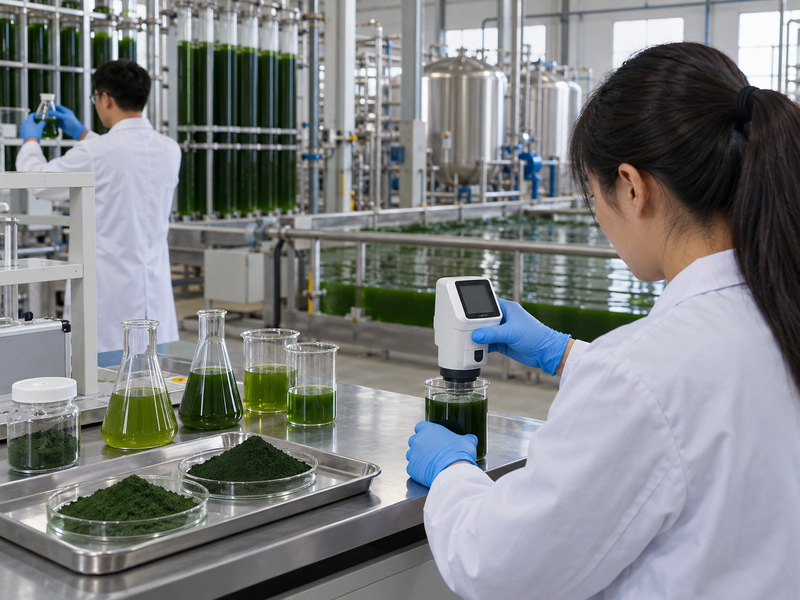
Chlorella biomass is a particulate ingredient rather than a fully soluble color. Add it under defined mixing conditions and record water temperature, order of addition, shear and hold time. A high-speed laboratory blender can mask problems that appear in a production tank. Test powder wetting, floating clumps, sediment height and redispersion after storage. If a stabilizer or emulsifier is used, evaluate its own label, texture and process requirements. Do not rely on a single just-made sample.
Scale the mixing step. Make a premix when direct addition creates dust or fish-eyes, then compare it with full-tank addition. Measure viscosity before and after Chlorella because a thicker base can delay settling without eliminating it. Inspect package corners and the final serving after a consumer shake. For a dry smoothie powder, test flow, segregation and dissolution after humid storage. The site’s Spirulina smoothie premix guide gives a related manufacturing framework, but Chlorella’s particle and flavor behavior must be checked on its own. A stable drink should meet both factory filling needs and consumer preparation expectations.
| Trial variable | Record | Failure signal |
|---|---|---|
| Addition order | Time and sequence | Clumps |
| Shear | Equipment and duration | Batch difference |
| Hold | Minutes before fill | Sediment |
| Storage | Temperature and duration | Hard-to-redisperse layer |
5. How should flavor fit be evaluated?
Test the whole drink with blinded comparisons
Chlorella can contribute green, earthy or marine-adjacent notes depending on grade and process. Do not assume a flavor profile from the Latin name alone. Screen the selected powder in the actual fruit, dairy or plant base at intended sweetness and acidity. Use a control without Chlorella and compare coded samples. Record onset, aftertaste and any texture-linked perception. A formula that appeals to a development team after repeated tasting may be less acceptable to new consumers.
Formulate around a defined defect. Citrus, berry or cocoa may mask different notes, yet masking can add sugar, acid or cost. If a supplier offers a milder grade, compare it against the same use level and COA limits. Check whether heat, light or storage creates new off-notes. The commercial powder sensory research shows why samples should be evaluated rather than assuming all Chlorella tastes alike. Keep the winning sample as a sensory reference with preparation instructions. Procurement can then assess alternate lots against an agreed target instead of subjective memories.
6. What affects green color in a smoothie?
Measure color in the final matrix
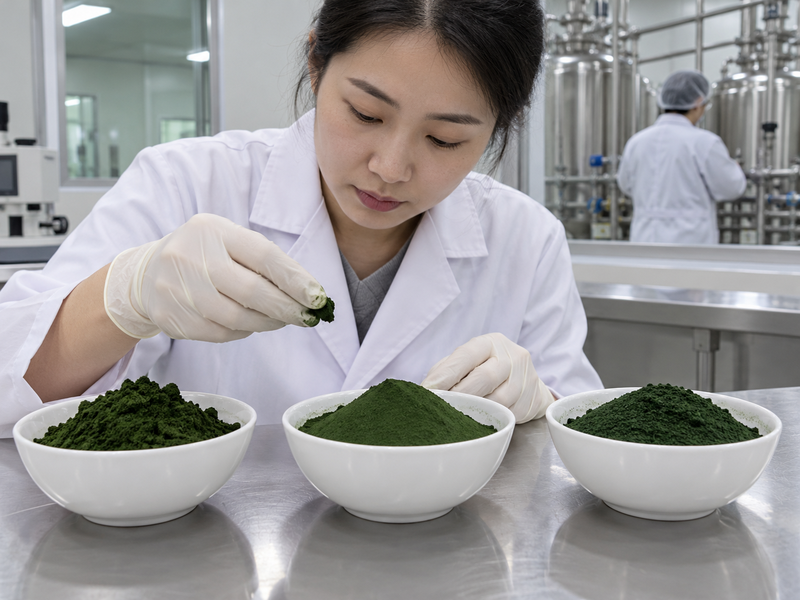
The apparent shade depends on Chlorella pigment, concentration, base color, pH, light exposure and processing. A pale oat drink and a purple berry blend can look different with the same powder dose. Set a color target using a prepared reference or instrument under consistent lighting. Examine both immediate appearance and change through shelf life. A dry powder chlorophyll value can help characterize a lot, but it cannot replace the visual test in your actual formulation.
Watch the package. A clear bottle can expose pigment to more light than an opaque carton. Heat treatment or long warm storage may change shade. Test the chosen pack under realistic retail conditions. If marketing wants a bright green photograph, compare it with a sample at end of life, not just a freshly blended cup. One study of stored C. vulgaris biomass observed condition-dependent changes; its plant-biostimulant design does not give a beverage expiry number. Build your own color acceptance range from the drink and package customers will actually buy.
| Factor | Trial comparison | Decision |
|---|---|---|
| Base color | Fruit vs neutral base | Visual fit |
| pH | Target range | Shade stability |
| Process | Before/after heat | Color loss |
| Pack | Clear vs opaque | Light protection |
7. How do processing and packaging alter performance?
Pilot the complete line, not a blender recipe
Commercial smoothies may pass through pumping, homogenization, heat treatment, deaeration and high-speed filling. Each stage can change dispersion, flavor or color. Ask whether the Chlorella is added before or after any validated microbial control step and whether that location is permitted under the site’s food-safety plan. Use a line trial with realistic hold time and batch size. Record yield, screen losses and deposit variation across beginning, middle and end of run.
Sample the package, not only the tank. A uniform mixing vessel can still produce unequal fill if heavy particles settle near the outlet. Test several filled units for appearance and ingredient distribution. Evaluate seal integrity, oxygen pickup and storage at intended conditions. If the product is shelf stable, the process authority or qualified technical team must validate its safety; Chlorella powder does not confer microbial protection. Keep line settings and raw-material lot in the pilot report. A smooth bench prototype becomes a dependable SKU only when the same result can be repeated at factory speed.
8. Which safety and label checks apply?
Treat biomass as a food ingredient with a defined use
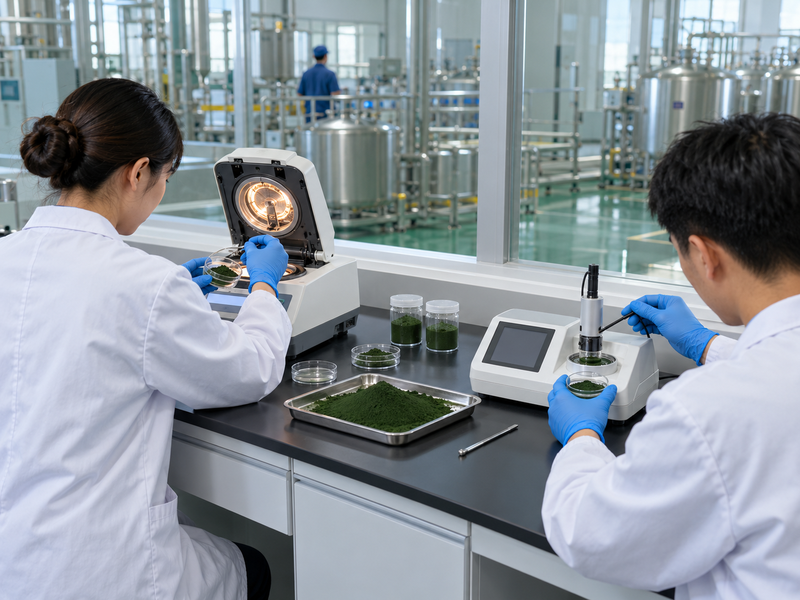
Qualify the exact Chlorella species and grade for the destination market and proposed food category. Review lot identity, microbiology, elemental contaminants and relevant process hazards. Ask whether the supplier’s regulatory dossier covers the same strain, processing route and intended uses; do not generalize FDA’s GRN 986 public notice to every Chlorella product. Determine whether the finished beverage needs allergen, nutrition, ingredient or other label statements under local rules. Claims about detoxification or disease outcomes require a different level of evidence and should not be inferred from powder composition.
Check the whole formula. Fruit, dairy, plant proteins, stabilizers and added vitamins create their own hazards and label responsibilities. Use the facility’s documented food-safety system and test the finished drink under the actual process. FDA’s Part 117 overview is relevant for applicable U.S. human food facilities. If the product is sold elsewhere, local counsel should verify category and limits. A green ingredient story works best when its species, dose and claims are all precise.
| Review | Evidence | Owner |
|---|---|---|
| Ingredient identity | Species and lot COA | Quality |
| Food safety | Hazard plan and line trial | Operations |
| Claims | Finished-product data | Regulatory |
| Label | Approved artwork | Brand/regulatory |
9. What should a factory pilot measure?
Collect decisions from one representative run
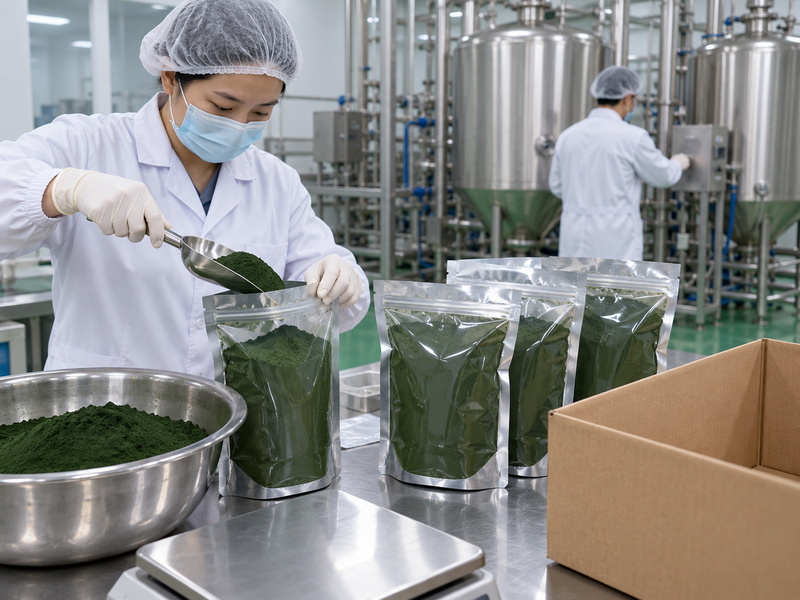
The pilot should use commercial Chlorella powder, normal equipment and the intended package. Measure dose accuracy, mixing time, batch uniformity, filling variation, sediment, color, pH, viscosity and sensory profile. Take samples from multiple line points and finished packages. Record raw-material lot, production settings and deviations. Start stability testing on finished packs under the claimed storage conditions. If the line requires a new ingredient feed system, include operator handling, dust and cleaning time in the yield calculation.
Plan pass or fail in advance. A team that sets thresholds after tasting can rationalize a weak result. Define maximum sediment, color window, sensory score and acceptable manufacturing loss before the run. If a problem appears, change one factor at a time and document what changed. A pilot can also reveal that a lower use level meets the visual target with better flavor and lower cost. Use those data to set the controlled recipe and raw-material range. The point of the trial is a launch decision, not just a pleasing photo.
10. How can a brand release a repeatable formula?
Lock materials, process and acceptance criteria
Write a formula specification that names the approved Chlorella grade, dose range, mixing order, equipment settings and finished-product limits. Keep an approved reference sample and documented sensory method. Require supplier notice before species, production site, drying process or particle-size changes. Purchase against lot-specific COAs and check incoming packs. If a substitute grade is needed, run a bridge trial rather than treating all green powders as equivalent.
Close the commercial loop. Cost each serving using actual production yield, not only quoted powder price. Include sampling, rejects, cleaning and storage losses. Set a regular trend review for color drift, consumer feedback and supplier variation. If the final drink cannot meet its promised appearance and flavor through shelf life, shorten the claim or change the formula before launch. A repeatable Chlorella smoothie is one whose ingredient, line and package stay inside measured boundaries. That gives marketing a credible story and gives operations a product it can manufacture again next month.
| Controlled item | Document | Recheck trigger |
|---|---|---|
| Powder grade | Ingredient spec | Supplier change |
| Dose/mix | Master recipe | Scale change |
| Finish | Product spec | Complaint trend |
| Pack | Packaging spec | Material change |
What to do next. Chlorella smoothie formulation succeeds when the actual grade disperses, tastes acceptable and holds its color under the final process and pack. Run a dose series, complete a factory pilot and set measurable acceptance criteria. Request current supplier lots for those trials; a good green concept deserves a drink that looks and tastes right at end of life.
FAQ
Q1: Does Chlorella fully dissolve in a smoothie? Whole biomass is particulate, so test dispersion and settling.
Q2: Is one published use level a commercial recommendation? No. Establish dose through your own formula, sensory and regulatory review.
Q3: Can a darker powder guarantee a greener drink? No. Matrix, pH, process and package affect perceived color.
Q4: Should a brand test multiple raw-material lots? Yes, especially when shade and flavor consistency matter.
Q5: What is the strongest launch test? A representative factory run followed by finished-pack stability testing.