
A green powder can look uniform while hiding a broken screen wire or a fragment from a packing tool. Chlorella powder foreign matter control gives manufacturers a way to prevent those events, find affected product and document the decision. This buyer guide follows the sanitation and process-control principles in 21 CFR 117.80; each site still needs a hazard analysis suited to its own equipment and market.
Contents
- What counts as foreign matter in chlorella powder?
- Where can particles enter after drying?
- How should the line prevent equipment fragments?
- What can sieves and magnets actually control?
- How should visual checks and samples be designed?
- How should packaging materials be controlled?
- What happens when an unusual particle appears?
- How can a site define the affected lot window?
- Which supplier records should a buyer request?
- How can buyer and supplier agree on release?
1. What counts as foreign matter in chlorella powder?
Separate unexpected material from normal powder variation
Foreign matter means material that does not belong in the agreed product. A piece of screen wire, gasket, hard plastic, glass or pallet wood is an obvious example. Dark green clumps deserve a different question: they may be agglomerated chlorella rather than an external object. The team should identify a suspect particle before assigning a cause. Color alone is weak evidence because chlorella powder naturally shows shade variation after drying and milling. Product specifications can describe normal granules, acceptable particle-size distribution and visible defects without pretending that every speck carries the same risk.
Start with the question: what is it, and where could it have entered? Record size, shape, hardness, magnet response and an image beside a scale. Keep the original object in a sealed, labeled container for later examination. The FDA human-food CGMP provision calls for adequate sanitation and quality control in processing. It does not prescribe one universal visible-particle count for chlorella. A buyer should expect a documented risk decision, not a made-up regulatory number.

2. Where can particles enter after drying?
Walk the route from dryer discharge to closed pouch
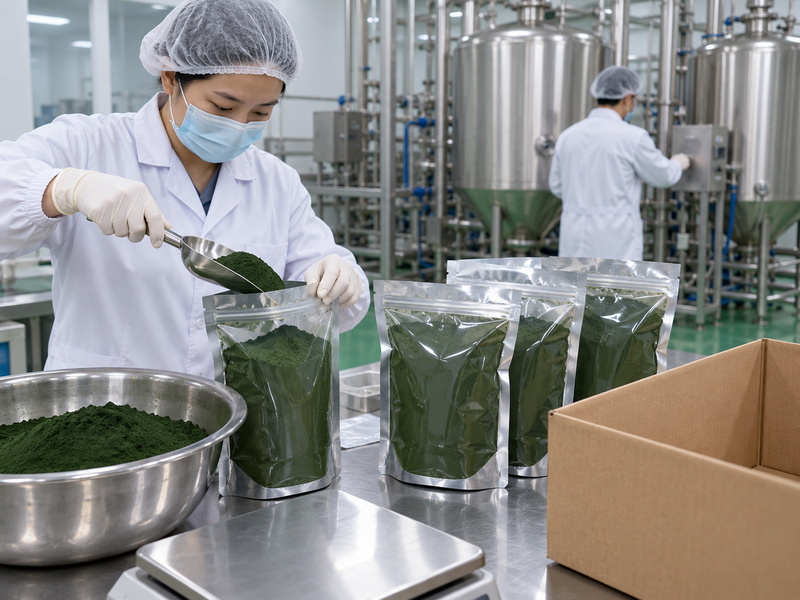
Map each point where powder contacts equipment or open air. Dryer collectors can shed worn seals; transfer hoses can abrade; milling screens can tear; valve seats can chip. Scoops, sample jars and bulk-bin liners add further possibilities. At filling, film trim, cutter blades, damaged funnels and torn gloves become relevant. The point of a route map is to locate credible origins. It should show both routine paths and temporary paths used during cleaning, maintenance or rework.
Watch the handoffs. A polished dryer does not protect powder that passes through a patched hose downstream. Compare the line diagram with an actual walk-through while product moves. Note open transfers, overhead work, exposed fasteners and repairs close to the product zone. Link each identified source to a preventive check and a response owner. If a supplier reports that every bag passes a detector, ask what it does about nonmetallic fragments. A detector cannot answer a glass or plastic question. For upstream quality context, our chlorella biomass drying guide explains how dryer configuration and collection records connect to later powder controls.
| Line point | Possible material | Practical evidence |
|---|---|---|
| Collector | Gasket or filter media | Change and inspection log |
| Transfer | Hose lining or clamp part | Pre-use condition check |
| Mill or sieve | Screen wire | Mesh integrity record |
| Filler | Film trim or tool fragment | Line clearance and maintenance log |
3. How should the line prevent equipment fragments?
Treat condition checks as production controls
Specify which product-contact parts need inspection, how often and what counts as damage. A pre-start check can inspect screens, gaskets, fasteners, hoses, scraper tips and visible surfaces. Maintenance should compare removed and replacement parts, then confirm that loose material has been recovered before restart. Use a tool inventory for work over an exposed line. Keep temporary fixes under controlled change procedures instead of allowing tape, wire or improvised plastic ties near powder.
The useful record is specific. “Equipment OK” cannot show which screen was checked or whether a torn edge appeared after a shift. Record component ID, observed condition, inspector, time and corrective work. At shutdown, inspect wear points again; a newly damaged screen may affect product made since the last intact check. FDA 21 CFR 117.40 requires equipment design and maintenance that protect against contamination. Site procedures should translate that broad duty into named parts and inspection intervals suited to the line.

4. What can sieves and magnets actually control?
Match each device to a material and failure mode
A sieve can retain particles larger than its effective openings when product passes through intact mesh. It may also create a hazard if the mesh breaks. A magnet attracts suitable ferromagnetic material but cannot recover every alloy, glass or hard plastic. Neither device substitutes for housekeeping or equipment upkeep. Position controls after likely introduction points without sacrificing product flow or allowing bypass. Document mesh identity, magnet position, cleaning frequency and how captured material is examined.
Look beyond a pass stamp. Review retained material by batch, not only the screen’s end-of-shift appearance. A sudden rise in metal filings may signal equipment wear even if finished bags pass later detection. Challenge a sieve with a representative test object only where a safe, controlled method has been approved; the objective is to verify the installed assembly and reject path without contaminating saleable powder. If a customer asks for a mesh size, explain what that choice can and cannot exclude. A very fine sieve may blind with cohesive powder and invite unsafe bypasses unless throughput and cleaning are addressed.
| Device | Helps detect or remove | Cannot establish |
|---|---|---|
| Sieve | Oversize material above effective opening | Absence of smaller particles |
| Magnet | Attracted metal | Absence of nonmagnetic metal |
| Visual inspection | Visible anomalies in inspected material | Status of all unobserved powder |
| Metal detector | Detectable metal in tested pack | Freedom from every physical hazard |
5. How should visual checks and samples be designed?
Give inspection a defined field of view
Define where an operator looks, under what lighting and for how long. A thin layer on a clean contrasting tray reveals more than a deep heap in a dark bin. Sampling should cover start, middle and end of a run plus areas with distinct equipment paths. Record the container, sample mass, lot and time. Keep the visual test separate from laboratory particle-size analysis; the two answer different questions. A quality unit can use microscopy or material identification for an unexplained speck, but the investigation still needs production context.
A clean sample has limits. Even repeated passes do not prove that every unit lacks a rare fragment. Use sampling as one piece of a control system built around prevention and device checks. Train operators with photos of actual, identified finds and realistic benign clumps. Blind training samples can reveal whether inspection conditions work. Avoid judging performance only by the number of rejected lots, since under-reporting makes that number attractive. The buyer should ask for examples of what operators escalate, including a false alarm that was resolved by evidence.

6. How should packaging materials be controlled?
Inspect every material that approaches open powder
Bulk liners, pouches, ties and cartons can shed material during opening or filling. Inspect incoming packaging for tears, loose edges, stray staples and damaged closures. Keep outer corrugated boxes away from open product where practical. At changeover, reconcile old labels and film rolls, clear trim and fragments, then approve the clean line for the next lot. A packaging specification should identify food-contact materials, approved suppliers and version changes. Supplier documents are useful, but a clean receiving sample does not excuse rough handling at the filler.
The seal area offers a clue. Powder trapped in a heat seal may reflect an overfilled or poorly timed fill head; it can also compromise the pack. Treat this as both a packaging issue and a possible source of loose film or debris. Record rejects and inspect their cause before rework. For a separate discussion of moisture and pack choice, see our chlorella bulk packaging article. A buyer receiving torn liners should preserve the bag and transport carton as evidence rather than pouring the contents into another container immediately.
| Packaging item | Incoming check | Line check |
|---|---|---|
| Inner liner | Tears and loose edges | Correct fit and intact opening |
| Pouch web | Damage and print debris | Trim control and seal cleanliness |
| Scoop or utensil | Material and condition | No chips after use |
| Carton | Damage and loose staples | Kept clear of exposed powder |
7. What happens when an unusual particle appears?
Preserve evidence before trying to explain it
Stop the relevant line under its written procedure and secure affected material. Photograph the object in place if possible, then seal and label it. Record finder, location, time, equipment state and all product containers nearby. A supervisor should assess immediate hazard without guessing the source from appearance. The quality team may compare the object with worn parts, packaging and incoming ingredients. If identity remains uncertain, external analysis can help; a verbal guess should never substitute for a documented examination.
One discovery changes the question. A single metal shard may indicate ongoing wear, whereas a lone fiber could come from a liner or cleaning cloth. Review historical rejects and maintenance events for patterns. Make a written disposition for every held unit, including reinspection, reprocessing or destruction where justified. Under 21 CFR 117.150, covered facilities must use corrective action procedures for relevant preventive-control failures and evaluate affected food. Whether this specific event falls under that provision depends on the facility’s hazard analysis. Do not release merely because a later scoop looks clean.

8. How can a site define the affected lot window?
Trace backward to the last verified good condition
The affected window starts with evidence, not a convenient shift boundary. If a mill screen tears at shutdown, identify the last documented intact check and all powder that passed the mill afterward. Add product held in hoppers, rework bins and partly filled bags. If the source is packaging trim, map the film roll, machine station and time of the last clean check. Product moved through another line may have a different exposure. A lot code helps only when the code maps to actual production events.
Do the arithmetic. Reconcile input powder, filled packs, rejects, retained samples and waste across the suspect interval. Missing mass deserves explanation before disposition. Hold downstream stock and ask whether any shipments left during the interval. If a distributor repacked material, include that path in the trace. Our chlorella lot traceability guide gives a fuller record-linking approach. A narrow hold can be justified with credible checks; a broad hold is prudent when evidence has gaps. In either case, document who approved the boundary and why.
| Boundary question | Evidence | If absent |
|---|---|---|
| Last sound component | Signed inspection | Widen time window |
| Product route | Batch and transfer logs | Hold connected bins |
| Pack count | Fill and reject reconciliation | Investigate missing units |
| Shipments | Dispatch records | Contact customers promptly |
9. Which supplier records should a buyer request?
Ask for evidence that follows one named lot
Start with the process flow showing the last open-product step, screening and detection positions. Request inspection logs for relevant equipment, maintenance closeout, retained-material findings, line clearance and final pack checks. A site can redact proprietary settings while still showing dates, equipment IDs and decisions. Review one routine lot and one deviation example. An immaculate blank form is less useful than a completed record that shows how a real problem was handled.
Make the request manageable. Ask whether the buyer’s exact grade, packaging format and plant match the examples. A supplier may operate different dryers or fillers for different customers. Check whether staff understand what to do with a suspect hard particle and whether quality can block shipment. The written specification should define foreign-matter expectations, inspection method and escalation route. A certificate saying “foreign matter: none” without method or sample context deserves follow-up. It may be a general statement rather than a meaningful result for the supplied lot.
10. How can buyer and supplier agree on release?
Put response rules into the quality agreement
State who owns lot holds, investigation, disposition and customer notice. Define which findings require immediate notice, which records accompany routine shipments and how both sides handle a disagreement about a speck. The contract can require retained evidence, traceable bag codes and access to investigation summaries. It should also specify how a detector or sieve failure changes the release process. Avoid promising that every bag is “free of all particles” when the available tests cannot prove it.
Close with a usable decision. Quality can release only after it understands the source, evaluates the full exposure window and confirms agreed checks. Purchasing should not overrule a technical hold to meet a delivery date. If the root cause requires a replacement part or revised cleaning method, verify the change on subsequent runs and keep the evidence. The buyer can then distinguish a supplier with a functioning prevention system from one that offers only a clean sales sample. That difference matters when chlorella powder enters a customer’s own beverage, capsule or tablet line.
| Agreement item | Supplier commitment | Buyer decision |
|---|---|---|
| Discovery notice | Report identified hard or sharp material | Assess downstream exposure |
| Evidence | Preserve object and linked records | Review cause and scope |
| Disposition | Document quality approval | Accept, reject or request work |
| Follow-up | Verify corrective action | Resume normal release |
FAQ
Q1. Does a green clump count as foreign matter? Not automatically. Identify it against the approved product description before deciding.
Q2. Can a metal detector replace a sieve? No. Each device addresses a different range of materials and sizes.
Q3. Is a passing final sample enough to release a suspect lot? No. Evaluate source, exposure window and other evidence.
Q4. Should buyers ask for a universal particle limit? Ask for a justified product specification and inspection method instead.
Q5. What should arrive with a complaint? Preserve the particle, pack, lot code, photos and receiving details.
Chlorella powder foreign matter control works when equipment checks, packaging discipline and lot traceability reinforce one another. Before approving a supplier, ask for a completed lot record and a real deviation example. If a particle appears, hold product and follow the evidence back through the line. That protects your customer’s formulation and gives both companies a fair basis for the release decision.