
Chlorella inoculum scale up expands a documented seed culture through larger vessels until it can start production cultivation. For buyers, a finished-powder result does not show whether the right strain entered the reactor or whether a weak seed delayed growth. A controlled seed train uses traceable identity, stage-specific growth checks, clean transfer and a clear handoff decision. A published Chlorella sorokiniana scale-up study moved culture through laboratory and pilot vessels, illustrating why conditions and measurement methods must be tracked at each stage.
Contents
- What belongs in a chlorella seed train?
- How is strain identity preserved?
- What makes a seed culture ready to transfer?
- How should each scale-up step be recorded?
- Which growth measurements are useful?
- How can contamination be detected early?
- How should transfer equipment be prepared?
- What changes when the vessel grows larger?
- When should a transfer be stopped or rejected?
- What evidence should a buyer request?
1. What belongs in a chlorella seed train?
Give each stage a purpose
A seed train starts with a defined stock, then moves through working cultures into one or more intermediate vessels before the production reactor. Each stage should produce enough healthy biomass for the next vessel without losing strain identity or carrying an avoidable contamination. The exact vessel sizes and number of steps depend on strain, cultivation mode and plant layout. Do not copy a laboratory volume ratio into a factory specification without trials. The useful question: what evidence shows the seed can establish growth after each transfer?
The pilot-scale C. sorokiniana study followed staged expansion and measured biomass during transfer. Its particular volumes were experimental conditions, not industry-wide rules. For a supplier, list each vessel ID, working volume, medium batch, inoculum source, start time and planned transfer criteria. Link the final seed lot to the chlorella lot traceability record. A batch number that begins only at harvest misses the history that created the crop.
2. How is strain identity preserved?
Control the source and working bank
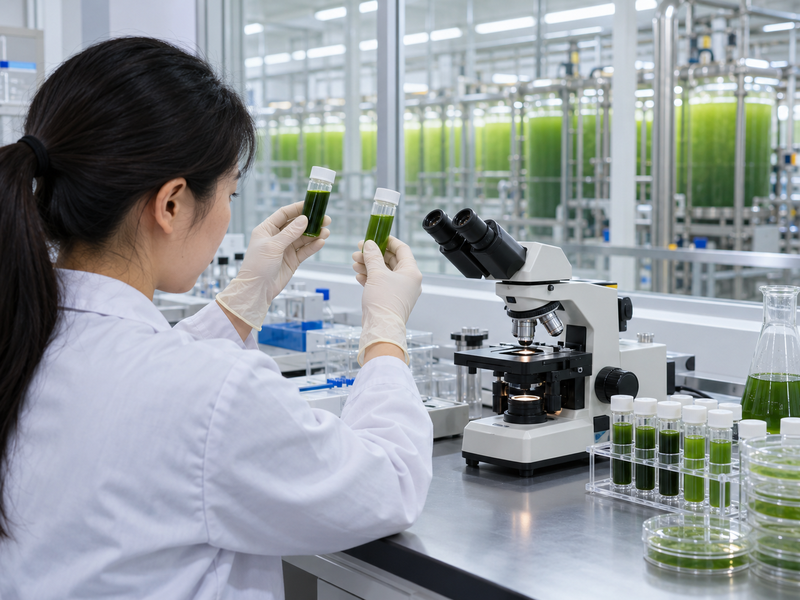
Record the species, strain designation, source, receipt record and method used for identity confirmation. A culture-bank label alone can be misread or copied. The ATCC entry for one C. vulgaris strain illustrates the level of strain designation and provenance that a formal collection supplies; it does not imply that all commercial chlorella uses that strain. Suppliers may rely on their own authenticated bank, but they should explain its origin and how working cultures are derived from it.
Separate a master source from routine working seed to reduce repeated handling of the original stock. Set a rule for the number of transfers or time in use based on the strain’s demonstrated stability, then record each passage. Check the identity chain: the seed-vessel label, culture log and production batch should carry a reconciled code. If a new isolate or strain replaces the old one, treat that as a supplier change with potential effects on cell wall, pigment, protein and downstream processing. The buyer should receive notice before material made with a changed strain is shipped under an existing specification.
| Identity control | Record | Buyer question |
|---|---|---|
| Original source | Receipt and designation | Where did the strain come from? |
| Working seed | Passage history | How many transfers occurred? |
| Production handoff | Linked lot IDs | Which seed started this batch? |
3. What makes a seed culture ready to transfer?
Judge fitness from growth evidence
Calendar time is a weak transfer rule. A seed may be older than expected because light or gas delivery failed; another may reach target biomass sooner under stable conditions. Establish criteria using cell count or dry biomass, growth trend, morphology, color, pH and contamination observations as appropriate. Optical density can serve as a rapid proxy, but it requires a calibration to dry weight or cell concentration for that strain and instrument. The C. sorokiniana scale-up paper reported its own optical-density conversion, underscoring that such conversions are process specific.
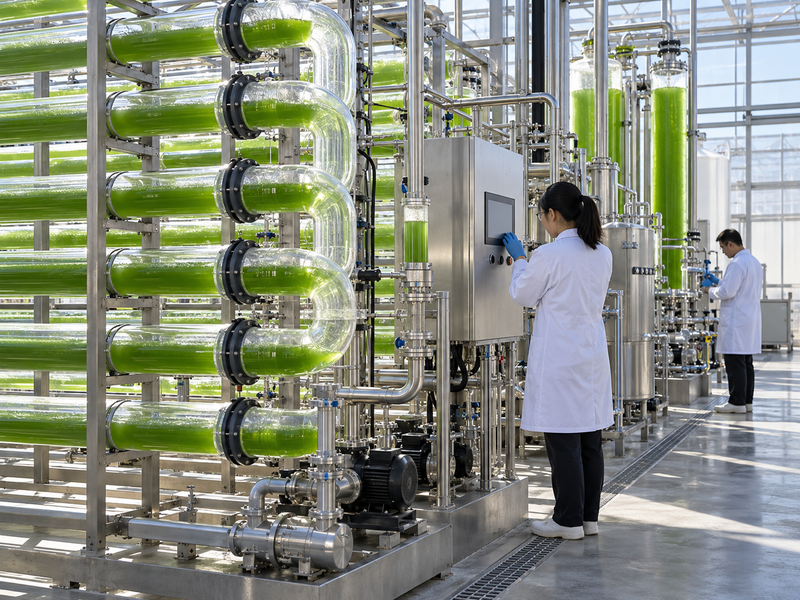
Review the growth trajectory over several readings. A rising biomass number with abnormal clumping or an unexpected pH drift deserves investigation. Before opening the valve: confirm the receiving vessel, medium and transfer line are ready. A healthy seed held too long after release can change before transfer. Record time between approval and inoculation, especially when operators share vessels between shifts. The final release decision should be signed and should state any allowed hold time determined by site trials.
4. How should each scale-up step be recorded?
Build a batch genealogy from small to large
At every step, record donor culture, recipient vessel, transfer volume, medium lot, start and end times, operator, equipment state and release result. If two seed vessels feed one production run, show both contributions. If one seed vessel is split among several reactors, trace each recipient. That map becomes indispensable when an abnormal seed result appears after production has begun. Follow the liquid: the records should reconcile what left one vessel with what entered the next, allowing for planned samples and line losses.
Also record preparation of nutrients, air or carbon dioxide supply, light schedule and temperature control. A seed-stage change in medium recipe can shift later growth even if cells look normal at transfer. Deviations need their own entries rather than handwritten corrections that erase the original observation. A supplier’s traceability system should connect these seed records with the cultivation, harvest and powder batches. Buyers can test this by choosing one delivered lot and asking for its seed genealogy without requesting every day’s raw monitoring sheet.
| Stage event | Minimum record | Why it helps |
|---|---|---|
| Seed split | Donor and recipients | Finds shared exposure |
| Medium preparation | Ingredient lots | Reviews nutrient issue |
| Transfer | Time and volume | Tests delayed handoff |
| Release | Reviewer and criteria | Shows decision basis |
5. Which growth measurements are useful?
Use more than one view of culture health
Cell count, optical density and dry weight answer related but different questions. Optical density is quick yet changes with cell size and aggregation. Dry weight gives a more direct biomass measure but takes longer and depends on careful washing and drying. Microscopy reveals morphology and possible foreign organisms without providing a full species identification. A trend in pH can reflect photosynthetic activity or gas supply, though it is not a stand-alone growth measure. Put readings on one timeline: a sudden optical-density jump without a corresponding cell or dry-weight change may signal aggregation or measurement error.
Choose sampling frequency from expected growth and how quickly a failing seed could be transferred. Compare each stage with a verified reference range developed for that vessel and strain. The study of C. vulgaris in several photobioreactor configurations observed growth and associated bacteria, a reminder that reactor conditions and microbiology can change together. A buyer should look for a method that detects a bad trend early enough to stop transfer, not for an impressive isolated productivity number.
6. How can contamination be detected early?
Define what an abnormal culture looks like
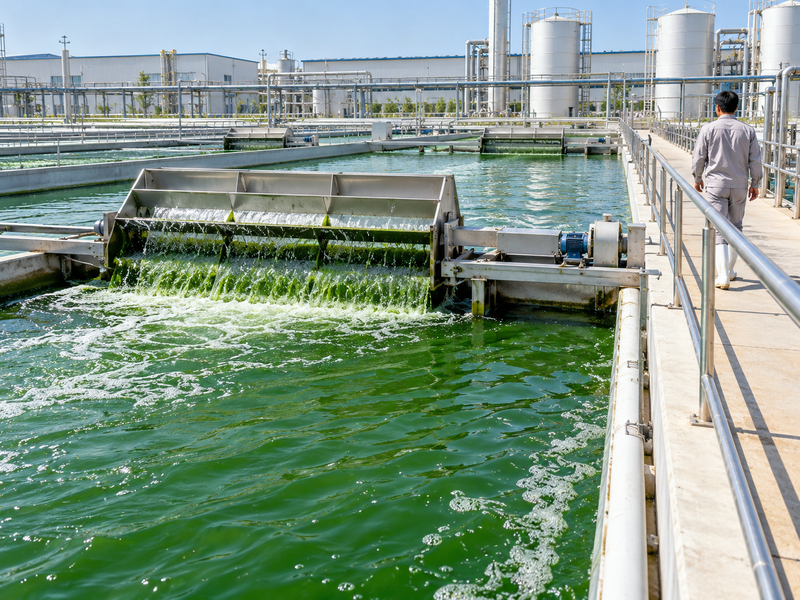
Seed vessels can receive bacteria, other algae or predators through water, air, sampling ports and transfer lines. A routine check may include microscopy, plate counts where relevant and observations of odor, flocculation or unexpected growth change. The published commercial-scale Chlorella study on a predatory bacterium shows that biological contamination can disrupt cultivation at substantial scale. It does not establish one universal test panel for food-ingredient facilities. Select checks based on the facility’s observed hazards and intended market.
Use a documented trigger for hold and investigation. A normal total count can still coexist with an undesirable organism, while an abnormal microscopy view may need specialist identification. Keep seed separate: avoid using a questionable vessel to inoculate multiple production reactors while waiting for a confirmatory result. Record which related vessels share water, air or tools. If a contamination event occurs, investigate the route and evaluate any downstream biomass; do not simply start a new seed train and leave affected material’s status ambiguous.
| Warning signal | Immediate action | Follow-up |
|---|---|---|
| Unusual morphology | Hold transfer | Confirm identity |
| Growth stalls | Check medium and biology | Investigate cause |
| Unexpected count | Segregate seed | Review source route |
7. How should transfer equipment be prepared?
Treat the transfer as a controlled operation
The receiving vessel and transfer path should be clean, suitable for use and correctly connected before seed is moved. Confirm hose identity, gasket state, valve position and the most recent equipment-release record. Sampling ports need procedures that limit contamination during repeated use. A closed transfer can reduce exposure, but “closed” is meaningful only if connections and vents are managed. A simple walk-down helps: ask the operator to point from donor vessel through each connection to the receiving vessel before opening the route.
Prevent mix-ups with line identification and a pre-transfer checklist. If a temporary hose is used, record its cleaning, storage and connection. Take a representative sample before and, where practical, after transfer to help locate a later problem. Record any spill, pressure interruption or unplanned hold. Water and gas used in the receiving reactor must be suitable for the process; the chlorella cultivation water quality review is relevant here. The handoff record should carry the exact time production cultivation began.
8. What changes when the vessel grows larger?
Recheck light, gas and mixing
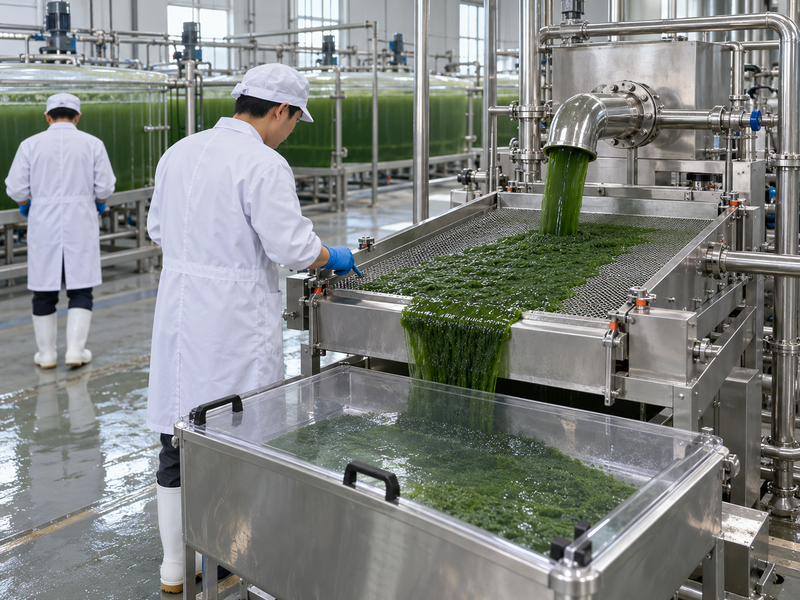
The large reactor does not behave like a bigger flask. A longer light path can leave more cells in shade; gas distribution and mixing may change; temperature gradients may emerge. A seed that grows well in a small vessel may stall after transfer if the recipient has a very different carbon supply or light exposure. The laboratory-to-pilot C. sorokiniana experiment studied staged performance rather than assuming identical behavior across sizes. For commercial work, use trials in the actual vessel design.
Compare growth lag, biomass trend, pH and temperature after each transfer. If the production reactor receives a different medium, evaluate adaptation rather than expecting an immediate copy of small-vessel growth. Watch the handoff: the period just after inoculation tells you whether the seed was fit and the receiving conditions were ready. Set a response for delayed growth before the run begins, including when to hold harvest or investigate. A buyer should expect a process explanation, not a promise that a fixed inoculum percentage works in every reactor.
| Scale-up factor | Small vessel question | Production question |
|---|---|---|
| Light | Is illumination even? | Is inner culture shaded? |
| Gas | Is carbon supplied? | Is distribution consistent? |
| Mixing | Do cells circulate? | Are dead zones present? |
9. When should a transfer be stopped or rejected?
Make hold criteria visible before urgency rises
Stop a transfer when identity is uncertain, growth falls outside the approved decision rule, contamination is suspected or receiving equipment is not released. An instrument failure may also block a required measurement. Record the reason and what evidence would allow a new decision. A seed that has already passed its allowed hold time should be reassessed, not waved through because the reactor is empty. A hold protects future lots: one questionable seed can affect a much larger biomass volume.
If transfer occurred before a concern was discovered, trace recipients and place them under review. Do not assume a later healthy-looking green color resolves a biological issue. Decide whether additional tests, a shortened cultivation cycle or disposal are appropriate for the specific concern. Keep the original deviation and disposition records. Buyers should be notified under the quality agreement when a released ingredient lot was grown from a seed culture with an unresolved deviation. Routine production pressure should never rewrite the original transfer criteria after results arrive.
10. What evidence should a buyer request?
Audit the handoff on one delivered lot
Ask for a concise seed-train diagram, strain source, identity-control approach, transfer-release criteria, contamination monitoring plan and a recent lot genealogy. Select one finished powder lot and trace it through production reactor, transfer, working seed and original bank designation. If the supplier cannot connect these stages, a finished COA alone cannot close the gap. Review one held or rejected seed case to see whether the rule works under production pressure. Prefer the decision trail: dates, results, signatures and disposition tell more than a generic standard operating procedure.
The buyer can then agree which seed-stage changes require notification, such as a new strain, medium, reactor type or transfer criterion. Chlorella inoculum scale up works when a verified culture moves through measured stages and arrives in a ready production system. Request a sample of the evidence before approving routine orders, then audit the same chain after a process change. This gives procurement and quality a practical way to ask whether the ingredient’s biological origin remained controlled.
| Buyer evidence | Decision supported | Gap to challenge |
|---|---|---|
| Strain record | Correct source | Vague species-only label |
| Seed genealogy | Linked production lot | Missing split transfer |
| Growth trend | Fit seed | One isolated reading |
| Deviation file | Effective hold | Transfer despite unresolved result |
FAQ
Q1: Is one fixed inoculum percentage suitable for every chlorella reactor? No. Vessel geometry, strain, medium and light affect transfer performance.
Q2: Can color alone release a seed culture? No. Use measured growth and checks tied to identified hazards.
Q3: Must a commercial seed train be sterile? The facility should define and control its microbiological status; a blanket claim of sterility needs proof.
Q4: What should happen if a seed vessel is suspect? Hold transfer, trace related vessels and document the investigation and disposition.
Q5: Which record links seed to product? A genealogy connecting bank, working seed, production reactor, harvest and finished lot.