
A free sample can make a beautiful prototype while leaving every commercial risk unanswered. Blue spirulina wholesale trial orders create a paid, controlled bridge between bench approval and repeat buying. The trial should use a defined SKU, commercial-style packing, batch documents and a planned production run. The Spirulina CN Blue Spirulina page shows why grade and composition need confirmation; neither a color swatch nor a sales promise can approve a production ingredient alone.
Contents
- What should blue spirulina wholesale trial orders prove?
- How large should the paid pilot be?
- Which SKU and pack must the trial use?
- What documents should travel with the lot?
- How should production behavior be tested?
- What does a receiving rehearsal reveal?
- How should the team record acceptance?
- What if the pilot exposes a failure?
- When can a successful pilot be scaled?
- What belongs in the next purchase order?
1. What should blue spirulina wholesale trial orders prove?
Set a release gate, not a vague “try it” exercise
Write down the decision before ordering: can this exact supplier SKU reach the plant, pass the signed specification and run in the intended product at the expected dose? Assign owners across procurement, quality, R&D, production and warehouse operations. A trial may also test commercial response time and paperwork accuracy. That purpose differs from a laboratory sample, which mainly screens color or solubility. Link the pilot to an approved candidate specification and a list of results that will either permit or block expansion.
Keep the scope narrow: one product, grade, carrier and pack format make the findings interpretable. Mixing suppliers or changing a formula mid-run blurs the cause of a result. The sample-testing protocol can support bench design, while the paid trial should test the actual buying and receiving route. Record what the pilot cannot prove too, such as long-term supplier consistency from one lot. That honest limit stops a successful day on the line from becoming a blanket approval.
2. How large should the paid pilot be?
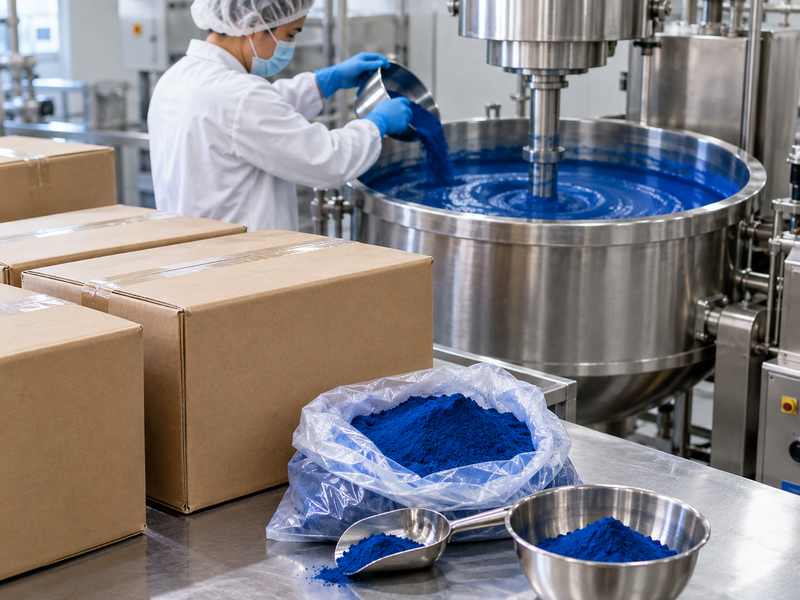
The quantity should support representative line conditions, release testing, retain samples and at least one repeat if a setup error occurs. A tiny sachet may not wet or meter like a commercial bag, yet a full annual buy creates unnecessary exposure before qualification. Calculate ingredient demand from the proposed batch size and approved dose, then add measured start-up loss and sampling needs. Respect the supplier’s pack multiple, but ask whether a documented pilot format is available when the full MOQ is larger than the evidence requires.
Here is a labeled example: a pilot of 20,000 finished units at an approved illustrative dose of 0.10 g needs 2 kg net. If line yield from prior trials is 90%, issue need is about 2.23 kg before lab and retention samples. These figures teach sizing, not a standard dose or supplier minimum. Ask the production supervisor whether one run covers all planned equipment states, including start-up and normal speed. If it does not, enlarge the pilot for evidence rather than simply for a price break.
| Pilot quantity input | Illustrative value | Source |
|---|---|---|
| Units | 20,000 | Trial plan |
| Formula dose | 0.10 g | Approved trial formula |
| Net need | 2.00 kg | Units × dose |
| Line yield | 90% | Prior run evidence |
| Issue need | 2.23 kg | Net ÷ yield |
3. Which SKU and pack must the trial use?
Order the proposed commercial SKU, not a generic “blue spirulina sample.” Confirm color value with its test method, carrier, declarations, net fill, liner and label. If the production order will use sealed drums, a pilot in a paper envelope does not validate drum opening, dispensing or storage after opening. Ask whether a smaller pilot unit has the same formulation and manufacturing process; keep any deviation visible in the approval report. Changes to carrier or grade should trigger a new compatibility review even when the powder looks similar.
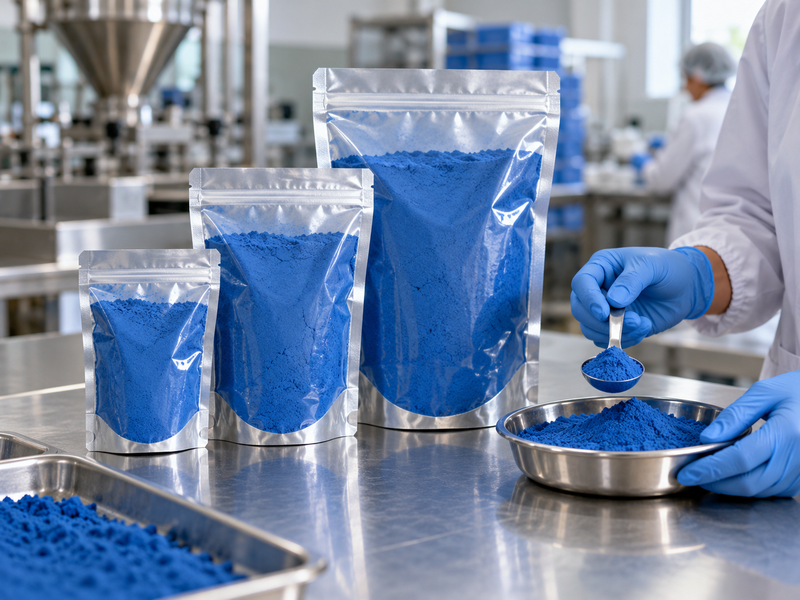
The pack tells a story: seals, lot marks and pallet labels affect traceability long before a color trial begins. Review the bulk packaging article for pack questions and the carrier selection article for composition questions. Photograph receipt condition and keep one unopened unit if practical. A trial that documents physical handling gives warehouse and QA a chance to identify issues before repeated receipts amplify them.
4. What documents should travel with the lot?
Request a current specification, lot-specific certificate of analysis, composition and carrier declaration, allergen statement, manufacturing and expiry dates, storage guidance and shipment documents appropriate to the destination. The COA should report actual results and methods against agreed limits. A copied sample certificate from another lot proves little about the material received. Quality should compare document identifiers with labels before sampling. The site’s COA guide provides a buyer checklist for that link.
Ask for documents before dispatch: a missing report discovered after the line has been scheduled causes avoidable delay. For U.S. applications, confirm the intended use against current 21 CFR 73.530. FDA’s color-additive update says the February 2026 expansion’s effective date was delayed pending objections. The pilot cannot cure a regulatory mismatch. Keep destination-specific review in the quality file rather than treating a seller’s general “food grade” phrase as a legal clearance.
| Document | Match point | Pilot decision |
|---|---|---|
| Specification | SKU and revision | Is target defined? |
| COA | Exact lot | Do results pass? |
| Composition | Carrier and grade | Does formula match? |
| Date and storage | Pack label | Is usable life adequate? |
| Shipping record | Order and route | Can receipt be traced? |
5. How should production behavior be tested?
Use the intended equipment, mixing order, water quality, temperature, hold time and package. Measure dispersion, line losses, color at fill and color after the product’s relevant storage period. If a pilot is smaller than normal production, write down which scale effects remain untested. A clean bench beaker cannot predict powder feeding, foaming or deposit on plant equipment. The color target should be documented with a method or controlled visual standard, not an impression that two bottles “look close.”
Put operators in the review: they can spot clumping, dust, slow wetting and cleanup burden that procurement cannot see in a quote. Record batch number, actual grams charged, deviations and any process adjustments. Avoid changing several variables until the blue looks right; then nobody can tell whether powder quality or mixing caused the improvement. Where heat or acidity matters, refer to product-specific stability trials such as the acidic beverage guide. A trial passes only the conditions actually tested.

6. What does a receiving rehearsal reveal?
Receiving should compare the purchase order, packing list, seal condition, number of units, lot codes and dates before material enters quarantine. Record transport condition and any discrepancy at the point of handoff. The exercise exposes whether supplier labels are readable, whether the warehouse can segregate lots and whether documentation arrives in time. A product may be analytically acceptable yet operationally awkward if every receipt requires manual reconstruction of which bag belongs to which COA.
Time each step: order confirmation, dispatch, transit, customs if applicable, arrival, sampling and QA release all belong in the true replenishment timeline. Use the paid pilot to record dates rather than relying on a promotional lead-time claim. ICC’s Incoterms 2020 introduction explains why the precise named point affects delivery and risk. Write the agreed rule and place into the pilot order so a later commercial contract can be based on the same boundary.
| Receiving checkpoint | Record | Failure route |
|---|---|---|
| Seal and package | Photos, count | Quarantine affected unit |
| Lot and date | Label transcription | Reconcile documents |
| Quantity | Net and gross | Note shortage |
| COA link | Exact lot code | Hold pending correction |
7. How should the team record acceptance?
Use a signed decision sheet with pass limits stated before the run. Include document review, incoming test results, production yield, shade, sensory observation and relevant storage outcome. Mark deviations separately; a batch that works only after an unplanned dose increase has not passed the original cost and formula assumptions. Capture the supplier’s response to questions and the time needed for corrective information. One clear owner should close each open item before procurement moves to a larger commitment.
Make the result portable: another plant should be able to read the report and understand what was purchased, how it was handled and what conditions passed. Attach photographs, line records, laboratory reports and an approved retained sample. If a visually attractive product fails a contaminant or document requirement, the trial fails for commercial release. FDA supplier-verification resources reinforce risk-based evaluation where relevant; a marketing sample cannot replace supplier approval.

8. What if the pilot exposes a failure?
Contain affected product and identify whether the cause lies with ingredient, handling, formulation, equipment or documentation. Do not prescribe a supplier change before checking the evidence. A blue shade that fades may reflect process heat or product pH, while a missing lot code is a supplier-documentation issue. Give the seller a clear deviation report with lot, observed result, test method and requested response. Agree on a corrective action and a new trial scope that actually retests the failed condition.
One failure can still save money: discovering a liner seal problem on a small pilot costs less than finding it across an annual supply. Record the cost and schedule effect without letting sunk pilot spend pressure the team into acceptance. If the grade changes, repeat dose and stability work. If only the pack label changes, receiving may be able to verify that correction without repeating a full formulation study. The decision should follow the cause, not a rigid rule that every defect requires the same restart.
| Failure type | Evidence | Likely retest |
|---|---|---|
| Shade or stability | Controlled product sample | Formula and storage |
| COA mismatch | Lot and document copies | Document chain |
| Pack damage | Photos and seal check | Packing/shipping route |
| Dispersion | Line record | Same process condition |
9. When can a successful pilot be scaled?
Scale when the exact SKU, pack, specification and supplier are approved and the pilot’s open points are closed. Set a routine incoming verification plan and a response path for deviations. A single pilot does not prove every future lot will match; it supports a controlled move into repeat purchasing. Check whether full production introduces larger mixing vessels, longer holds or different thermal exposure. If so, schedule a commercial validation run and hold the expansion decision until those conditions pass.
Keep the boundary written: identify which product categories and plants may use the approved material. A pilot in a neutral frozen dessert does not approve an acidic drink. Likewise, a small pack does not automatically validate a large drum with a different liner. Ask the supplier to notify you before changing grade, carrier, process or pack. That turns a successful trial into a maintained supply arrangement rather than a one-off memory of a good sample.

10. What belongs in the next purchase order?
State the approved SKU and specification revision, quantity, pack configuration, lot-document requirements, remaining shelf-life threshold, delivery window, exact trade rule and named place. Attach or reference the quality agreement and acceptance process. A generic description such as “blue spirulina E18” leaves too many choices open. Include notice requirements for substitutions and a clear contact when a lot cannot meet the date. The next order should reproduce the configuration that passed, or explicitly call out any change requiring new approval.
Close the commercial loop: compare pilot actuals with original assumptions for lead time, yield, freight and testing. Use that evidence to set the opening order and reorder point. Blue spirulina wholesale trial orders work when they produce a documented yes, no or conditional decision. Ask your supplier for a paid pilot quote tied to your proposed commercial SKU and pack. A small, measured investment now can prevent a much larger interruption later.
| Purchase-order field | Pilot evidence | Next-order action |
|---|---|---|
| SKU and grade | Approved trial report | Lock exact code |
| Pack | Receiving record | Specify liner and fill |
| COA | Lot review | Require with dispatch |
| Delivery | Actual timeline | Set realistic date |
| Acceptance | Signed limits | Reference specification |
FAQ
Q1: Is a free lab sample enough for supplier approval?
No. It can screen formulation fit, while a commercial-style paid trial tests packing, documents and production behavior.
Q2: Must the pilot meet a standard MOQ?
Not necessarily. Ask for a documented pilot offer and record any differences from the intended commercial supply.
Q3: What if the pilot uses a different pack?
Limit the approval accordingly and test the commercial pack before broad release.
Q4: Can one passing lot prove long-term consistency?
No. Keep routine lot verification and a change-notification process.
Q5: Who signs the pilot decision?
Quality, R&D, production and procurement should approve their respective evidence before volume expansion.