
A supplier can send a vivid blue sample that performs well in a cup and poorly in a production line. The sample might come from a different lot than the order, use a carrier absent from the quoted grade, or be tested at a dose the finished product cannot afford.
This blue spirulina sample testing protocol gives procurement, R&D and quality one shared record. It covers the sample’s identity, a matched dose ladder, the proposed process, packaged storage and a retained reference. Phycocyanin responds to pH, heat and light, as summarized in a peer-reviewed stability review, so each test belongs in the actual product matrix.
Contents
- What decision should the trial answer?
- Which samples and controls should be included?
- How should sample identity be documented?
- How do you build a fair dose ladder?
- What preparation method should every trial use?
- Which production steps must the sample face?
- What should be measured during storage?
- How should sensory and cost be recorded?
- How do you judge differences between lots?
- What evidence closes sample approval?
1. What decision should the trial answer?
Write the purchase decision before mixing
State the intended product, market, package, process and expected use level. A test for a chilled oat beverage cannot approve the same powder for a heated gummy or a shelf-stable clear drink. Write the question in terms the team can act on: which supplier grade meets the agreed shade and physical performance after processing and storage at an acceptable finished-unit cost? Quality should add the nonnegotiable document and release requirements before R&D starts mixing. Otherwise a beautiful sample can win a trial while lacking a usable lot certificate.
Do not declare that a grade “passes stability” without naming the matrix, package and storage schedule. A slight starting shade difference may be manageable; visible sediment in a clear bottle may end the test.
| Decision field | Record before testing | Owner |
|---|---|---|
| Finished matrix | Formula version and target pH | R&D |
| Process | Addition stage, heat and mixing path | Production |
| Acceptance | Shade, clarity, sediment and flavor targets | R&D and quality |
| Commercial boundary | Maximum cost per finished unit | Procurement |
| Release documents | Specification and lot COA | Quality |
2. Which samples and controls should be included?
Include the product without color
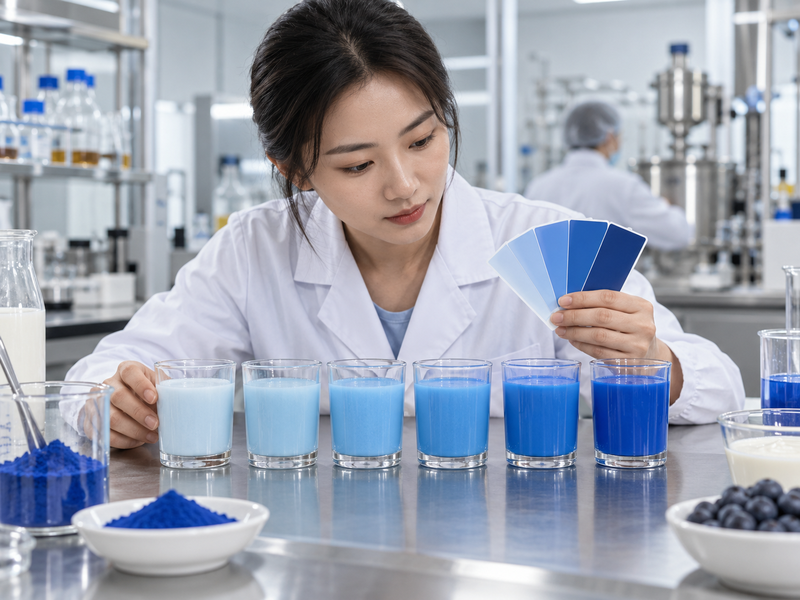
The uncolored base shows what the beverage, confection or powder contributes to the observed shade. Add a current approved ingredient as a reference if the company already has one. Then use at least one commercial lot from each supplier, rather than an unlabeled sales sample. A second lot helps reveal whether a promising result belongs to the grade or only to one production run. If a supplier cannot provide a second lot during screening, record that limitation and make lot-to-lot confirmation a later approval condition.
Code the samples for visual review so brand expectations do not influence the panel. Capture the raw powder appearance, the as-sold carrier declaration and the test weight. Record any sample that arrived warm, opened or damaged. Those observations may explain a result, but they cannot be erased after the color comparison.
| Sample | Purpose | Approval caveat |
|---|---|---|
| Uncolored base | Exposes matrix color and haze | Use the same base batch |
| Approved reference | Preserves the current commercial target | Check its age and storage |
| Supplier lot A | Screens candidate performance | Match the quoted SKU |
| Supplier lot B | Tests lot variation | Request a different batch |
| Retained portion | Supports investigation | Seal and label immediately |
3. How should sample identity be documented?
Link the pouch to the paperwork
Photograph the intact package label, seal and lot code before opening it. Record the exact SKU, batch number, production or expiry date, country of origin as declared, pack condition and carrier ingredients. Save the supplier specification and COA under the same lot code. A catalog page is useful background; it is not proof of what is inside the received pouch. Ask the supplier whether the trial sample represents a normal commercial lot and whether any pilot processing differs from the proposed bulk material.
Make a sample ID that follows the powder into every worksheet and storage photograph. One ID might identify supplier, SKU and batch; a separate preparation ID identifies the formula, dose and test date. This prevents a common error: results from a strong sample become attached to a later quote for a different grade. The site’s Blue Spirulina product page lists several commercial color-value grades, which makes exact SKU control especially useful. If the supplier changes carrier, grade or extraction route before purchase, repeat the relevant application trial.

4. How do you build a fair dose ladder?
Compare finished shade, then compare cost
Start with a reference dose chosen from the desired product appearance or an approved formula. Add lower and higher trial levels around it, using the same finished batch size for all candidates. The step sizes are a design choice; they should be small enough to find the usable shade without making the number of samples unmanageable. Record the powder mass and the total finished mass so the calculation can be checked later. Do not set equivalent doses by comparing E-grade numbers alone. Color value is measured under a specified optical method, while finished appearance also depends on the food matrix.
Prepare every dose in the same order and randomize visual review positions. If a candidate needs more material to reach the target shade, note the actual dose before reviewing price. Procurement can then calculate ingredient cost per finished unit from the quoted landed price and measured dose. Those outcomes belong on the same record as color.
| Dose record | Why it is needed | Common mistake |
|---|---|---|
| Powder mass | Recreates each sample | Rounded scoop estimate |
| Finished batch mass | Converts dose to product basis | Ignoring dilution |
| Grade and lot | Ties dose to a real supply | Writing only “blue spirulina” |
| Color result | Identifies the matched shade | Judging from powder color |
| Sensory/physical result | Shows dose tradeoffs | Recording color alone |
5. What preparation method should every trial use?
Control wetting and mixing
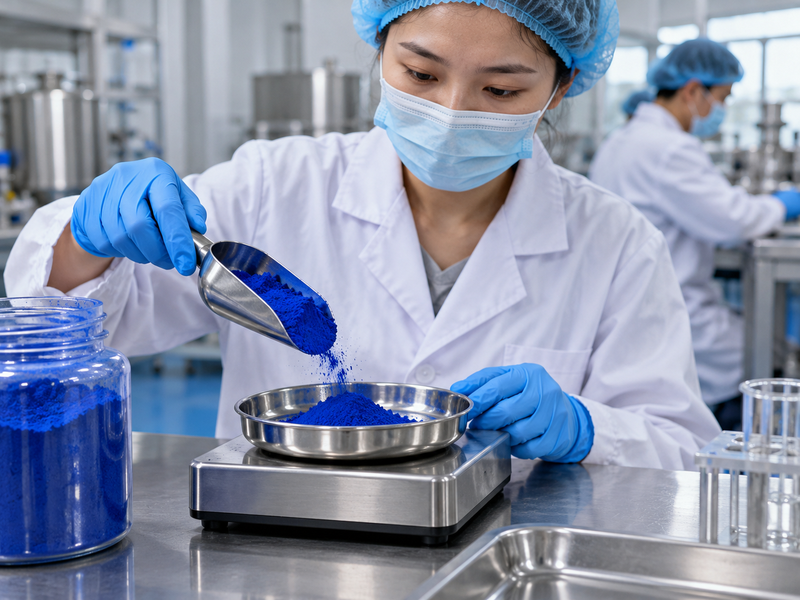
Write down the ingredient addition order, water temperature, premix method, mixing tool, speed and time. Blue spirulina extracts may wet and disperse differently because their carrier systems and particle properties differ. A clump that survives a short hand stir could disappear under production shear; the reverse can happen if a long bench mix masks a problem on a fast line. The trial should therefore include a practical bench preparation and, when possible, a pilot preparation that resembles production.
Keep the base formula batch fixed. If the finished product contains acid, protein or fat, add those ingredients in the intended order. Record whether color entered before or after acidification and heating. Researchers describe phycocyanin as sensitive to formulation conditions, including pH and temperature, in the stability review. The trial’s job is to show the effect under the buyer’s process, not to assume a supplier’s generic mixing instruction applies.
6. Which production steps must the sample face?
Follow the proposed process path
An attractive unprocessed cup is only the first observation. Run the color through the processing steps that define the commercial product: mixing, holding, heating or cooling, filling and package closure. Note the actual product temperature over time rather than writing only the equipment setpoint. Take samples before and after each critical stage so a color loss can be traced to a step. If the production method uses hot fill or pasteurization, quality must validate food safety separately; a color trial does not prove microbiological adequacy.
Include the intended packaging material. Published work documents effects of pH, heat and light on phycocyanin, but no general review can predict the result for every formulation and package.
| Process point | Sample to keep | Question answered |
|---|---|---|
| After mixing | Pre-process aliquot | Did powder disperse? |
| After heat or cooling | Processed aliquot | Did the step shift shade? |
| After filling | Sealed pack | Did packaging introduce haze? |
| During storage | Dated pack | Is color changing over time? |
| Final checkpoint | Retain pack | Does the proposed life meet the target? |
7. What should be measured during storage?
Keep the same viewing and measurement method
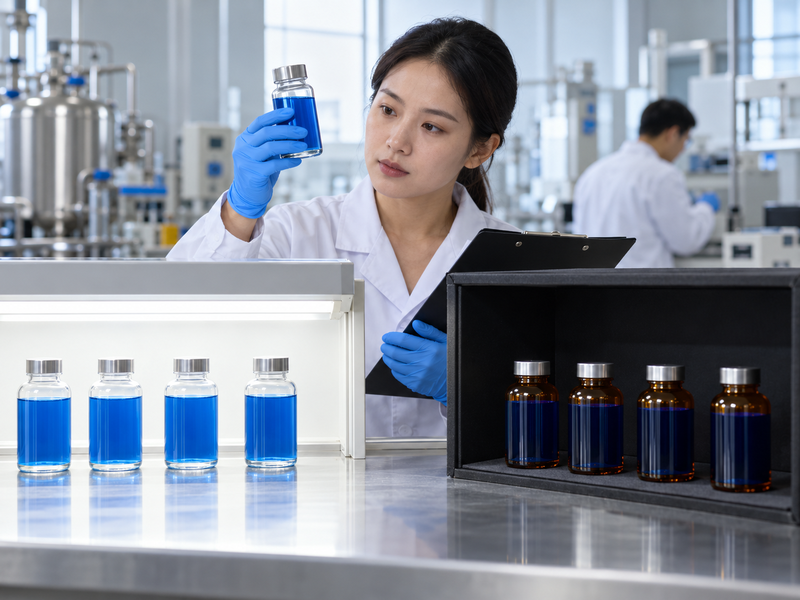
Photograph samples under fixed lighting, background, distance and camera settings. More useful still, use an instrumental color method when the team has one, recording the measurement geometry and sample presentation. The International Commission on Illumination defines color-difference terminology, but a numerical difference is meaningful only when measurement conditions are held constant. Pair the number with a controlled visual review. Consumers see the packed product, not the cuvette.
At each scheduled point, record pH where relevant, visible fading, haze, settled material, ring formation and package condition. Opened samples may behave differently from sealed packs, so keep them separate. If the label life is long, accelerated tests can help screen candidates but should not silently replace observations under the intended storage condition. Record actual dates and exposure, not “week one” without a start date.
8. How should sensory and cost be recorded?
Put tradeoffs beside the shade result
Color can win a bench comparison while taste or process behavior loses the sale. Have the sensory group review coded samples at the proposed dose and after the intended storage interval. Ask for specific observations such as grassy aroma, bitterness, mouthfeel or aftertaste rather than a vague “acceptable.” Record whether the judgment came from a trained internal panel, an informal team tasting or a formal consumer study. Each supports a different decision. Use food-safe trial material and follow the company’s tasting policy.
Procurement should calculate cost using the actual dose that met the visual target, not a standard spoonful or catalog recommendation. Include landed ingredient price, expected process loss and any packaging or mixing change caused by the grade. A lower price per kilogram can still cost more per drink if the formula needs a much higher addition. Keep commercial assumptions separate from measured results so a price revision can be rerun without repeating the bench work.
| Outcome | Measured or quoted input | Decision use |
|---|---|---|
| Matched shade dose | Grams per finished mass | Cost calculation |
| Flavor observation | Coded sample notes | Dose ceiling |
| Sediment or foam | Timed inspection | Process fit |
| Landed price | Current written quote | Commercial comparison |
| Process loss | Pilot mass balance | Finished-unit cost |
9. How do you judge differences between lots?
Compare each new lot with an approved reference
Run the same test recipe on a second commercial lot when one becomes available. A difference can come from raw material, extraction, carrier, drying or storage, but do not assign a cause from color alone. Review the two COAs, pack histories and sample handling before asking the supplier for an investigation. If the lots fall within the supplier’s color-value specification yet appear different in the finished product, the buyer may need a tighter application-based acceptance criterion.
Write the acceptance range before seeing the second-lot result. Otherwise the team may adjust a limit to fit a preferred supplier. A useful rule can combine instrumental color, visual reference and physical defects, with an escalation path for borderline samples. Keep a sealed portion of the approved lot and the challenged lot under controlled conditions. Lot control should help production receive the same working ingredient repeatedly.

10. What evidence closes sample approval?
Release a specific SKU and process use
The approval packet should identify the supplier, SKU, grade, declared composition and tested lots. Attach the current specification, lot COAs, sample preparation record, dose ladder, color and physical observations, photographs, storage plan, sensory notes and commercial calculation. Name the formula version and process settings that produced the approved result. If any of those inputs change, the packet should tell the next buyer which trial must be repeated.
Procurement should put the same SKU and carrier description on the purchase order, with a change-notification requirement. R&D should sign off the finished-product target, and regulatory staff should review market-specific use and labeling. For US food use, the current spirulina extract regulation is a starting point; its permitted-use text must be checked for the actual food category. Once the packet is signed, production has a working instruction rather than a sales sample story.
Frequently asked questions
Q1. Can a supplier’s demonstration drink replace our own test? No. Use it to identify a candidate grade, then test the quoted SKU in the actual formula and package.
Q2. How many supplier lots are needed? One lot can screen a candidate. A second commercial lot gives useful evidence about repeatability before a large supply commitment.
Q3. Should every candidate use the same powder dose? Use a common starting ladder, then compare each grade at the dose that reaches the agreed finished shade.
Q4. Can a high E value substitute for a storage trial? No. E value describes an optical result under a method; storage behavior belongs to the finished product.
Q5. What should we retain? Keep sealed ingredient samples, matched finished packs, lot documents and the trial record under the company’s retention policy.
Request a matched commercial sample
Send Spirulina CN the finished product category, target market, formula pH, process path, package and expected order scale. Request an identified commercial-lot sample, the current specification and lot COA. Put every candidate through the same documented trial before approving a purchase description.