
Spirulina vs Galdieria phycocyanin stability is a source-specific technical comparison. Both organisms can yield blue C-phycocyanin, but an ingredient buyer cannot assume their extracts have identical heat, light, pH, regulatory, or supply profiles. A published comparison suggests differences under defined laboratory conditions. The useful commercial decision still depends on a permitted product, a traceable lot, and performance in the finished food.
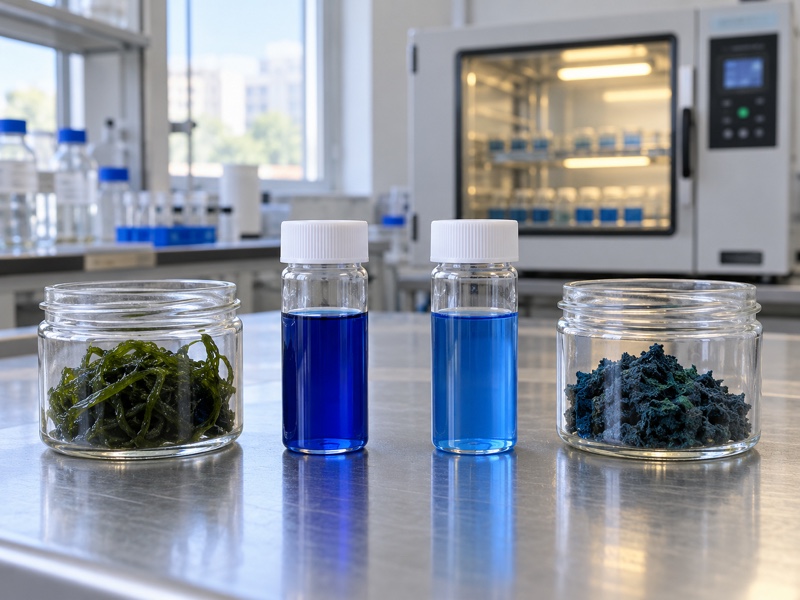
A 2021 Algal Research paper compared C-phycocyanin from Galdieria sulphuraria and Spirulina platensis under heat, pH, light, and stabilizer conditions. It reported better stability for its Galdieria material in several tested settings. That finding is a research result, not a specification for every commercial Galdieria extract or a failure verdict on all spirulina powders. In the United States, the FDA lists Galdieria extract blue and spirulina extract separately. Their use conditions need separate review.
1. What are the two biological sources?
Identify the organism behind the pigment
Spirulina used for commercial blue extract is a cyanobacterial source; Galdieria is a red alga associated with very different growth environments. Both can produce C-phycocyanin, but the source organism and production process can affect the extracted material. A comparison should name the species, extract preparation, purification or formulation steps, and intended food use. “Phycocyanin” on a seller page does not supply those details.
Our current catalog lists blue spirulina/phycocyanin as powders E3, E6, E18, E25, E35, and E40. It does not list Galdieria extract blue. Galdieria appears here as an alternative source for research comparison, not a product offer. Whole spirulina and chlorella are separate powders or tablets; neither is a substitute for a defined blue extract in a controlled color trial.
Ask suppliers for organism identity and production-site traceability. If a commercial quotation uses a broad name such as “natural blue algae extract,” confirm the exact legal ingredient identity before testing. The answer affects the regulatory route, label, and evidence required for approval.
2. What did the direct stability study test?
Keep the result inside its methods
The Wan and colleagues study compared C-phycocyanin isolated from Galdieria and spirulina across pH, heat, light, and stabilizer conditions. Its abstract reports greater stability for the tested Galdieria material under those conditions, including a clear difference after a defined neutral-pH heat exposure. The study also examined antioxidant capacity, but that laboratory endpoint should not be turned into a health claim for a colored food.
| Paper factor | What was compared | Buyer question |
|---|---|---|
| Source | Galdieria and spirulina extracts | Do commercial samples match the studied materials? |
| Heat | Defined temperature and time | Does the plant process match? |
| pH | Controlled model conditions | What is the finished-food pH? |
| Light | Laboratory exposure | What does the sale pack see? |
| Stabilizer | Added materials | Are those ingredients in the actual formula? |
The authors’ numerical retention values belong to their sample preparation and method. A seller should not paste them into a specification for an unrelated grade. Request product-specific data and run a matched trial with the intended process. The research helps identify which stresses to challenge.
3. Why can source species affect color behavior?
Separate protein origin from finished formulation
C-phycocyanin is a pigment-protein complex. Source biology can influence the properties of the recovered material, while extraction, purification, drying, carrier selection, and storage can also change commercial performance. A different source is therefore a plausible reason to test stability, not a guarantee of a fixed advantage. Two spirulina extracts can differ from each other as well; two Galdieria preparations can differ in processing and composition.
A buyer should compare like with like where possible: similar target shade, defined pigment concentration or color strength by a stated method, and the same finished-food matrix. If one sample contains a stabilizer or carrier and the other does not, a stability difference may come from formulation rather than organism. Ask for the full intentional-ingredient declaration and method behind any “high stability” claim.
Do not infer a purity or color value from our E3–E40 names. Each grade needs its own technical sheet and lot COA. The grade code is not a shared industry measurement scale and cannot be used to normalize a Galdieria quote.
4. Which heat test gives a meaningful comparison?
Copy the plant process, not a headline number
Record when the blue is added, the actual product temperature, hold time, cooling profile, and any reheating. Make samples of both candidate colors in the same food at matched initial shade, then run the required safety process. Measure color before heat, after cooling, and during storage. If a color can be added after heat, evaluate whether that process change is allowed under the validated manufacturing and hygiene controls.
| Heat-trial point | Observation | Record |
|---|---|---|
| Before process | Starting shade and dispersion | Dose, pH, lot |
| After warm-up | Early color shift | Ramp time |
| End of hold | Immediate pigment loss | Product temperature, dwell |
| After cooling | Final process color | Cooling time |
| After storage | Delayed change | Pack and conditions |
A commercial line can heat unevenly or hold material longer than the nominal set point suggests. For a cold-filled product, heat may be irrelevant while acid and light dominate. Select tests from the product brief instead of forcing every source through the same generic stress. The existing phycocyanin pasteurization guide provides a broader heat framework for spirulina-derived powder.
5. How should pH and acid exposure be tested?
Use the actual acid system
A model buffer offers a clean comparison, but a beverage or dessert can contain citric acid, fruit juice, minerals, proteins, and flavor components. Each may affect phycocyanin behavior. Prepare samples at the finished product’s target pH and reasonable production tolerance. Test whether pH changes after heat or storage. If the color is added before acid, measure the transition; if it is added after acid, measure dispersion into the acidic base.
The 2021 comparison found source-dependent differences under its pH conditions. Another Galdieria cultivation and pigment paper discusses acid and thermal stability of its extract. Neither establishes a universal threshold for every Galdieria product. Keep the claim tied to the grade and lot under review.
Watch for aggregation and sediment as well as fading. A clear bottle may fail from haze even when an instrument still detects blue pigment. In an opaque food, texture and visible specks can matter more. The blue spirulina acidic-beverage guide explains the existing spirulina challenge; this comparison adds source identity as a separate experimental variable.
6. What light and package conditions matter?
Test the intended shelf exposure
Blue color may change under light, and a transparent pack exposes the product differently from an opaque carton. Test both candidate samples in the sale package with the planned fill volume, headspace, and storage conditions. Include an unexposed control to separate light-related change from ordinary aging. Record display light and sampling dates rather than describing exposure as merely “room light.”
| Package factor | Trial condition | Why record it |
|---|---|---|
| Material | Actual bottle, tub, or pouch | Barrier and appearance differ |
| Opacity | Clear vs protected control | Separates light effect |
| Headspace | Intended fill | May affect product behavior |
| Temperature | Planned and stress storage | Changes color kinetics |
| Display duration | Intended shelf window | Sets decision horizon |
Use both instrument readings and a blind appearance review. A technical color coordinate can miss an unacceptable surface ring or sediment. A dramatic photograph can exaggerate a small difference if camera exposure changes. Keep camera, lighting, sample depth, and background consistent. The separate light-stability packaging article offers pack-screening details for spirulina powder.
7. How do U.S. regulatory identities differ?
Verify each listing on its own terms
The FDA’s color-additive summary lists spirulina extract under 21 CFR 73.530 and Galdieria extract blue under 21 CFR 73.167. Separate listings mean a buyer must check each material’s definition, specifications, permitted categories, conditions, and label name. A conclusion for spirulina extract does not automatically cover Galdieria extract blue. A color’s origin from an organism also does not eliminate the need for additive compliance.
| Approval-file item | Spirulina route | Galdieria route |
|---|---|---|
| Legal ingredient name | Spirulina extract | Galdieria extract blue |
| Applicable listing | 21 CFR 73.530 | 21 CFR 73.167 |
| Composition | Match sold powder to definition | Match sold material to definition |
| Food use | Check exact category and condition | Check exact category and condition |
| Export | Review destination market | Review destination market |
Rules can change; use the current FDA color-additive resource and a qualified regulatory reviewer before final approval. Do not use a scientific paper’s phrase “food application” as legal authorization. For international launches, confirm the local status separately. A U.S. permission is not a global permission.
8. How should a buyer compare commercial samples fairly?
Normalize the finished-food result
Request a production-representative sample of each legally suitable color. Record grade, lot, specification revision, composition, carrier, and measured color strength by a stated method. Set doses to reach the same initial shade in the actual food, then compare post-process and end-of-life outcomes. A one-gram-versus-one-gram test can be useful as a laboratory characterization, but it rarely answers cost in use.
Keep all other ingredients constant. If one color needs an added stabilizer or changed pack, document it as a separate formula variant. Compare color, haze, sediment, sensory effects, process handling, and cost. A better heat result can be offset by poor solubility or a non-permitted use. Make the decision against a written product brief rather than a ranking of pigment names.
Ask both suppliers for lot-to-lot consistency data and a change-notification process. If a production sample differs from the first trial lot, repeat the key acceptance checks. A research-based source comparison is valuable only when commercial material can reproduce the needed performance.
9. What supplier evidence should support the chosen source?
Keep source and lot traceable
For any powder, request the species/source declaration, current product specification, composition and carrier statement, lot COA, manufacturing site, storage guidance, and representative sample. Request application data with the test matrix and process disclosed. Ask which analytical method supports a color-strength or pigment-content claim. A supplier statement that one source is “more stable” without test conditions should be treated as a proposal to test, not an approval result.
| Record | Why the buyer needs it | Check |
|---|---|---|
| Source identity | Determines legal and technical route | Named organism and product |
| Grade specification | Defines release limits | Revision and methods |
| Lot COA | Links trial to shipment | Lot number and units |
| Composition | Label and formulation review | Carriers and intentional ingredients |
| Application report | Informs pilot | Matrix, heat, pH, light, pack |
Our confirmed offering is spirulina-derived blue/phycocyanin powder in E3, E6, E18, E25, E35, and E40 grades. Galdieria extract is not in that current product list. A buyer considering it should source and qualify it separately. Do not present Galdieria performance research as evidence that one of our powder grades has the same properties.
10. When is the source-selection decision ready?
Use a staged technical and regulatory gate
First, confirm that each material has a route for the intended food and market. Second, run matched bench tests at a comparable finished shade. Third, pilot the best candidate through the real process and package. Fourth, check the end-of-life target and delivered cost per unit. Only then should purchasing lock a grade and contract. If one option fails a regulatory gate, do not spend further time comparing its color in an unauthorized category.
A result from the 2021 paper may suggest which source to test first under heat or acid, but a commercial formula can behave differently. Keep the study’s conditions visible in the decision file and name every departure. If the selected source changes, repeat both regulatory and technical checks. If the selected supplier changes grade or process, review its change notice and retest the affected endpoints.
For our spirulina-based powders, request the current specification and a lot-linked sample of the intended E-grade. Evaluate the blue against the actual food, not against a generic source reputation. That gives the buyer a defensible answer even when research and supplier claims point in different directions.
FAQ
Q1: Is Galdieria extract one of this supplier’s confirmed products?
No. The confirmed blue range is spirulina-derived E3, E6, E18, E25, E35, and E40 powders. Galdieria is included here only as a research and market comparison.
Q2: Did the published study prove Galdieria is always more stable?
No. It reported better stability for its tested Galdieria material under defined conditions. Commercial grades and finished foods require their own tests.
Q3: Can I infer phycocyanin content from an E-grade number?
No. Request the grade specification, analytical method, and batch COA. The code alone is not an assay or shared industry scale.
Q4: Are the two extracts interchangeable under U.S. rules?
No. Spirulina extract and Galdieria extract blue have separate FDA listings. Verify the exact use and current rule for each.
Q5: What is the minimum useful comparison?
Use lot-linked samples at matched finished-food shade, run the real process, then check color and physical stability in the intended pack through the required life.