
A supplier writes “80 mesh” on a spirulina powder quotation, yet your beverage prototype still shows specks. Another lot passes a sieve but gives different mouthfeel. A purchasing team needs a specification that describes the distribution, sampling method, and test conditions rather than a single unqualified mesh number. This guide explains how to compare whole spirulina powder lots for food and supplement production. It draws on ISO 13320:2020 for laser diffraction terminology and asks buyers to verify each claim on a current sample and batch report.
Contents: definition · measurement · mesh · sampling · applications · process · reports · acceptance · troubleshooting · request.
1. What does spirulina powder particle size describe?
Think in distributions, not a single grain
The short answer: a batch contains many particle sizes. Spirulina cells, fragments, agglomerates, and drying residues can all appear in a powder sample. “Fine” describes a visual impression; it does not tell your formulator how much coarse material remains. A useful specification names at least one upper-tail measure and explains how the sample was dispersed. D10, D50, and D90 refer to particle diameters below which 10%, 50%, and 90% of measured volume falls when a volume-based laser diffraction method is used. A D90 value does not mean every particle is smaller than that number. Meanwhile a sieve result reports retained or passing mass at particular apertures, so its numbers cannot be swapped with a laser result without a comparison study. Whole green spirulina powder also differs from blue phycocyanin extract powder; their processing and particle structures may differ. Confirm which material the report describes before a team sets limits.
| Term | What it tells a buyer | What it does not tell |
|---|---|---|
| D50 | Middle of a stated size distribution | Maximum particle size |
| D90 | Upper-tail volume threshold | That every particle passes a sieve |
| Sieve pass | Mass passing a named aperture | Full fine-particle distribution |
| Visible clump | Possible agglomeration or moisture issue | Original primary-particle diameter |
2. How should a buyer measure the distribution?
Match the method to the decision
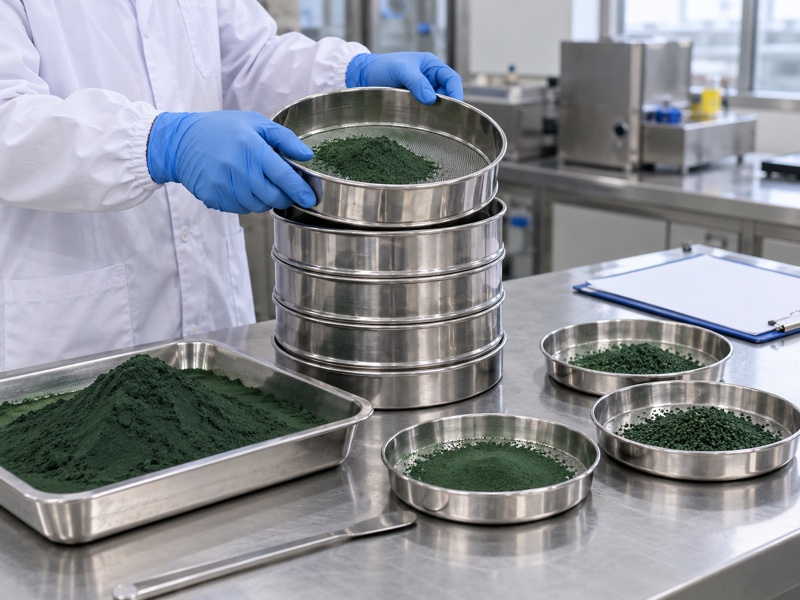
Start with the use case. A sieve stack can answer whether coarse fragments remain above a defined aperture. Laser diffraction gives a broader distribution, provided instrument settings and dispersion conditions are documented. Microscopy can identify long filaments, agglomerates, foreign particles, or cell fragments that a summary number hides. ISO 13320 covers laser diffraction of powders and other two-phase systems, but it does not prescribe a spirulina-specific pass limit. For laser work, ask whether the sample was measured dry or suspended in liquid, which optical model was used, and how strongly the powder was dispersed. Aggressive sonication may break clusters and report a finer curve than your dry manufacturing process experiences. For sieve work, record sieve standard, aperture in micrometres, loading mass, shake time, and any brushing or tapping. Compare like with like across suppliers. A method change can look like a lot change even when material has not changed.
3. What does an 80-mesh claim actually mean?
Ask for the aperture and passing fraction
Here is the catch: “80 mesh” can mean a nominal screen reference, a pass criterion, or a marketing shorthand. Mesh counts openings per inch, while aperture also depends on wire diameter and the standard used. A buyer should request the actual aperture in micrometres and a statement such as the mass fraction passing that sieve under a named method. An upstream harvesting net described as 200–300 mesh is a different operation and says nothing reliable about a dried powder’s final grind. A current US search result on bulk spirulina shows a mesh-size field on a sample COA, which makes the field worth checking, but the competitor’s value cannot serve as a specification for this catalog. If two lots each pass a coarse sieve, compare retained fractions on finer screens or use laser diffraction before accepting that they will disperse or feel alike.
| Claim on offer | Clarifying question | Better evidence |
|---|---|---|
| “80 mesh” | Which aperture and standard? | Signed sieve method and result |
| “100% pass” | At what sample mass and shake time? | Lot test with retained mass |
| “Ultra fine” | What distribution and dispersion mode? | D10/D50/D90 curve with method |
| “Same as last lot” | Was testing repeated on this lot? | Both lot reports and retention samples |
4. How can sampling change a particle-size result?
Build a representative composite
A small scoop can mislead. Fine particles may settle differently from coarse fragments during filling or transport. A sample taken only from the top of a drum can miss segregated material elsewhere. Agree on sampling locations, increments, and the number of containers before a release test. Close containers promptly because humid air can create temporary lumps that change dry-sieve performance. Keep a sealed retention sample from each tested lot and identify the exact lot and packaging unit on the lab report. Split the composite with a riffle splitter or another controlled method rather than choosing attractive powder by eye. For a complaint, test the supplier’s retained sample alongside unopened incoming material and an in-process sample. If results differ, investigate transport, storage, and handling before assigning blame to milling. Three replicated measurements and a stated variance often reveal whether a small shift is real or within normal sample preparation noise.
5. Which size profile fits each product format?
Use a trial in the actual formulation
There is no universal best size. A smoothie powder may tolerate visible specks that a clear beverage cannot. A nutrition bar may hide particles in a dense matrix, while a tablet blend has different compaction and die-filling needs. These examples are development hypotheses, not guaranteed performance or a specification offered by this supplier. Run small-scale trials at the planned dose, mixing energy, water temperature, and packaging conditions. Judge appearance, mouthfeel, sediment, and blend homogeneity after realistic holding time. For dry mixes, test whether fine particles coat other ingredients or segregate during vibration. For capsules, observe fill-weight variation as well as the size curve. Particle size belongs in a broader control plan with moisture, bulk density, and microbiology. The existing guide to blue spirulina versus green spirulina helps teams keep whole biomass distinct from the extracted blue ingredient when writing a formulation brief.
| Format | Trial observation | Size-related risk |
|---|---|---|
| Dry beverage mix | Dispersal and sediment after standing | Coarse visible residue |
| Nutrition bar | Texture after storage | Grit or local color streaks |
| Capsule or tablet | Fill-weight and compaction behavior | Segregation or inconsistent filling |
| Savory sauce | Surface smoothness at serving | Uneven particles or clusters |
6. How do milling and screening change the powder?
Separate process history from a finished-lot result
Process words need evidence. Milling can reduce coarse fragments, while screening removes or recycles material retained above an aperture. Drying conditions, feed moisture, mill energy, and screen loading affect the resulting distribution. Agglomeration is another process: it joins fine particles into larger structures to change handling and wetting, so it may move size numbers upward even when the material performs better for a particular use. That is why particle size cannot replace a flowability test. Size distribution and screening evidence deserve their own acceptance criteria apart from hopper handling. Ask for a production flow description, but do not infer final particle size from equipment names alone. At approval, compare finished-lot measurements against the sample that passed your line trial. A change in mill screen or dry-down method may warrant another trial even if a one-point mesh claim still passes.
7. What belongs on a batch particle-size report?
Make the result reproducible
A number needs its method. The report should identify the material as whole spirulina powder, state the lot, sampling date, preparation, instrument or sieve standard, result units, and acceptance criterion if one was agreed. For laser diffraction, include the distribution curve and D values with the dispersion medium or dry pressure. For sieve analysis, show each aperture and retained or passing mass percentage; a single “conforms” hides useful information. Record laboratory identity and the report date. If the method was performed by an outside laboratory, retain the complete signed report rather than copying only values onto a sales sheet. Flag a change in sample basis: a dry-basis report and an as-received powder report are not automatically comparable. Treat photos of powder as supporting observations, never quantitative proof. One rejected lot may be a sampling issue, while a repeated upward drift can signal screen damage or process change.
| Report field | Buyer check | Why it matters |
|---|---|---|
| Lot identity | Matches container and COA | Avoids unrelated generic data |
| Preparation | Dry or wet; dispersion setting | Changes measured clusters |
| Result | Curve or retained fractions | Shows tails hidden by one value |
| Limits | Agreed method and thresholds | Enables consistent acceptance |
8. How should teams set and check acceptance limits?
Work backward from a qualified trial
Begin with what your line can tolerate. Test several candidate samples through the target process, then identify size attributes that track an observed defect. If coarse grit drives rejection, a top-sieve retained limit may be useful. If dispersion differs despite similar sieve passes, add a distribution measure. Define an action band and a reject band only after considering method repeatability and production variation. Avoid copying another seller’s advertised mesh range into a contract. A practical purchase specification states product identity, test method, sample plan, numerical limit, rounding rule, and the party that resolves disputes. Retest a borderline lot under an agreed protocol rather than averaging away an out-of-limit result without explanation. If a formulation changes from bar to drink, re-evaluate the limit; the same powder can perform differently. Maintain the approved sample and its result so procurement can explain why a future lot is accepted or put on hold.
9. What should you investigate when sizes shift?
Diagnose the source of the difference
Do not jump straight to the mill. Check whether the supplier and receiving laboratory used the same aperture, instrument settings, dispersion pressure, and sample preparation. Compare container sampling positions and the age of each specimen. Moisture uptake can create soft agglomerates that appear coarse in a dry sieve yet break under wet laser dispersion. A change in drying, milling, or screen integrity may create true coarse fragments. Fines can also increase after prolonged handling or transport. Review moisture, appearance, and packaging seal data alongside particle size. If the discrepancy affects a beverage, repeat the actual dispersion trial, since a lab curve may not predict sediment by itself. Document what changed and which corrective action restored the prior result. This evidence helps distinguish a supplier change, a measurement artifact, and a formulation problem without treating any one result as a complete diagnosis.
| Symptom | Plausible cause | Immediate check |
|---|---|---|
| Coarse dry sieve result only | Humidity or soft clumps | Moisture and gentle deagglomeration |
| Higher D90 across methods | Milling or screen change | Equipment and retained-lot review |
| Good size, poor dispersion | Wetting or matrix effect | Finished-formulation trial |
| Wider lot-to-lot spread | Sampling or process variation | Replicate composite samples |
10. What should a buyer request before approval?
Put the size claim into a purchase-ready packet
The useful request is specific. Ask for a current whole spirulina powder sample, lot-linked COA, complete particle-size method and results, sampling plan, moisture result, and a statement of any planned process changes that could alter size. Request a retention sample and written agreement on how disputed tests will be handled. Run a line trial using your real recipe and record sensory and process observations beside the lab data. Where an offer says “custom mesh,” ask what manufacturing controls, minimum order, and requalification steps would apply; do not assume any particular custom capability. The supplier’s catalog includes whole spirulina powder and tablets, but no fixed particle-size limit has been supplied for this article. Use the approved trial result as a benchmark, then place an order only after purchasing, quality, and formulation teams agree on the measurable pass criteria. A clean specification prevents one vague mesh phrase from deciding an expensive production run.
For the next inquiry, send the target application, trial quantity, acceptable texture, and requested sieve or laser method. Ask the supplier for a lot-specific report and sample that your team can test. For broader ingredient selection, review the published blue spirulina powder guide, while keeping blue extract and whole green spirulina separate in the brief.
FAQ
Q1: Is a smaller particle always better? No. Smaller particles may improve some textures while changing dusting, wetting, and handling. Qualify size in your finished format.
Q2: Can 80 mesh be converted directly to D90? No. Sieve passing mass and laser-diffraction volume distributions measure different properties under different preparation conditions.
Q3: Does a fine powder dissolve completely? Whole spirulina biomass does not become a true molecular solution merely because it is milled finely. Check dispersion and sediment in the actual matrix.
Q4: Which lot should a buyer test? Test a representative lot linked to the planned shipment, and retain a sealed sample for comparison.
Q5: Can a supplier guarantee a particle size from a catalog photo? No. Request a written method, limit, and current batch result.