
Spirulina powder vs pill selection starts with whole green biomass, supplied loose or compressed into tablets. A low price per kilogram can hide dosing, conversion, and packing costs, while a convenient tablet may not suit a beverage formula. This guide compares the two formats as ingredients and finished products so procurement, formulation, and quality teams can choose on the same basis.
Contents: identity · process · composition · applications · dose · quality · packing · cost · supplier · decision
1. What is being compared in spirulina powder vs pill?
Keep the same whole-green ingredient in view
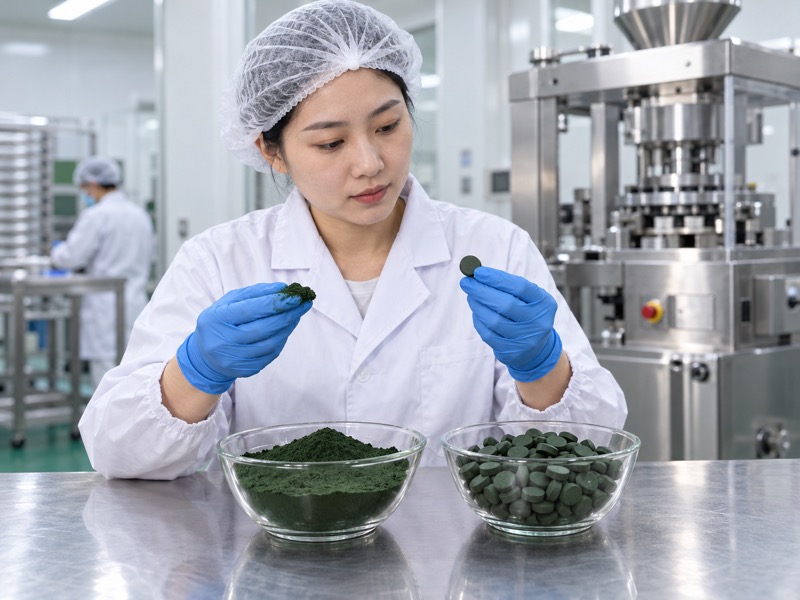
For a fair spirulina powder vs pill comparison, start with whole green spirulina biomass. Powder is dried biomass supplied loose. A pill or tablet is a measured piece formed from that powder, possibly with other ingredients needed for pressing. The word pill can also describe capsules or other dosage forms, so specify tablet if that is what the buyer needs. Blue spirulina or phycocyanin extract is a different material and should not be used as the powder side of this comparison. The supplier’s current catalog lists whole spirulina as powder and tablets; it does not establish a particular tablet size, excipient formula, or certification. See our blue versus green spirulina guide for that identity boundary.
Check the ingredient line. Ask whether both forms originate from the same whole-biomass grade, and request the exact tablet composition. A powder and tablet guide compares consumer formats. Commercial buyers also need lot identity, composition, and intended use. A tablet that contains 500 mg of material should state whether that number is tablet mass or spirulina content.
| Format | Physical state | Minimum identity question |
|---|---|---|
| Loose green powder | Whole biomass particles | Is it unblended whole spirulina? |
| Compressed tablet | A measured solid unit | What mass is spirulina and what else is present? |
| Blue extract powder | Separated phycocyanin-rich material | Is this a different product specification? |
2. How does manufacturing differ for powder and pills?
Treat tableting as a second process, not a label change
In a spirulina powder vs pill comparison, both forms may share cultivation, harvest, drying, and milling. Powder production can end after particle control, testing, and packing. Tablet production continues through blending if required, compression, dedusting, and tablet-specific checks. Each added operation creates another point where material can be mixed, lost, or altered. A buyer should ask for a flow chart showing the exact split between the shared powder lot and the tablet run.
Compression may require attention to powder flow, density, and moisture. Poor flow can cause variable tablet weight; too much force can affect hardness and disintegration. These are engineering concerns, not proof that tablets are nutritionally worse. Follow the parent lot. The tablet batch record should identify the powder lot and any added components. The powder COA does not by itself establish tablet weight, breakage rate, or final-pack quality. Conversely, a good tablet does not prove the incoming powder’s cultivation history. FDA’s dietary supplement CGMP guide describes batch records and component controls for U.S. supplement manufacture.
3. When can a tablet have different ingredients?
Compare formulation sheets instead of appearance
Some tablets contain only compressed spirulina. Others include binders, disintegrants, lubricants, coatings, or other declared ingredients. The need for these materials depends on equipment and product design; a buyer cannot infer their presence or absence from the tablet’s green color. Request an ingredient statement and quantitative formula information appropriate to the intended market and confidentiality agreement. If a finished brand claims a single ingredient, the buyer must verify that claim against the actual tablet recipe and processing aids, not assume it because the starting powder was single-ingredient.
The comparison also changes when a tablet combines spirulina with chlorella, vitamins, or another botanical. That may be a useful product, but it no longer compares equal masses of spirulina. Read the per-unit math. Separate tablet gross weight, declared spirulina weight, and serving count. A 600 mg tablet containing 500 mg spirulina is not equivalent to 600 mg loose spirulina. Use the current formulation revision, then reconcile it to the lot COA and label. The Alpha01 guide illustrates how consumer-facing labels can make these differences visible, though its particular formulations are not specifications for another supplier.
| Document field | Powder quote | Tablet quote |
|---|---|---|
| Whole spirulina content | Mass or percentage of supplied powder | Milligrams of spirulina per unit |
| Other ingredients | Each intentional addition | Binder, coating, or blend ingredients |
| Dose statement | Grams per serving or formulation | Units and spirulina mass per serving |
| Formula revision | Powder grade and specification date | Tablet recipe and specification date |
4. Which format fits the intended application?
Let downstream handling make the choice
Spirulina powder vs pill choices give a formulator flexibility in smoothies, dry mixes, nutrition bars, and premixes. It can be weighed into a batch, blended with other ingredients, or dosed through a feeder. Those benefits come with dust, color transfer, dispersion, and taste considerations. A tablet offers a counted dose and may simplify direct-to-consumer use, but it needs a product concept in which customers swallow or chew units. Crushing tablets into a beverage mix usually adds work and may introduce excipients that the formula did not need.
For private-label supplements, tablets may reduce a brand’s need for its own compression line. For a beverage manufacturer, bulk powder is usually the natural trial material. For a contract packer serving both channels, the right answer may be two linked specifications with separate commercial terms. Trial the final use. Test powder for dispersion and flavor in a realistic recipe. Test tablets for hardness, disintegration, appearance, and package survival under the actual distribution route. Neither format is universally superior. The supplier should provide samples from representative production lots, not hand-selected display units.
5. How should buyers compare spirulina powder vs pill serving size?
Convert both formats to grams of whole spirulina
Start with the desired amount of whole spirulina per serving. For loose powder, that mass can be measured directly after accounting for any blend composition. For tablets, multiply spirulina mass per tablet by the number of tablets per serving. Do not multiply by gross tablet weight unless the tablet contains only spirulina and its specification confirms that fact. If a buyer is comparing nutrient delivery, use measured nutrient data from matched lots and the intended serving, rather than assuming the same percentage for every producer or process. Drying and formulation may change measured values.
For example, a hypothetical target of 2 g whole spirulina requires four tablets with 500 mg spirulina each. If each tablet weighs 600 mg, the four tablets weigh 2.4 g in total, but only 2 g is spirulina. A 2 g scoop of pure powder contains 2 g whole spirulina before any preparation loss. These are arithmetic examples, not recommended doses or actual product specifications. Normalize before pricing. The same calculation will later reveal cost per serving and prevent a cheap-looking tablet from winning because its listed weight includes non-spirulina material.
| Comparison item | Calculation | Example |
|---|---|---|
| Powder spirulina mass | Serving powder mass × spirulina fraction | 2 g × 100% = 2 g |
| Tablet spirulina mass | Units × spirulina per unit | 4 × 500 mg = 2 g |
| Tablet gross mass | Units × total unit mass | 4 × 600 mg = 2.4 g |
6. Which quality tests are shared and which differ?
Write two specifications with a common base
Powder and tablets need evidence for identity, relevant contaminants, and traceability. Depending on intended use and market, the specification may cover moisture, microbiology, heavy metals, and composition. The finished tablet adds physical tests such as unit weight, hardness, friability, and disintegration where applicable. Powder adds handling tests such as particle size, bulk density, or flow when those properties matter in a line. Some tests can use the same analytical method across forms; others need separate preparation or acceptance limits.
If a tablet contains added ingredients, contaminants in those components also need risk review. The finished tablet COA should refer to the final batch, while the incoming powder COA should refer to its own parent lot. Match the certificate to the form. A COA bearing the word spirulina but no clear product code or lot genealogy is not enough for release. Under U.S. dietary supplement rules, manufacturers establish specifications for components and finished batches; FDA’s CGMP guide explains that framework. Food-ingredient rules and other markets may differ, so confirm the product’s actual regulatory category.
7. How does packaging change the commercial choice?
Specify the ship unit and the consumer unit separately
Bulk powder may arrive in lined bags or drums, then move into a manufacturer’s own packaging. Tablets may be supplied in bulk for bottling or already packed for retail. Each route has different exposure, counting, sealing, labeling, and breakage risks. A quote for bulk tablets without bottles should not be compared with a powder quote that includes retail pouches. Ask which party supplies each packaging component and who performs final release. The buyer should define transport conditions and inspect the received unit before using the ingredient.
Tablet packages must protect units from moisture and mechanical damage; powder packages must limit ingress and prevent leaks or caking. Those are design goals, not proof that any specific pack works. Request pack specifications and appropriate stability evidence for the exact product. Open a shipped sample. Check the seal, count or net weight, dust, clumping, and visible damage after realistic transit. Then put those observations into acceptance criteria. For bulk orders, the relationship between inner pack, outer carton, pallet, and lot code belongs in the purchase terms.
| Commercial question | Powder route | Tablet route |
|---|---|---|
| Purchase unit | Kilograms per liner or drum | Tablets per bag, bottle, or carton |
| Receiving check | Net mass, seal, clumping | Count, breakage, seal |
| Downstream step | Formulation or repack | Bottling, labeling, or retail sale |
| Stability evidence | Powder in proposed pack | Tablets in proposed pack |
8. How can a buyer compare spirulina powder vs pill unit cost?
Price the delivered usable serving
In a spirulina powder vs pill quote, cost per kilogram is only a starting point. For powder, add freight, import costs, handling, dosing loss, and any repacking. For tablets, add compression, ingredients, inspection, count loss, bottle or pouch, labeling, and freight according to who performs each step. Divide total landed cost by usable servings with the same grams of whole spirulina. Use an agreed yield assumption, then replace it with actual trial data. This makes two quotes comparable even when one seller prices powder by mass and another prices tablets by thousand units.
Suppose one hypothetical offer contains 100 kg pure powder and another contains 200,000 tablets with 500 mg spirulina each. Both represent 100 kg spirulina before losses, despite very different unit counts. Their economics diverge after tableting, packaging, freight, and scrap. Compare the same endpoint. A brand buying finished bottles should price finished, saleable bottles. A co-manufacturer buying raw input should price accepted ingredient at its plant gate. A low ex-works price can lose its advantage when tablet breakage or powder feeder waste rises.
9. What should a supplier quote and document?
Request a matched evidence pack
Ask for separate specifications and quotes for whole powder and tablets. Each should state product identity, composition, lot size or minimum order, package, unit of sale, lead time, shelf-life basis, and country of manufacture. Request representative COAs, but treat them as examples until the purchase lot is identified. For tablets, add tablet mass, spirulina mass per unit, excipients, and physical criteria. For powder, add the particle and handling properties relevant to the intended plant. Neither a generic certification logo nor a seller’s self-description establishes that these details apply to a specific lot.
Keep the versions together. Put document revision numbers on the RFQ comparison sheet and require notice before a source, process, recipe, or package change. Confirm who investigates a failed batch and how retained samples are held. If the supplier offers both forms, ask whether the tablets are made from the same powder grade and whether each finished lot can be traced back to its parent. FDA’s CGMP guide makes clear why component and finished-batch records matter in U.S. dietary supplement manufacture. The buyer still needs its own risk-based specification.
| RFQ field | Why it belongs in writing |
|---|---|
| Exact identity and formula | Prevents a blue extract or blend substitution |
| Spirulina mass per tablet | Enables true serving and cost comparison |
| Lot-linked COA format | Shows how shipment release will be documented |
| Packaging and Incoterm | Defines delivered scope and freight responsibility |
| Change notice | Protects an approved formula or label |
10. How should a team decide between spirulina powder and pills?
Use a short decision matrix and a real trial
Start with the end product. If spirulina will enter a food formula, trial loose powder for sensory fit, dispersion, metering, and color. If the brand sells a counted supplement, trial tablets for unit consistency, disintegration, package survival, and consumer instructions. Ask quality to compare lot evidence for both. Ask procurement to normalize price per usable gram of spirulina and per saleable serving. Regulatory staff should review the intended market and proposed claims. Make the decision only after these teams have reviewed the same product codes and formulation revisions.
The spirulina powder vs pill question has no universal winner. Powder offers flexibility in recipes and bulk handling. Tablets add a measured unit and a compression-and-packing process. Put a name beside every assumption. Who owns tableting? Who approves excipients? Who releases the finished pack? Who absorbs breakage? Document those answers in the order rather than leaving them for a complaint. If the supplier cannot connect a tablet lot to its powder parent, resolve traceability before committing to a large run.
Choose the format that works in the actual production or selling channel. Request matched specifications and lot evidence, calculate cost on equal spirulina content, and test both forms where the choice remains close. That gives your team a commercial decision it can repeat when the next lot arrives.
FAQ
Q1: Is a spirulina pill always just compressed powder? No. Some tablets contain other declared ingredients. Request the complete formulation and spirulina mass per unit.
Q2: Does tablet weight equal spirulina weight? Only if the specified tablet contains no other material. Check both values on the current specification.
Q3: Can a beverage brand use crushed spirulina tablets? It can test that route, but loose powder usually avoids an extra compression step and possible excipients.
Q4: Which format is cheaper? Compare landed cost per usable serving with the same grams of whole spirulina and realistic losses.
Q5: Can one COA cover powder and tablets? Incoming powder and finished tablets are different lots or stages. Each needs the evidence appropriate to its specification.