
Chlorella drying methods affect more than the moisture number on a certificate. The drying step turns wet biomass into a powder that can be stored, shipped, blended, or pressed into tablets. It can also change color, aroma, particle behavior, microbial results, and production cost. A buyer should compare finished lots and the records behind them, not choose a method from its name alone.
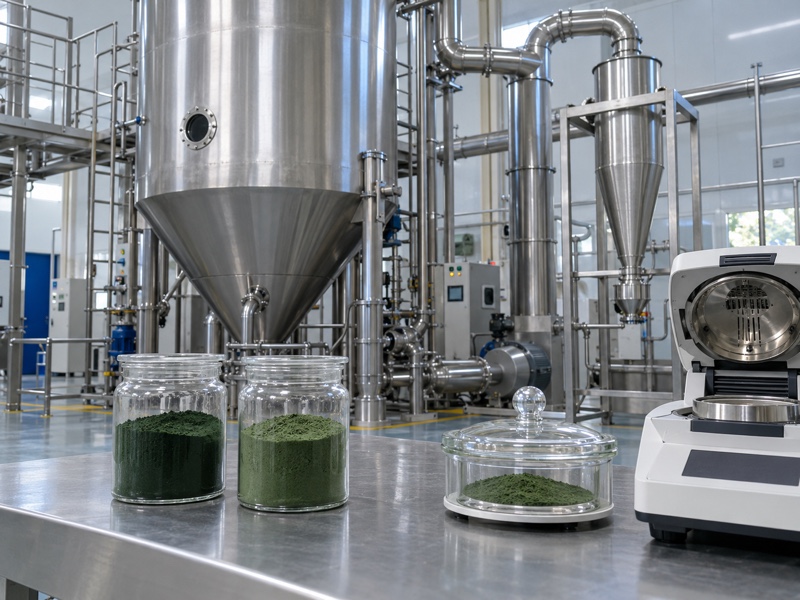
Our current catalog confirms Chlorella powder and tablets. It does not state which dryer produces a particular lot. These are whole-algae products, distinct from the blue extract in our blue spirulina versus Chlorella guide. Request the current specification, batch COA, and process description before treating any route discussed below as a claim about this supplier. The useful decision is whether the powder made by a defined route meets your application and remains consistent when the next order arrives.
1. Why is drying a purchasing decision for Chlorella?
Wet biomass is time-sensitive
Freshly harvested Chlorella needs controlled handling. The producer may dewater it, dry it, collect the powder, and pack it. Delays and equipment settings affect the finished material. A low final moisture figure does not explain those earlier steps.
Drying matters when powder must disperse in a drink, retain green shade, avoid off-notes, or flow through a tablet line. Define those outcomes before comparing process names.
| Buyer objective | Why the drying stage matters | Evidence to request |
|---|---|---|
| Shelf stability | Residual moisture and water activity influence storage behavior | Lot values, methods, storage study |
| Green appearance | Heat, light, and hold time may affect pigments | Color data and retained samples |
| Powder handling | Particle and agglomerate properties affect flow and wetting | Flow, sieve, or dispersibility trial |
| Food safety | Wet handling and powder collection create control points | Microbiology and process records |
| Tablet production | Powder behavior affects compression and consistency | Pilot run and linked powder lot |
This is a checklist for supplier comparison, not a claim that one dryer always wins. Finished-lot tests and your own application trial remain the deciding evidence.
2. Which Chlorella drying methods are used or studied?
Compare the mechanism before the label
Freeze drying removes water after freezing, usually under reduced pressure. Spray drying atomizes liquid feed into heated air. Solar drying uses sunlight or solar-derived heat. Pulse combustion drying uses pulsed hot gas. Agitated thin-film drying spreads feed across a heated surface while mixing. Actual settings and feed preparation vary.
A 2025 peer-reviewed comparison indexed by the publishing research institute tested five of these routes on heterotrophic Chlorella vulgaris: freeze, spray, solar, pulse combustion, and agitated thin film. It measured nutrition, selected safety indicators, environmental impact, and cost. Its comparison is useful for designing questions, but it is not a certificate for an unrelated producer's powder.
| Method family | Process feature | First buyer question |
|---|---|---|
| Freeze drying | Frozen feed loses water under reduced pressure | What are the cycle time and finished quality? |
| Spray drying | Atomized feed meets heated air | What is the product temperature and collection loss? |
| Solar drying | Solar energy contributes to drying | How are weather, enclosure, and hygiene controlled? |
| Pulse combustion | Pulsed hot gas transfers heat rapidly | What are yield and process controls at scale? |
| Agitated thin film | Thin moving layer contacts a heated surface | Is residence time uniform and documented? |
Ask which method produced the offered sample and current lots. A lab comparison of several dryers may not reflect the commercial equipment used for your order.
3. What did the 2025 drying study actually find?
Keep the result inside its study conditions
The Algal Research study worked with heterotrophic C. vulgaris. The authors examined nutrient composition, selected polycyclic aromatic hydrocarbons, microbial counts, environmental impact, and costs. Their abstract reports relatively small nutrient-composition differences across most tested routes, except changes in carbohydrate and fiber content with agitated thin-film drying. In their assessment, spray drying carried the highest environmental impact and cost, while solar drying performed best overall; pulse combustion ranked next but had a yield issue.
Those findings belong to the tested feed, equipment, energy assumptions, and scale. They do not make solar drying the safest or cheapest option for every plant. A different strain, wetter feed, climate, energy source, or throughput can move the result. Solar equipment needs a clear explanation of enclosure, hygiene, and rainy-season operation.
Use the paper as a set of hypotheses. Ask a supplier for its measured powder quality, actual drying yield, energy basis, and food-safety controls. If it claims a route is “gentle,” request the relevant before-and-after data. If it claims lower cost or impact, ask whether the calculation reflects routine production rather than a pilot demonstration.
4. Which temperature and time records matter?
Product exposure is not the same as an inlet setting
A dryer may have several temperatures: heating medium, air inlet, air outlet, equipment wall, and the product itself. Reporting only the hottest air number can exaggerate product exposure; reporting only a nominal low set point can conceal a long hot hold. Ask which temperature was measured, where, how often, and for which lot. Residence time and feed solids belong beside it.
For spray drying, request feed concentration, atomization approach, inlet and outlet temperatures, collection point, and powder temperature if monitored. For freeze drying, request freezing conditions, chamber pressure, cycle duration, and finished moisture. For a surface dryer, ask about wall temperature, product contact time, mixing, and handling of material that stays on the surface too long. A solar route needs weather and enclosure records as well as its nominal temperature target.
| Record | Why a buyer needs it | Common weak answer |
|---|---|---|
| Feed solids before drying | Changes the water load and process comparison | “Wet algae feed” |
| Product or outlet temperature | Helps interpret heat exposure | Inlet setting alone |
| Residence or cycle time | Shows how long material was exposed | “Fast process” |
| Final moisture and water activity | Supports storage decision | One unspecified moisture number |
| Deviation disposition | Explains what happens after an upset | No documented hold/release rule |
Do not set a universal time-temperature limit from a blog post. The correct range depends on the equipment, product, intended use, and validated control plan.
5. How should moisture, water activity, and storage be assessed?
Test the finished packed powder
Moisture content tells you how much water is present by a specified method. Water activity describes the availability of water for reactions and microbial growth under defined conditions. They are related, but one does not substitute for the other. A supplier should state its test method, units, acceptance limit, sampling plan, and packaging condition. Ask whether the result was measured after the powder equilibrated in the final pack or immediately off the dryer.
The packaging system matters because dried Chlorella can pick up moisture after production if it is exposed during milling, filling, or storage. Review the barrier properties and seal integrity relevant to your shelf life, along with warehouse humidity and temperature records. A powder that leaves the dryer in specification but sits in an open hopper is not adequately described by its dryer set point.
Run a receiving test on the first commercial lot and retain a sealed reference sample. If a later bag cakes or changes odor, compare the product's lot values, packaging, transport conditions, and retained sample. A single moisture number without a method or trend cannot diagnose the cause.
6. Which safety checks should accompany a drying claim?
Drying is one control among several
Drying can reduce available water, but it does not erase contamination that entered earlier, and it is not a substitute for a validated food-safety plan. Ask where the biomass was held before drying, how the dryer and collector were cleaned, whether post-dryer equipment is enclosed, and how operators sample the powder. Review microbial specifications and the actions taken after an out-of-range result.
The 2025 study included microbial counts and selected polycyclic aromatic hydrocarbons because method and heat source can create different questions. That does not prove the same risk level in another dryer. A buyer should request risk-based test data for its own material and market, with named methods and reporting limits. If a route uses combustion gases or direct heat, ask how exhaust contact and potential contaminants are controlled. If it relies on ambient exposure, ask how insects, dust, and weather are excluded.
| Control point | Buyer question | Evidence |
|---|---|---|
| Wet biomass hold | How long before drying and at what temperature? | Batch time log |
| Dryer hygiene | How is cleaning verified between lots? | Cleaning and inspection record |
| Heat or air source | Can contaminants contact product? | Equipment design and monitoring |
| Powder collection | Is post-dryer transfer enclosed? | Flow diagram and site observation |
| Final release | Which tests govern approval? | Lot COA and deviation rules |
Ask for the actual control plan. “Food grade dryer” is too vague to settle these points.
7. How can drying affect color, taste, and powder handling?
The application decides which difference matters
Two Chlorella powders can pass the same basic safety tests yet behave differently in a finished food. Compare color in the intended matrix, not only as dry powder in a clear bag. Taste a standardized dilution or prototype with blind codes. Observe whether the powder wets, sinks, floats, clumps, or leaves visible particles under your mixing conditions. For tablets, run a small compression trial and record defects rather than assuming free-flowing powder will compress well.
Drying interacts with dewatering, milling, and particle classification. Spray drying can create different particle shapes from tray or freeze drying; post-drying milling can erase or add some of those differences. Do not attribute every flow or dispersion change to the dryer without checking the full process history. Ask whether a sample was milled, screened, blended, or agglomerated after drying.
| Application | First observation | Useful follow-up |
|---|---|---|
| Beverage powder | Wetting and visible clumps | Timed dispersion under normal mixing |
| Light-colored food | Green shade and off-notes | Matrix-matched color and sensory trial |
| Bulk powder filling | Dust and flow variation | Pilot fill-weight consistency |
| Tablet | Sticking, capping, hardness | Compression and storage pilot |
Repeat the trial with the exact grade and a current production lot. The catalog lists powder and tablets, but it does not assign a drying technology to either form.
8. How should cost and environmental claims be compared?
Use the supplier's real operating basis
The lowest energy figure per hour is not necessarily the lowest cost per kilogram of released powder. Feed solids, dryer throughput, yield, labor, cleaning, rejected material, packaging, and energy price all matter. Ask whether a quoted figure counts startup and shutdown losses and whether it comes from a pilot or regular production. If a supplier proposes a higher-priced powder as “better preserved,” compare the tested attribute that matters to your product and its cost in use.
Environmental comparisons need the same boundary. A solar route may depend on local weather, land, backup heat, and enclosure design. A spray route may differ substantially with the energy source and waste-heat recovery. The published drying comparison is a useful example of doing a defined assessment, not a universal label to attach to every plant.
Ask the supplier what its cost and footprint calculation includes. If it cannot provide a formal life-cycle study, it can still disclose process yield, energy type, and where loss occurs. Keep unsupported “greenest method” claims out of your own purchasing record.
9. What supplier documents should go in the approval file?
Connect a process description to a saleable lot
Request a process flow that identifies the drying step, any outsourced handling, and the lot code at each transfer. Add the product specification, a current representative COA, moisture and water-activity methods, microbiology, sensory or color reference, shelf-life evidence, and packaging description. Ask for a change-notification commitment covering dryer, feed preparation, site, or post-drying processing. Those changes can alter the material even when the item name stays the same.
Record what the supplier actually claims. A photo of a spray dryer does not prove that your lot was spray dried. A sample from a test run may not represent the commercial line. Match the sample ID, production record, COA, and final package. If the site outsources drying, ask which company releases the powder and who investigates a deviation.
| Document | Match it to | Review owner |
|---|---|---|
| Process flow | Offered grade and current production site | Supplier quality |
| Drying batch record | Finished lot and harvest batch | Quality assurance |
| COA | Specification, methods, and batch code | Technical buyer |
| Packaging record | Bag type, seal, and lot label | Receiving team |
| Change notice | Dryer, site, or process changes | Procurement and quality |
A usable approval file lets a buyer compare the next lot with the one that passed the initial trial.
10. How can a buyer decide between real lots?
Test before negotiating the annual volume
Send suppliers the same brief: Chlorella powder or tablet, destination market, planned application, critical sensory and physical attributes, target pack, estimated demand, and required documentation. Request a sample tied to a routine production lot. Test it under the actual blending, filling, or tablet conditions. Set acceptance criteria before seeing results, including moisture and water activity, microbiology, shade, flavor, handling, and any composition measures relevant to your product.
If two lots made by different methods both pass, compare delivered cost, capacity, lead time, and change control. If one fails, ask whether the issue arose during cultivation, dewatering, drying, milling, or packaging; do not assume the dryer caused every difference. A supplier that can trace the process can correct a problem faster than one that only knows the method name.
Before a larger order, obtain current lot data and a written agreement on the approved grade, specification, packaging, and changes that require notice. Ask which drying route produced the material you will receive. That answer, backed by records and a successful pilot, is more useful than a claim that any single method is “best.”
Frequently asked questions
Q1: Is freeze-dried Chlorella always higher quality than spray-dried Chlorella?
No. Compare finished lots using the attributes your product needs, including safety, moisture, color, sensory fit, handling, and cost.
Q2: Did the 2025 study prove solar drying is best for every supplier?
No. Its result applies to the tested heterotrophic C. vulgaris, equipment, and assessment boundaries. Verify any commercial site's own quality and hygiene controls.
Q3: Is a low moisture value enough to approve a powder?
No. Review water activity, method, packaging, microbiology, storage evidence, and how the lot behaves in your application.
Q4: Do Chlorella tablets in this catalog use a specified dryer?
The catalog confirms tablets as a product form, not a drying route. Request the linked powder and tablet production records.
Q5: What is the first useful sample request?
Ask for a sample from routine production with its lot code, specification, COA, drying route, and pack details so your pilot can be traced.