
Spirulina nutrition facts should be read per serving, using measurements from the actual product. Spirulina nutrition panels can be deceptively impressive when one page uses a 100-gram reference and another uses a few grams of powder. The values may both be mathematically correct but answer different buying questions. This guide shows how to translate reference figures into a realistic portion, identify nutrients that require special care, and ask for evidence before printing label claims.
Contents
- What food is represented by a spirulina nutrition table?
- How do you convert per-100-gram values to a serving?
- Why can protein percentages mislead?
- Which minerals deserve a closer calculation?
- Does a B12 result mean biologically useful B12?
- What do color and pigment tell you nutritionally?
- How should a label use supplier and reference data?
- Why do lots show different nutrition numbers?
- Which nutrition claims are easiest to overstate?
- What should a buyer request before choosing a powder?
1. What food is represented by a spirulina nutrition table?
Identify the material before comparing numbers
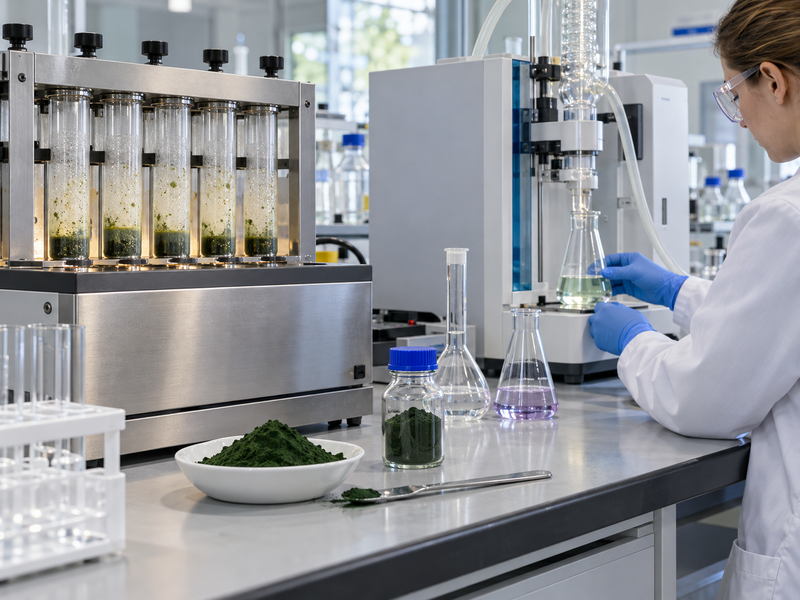
Most reference entries describe dried, whole spirulina biomass rather than fresh paste, tablets with binders, a beverage blend or concentrated blue phycocyanin. Water content, carriers and processing change the denominator. A label for a drink mix may list nutrition for the entire mix, so the spirulina contribution cannot be read directly from the finished panel.
The USDA FoodData Central record for dried spirulina is useful as a reference, but it is not a certificate for every commercial lot. Begin with scientific identity, whole-biomass versus extract, dryness and ingredients added during manufacturing.
A useful next step
Ask whether a published figure represents the exact material being purchased. Match the reference to the ingredient list and production lot before comparing brands. If one listing covers a blend, request the component contribution separately.
2. How do you convert per-100-gram values to a serving?
Use the portion as the denominator
The calculation is simple: nutrient per serving equals nutrient per 100 grams multiplied by serving grams divided by 100. The USDA reference lists about 57.47 grams of protein and 28.5 milligrams of iron per 100 grams of dried spirulina. A purely illustrative 3-gram amount therefore calculates to about 1.72 grams of protein and 0.855 milligrams of iron before rounding or lot variation. This example is arithmetic, not a suggested daily dose or a substitute for finished-product testing. A 100-gram table can mislead when readers unconsciously treat its numbers as spoonful values.
A useful cross-check is to calculate the same nutrient from two independent views of the formula. First scale the supplier’s per-100-gram result by the grams of spirulina used. Then compare the estimate with the nutrition analysis of the finished product, allowing for nutrients contributed by other ingredients. If the two figures disagree substantially, inspect unit conversion, moisture basis, batch yield and analytical variation before choosing the more attractive number. For a multi-serving pack, divide by the number of portions actually declared on the label, not the number suggested by a photograph or scoop.
A useful next step
Write the serving mass in grams at the top of the calculation. Retain extra decimal places until the final label review, then apply the destination market’s rounding rules. Use a lot assay for commercial decisions.
| Reference value | Per 100 g | Illustrative 3 g |
|---|---|---|
| Protein | 57.47 g | 1.72 g |
| Iron | 28.5 mg | 0.855 mg |
| Energy | 290 kcal | 8.7 kcal |
| Multiplier | 3 divided by 100 | 0.03 |
3. Why can protein percentages mislead?
Separate dry-matter percentage from portion contribution
“More than half protein” describes the dry ingredient’s composition, not a large protein intake from any amount sprinkled into food. At the illustrative 3-gram amount, the USDA reference converts to less than 2 grams of protein. A finished smoothie with milk, soy or yogurt may contain much more protein from those ingredients. For manufacturing, the measured protein content of a supplier lot may also reflect the analytical method and nitrogen conversion factor.
The honest question is how many grams the finished portion provides, and whether the local criteria for a protein claim are met. A high raw-powder percentage by itself is insufficient.
A useful next step
Show grams per labeled serving prominently in technical review. Confirm whether the supplier reports crude or true protein and which method it used. Test the finished formula if the claim will appear on retail packaging.
4. Which minerals deserve a closer calculation?
Compare amount, absorption and claim thresholds
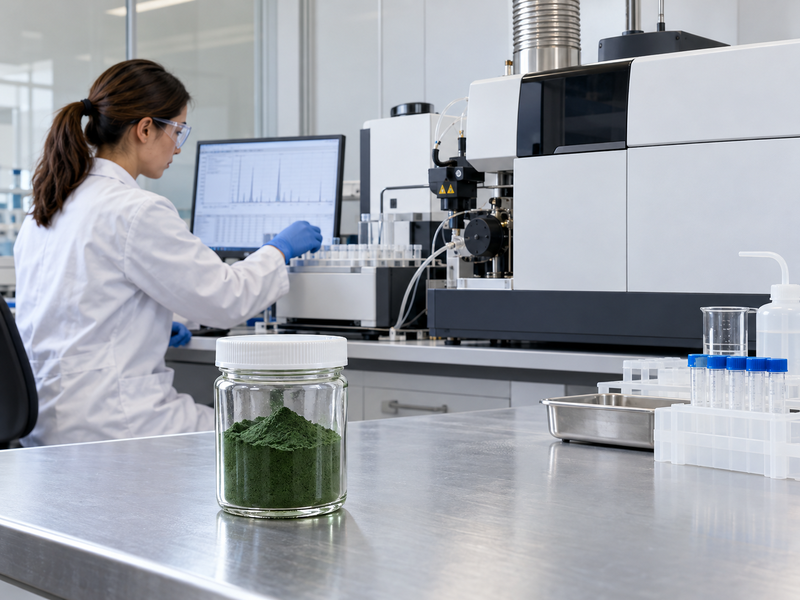
Iron draws attention because the dried reference value is substantial per 100 grams, but realistic servings yield much less. The NIH iron fact sheet gives adult requirements and explains that nonheme iron absorption varies with meal composition. A label amount does not equal the amount absorbed. Other minerals may also vary between lots and cultivation systems.
Avoid listing a long mineral panel from an old dataset as if every nutrient is present at a meaningful level in the current powder. Where a nutrient is central to positioning, commission validated analysis and assess the final food serving.
A useful next step
For each mineral, calculate milligrams in the actual portion and compare with the applicable Daily Value or local reference intake. Record the assay uncertainty and whether other ingredients add or inhibit the nutrient.
| Question | Required input | Why |
|---|---|---|
| How much? | Lot assay and grams used | Amount |
| How variable? | Several representative lots | Label stability |
| Absorption? | Food matrix and evidence | Nutrition context |
| Can it be claimed? | Market-specific rule | Compliant wording |
5. Does a B12 result mean biologically useful B12?
Distinguish corrinoid signal from active vitamin
A broad microbiological assay can detect B12-like corrinoids that do not function as human vitamin B12. In an original analysis of edible algae and tablets, researchers found inactive pseudovitamin B12 predominated in the spirulina tablets studied. That result does not mean every future lot is identical, but it is enough to reject a generic “spirulina supplies B12” assumption. A vegan should use reliable fortified foods or supplements for B12 rather than depend on spirulina.
Brands considering a B12 claim need an analytical method that discriminates active forms and a defensible label value in the finished product.
A useful next step
Ask the laboratory which compounds the method measures. Do not translate a non-specific total corrinoid number into a vitamin B12 claim. Refer people needing B12 to established dietary sources and professional advice.
6. What do color and pigment tell you nutritionally?
Do not confuse appearance with a nutrient assay
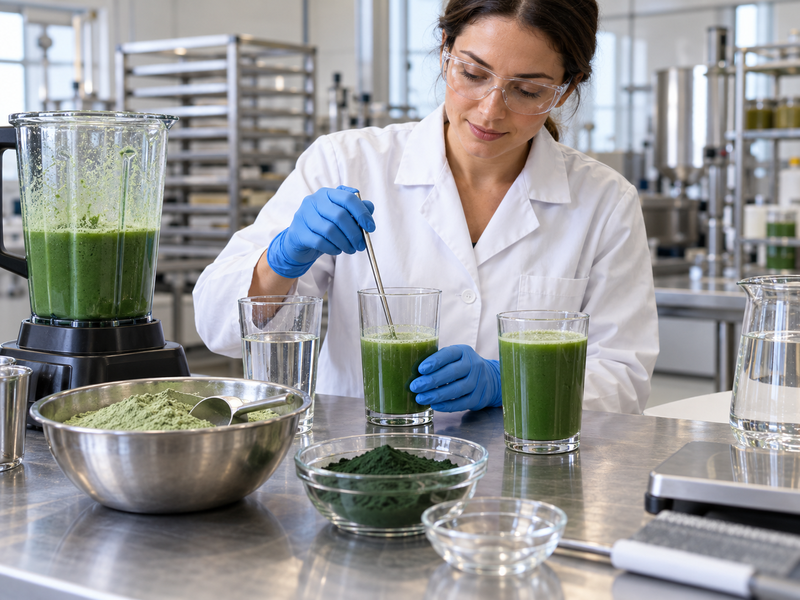
A deep green shade may reflect pigments and processing, but it does not specify protein, iron or vitamin content. Likewise, blue phycocyanin extract may offer striking color while containing carriers and substantially less whole-biomass nutrition per gram. Store photos and color standards are useful for appearance quality, not nutritional certification. If a buyer wants a nutrient-dense ingredient, whole biomass and an actual nutrient panel are more relevant than a color grade.
If the goal is natural blue coloration, a separate extract specification and use-level trial are appropriate. Treat the two product families as distinct materials.
A useful next step
List the functional reason for inclusion: nutrition, color or both. Request the corresponding assay and finished-product trial. Never substitute pigment concentration for an unmeasured vitamin or protein claim.
| Observation | What it can show | What it cannot show |
|---|---|---|
| Deep green shade | Appearance consistency | Protein amount |
| Blue shade | Pigment function | Whole-biomass nutrients |
| High color value | Color intensity method | Health effect |
| Smooth dispersion | Formulation behavior | Iron absorption |
7. How should a label use supplier and reference data?
Build a defensible source hierarchy
A current finished-product analysis is most directly relevant to the label on that product. Validated supplier-lot data and a documented calculation can help during development. Generic composition tables are useful screening tools, but they cannot guarantee a finished blend’s values after formulation, processing and shelf storage. The FDA dietary supplement nutrition-labeling guide explains serving-size and declaration principles for US supplements; conventional food labels use related but distinct rules.
Brands should establish which category and market apply before approving artwork.
A useful next step
Maintain a calculation sheet with source file, date, material identity, moisture basis, inclusion rate and rounding method. Recheck the sheet after supplier or formula changes. Have a qualified label reviewer approve the final panel.
8. Why do lots show different nutrition numbers?
Expect biological and analytical variation
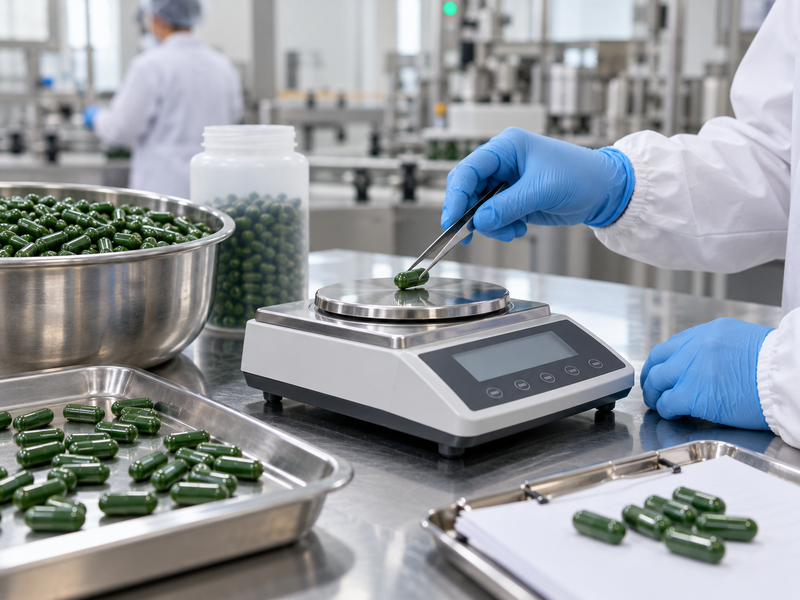
Spirulina is cultivated biomass. Growth conditions, harvest timing, drying, moisture and analytical procedures can affect reported composition. Even accurate laboratories may produce slightly different numbers because sample preparation and methods differ. A single certificate is a snapshot of a lot, not a permanent guarantee for every future shipment. For a claim-critical nutrient, a buyer should inspect several production lots, choose a sampling strategy and set a specification compatible with actual process variation.
This is more useful than insisting that every shipment exactly reproduces a website percentage. Variation becomes a label problem when it makes the printed value unreliable.
A trend chart is more informative when every point represents the same kind of material. Separate whole biomass from extract, dry-basis results from as-sold results, and laboratory methods that use different nitrogen factors. Add the lot date and manufacturing site beside each value. If a new series shifts, ask whether cultivation, drying, sampling or method changed before treating the difference as a nutrient improvement. The purpose of a label basis is to remain truthful across routine production, so selecting the highest observed lot as the printed value is a poor shortcut.
A useful next step
Ask for a series of representative lot results with the same method and units. Calculate a conservative label basis and set change-notification rules. Investigate shifts rather than hiding them by averaging incompatible data.
| Source of variation | Check | Response |
|---|---|---|
| Cultivation | Harvest and site record | Trend lots |
| Drying | Moisture basis | Normalize data |
| Sampling | Representative composite | Improve plan |
| Lab method | Same units and assay | Reconcile |
9. Which nutrition claims are easiest to overstate?
Watch the serving and the verb
“High protein,” “iron rich,” and “B12 source” each imply defined nutrient levels and, in many markets, regulated criteria. “Complete nutrition” makes an even broader promise that a modest serving cannot justify. A product may contain a nutrient without qualifying for a marketing claim about it. Be wary of stacking per-100-gram values next to lifestyle imagery that suggests a teaspoon delivers them all. Good nutrition copy names the actual serving, reports the amount and uses claim wording reviewed for the destination market.
It also avoids implying that a food ingredient treats a deficiency or medical condition.
A useful next step
Audit copy sentence by sentence against a verified value and a legal threshold. Replace a claim that fails with a neutral ingredient description. Keep citations and calculations in the product file for future revisions.

10. What should a buyer request before choosing a powder?
Select a product with usable evidence
Request a current specification, lot-specific certificate, ingredient statement, method for protein and important nutrients, contaminant results and storage instructions. State whether the product will be sold as a supplement, used in food or purchased as a color source. The supplier should answer in those terms, not send a generic “superfood” sheet. Compare two powders at the same inclusion level in a real recipe; a small nutrient advantage may be irrelevant if a powder adds too much odor or sediment.
The best nutrition facts are those that survive the transition from ingredient assay to finished product and consumer portion.
A useful next step
Create a side-by-side sheet with lot identity, measured nutrients, use level, taste, safety documents and price per finished serving. Approve the choice only after the intended claim and application both work.
| Buyer priority | Document | Trial |
|---|---|---|
| Protein | Lot assay | Finished serving |
| Iron | Element assay | Label math |
| Taste | Sensory profile | Recipe comparison |
| Safety | COA and traceability | Receiving review |
Frequently asked questions
Is spirulina mostly protein?
Dried whole biomass can contain a high proportion of protein, but the amount consumed is what determines protein grams in a serving.
Can I use a per-100-gram chart as a label?
Not without checking the actual product, portion, rounding and market rules. Reference data are a starting point, not lot certification.
Does green color prove more iron?
No. Color is not a quantitative iron measurement. Request an assay for the chosen powder.
Should vegans rely on spirulina for B12?
No. Inactive B12 analogues complicate spirulina measurements. Use established reliable B12 sources.
Why does my package differ from USDA data?
Products may differ by lot, moisture, formulation and label method. Compare like materials and serving sizes.
Conclusion
Spirulina nutrition facts become useful only when the material and portion are clear. Use per-100-gram tables for screening, then calculate and verify the actual serving. Treat B12 and disease-related promises with particular care. For brands, a documented source hierarchy and finished-product review turn appealing nutrition language into a reliable label.
For ingredient documentation, compare the whole spirulina range, the whole-biomass product details and the heavy-metal testing guide. These product pages can start a supplier discussion; final nutrition and safety statements still require the chosen lot and finished-product evidence.