
Spirulina powder heavy metal testing measures specified toxic elements in a defined whole-biomass lot. A “heavy metals passed” line gives buyers little help if the individual elements, method, and destination rule remain hidden. This guide shows how to build an analyte panel, request meaningful laboratory data, and decide whether a commercial lot fits its intended food or supplement use. The FDA Elemental Analysis Manual is a primary method reference; limits still require a separate market and product-category review.
Contents
- Why can whole biomass contain toxic elements?
- Which elements belong on the test panel?
- How do destination rules change the limit?
- What sampling plan represents a bulk lot?
- How should a laboratory method be reviewed?
- What do units and less-than results mean?
- Should total arsenic trigger more questions?
- How can exposure be assessed for a product?
- What if the result is disputed?
- How should the RFQ and release file record the decision?
1. Why can whole biomass contain toxic elements?
Trace the possible pathway before setting tests
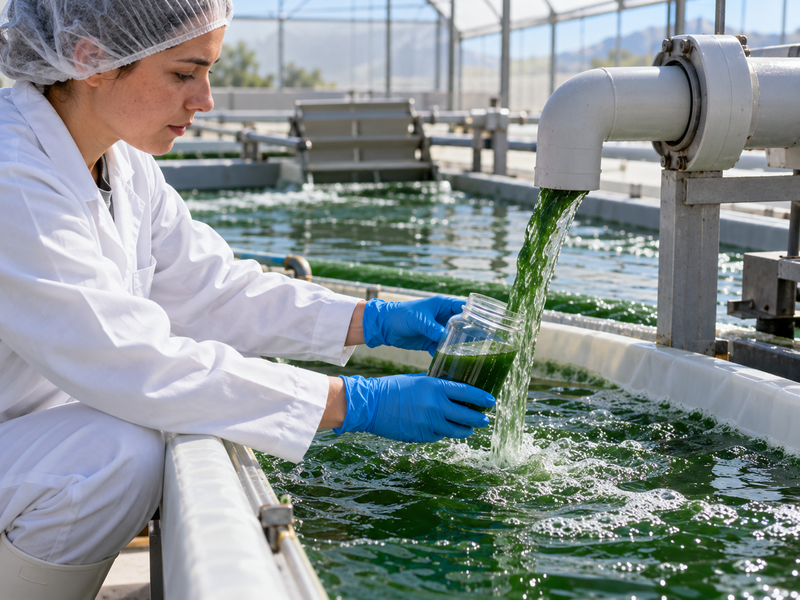
The source is part of the specification. Cultivation water, mineral inputs, surrounding environment, processing equipment, and packaging can contribute elemental contamination. Whole-biomass powder retains dried cellular material, so an element present in culture material may remain in the ingredient. An extract and a green biomass powder may partition elements differently; do not assume a blue extract report describes whole biomass. Ask the supplier to identify water source, input controls, monitoring points, and any changes since the last approved lot. Avoid claims that a specific geography guarantees a clean result.
FDA explains in its toxic-elements overview that it monitors elements in foods and related products. That establishes the relevance of testing, not a blanket finding about spirulina origins. A purchaser can ask for a sequence of lot results and a current production-site map. If values shift materially after a water-source change, require investigation before treating the new grade as equivalent. This upstream review makes a laboratory number more useful because it reveals which controls might fail again.
| Possible source | Supplier record | Follow-up |
|---|---|---|
| Water | Testing history and source change log | Check trend |
| Nutrients | Input specification | Review contaminants |
| Equipment | Maintenance and contact surfaces | Investigate anomalies |
2. Which elements belong on the test panel?
Name analytes rather than asking for a generic total
Write out the elements. Lead, cadmium, arsenic, and mercury commonly appear in buyer panels, but the exact scope follows market law, customer specification, intended dose, and hazard analysis. Some buyers also investigate nickel or chromium where source history warrants it. “Total heavy metals” may reflect an old screening convention that hides which metal drives the result. A test request should list analytes individually, their units, acceptance criteria, and a suitably low reporting limit. Ask whether the laboratory reports total element or a chemical species.
The FDA EAM 4.7 listing describes ICP-MS determination of arsenic, cadmium, chromium, lead, mercury, and other elements in food after microwave-assisted digestion. This is a method example, not proof that every lab using the phrase “ICP-MS” has validated the same matrix. Confirm the lab’s current method version and accreditation scope. For a new grade, request a full panel on commercial lots, then use supplier history and risk review to decide verification frequency. Never invent a supplier’s values from a typical industry chart.
3. How do destination rules change the limit?
Classify the final use before copying a number
The same powder can enter different products. A food supplement, beverage ingredient, and color extract may be regulated under different provisions. In the EU, Regulation 2023/915 sets maximum levels for specified contaminants by food category. Read its current consolidated form and notes, including rules for dried or processed foods, before applying a row. A limit applicable to supplements is not automatically the raw-material acceptance limit for every food application. Your customer may set a stricter ingredient criterion to manage finished-product exposure.
For U.S. sales, do not paste the elemental limits in 21 CFR §73.530 into a green biomass specification: that regulation defines spirulina extract for color use. Determine which food or supplement framework actually applies, then ask regulatory staff for the current legal basis. Record the source and review date beside each limit in the buyer specification. This avoids a common procurement failure in which two suppliers appear different only because one used a category-specific rule unrelated to the buyer’s product.

| Destination question | Record | Risk if skipped |
|---|---|---|
| Product category? | Finished-use description | Wrong limit selected |
| Current legal text? | Citation and date | Outdated rule used |
| Customer criterion? | Contract specification | Nonconforming ingredient |
4. What sampling plan represents a bulk lot?
Map harvests, packing runs and container selection
A result belongs to a sample. Define the finished lot by contributing harvests, drying runs, milling batches, packing date, and total bags. Select containers across that population according to a prewritten plan. Record increment location and weight, tools used, compositing scheme, retain quantity, seals, and handoff to the laboratory. If a large commercial lot combines several source batches, a single sample from one bag may not represent the blend. Conversely, an overly broad composite can dilute a localized problem. Ask a qualified sampler to choose a design suited to your decision.
The FDA BAM sampling chapter is written for microbiological work, yet its attention to sample integrity and identification illustrates why chain of custody matters. For elemental analysis, use containers and tools that will not contaminate the sample. Retain an unopened commercial pack where practical. If testing occurs before final packing, obtain the manufacturer’s evidence that the tested lot remains the same material after milling and handling. Document exceptions rather than relying on a verbal “same batch” assurance.
5. How should a laboratory method be reviewed?
Look past instrument branding
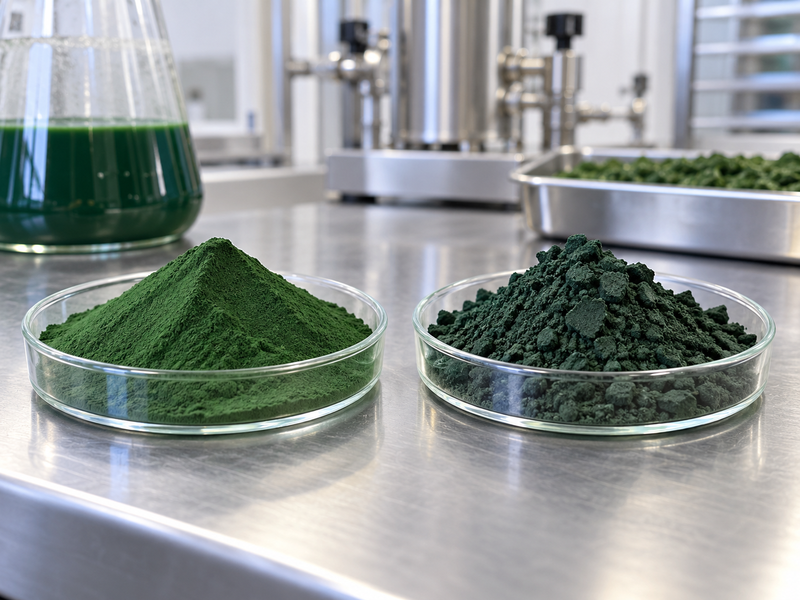
ICP-MS is a start, not a complete method. Ask how the sample is homogenized, digested, diluted, calibrated, and checked for recovery. The FDA Elemental Analysis Manual lists EAM 4.7 for several elements in foods and emphasizes method revisions. A supplier may use an equivalent method; request its identifier and version rather than insisting on a name alone. Check whether the laboratory has demonstrated performance in a high-pigment biomass matrix and whether relevant analytes fall within its accredited scope.
Also inspect the report’s analytical quality indicators when a result matters commercially: method blank, calibration check, duplicate or reference material, recovery, and measurement uncertainty where available. ISO/IEC 17025 provides the competence framework for laboratories, but accreditation must be read with the scope document. Ask whether the sample was tested on an as-received or dry basis. A method that can measure total arsenic does not by itself identify inorganic arsenic. One verified method on a traceable lot beats several decorative badges on an anonymous PDF.
| Method field | Buyer check | Why it matters |
|---|---|---|
| Matrix | Whole dried biomass | Recovery can vary |
| Reporting limit | Lower than buyer criterion | Permit decision |
| Scope | Analyte and method covered | Support confidence |
6. What do units and less-than results mean?
Normalize before comparing suppliers
A unit error can reverse a decision. Results may appear as mg/kg, µg/kg, ppm, or ppb. In a solid food matrix, mg/kg equals parts per million by mass and µg/kg equals parts per billion by mass. Still, ask the lab to state exactly which basis it used, especially when a seller reformats a report. “<0.05 mg/kg” means below that reporting threshold, not zero. A threshold above your criterion cannot establish that the lot meets it. Compare values and limits on the same dry or as-sold basis.
A worked purchasing example is simple: one lab reports 80 µg/kg and another reports 0.08 mg/kg for the same analyte. Those numbers are equal after conversion. If the COA rounds both to “0.1,” nuance disappears near a narrow criterion. Keep the original report attached and define rounding rules before disputes arise. Ask whether the COA displays the laboratory’s measurement uncertainty or only a rounded result. Do not apply a legal maximum to a recalculated dry-basis result without checking how that maximum is expressed in the relevant rule.
7. Should total arsenic trigger more questions?
Distinguish an elemental total from a chemical species
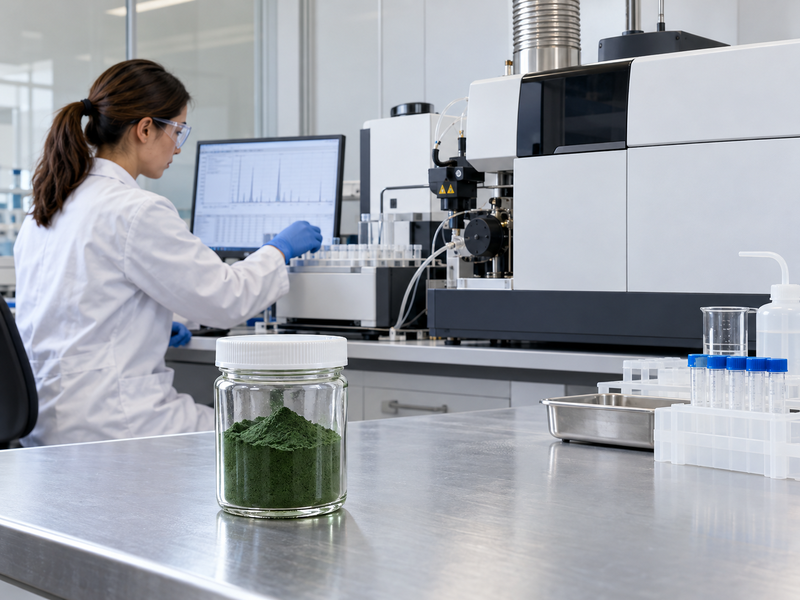
Arsenic has more than one analytical form. A total arsenic result measures all arsenic species after digestion; it does not tell you the amount of inorganic arsenic. Depending on market rule, customer requirement, and finding, a targeted speciation method may be appropriate. Do not subtract an assumed organic fraction or claim a harmless form without data. FDA’s Elemental Analysis Manual lists separate methods for total elements and arsenic species in some food matrices, illustrating the analytical distinction.
For spirulina, ask the laboratory whether its speciation method has been validated for dried whole biomass. A method developed for rice or juice cannot automatically be applied unchanged to this matrix. Review extraction recovery and how results are reported. If total arsenic is well below a relevant buyer limit, additional speciation may not be needed under that program; if it is close or a market rule requires a species, write the required test into the specification. The quality team should document the decision rather than asking sales staff to interpret chemistry from a one-line COA.
| Result type | Answers | Does not answer |
|---|---|---|
| Total arsenic | All measured arsenic combined | Inorganic fraction |
| Inorganic arsenic | Specified species under method | Every other species |
| “Heavy metals pass” | Seller’s summary claim | Individual concentrations |
8. How can exposure be assessed for a product?
Translate ingredient concentration into a serving scenario
The formulation matters. A powder used at a small inclusion rate in pasta creates a different finished serving than a supplement tablet containing mostly spirulina. Calculate the element mass contributed by the ingredient from its measured concentration and the maximum planned ingredient weight per serving. Then examine the applicable finished-food rules, customer standard, and total exposure from other ingredients. This calculation helps set an ingredient purchasing limit that supports the finished product rather than guessing from a generic internet chart.
Do not use dilution math as an excuse to accept material that violates an applicable rule or an agreed contractual limit. Account for multiple daily servings where the product’s use instructions allow them. Include children or other intended users in the assessment only if the product actually targets them. If a supplier offers grades with different source-water profiles, compare verified lot history and cost in use, not just one average COA. Regulatory and toxicological review belongs with qualified staff, while purchasing should make sure the contract carries the approved numbers and test capability.
9. What if the result is disputed?
Preserve the original finding and control the retest
Hold the lot while you investigate. Match the test report to the physical bags, check units and transcription, inspect sample seals, and verify the laboratory method. If the supplier and buyer sampled different parts of a heterogeneous lot, repeat sampling under a joint written plan may answer the dispute. Select sealed retain or commercial packs, define a referee lab, and agree how all results will be judged before opening samples. Do not retest repeatedly until a passing value appears.
Ask whether a source-water change, process equipment, or mixed harvest explains an outlier. Retain all reports and the supplier’s corrective-action record. If a criterion is exceeded, follow the contract’s hold and rejection terms and any applicable legal duties. If a measurement lies near a limit, let the approved decision rule address uncertainty; avoid inventing a tolerance after results arrive. A transparent resolution keeps both companies focused on the material, not on defending an earlier marketing claim. Future purchase conditions may include tighter monitoring until the cause is understood.
10. How should the RFQ and release file record the decision?
Write a test request that can be fulfilled
Give the supplier a precise question. The RFQ should state whole dried biomass, target use and market, required elemental panel, limit for each analyte, method or allowed equivalent, reporting limit, sample plan, laboratory requirements, and the lot documents needed before shipment. Ask whether the quote includes testing cost, an independent report, and a retain sample. On receipt, quality staff should sign a comparison of results with the approved specification and link it to the inventory lot. Purchasing releases payment or replacement instructions under that decision.
The Spirulina CN website may help start a supplier inquiry, but a public product description is not a current lot result. Request the offered grade’s present specification and actual batch COA. If the market or application changes, revisit the analyte panel and criteria rather than recycling last year’s template. That discipline makes price comparisons more honest: suppliers are quoting the same test burden and quality standard. It also lets your team explain a release decision months later without relying on memory.

| RFQ field | Exact request | Review owner |
|---|---|---|
| Element panel | Individual analytes | Quality |
| Market criterion | Source and revision date | Regulatory |
| Lot evidence | COA and sample chain | Receiving |
FAQ
Q1: Which four elements are often requested? Lead, cadmium, arsenic, and mercury are common candidates; the approved panel must reflect the product’s real market and risk.
Q2: Is “total heavy metals” enough? Usually not for a detailed buying decision because it hides individual elemental results.
Q3: Does ICP-MS prove the test is suitable? No. Check sample preparation, matrix validation, reporting limit, quality controls, and laboratory scope.
Q4: Can an extract COA stand in for green powder? No. Test the correct commercial material and lot.
Q5: Should a close result be automatically retested? Follow a pre-agreed investigation and decision rule while the lot remains held.
Spirulina powder heavy metal testing is a chain of decisions: classify the market, name each element, draw a representative sample, read the method, and sign a lot outcome. Request full elemental reports with the next supplier quote. A precise panel is far more useful than a broad “passed” badge when your formulation and customers depend on the result.