
Spirulina biomass washing salt control is the managed removal of residual cultivation medium from wet harvested cells. Buyers may see variable ash, salty taste or slow drying and wonder where the difference began. A controlled wash links water quality, measured rinse performance and wet solids sent to the dryer. A recent cultivation study compared rinsing and pressing approaches, showing why the wash step merits its own records rather than a generic “washed” label.
Contents
- Why wash harvested spirulina?
- Which salts are being controlled?
- What quality must wash water meet?
- How is a wash process defined?
- What does conductivity tell the operator?
- How can washing change solids recovery?
- Where does the drying tradeoff appear?
- How are ash and sensory results interpreted?
- Which records support a buyer review?
- How should a wash deviation be investigated?
1. Why wash harvested spirulina?
Remove carryover without losing product
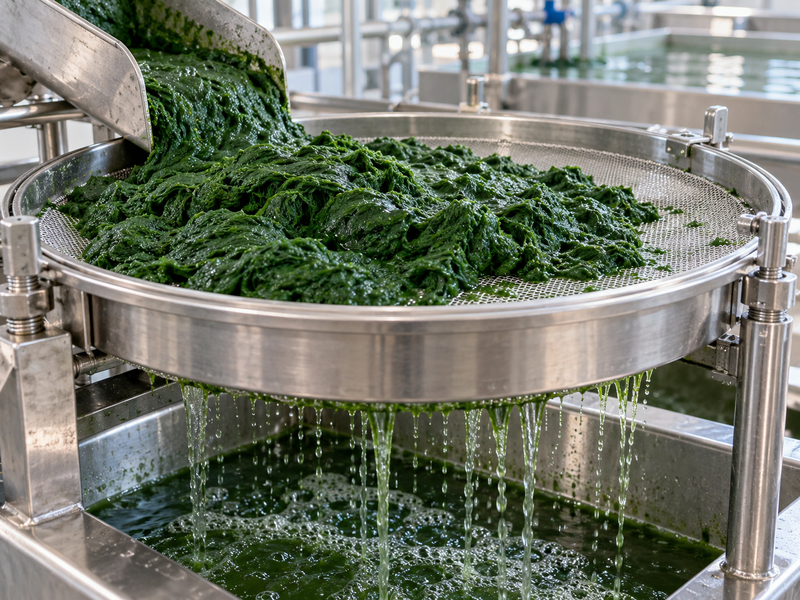
Arthrospira grows in mineral-containing alkaline media, so harvested wet biomass can carry residual liquid between filaments. Washing aims to reduce that carryover before drying. It does not automatically remove minerals inside cells or guarantee a particular sodium result. The process also adds water that later must be separated or evaporated. Ask a supplier whether rinsing occurs on a screen, in a resuspension tank or in another controlled arrangement, and where the drained liquid goes.
Think in balances. If wash volume increases, residual salts may fall while effluent and dryer load rise. The study comparing wash and pressing treatments measured changes in ash for a particular Limnospira culture; its procedure is not a mandatory recipe for all commercial spirulina. Buyers should ask for the producer’s own before-and-after data, including solids yield.
2. Which salts are being controlled?
Distinguish medium residue from product minerals
Cultivation media commonly contain carbonate or bicarbonate and other mineral nutrients. Their exact composition varies with strain and process. Some dissolved material remains with the retained liquid when biomass leaves the pond. Washing and dewatering primarily target this external carryover. A finished-powder total ash result measures all mineral residue after combustion; it cannot identify which individual mineral caused a change. For a sodium concern, request a specific sodium test on an agreed basis rather than assuming total ash equals sodium.
Ask for a map. The supplier should identify which medium components matter for its buyer specification and which measurements it uses at washing. Conductivity is a useful proxy for dissolved ions in a liquid under controlled conditions, but its relationship to a particular salt must be demonstrated. A review of Arthrospira cultivation documents varied media and salinity conditions. That variability explains why comparing one factory’s raw conductivity number with another’s may be misleading. Compare results within the same defined method and product target.
| Question | Suitable measurement | What it cannot prove |
|---|---|---|
| Is rinse liquor changing? | Conductivity trend | Specific sodium amount |
| Is mineral residue high? | Total ash on dry basis | Source of each mineral |
| Is sodium specified? | Sodium assay | Other ion concentrations |
| Is wet mass diluted? | Solids and mass balance | Final powder quality alone |
3. What quality must wash water meet?
Treat direct-contact water as an ingredient exposure
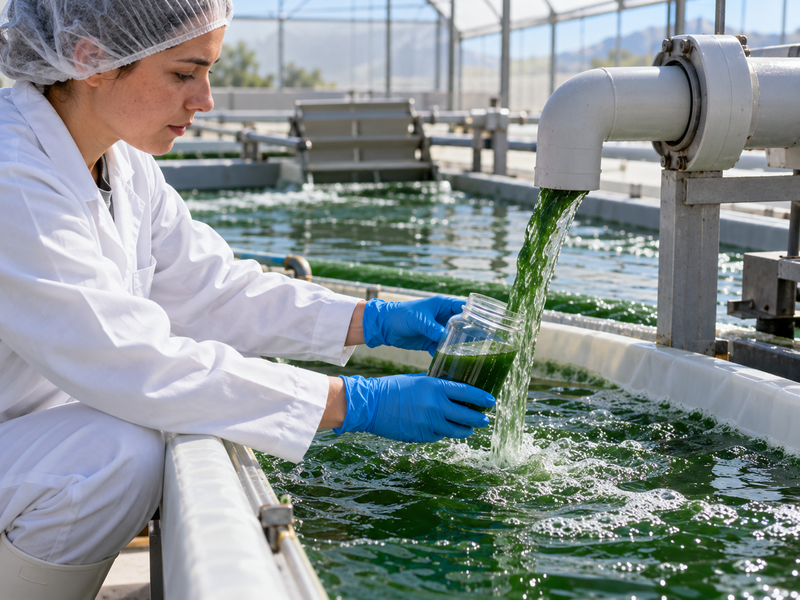
Water added directly to biomass contacts food and food-contact equipment. Under 21 CFR 117.37, water that contacts food in a covered US food plant must be safe and of adequate sanitary quality. Other markets have their own rules. The supplier should document source, treatment where used, monitoring, distribution point and response to an out-of-specification result.
Follow the flow. Ask where rinse water enters, whether any water is reused, how backflow is prevented and how a change of source is approved. Sample at a point that represents what actually reaches the product under the site’s plan. Record water lot or treatment period with harvested biomass. If a quality result fails after washing, the supplier should identify all material exposed since the last acceptable check. Direct-contact wash water needs its own documented use conditions.
4. How is a wash process defined?
Specify what operators actually control
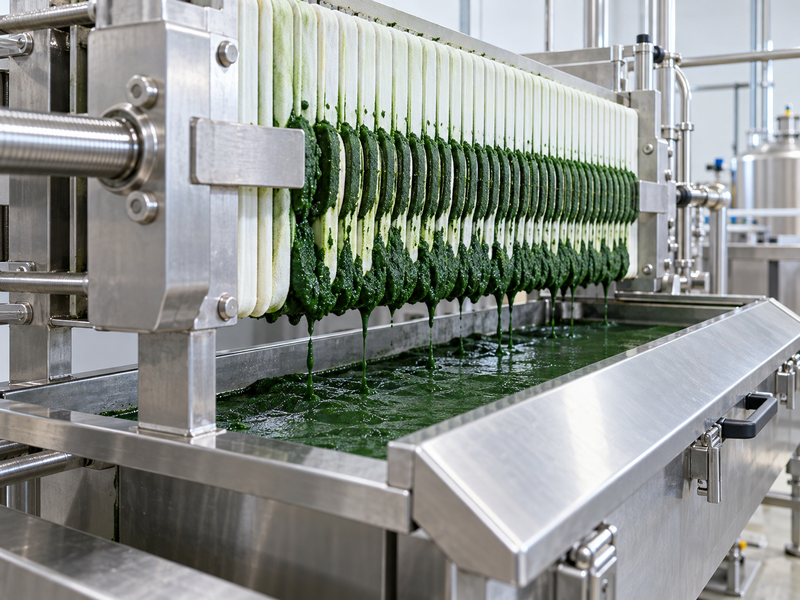
A useful instruction names incoming wet biomass, water source, flow or dose, contact method, screen or separator, drainage endpoint and sampling point. It should explain how operators handle a blocked screen or interrupted water supply. “Rinse until clean” invites inconsistent results. Record both target and actual settings for each harvest batch. Where several harvests share a wash run, document how those streams are combined.
Watch the boundary. Rinse water applied to a thick cake may channel through a few paths rather than contact all material. Resuspension may improve contact while increasing handling and dewatering work. Neither arrangement is automatically superior. Verify that the chosen configuration works across normal production throughput and biomass density. The published rinse comparison demonstrates the value of comparing process options experimentally, but supplier validation should reflect its own equipment. Buyers can request a process map and one completed wash record without demanding proprietary recipe details.
| Control point | Operator record | Reason |
|---|---|---|
| Incoming biomass | Harvest lot and wet mass | Links source |
| Rinse water | Source and volume | Defines exposure |
| Screen or separator | Setting and inspection | Explains retention |
| Outlet sample | Time and method | Supports endpoint |
5. What does conductivity tell the operator?
Use a calibrated trend, not a magic number
Conductivity reflects the ability of a liquid to carry electrical current and generally rises with dissolved ions. It can show whether rinse runoff is approaching the inlet-water condition, provided temperature, sample point and meter procedure remain consistent. It cannot distinguish carbonate from sodium chloride or reveal how much intracellular mineral remains. A low reading from a diluted sample may be false reassurance. Identify whether the reading comes from feed water, drain water or a prepared biomass extract; these are different matrices.
Check the method. A plant should record meter identification, calibration or verification, temperature compensation where relevant and repeated readings around the endpoint. A sudden step change may come from changed wash flow or a blocked sampling port. Confirm it against the equipment state before changing the product decision. If the buyer specifies powder ash or sodium, validate how the wash reading predicts those finished results.
6. How can washing change solids recovery?
Count biomass lost with the rinse
Fine fragments can pass through a screen or leave with overflow, while repeated handling can retain more water in the biomass. Compare incoming dry solids with recovered solids and measured loss streams, using the plant’s sampling method. A wet-mass comparison alone is misleading because water content changes during washing. Track screen condition and throughput; a worn mesh may lose material that an intact screen retains. Large-scale cultivation research notes that Arthrospira’s filamentous structure allows filtration, yet equipment choice still affects dewatering performance.
Use a real run. If a supplier reports lower ash after doubling rinse volume, ask whether dry-solid recovery fell and whether the dryer required longer residence time. Both affect cost and product quality. Separate a sampling error from physical loss before revising the rinse target. Buyers can review paired wash trials to understand the tradeoff; avoid treating the lowest ash result as automatically best if it came with excessive product loss.
| Balance item | Measure on | Decision supported |
|---|---|---|
| Incoming cake | Wet mass and solids | Baseline biomass |
| Recovered cake | Wet mass and solids | Dry yield |
| Effluent | Volume and solids | Lost biomass |
| Dryer feed | Solids and temperature | Downstream load |
7. Where does the drying tradeoff appear?
Track moisture entering the dryer
A larger rinse can reduce medium carryover but may leave a wetter cake if dewatering capacity stays fixed. The dryer then handles more water per unit of spirulina solids. That can alter throughput or require changed settings. Record dryer-feed solids for each wash lot and keep the wash-to-dryer link intact. If a supplier claims washing improved powder quality, compare the resulting moisture, water activity, color and relevant composition values. Those finished results are influenced by drying too, so assess both steps together.
The practical point: a wash endpoint cannot be optimized in isolation. Check hold times and sanitary protection before and after dewatering. The site’s dryer cleaning verification and powder moisture guidance address separate downstream controls. For a buyer audit, ask for one paired wash and dryer record showing that the process produced a releaseable powder lot.
8. How are ash and sensory results interpreted?
Keep each test within its scope
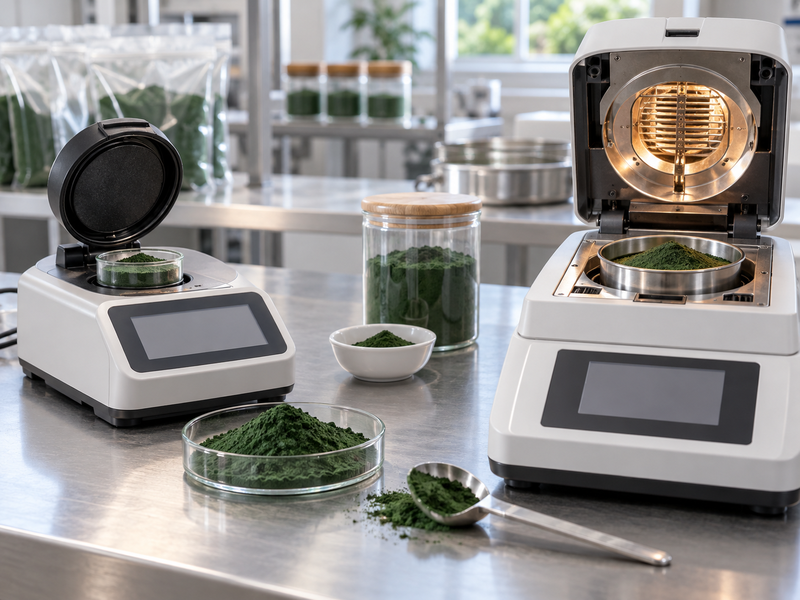
Total ash reports inorganic residue after a defined analytical burn. It can reflect mineral composition of biomass and residual medium, while method basis and sample preparation affect comparisons. A saltier sensory impression is a useful complaint signal but does not quantify sodium. Test sodium specifically when it is a contractual attribute. Compare results on a common dry or as-received basis, with method and lab identified. The wash study used ash to compare treatments within its experiment; its numbers should not become a generic acceptance limit.
Investigate pattern. High ash across several lots may indicate a changed medium, a rinse problem or a different test basis. One outlier may reflect sampling or a single equipment interruption. Examine the wash record and retained sample before asking the supplier to repeat the test. If flavor is relevant, run a controlled panel using comparable powder concentration and water. Keep blind codes and a reference lot so observers are less influenced by the complaint narrative.
| Result | Useful interpretation | Follow-up |
|---|---|---|
| High ash | More mineral residue possible | Basis and wash trend |
| High sodium | Contract attribute may fail | Confirm method and sample |
| Salty note | Sensory difference | Blind reference comparison |
| Wet cake | Higher dryer load | Solids and hold record |
9. Which records support a buyer review?
Link water, biomass and powder lots
Request a process map, controlled wash instruction, water-quality evidence, equipment checks, actual rinse readings, solids balance and dryer-feed results. Each should carry a common batch identifier or an explicit conversion table. A finished certificate without the wet-biomass link cannot show why ash changed. Ask for a representative accepted lot and one out-of-trend lot. Compare their water source, wash dose, screen state and analytical method.
Make a quick trace. Pick a powder bag and follow it back through dryer run, washed cake, harvest and wash-water exposure. Then choose a water treatment interruption and trace forward to affected cake and powder. The supplier’s lot-traceability records should support both directions. Where water is supplied continuously, the site may use a time-defined treatment period rather than a discrete water lot. The definition must be clear enough to set a hold scope after a failure.
10. How should a wash deviation be investigated?
Contain material, then identify the pathway
An unusual conductivity reading, water-quality failure, torn screen or high-ash powder needs a defined response. Hold the affected material from the last satisfactory check, inspect the equipment and preserve water and product samples where practical. Determine whether the problem concerns product safety, buyer specification or process yield; more than one may apply. Review sample method and meter status before assuming the wash itself failed. If a screen broke, identify missing material or possible foreign fragments as well as salt control.
Close the loop. The supplier should document cause, product disposition, corrective action and a later effectiveness check. For example, a shifted rinse nozzle may call for restored position, a revised pre-start check and review of subsequent lots. A single passing ash retest does not prove the nozzle will stay aligned. Buyers should ask who authorized release and what evidence covers every affected lot. That process makes spirulina biomass washing salt control auditable without pretending that a single rinse number describes the entire powder.
| Deviation | Immediate hold | Evidence for closure |
|---|---|---|
| Water failure | Exposed wash lots | Source correction and assessment |
| High runoff | Current cake | Flow and sampling review |
| Torn screen | Since last intact check | Fragment and yield review |
| High ash | Finished lot | Method, medium and wash history |
FAQ
Q1: Does washing remove all minerals? No. It mainly reduces external medium carryover; cellular minerals remain.
Q2: Is conductivity a sodium test? No. It responds to dissolved ions collectively and needs a defined sample method.
Q3: Can more rinse water always lower ash? It may lower carryover, but contact, drainage and solids loss determine the result.
Q4: Which water standard applies? Apply the rules for the manufacturing and destination markets and verify direct-contact water quality at the use point.
Q5: What should buyers request? Ask for paired wash readings, solids recovery, finished ash results and the linked lot record.
Practical next step
Spirulina biomass washing salt control should show an acceptable mineral profile without sacrificing sanitary water use, solids recovery or drying control. Request one complete wash-to-powder record and compare it with another lot that differed in ash or sensory result. Agree on test basis and a response plan before ordering tightly specified material.