
Phycocyanin whey protein interactions are relevant when a food team wants a blue, acidified protein drink or another whey-containing system. A laboratory study suggests that some whey-protein systems can reduce phycocyanin aggregation at low pH. It does not prove that every whey powder, every blue spirulina grade, or every finished beverage will stay clear and blue. The commercial task is to test the exact ingredients under the actual process and shelf-life conditions.
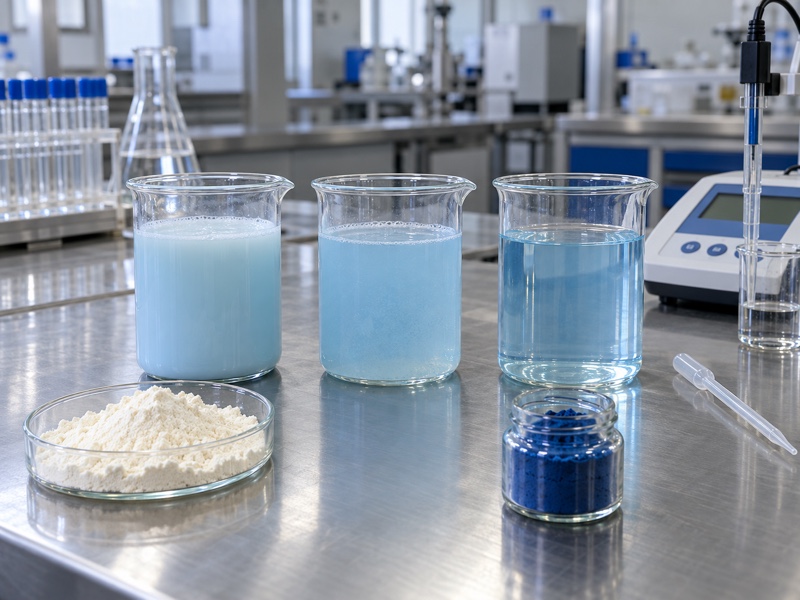
The 2020 Food Hydrocolloids paper compared whey with other proteins and examined phycocyanin behavior in an acidified model. The authors reported that undenatured, complete whey protein protected the pigment better than some alternatives under their test conditions. A later study on whey protein isolate, phycocyanin, and chitosan explored a different composite approach. These studies offer hypotheses and methods, not a finished-product guarantee or an instruction to use chitosan in every food.
1. Why do whey protein and phycocyanin meet in a formula?
Blue protein products create a combined problem
A developer may want a blue appearance in an acidified whey drink, a cultured protein dessert, or a powdered blend that is later mixed with acid. Phycocyanin is itself a protein pigment. Its appearance can change as the environment becomes acidic or as proteins interact. Whey brings additional proteins and, depending on the ingredient, minerals, lactose, flavor, and processing history. The combination can alter color, haze, precipitation, and mouthfeel.
Separate two questions. First, does the product need whey for its nutritional or sensory brief? Second, does that whey system help or harm phycocyanin performance in the exact food? A positive result in a model solution should not be turned into a broad claim that “whey stabilizes blue.” The whey type, denaturation state, concentration, pH, and order of addition all matter. A buyer should define those parameters before choosing a pigment grade.
2. What did the published interaction study show?
Read the comparison, not only the headline
The Zhang, Li, and Abbaspourrad study investigated phycocyanin aggregation under acidified conditions. In its pH 3.0 model, whey protein was more effective at preventing aggregation than pea or egg-white protein under the tested conditions. The authors also reported differences among undenatured, denatured, and hydrolyzed whey, and between complete whey and selected fractions. Their analytical tools included spectroscopy, electrophoresis, and particle-size or charge methods.
The reported minimum whey-solution condition in that model is not a recommended inclusion rate for a commercial beverage. Supplier powders differ, and a finished formula may contain fruit acid, minerals, sweetener, flavors, preservatives, and a heat step absent from the model. What transfers is the experimental logic: compare protein identities and histories at a stated pH, then measure aggregation and color rather than relying on a single visual sample.
| Study factor | Why it matters to a buyer | What to test locally |
|---|---|---|
| Protein type | Different proteins interact differently | Actual whey ingredient vs control |
| Protein history | Denaturation can change behavior | Before and after the plant heat step |
| Acidity | Aggregation risk changes with pH | Intended product pH range |
| Pigment source | Commercial lots can differ | Exact grade and lot |
| Analytical endpoint | Blue color and colloids differ | Both color and haze/sediment |
3. Which whey ingredient should be named in the trial?
“Whey” is not one material
Whey protein concentrate, whey protein isolate, hydrolyzed whey, and a complete whey ingredient can differ in composition and processing history. A formula may also use a finished whey beverage base with mineral and stabilizer systems already present. Request the exact whey ingredient specification and lot. Record its protein level, relevant minor components, solubility, pH of a standard dispersion, and heat treatment history. Avoid assuming two vendors’ products are interchangeable because both say “whey.”
The 2020 paper found that undenatured whey performed differently from denatured and hydrolyzed forms under its test conditions. A commercial plant process can change a whey ingredient after it is weighed. That is why a trial should compare samples before and after the real process, not only different powders in cold water. If the brand requires lactose-free, clear, or high-protein positioning, those constraints may narrow the whey options before phycocyanin is considered.
Treat allergens separately. Whey is milk-derived, so a whey formula has milk-allergen labeling and cross-contact questions. The pigment’s own declaration and carrier still need review. A favorable colloidal interaction does not remove either obligation.
4. How should you structure a controlled interaction trial?
Use matched controls at the same pH
Prepare a phycocyanin-only sample, a whey-only sample, and phycocyanin-plus-whey samples using the planned protein ingredient. Include at least one alternative whey dose if the product brief allows it. Keep pigment lot and dose, pH, sweetener, salt, process temperature, and measurement method constant. If you vary whey type and pH together, you will not know which factor caused a result.
| Sample | Pigment | Whey | Purpose |
|---|---|---|---|
| A | Yes | No | Show pigment behavior alone |
| B | No | Yes | Show base haze and color |
| C | Yes | Planned dose | Test saleable formula |
| D | Yes | Alternative dose | Check concentration response |
| E | Yes | Another protein, if relevant | Test specificity of interaction |
Use replicate preparations and blind sample codes for appearance scoring. Record addition order: acid before pigment, pigment before whey, or a precomplex step may produce different outcomes. A laboratory method that cannot be implemented on the plant line should remain an exploratory experiment. For a clear beverage, compare apparent clarity at the same container depth; for an opaque product, focus more on sediment, texture, and visible shade.
5. Which measurements separate color from colloidal stability?
Do not let an attractive blue hide precipitation
Record color coordinates, haze or turbidity, particle-size distribution, visible sediment, pH, and protein or pigment signals where the method is validated. A larger particle signal can reflect useful complex formation, flocculation, or a measurement artifact. Interpret it with visual and storage evidence. Photograph undisturbed samples and note whether mixing restores appearance. A ready-to-drink bottle that requires hard shaking may fail the product brief even if the pigment remains chemically present.
| Measurement | Buyer question | Important limitation |
|---|---|---|
| Color coordinates | Is the shade acceptable? | Opacity affects readings |
| Turbidity | Is the drink clear or hazy? | Protein base may be inherently cloudy |
| Particle size | Are aggregates developing? | Dilution can change distribution |
| Sediment height | Does the pack separate? | Need defined storage and no pre-shake |
| pH | Did the matrix drift? | pH alone does not explain all failure |
Set acceptance criteria before seeing the samples. If the product is intentionally opaque, high turbidity is not a defect by itself. If the product is marketed as clear, a small color improvement that creates persistent haze may be unacceptable. Connect each analytical method to the intended finished-food appearance.
6. How do acid and heat change the interpretation?
Process the formula, then judge it
The study’s acidified model makes the interaction interesting, but a commercial food may be pasteurized, homogenized, held warm, or exposed to fruit acid and mineral salts. Protein can denature and phycocyanin can lose color under some combinations. Test the required safety process at the real temperature and dwell time. Compare before and after processing, then through storage. Do not shorten a validated thermal step for color without a process-authority review.
Measure pH after each major addition and after heating; a recipe target is not an actual final pH. If color loss occurs before pasteurization, changing the heat profile is unlikely to solve that first failure. If the system looks good until heat, consider addition sequence, alternative process design, or a different product concept within safety constraints. The prior acidic beverage stability guide covers the broader phycocyanin challenge; this article asks specifically what whey contributes.
The later whey-protein/chitosan paper tested a composite, not plain whey in a finished commercial drink. A buyer should not list its reported retention as the expected outcome for a standard whey isolate formula.
7. What should a finished-pack shelf-life test include?
Keep light, headspace, and storage realistic
Fill samples into the intended primary package, at the intended volume and headspace. Include relevant chilled or ambient conditions and any expected display light. Test initial and scheduled intervals for color, haze, sediment, flavor, and microbiological acceptability under the product’s standard program. One week of refrigerated laboratory storage is not evidence for a long-life shelf claim.
| Time point | Appearance | Physical check | Supporting record |
|---|---|---|---|
| After make-up | Blue and initial haze | Particle state | Addition order, pH |
| After process | Immediate change | Sediment/viscosity | Heat and shear log |
| At fill | Pack appearance | Foam and air | Headspace, package |
| During storage | Fade or shift | Sediment and layer | Light, temperature, date |
| End of intended life | Final acceptance | Resuspension behavior | Blind score and lab result |
Retain an unexposed control when feasible so a failed display sample can be distinguished from normal aging. Be explicit about whether samples are shaken before evaluation. Consumers may shake a drink, but a persistent clump or hard sediment can still be a quality failure. Use the same sample handling at every time point.
8. How do you avoid confusing protein color with nutrition claims?
Keep the job of the pigment clear
Phycocyanin may be discussed in research as a bioactive protein, but a color dose does not establish a nutritional or health effect in a finished drink. Whey may carry a protein-content claim if the complete formula and label meet the relevant rules; phycocyanin’s role as color should be evaluated separately. Do not add “antioxidant,” “anti-inflammatory,” or immune claims to a commercial brief merely because a paper measures an in vitro endpoint.
A blue protein drink can also contain multiple protein sources, so flavor, mouthfeel, and allergen requirements influence the decision. A pigment that protects color but changes taste at the needed dose may not fit the product. Blind sensory review should compare the current drink, the phycocyanin version, and an uncolored base under the same serving conditions.
Ask the regulatory team to review ingredient names, milk allergen declaration, and any color claims for each destination market. A “natural” marketing phrase is not a substitute for the exact ingredient statement or additive-use review.
9. What should the phycocyanin supplier document?
Tie the result to one powder grade
Request the exact blue spirulina powder code, current technical specification, composition and carrier declaration, lot COA, storage guidance, and a sample linked to the commercial manufacturing site. If the supplier offers application data in protein drinks, ask for the protein type, pH, heat process, and storage pack. A photo of a blue shake cannot show whether the liquid was stable after two months.
| Requested item | Decision supported | Follow-up question |
|---|---|---|
| Powder code | Identifies trial material | Will production match the sample? |
| Specification | Sets release limits | Which revision applies? |
| Lot COA | Shows tested lot | What methods and units? |
| Composition | Supports label/allergen review | Is a carrier present? |
| Application evidence | Suggests conditions | Was whey and pH comparable? |
Our confirmed blue spirulina/phycocyanin range is E3, E6, E18, E25, E35, and E40 powders. The E-code alone does not declare phycocyanin percentage, color value, purity, or performance with whey. Whole spirulina and chlorella powders or tablets are separate products. Request the batch evidence for any numerical claim before a formulation team uses it in a purchasing specification.
10. When can a whey-phycocyanin formula advance to pilot scale?
Approve the system, not a single sample
A formula should meet color, clarity or intended opacity, sediment, taste, label, safety-process, and end-of-life criteria before pilot scale. A pilot must repeat the bench result in the real equipment with the same ingredient grades and addition sequence. Record what changes under larger shear, heat transfer, and fill conditions. If the whey ingredient changes supplier or hydrolysis state, repeat the interaction check.
Compute cost per finished unit from the accepted pigment and protein doses, process losses, and any pack change. A protein ingredient added solely to stabilize color may not be justified by a color benefit; if whey is already part of the product brief, its interaction can be an advantage worth measuring. Keep the decision commercial as well as technical.
Send the supplier the formula’s whey type, target pH, process, pack, and test questions. Request a lot-linked sample and current specification for the phycocyanin powder under review. The supplier can provide a starting point; the buyer’s finished-food pilot establishes whether the interaction works.
FAQ
Q1: Does whey protein always prevent phycocyanin precipitation?
No. The reported protection came from defined acidified laboratory conditions. Test the intended whey ingredient, pigment grade, pH, heat step, and shelf life.
Q2: Is whey isolate equivalent to complete whey in the study?
No. The paper compared different protein forms and fractions and found differences. Review the method before transferring a result to a purchased ingredient.
Q3: Can a clear blue drink use this approach?
Possibly, but it must pass haze and sediment limits in the finished pack. A blue appearance alone does not prove clarity or stability.
Q4: Does an E40 powder guarantee stronger interaction than E18?
No. The codes are product identifiers. Use technical specifications, lot COAs, and a matched trial rather than inferring composition or behavior from the number.
Q5: Does the interaction remove milk-allergen labeling?
No. A whey-containing food remains subject to the applicable milk-allergen review. Color performance and labeling are separate decisions.