
Spirulina blue vs gardenia blue is a practical comparison for food developers who need a natural-source blue but work with different pH, heat, labeling, and market rules. Neither name alone tells a purchasing team whether a colorant will survive its product or is permitted for its exact use. The comparison should begin with a food category and process map, then move to lot-specific samples and a controlled finished-food trial.
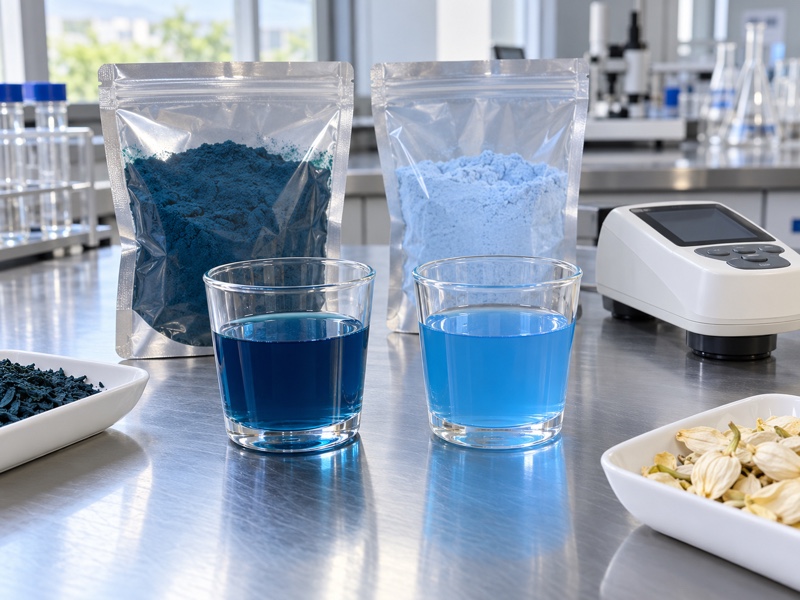
A ranked comparison guide shows that formulators are actively comparing these sources. Some broad claims in supplier guides should be checked against primary research and official rules. In the United States, the FDA lists spirulina extract and gardenia (genipin) blue as separate color additives with different conditions of use. The gardenia listing currently names specific drink and candy categories; it is not a blanket permission for all foods.
1. What are the two blue ingredients?
Separate source from marketing name
Spirulina extract derives its color mainly from phycocyanin, a blue protein pigment obtained from spirulina biomass. Gardenia (genipin) blue is produced through a different chemistry involving compounds from gardenia fruit and an amino-acid reaction. “Natural blue” describes a market goal, not a shared molecule or processing profile. The materials differ in how they respond to a formula and in how regulators identify them.
A buyer should ask for the exact legal ingredient name, composition, manufacturing description, and regulatory basis in the destination market. A retail label photo does not establish that another supplier’s powder has the same carrier, particle size, or permitted use. Our confirmed blue spirulina/phycocyanin range is powder grades E3, E6, E18, E25, E35, and E40. Gardenia blue is discussed here as a market alternative, not as a product we claim to sell. Whole spirulina and chlorella are separate powders or tablets and should not enter this blue color comparison as substitutes.
2. Which decision criteria matter before a sample arrives?
Put the finished food on paper
Start with the food category, intended sale countries, label position, target shade, pH, thermal process, expected light exposure, and target shelf life. Include whether the color is added before or after heat. The shortest supplier claim often ignores those conditions. A gardenia sample shown in a candy and a spirulina sample shown in a cold beverage answer different questions.
| Decision field | Spirulina extract question | Gardenia blue question |
|---|---|---|
| Intended category | Is this use covered in the market? | Is this exact category named in permission? |
| Formula pH | Does the blue hold in this matrix? | Does this grade hold after process? |
| Heat | Can addition occur after heating? | What does a real heat trial show? |
| Label | What is the required ingredient name? | What is the required ingredient name? |
| Supply | Which lot and specification? | Which lot and specification? |
Give purchasing and R&D the same brief. Otherwise one team may compare price per kilogram while the other tests a color source that cannot legally or technically fit the product. Make the qualification target explicit before inviting quotations.
3. How do structure and formulation behavior differ?
Treat stability as a measured property
Phycocyanin is a protein complex whose color can change with heat, acidity, light, and interactions in the food matrix. Gardenia blue is chemically distinct. Reviews of natural and synthetic blue colorants discuss different light, heat, and pH behaviors, but results vary across preparations and test conditions. A review of blue food dyes summarizes those differences and reports that performance depends on matrix and exposure.
Do not convert a vendor’s generic temperature or pH range into a pass criterion. A pilot uses the supplier’s actual grade, dose, processing sequence, and package. A formula with proteins, fruit acid, mineral salts, or emulsified oil can behave differently from a clear laboratory solution. Record whether the liquid remains blue, shifts hue, clouds, sediments, or stains a food component. These are separate failure modes and may need different fixes.
A comparison is fair only when both colors aim at the same finished-food shade. Equal powder mass is not a useful rule if the products have different color strengths or carriers. Set a target using finished-food color coordinates and sensory review, then calculate the dose and cost required for each.
4. What do current U.S. color rules require?
Read the listing, not a blog summary
The FDA’s color-additive summary lists spirulina extract under 21 CFR 73.530 and gardenia (genipin) blue under 21 CFR 73.168. The FDA gardenia status page lists sport drinks, flavored or enhanced noncarbonated water, fruit drinks and ades, ready-to-drink teas, hard candy, and soft candy. An additional petition for broader gardenia uses may be pending, but a petition is not an approved use. Have a regulatory specialist check the current rule and the product’s exact category before making a purchase decision.
| U.S. item to verify | Why it matters | Record in approval file |
|---|---|---|
| Additive identity | The name must match the material | Specification and supplier declaration |
| Permitted food category | Some colors have limited uses | Applicable rule text and date |
| Conditions or limits | Use may be constrained | Intended dose and category review |
| Labeling | Name and claims need review | Proposed ingredient statement |
| Changes in rule | Petitions and effective dates change | Date and source checked |
Do not infer that “exempt from batch certification” means unregulated. Both listed colors still need to meet their specifications and use conditions. For exports, repeat this review for each destination market; a U.S. listing does not authorize a use elsewhere. The existing spirulina extract FDA article covers the U.S. spirulina rule in more detail.
5. How should a buyer compare color in a real formula?
Make matched finished-food samples
Prepare a control without added blue and separate samples of each color in the same base. Adjust dose until each approaches the agreed target shade after processing, not merely in water before processing. Use the same mixing order, pH, heat history, fill level, package, and storage. Run replicates. Record the sample lot for every ingredient and keep retained samples so a surprising result can be investigated.
An instrument can compare color coordinates, but the product team should also inspect the sample in the packaging consumers will see. Clear bottles reveal haze and sediment; opaque foods require a surface and cut-face evaluation. Photograph under consistent light and set a blind visual acceptance test when shade judgment is subjective. If one color requires a changed sweetener or acid system, that becomes a new formula, not a direct pigment substitution.
Ask how the grade handles in production: predispersion, filtering, shear tolerance, and potential deposits on equipment. A seemingly stable bench cup may behave differently in a large batch or after a cold storage cycle. Keep process observations with the color result.
6. Which processing conditions deserve the most attention?
Stress the likely weak points
Map the order of heating, acid addition, flavor addition, homogenization, and filling. If spirulina extract can be added after a hot step without compromising food safety or process control, that may be worth testing. If the product must be heated after color addition, measure the loss in that actual step. For gardenia blue, do not assume a broad “heat stable” claim means identical retention in every food. Process and matrix testing remain necessary.
| Process point | Possible failure | Trial sample to collect |
|---|---|---|
| Premix | Poor dispersion or lumps | After addition |
| Acid adjustment | Hue shift, aggregation | Before and after pH change |
| Heating | Color loss | Before heat and after cool |
| Homogenization | Foam or haze | After shear |
| Filling | Pack appearance | Filled sale pack |
| Display | Light or time loss | Planned shelf-life intervals |
Use the actual product temperature and dwell time, not equipment set points. A one-minute high-temperature step and a long warm hold may produce different color outcomes. The phycocyanin pasteurization guide is useful for designing a spirulina-specific heat trial, but the buyer must still qualify the final food.
7. How do labeling and claims affect the choice?
Keep ingredient identity separate from a health claim
The chosen color source changes the ingredient declaration and sometimes the marketing language. A “natural-source blue” concept is not permission to make a nutrition, antioxidant, anti-inflammatory, or general wellness claim. A small dose used for color should be assessed as a color ingredient; health effects inferred from laboratory pigment work cannot be transferred to the finished food. Ask regulatory counsel to review claims and names in each destination market.
The supplier’s composition statement matters because a color powder may include a carrier or other intentional ingredient. Review those components for the customer’s label, allergen requirements, and product standard. Do not assume a supplier’s product sheet is a finished-food label instruction. Check the actual rule and ingredient composition together.
For our E3–E40 powders, request the current technical specification and the batch COA. The numbers in the product code do not by themselves describe phycocyanin percentage, purity, color strength, or a market authorization. A brand using the powder should make its own label and claim decision for the specific formulation and market.
8. How should commercial buyers compare cost in use?
Price the accepted finished shade
A lower kilogram price can produce a higher finished-unit cost if more pigment is needed or if processing causes more loss. Compute the amount required to meet the approved shade at end of life, then add the cost of any process adjustment, stabilizer, package change, test program, or waste. Compare at the same delivered quantity and shipping basis. A supplier quotation without the actual pack, order size, and destination is not a cost comparison.
| Cost element | Calculation question | Evidence |
|---|---|---|
| Color dose | How much reaches target shade? | Finished-food trial |
| Process loss | How much is lost before fill? | Before/after process data |
| Shelf-life margin | Is extra dose needed? | Storage trial |
| Formula change | Are other ingredients changed? | Approved recipe and price |
| Logistics | What is delivered cost? | Comparable quotes |
Document any uncertainty. A new natural color source may offer label value that a simple ingredient-price table cannot quantify, but a buyer should state the product or customer requirement behind that value. Avoid assigning an invented premium to a pigment name.
9. What documents should you request for each option?
Qualify products, not just colors
For both choices, request the exact product name, composition, grade specification, production site, sample-lot identity, representative COA, storage instructions, shelf-life basis, and technical contact. Ask for regulatory statements tied to the proposed food category and destination. Compare certificates only when the methods and units are clear. A sheet for another grade or market should not be filed as proof for the sample in hand.
| Document | Spirulina blue check | Gardenia blue check |
|---|---|---|
| Specification | Exact E-grade and revision | Exact offered grade and revision |
| COA | Lot and test methods | Lot and test methods |
| Composition | Carrier and intentional ingredients | Reaction-product composition and carrier |
| Regulatory statement | Food category and market | Food category and market |
| Application report | Matching pH/process/pack | Matching pH/process/pack |
A supplier may be able to discuss both colors, but our confirmed catalog covers only blue spirulina/phycocyanin powders among those two. Ask for a lot-linked blue spirulina sample rather than assuming we hold a gardenia blue SKU. The blue spirulina COA buyer guide explains how to connect a proposed purchase to its release record.
10. When should a team choose one blue over the other?
Decide after regulatory and pilot gates
Choose a candidate only after the regulatory reviewer confirms the exact use, the finished food meets color and physical acceptance at end of life, and purchasing can obtain a consistent lot under agreed terms. A favorable laboratory result cannot override a category restriction. A broad supplier claim cannot replace a pilot. If neither color works, revisit the target shade, process timing, packaging, or product concept rather than forcing a poorly fitting ingredient.
For a product that can add color late and protect it from severe heat or acid, a spirulina-extract powder may be worth testing. For other products, gardenia blue may be a viable market alternative if permitted for the exact category. These are trial directions, not universal rankings. The finish line is an approved formula and a traceable supply specification.
Send suppliers the same formulation brief and ask for lot-linked samples. Record which powder, recipe, process, and destination market the decision covers. Requalify when any of those change. That gives R&D, quality, regulatory, and purchasing one decision record rather than four separate interpretations of “blue.”
FAQ
Q1: Are spirulina blue and gardenia blue the same pigment?
No. Spirulina extract contains phycocyanin, a blue protein complex; gardenia (genipin) blue is a different colorant. They need separate technical and regulatory checks.
Q2: Is gardenia blue sold in this supplier’s current catalog?
No. This article compares it as a market alternative. The confirmed blue product range is E3, E6, E18, E25, E35, and E40 phycocyanin powders.
Q3: Does the FDA allow gardenia blue in every food?
No. The current U.S. listing names specific drink and candy categories. Check the official rule for the product and current date.
Q4: Can I compare the powders at the same dose?
Use equal dose as one diagnostic, then compare the doses needed for the same accepted finished-food shade. Cost and stability decisions require that matched result.
Q5: Does a natural-source blue make a food healthier?
No such conclusion follows from color source alone. Review any consumer claim separately from pigment performance and permitted use.