
Phycocyanin sugar stability matters when a blue food formula contains syrup, fruit solids, or a sweetener system and then faces heat or storage. Sugar can change water activity and protein behavior, but it does not guarantee a stable blue. The useful question for a buyer is which sugar, at what concentration, in which finished food, through which process. A controlled trial answers that question more reliably than a blanket “sugar protects color” claim.
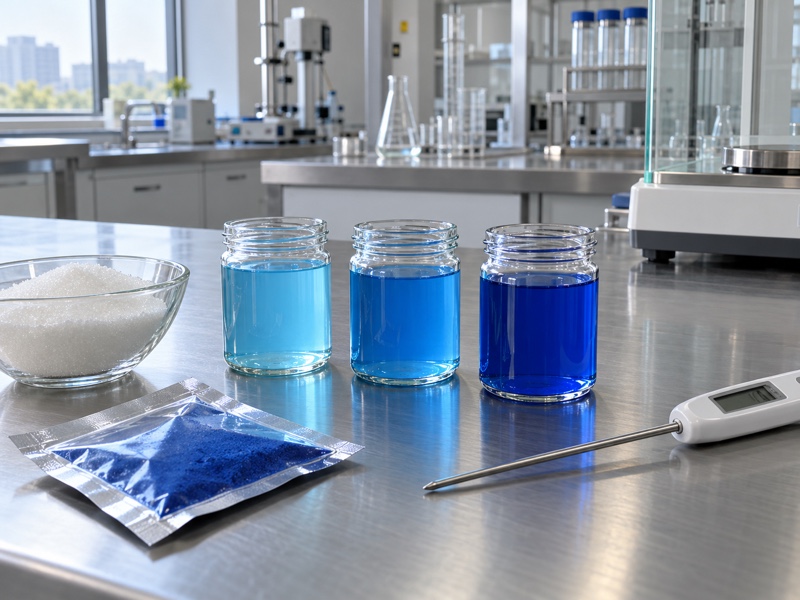
A 2018 Food Bioscience study tested glucose, sucrose, and fructose with phycocyanin solution at several heating temperatures. A separate Food Research International paper studied sucrose and trehalose systems and found that solute type and concentration changed color-loss kinetics. These experiments guide trial design. Their outcomes are not universal specifications for commercial blue spirulina powder.
1. What does sugar stability mean for phycocyanin?
Name the outcome before selecting a sweetener
Phycocyanin is the blue protein pigment in spirulina extract. Under stress, the protein structure and the visible blue can change. “Stability” might mean retained color coordinates, retained phycocyanin concentration by a chosen method, no sediment, or an acceptable product appearance at the end of shelf life. Those measures do not always move together. A syrup might keep a stronger instrument signal yet look dull in an opaque dessert, while another formula may retain hue but develop sediment.
Define a finished-food target. Record the initial shade, acceptable shift, process temperature, exposure time, pH, light conditions, and pack. Sugar concentration belongs in that record alongside acid, salt, protein, preservative, and flavor ingredients. An isolated sugar-water model is a screening tool, not a substitute for the actual beverage or topping. The trial should state whether the buyer wants to preserve blue through processing, through retail display, or both.
2. Which sugars and systems should a buyer compare?
Test the formula you intend to sell
The 2018 study compared glucose, sucrose, and fructose in a controlled solution. The 2020 saccharide study looked at sucrose and trehalose across concentrations. Neither result says one sweetener will win in every food. A low-sugar beverage, a high-solids syrup, and a frozen dessert have different water mobility, acid profiles, and heating histories. Include the product’s real sweetener blend, not only single-sugar laboratory solutions.
| Trial system | Why include it | Decision it informs |
|---|---|---|
| No-sugar control | Shows the base pigment response | Whether sugar changes the outcome |
| Current commercial sweetener | Represents the planned product | Whether the formula is viable |
| Alternative sugar or blend | Tests a feasible reformulation | Whether change improves color |
| Equal-solids comparison | Reduces concentration bias | Which sweetener behaves differently |
| Finished food matrix | Includes all ingredients | Whether model results transfer |
If the finished product is sweetened with non-sugar ingredients, a comparison to sucrose should be framed as a process control, not a direct nutrition or label substitute. Some alternatives affect viscosity and water activity differently. Measure the physical properties rather than assuming a sweetness-equivalent dose gives a comparable pigment environment.
3. What did the published sugar studies show?
Read the methods before borrowing a conclusion
The Food Bioscience paper heated phycocyanin solutions with different sugars at 40, 60, and 80 °C for 60 minutes. It reported that sugar identity changed concentration and color outcomes, with fructose reducing color degradation under one 80 °C condition and glucose affecting other measured endpoints. Those outcomes describe the study’s buffer, concentrations, analytical method, and heat exposure. A production line with another pH or short high-temperature step needs its own evidence.
The Food Research International study examined color loss in water, sucrose, and trehalose solutions. It found that more solute could reduce color loss under its conditions and that sucrose performed better than trehalose at similar concentration in the reported comparison. Water activity and solute concentration mattered. This is a useful reminder that “sugar type” is not the only variable: two syrups with different total solids cannot be compared as though only their names differ.
Neither paper establishes health benefits in a finished food. For a color application, keep the trial decision on color, handling, safety, and product quality rather than on antioxidant assays that do not translate into a permitted consumer claim.
4. How do you design a fair sugar stability trial?
Change one factor at a time
Start with one phycocyanin grade and a production-representative lot. Make a base batch of the intended food, then divide it into coded sub-batches before adding the sweetener variables. Hold pigment dose, pH, total solids when feasible, mixing order, vessel geometry, and process temperatures constant. If equal-solids and equal-sweetness comparisons require different formulations, run them as separate experiments and say which question each answers.
| Variable | Hold or vary? | Record |
|---|---|---|
| Powder grade and lot | Hold | Product code and COA |
| Sugar identity | Vary deliberately | Type, source, purity |
| Total soluble solids | Hold for one comparison | Measured °Brix or suitable method |
| pH and buffer | Hold where possible | Before and after heat |
| Heat profile | Hold | Product temperature and time |
| Pack and light | Hold | Container and exposure |
Prepare at least a duplicate batch for a screening decision. A single jar can fail because of a mixing error, unclean vessel, or dose miscalculation. Blind the sample names during color evaluation. If one sugar makes the formula much thicker, note that viscosity may also change heat transfer and visual appearance; it is part of the result, not an invisible nuisance.
5. Which heat conditions should the trial reproduce?
Use the product’s real time-temperature path
A published hour-long hold at a fixed temperature helps compare ingredients under stress. A plant may use a shorter pasteurization step, a hot-fill hold, cooking before pigment addition, or a cold process. Measure product temperature where the pigment sits, not only the heating jacket. Record ramp-up, hold, cooling, and any reheating. Color loss may occur during the slow cooling period even when the official process step is brief.
Run a heat-only control without sugar and the finished-formula trial in the same equipment. Include a sample taken immediately before heating and another at the first safe point after cooling. This separates damage during manufacture from change during storage. If the product has fruit acid or mineral fortification, keep those ingredients in at least one trial arm because they can affect the protein independently of sugar.
Do not alter a validated food-safety process solely to protect color without a qualified process review. A colorant must fit the safe product, not the other way around. The existing pasteurization stability guide addresses broader heat questions; this article focuses on sugar-system comparisons within the required process.
6. What measurements show real color retention?
Pair instrument data with a product view
Measure the same sample depth and container under a defined light source. Record color coordinates with a calibrated instrument and note visible hue, precipitation, foam, and ring formation. In a clear syrup, transmission and haze may matter; in frosting or a frozen base, surface and cross-section appearance matter more. Sampling protocol should be fixed before the results are known.
| Measure | What it tells you | Limitation |
|---|---|---|
| Color coordinates | Repeatable shade and change | Sensitive to sample geometry |
| Spectral absorbance | Pigment signal in a defined solution | Can be distorted by haze or dilution |
| Haze/sediment | Physical instability | Not a direct color value |
| pH | Acid stress and drift | Does not explain all color loss |
| Water activity/solids | Matrix context | Must be interpreted with formula |
Calculate percent retention only when the method and baseline are stated. A percentage measured in a diluted clear sample should not be presented as finished-food visual retention. Keep raw photos and instrument files. The color measurement guide can support a consistent instrument protocol, but a team still needs an acceptance target tied to its own product.
7. Why can two sugar formulas give different results at the same sweetness?
Sweetness is not a physical measurement of the matrix
A formula may achieve equal perceived sweetness with different masses of sugar or sweetener. That changes water activity, viscosity, solids, and sometimes pH. Phycocyanin sees the physical and chemical environment, not a sweetness label. Glucose, fructose, sucrose, and trehalose differ in molecular structure and in how a formula is built around them. A compound syrup may also bring acid, salt, preservatives, or flavors.
Compare formulations on at least two bases: equal intended consumer sweetness and equal relevant solids or water activity where possible. These questions can produce different winners. If the product team intends to change sugar for nutrition or tax reasons, evaluate the replacement formula as a complete food. A stable blue control made with more sucrose may be technically informative but commercially unusable.
Avoid extrapolating a paper’s reported mechanism too far. Some laboratory conditions may allow protein-sugar interactions that do not occur to the same extent in a cold mixed drink or short industrial process. The practical decision rests on reproducible color and physical results in the saleable matrix.
8. How should you test storage, light, and packaging?
Follow the finished product through its intended life
Sugar may reduce some thermal damage yet leave the blue vulnerable to light, acid, oxygen, or other ingredients. Fill trial product into the intended pack, with realistic headspace and seal. Store it at planned and reasonably foreseeable conditions. A clear bottle on a bright shelf creates a different exposure than an opaque pouch. Test both immediately after processing and at intervals throughout the proposed shelf life.
| Sample point | Color result | Physical result | Context to record |
|---|---|---|---|
| Before process | Starting shade | Dispersion or haze | Dose, pH, solids |
| After process | Immediate loss | Sediment or foam | Heat history |
| Early storage | Initial drift | Layering | Light and temperature |
| Mid-life | Trend | Pack interaction | Time since fill |
| End of life | Acceptance | Consumer-visible defects | Actual pack and display |
Use the same evaluation sequence each time. If a sample is shaken before measuring, document that and also inspect it undisturbed. Sediment that disappears after vigorous laboratory mixing may remain unacceptable in a ready-to-use product. Keep a retained sample from the starting lot so an unexpected result can be checked against a known control.
9. What should the powder supplier provide?
Ask for evidence, not a promise that sugar “fixes” blue
Request the exact powder grade, a current specification, batch COA, composition or carrier information, storage guidance, and a production-representative sample. Ask whether any stability recommendation comes from a finished-food test, a model solution, or a paper. These are different evidence levels. A model test can help choose variables but cannot qualify the buyer’s recipe.
| Supplier record | Use in the trial | Question to resolve |
|---|---|---|
| Grade specification | Defines tested material | What revision applies? |
| Batch COA | Links sample to lot | Which methods and units? |
| Composition statement | Supports label and matrix review | Is a carrier present? |
| Handling instructions | Sets addition conditions | What water temperature and mixing? |
| Application data | Suggests a starting point | Was sugar, pH, heat, and pack comparable? |
Our confirmed blue spirulina/phycocyanin products are powders labeled E3, E6, E18, E25, E35, and E40. None of those codes alone states a phycocyanin percentage, color value, or sugar-stability rating. Whole spirulina and chlorella are separate powder or tablet products. Do not substitute them for blue extract or describe them as a sugar-stabilized blue colorant.
10. When is a sugar-system decision ready for scale-up?
Choose the result that survives the real process
A formulation is ready to move from bench to pilot when it meets the product team’s color target at the end of the planned life, follows the validated safety process, and can be made with controlled ingredient addition and measurable quality limits. Compare cost per finished unit, including pigment dose, sugar or sweetener system, process losses, packaging changes, and any extra testing. A visually stronger bench jar is not a commercial winner if its sweetness, nutrition target, or label is wrong.
At pilot scale, repeat the best two formulas in the actual equipment. Check whether heat transfer, mixing, and cooling match the bench assumptions. Use the same analytical method and acceptance limits. If a sweetener switch changes texture or water activity, route that change through the product’s broader safety and shelf-life review rather than treating it only as a color decision.
For a supplier discussion, send the intended matrix, sugar system, pH range, process profile, pack, and required color target. Ask for the technical sheet and a lot-linked sample of the powder grade under consideration. The supplier may suggest starting conditions, but the buyer’s finished-food trial establishes the answer.
FAQ
Q1: Does adding sugar always protect phycocyanin blue?
No. Published results depend on sugar type, concentration, temperature, pH, and measurement method. Test the finished formula and its process.
Q2: Which sugar performed best in the research?
Different studies and endpoints favored different conditions. The 2018 paper compared glucose, sucrose, and fructose; the 2020 paper compared sucrose and trehalose systems. Use their methods to design a comparison rather than naming a universal winner.
Q3: Can a low-sugar beverage use those results?
Only as a starting hypothesis. A low-sugar formula has different solids and water activity. Run a matched finished-product trial with the actual sweetener system.
Q4: Does an E18 or E40 code tell me sugar stability?
No. Those are powder identifiers in the current catalog. Request the specific grade sheet and batch COA, then measure performance in your food.
Q5: Should I optimize color before validating the heat process?
No. Keep the required food-safety process. Adjust the color system, point of addition, or formulation only within a qualified process design.