
Phycocyanin in food emulsions is a promising research topic, but a blue powder does not automatically become a commercial emulsifier. Food developers need to separate three outcomes: a desirable blue shade, stable oil droplets, and acceptable color after processing and storage. This guide shows how to evaluate the research, plan a controlled trial, and ask a supplier for the evidence needed before scale-up.
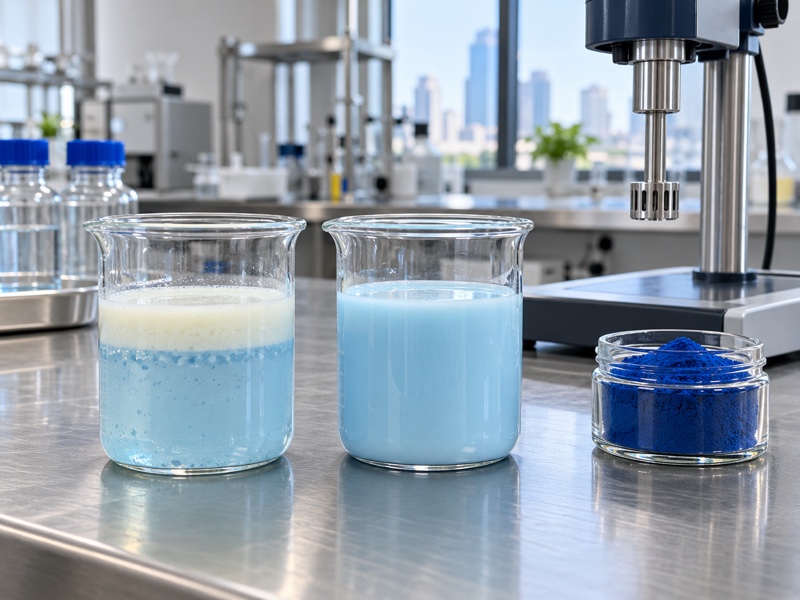
A 2025 Food Hydrocolloids study examined phycocyanin with treated pea protein isolate in oil-in-water emulsions. That is a defined experimental system, not proof that every commercial blue spirulina grade can replace an emulsifier. Our confirmed blue spirulina range consists of E3, E6, E18, E25, E35, and E40 powders. Those names are identifiers, not stated phycocyanin percentages, protein purity, or emulsifying ratings. Request a current specification and lot certificate before designing a trial around any one grade.
1. What does “phycocyanin in food emulsions” mean?
Start with the physical system
An emulsion puts droplets of one liquid inside another. In an oil-in-water product, oil droplets are dispersed through a continuous water phase. Protein, particles, or other surface-active ingredients can reduce the energy at the oil-water interface and help prevent droplets from joining again. Phycocyanin is a blue protein complex, so researchers have investigated whether it can contribute both color and interfacial behavior.
These jobs should be measured separately. A sample that stays vividly blue may still cream or coalesce. A stable white emulsion may lose blue when acid, heat, light, or other ingredients enter the formula. The 2025 study used pea protein particles made by a particular pH-shift and high-pressure treatment, then added phycocyanin. The paper reports stability in that model, but its preparation and material characteristics may differ from a buyer’s sauce, dressing, dessert base, or beverage.
For a commercial brief, state the continuous phase, oil type and fraction, target droplet size, viscosity, pH, thermal process, package, and shelf life. “We want a stable blue emulsion” leaves too many variables undefined to select a powder or interpret a test.
2. Which ingredient role should a buyer specify first?
Give the powder one primary job
Decide whether phycocyanin is being evaluated as a color, a co-stabilizer, or both. A color trial can use the existing emulsifier system and test shade at the intended dose. A functionality trial needs a true control with the same color target and a defined reduction in conventional stabilizer. Otherwise, a visible difference may be caused by pigment concentration rather than interfacial performance.
| Proposed role | Main question | Keep constant | Measure |
|---|---|---|---|
| Color only | Does the blue meet the brief? | Existing emulsion system | Hue, color retention, sensory fit |
| Co-stabilizer | Does it change droplet stability? | Oil phase, shear, protein base | Droplet size, creaming, separation |
| Dual role | Can one dose serve both jobs? | Target shade and formula | Color plus physical stability |
| Comparison color | Is another blue source easier? | Finished product target | Cost in use and process fit |
A buyer should not ask a seller to guarantee “emulsifier performance” based on a label or an E-code. Ask instead for composition, dispersibility, recommended handling, and evidence from a comparable matrix if the seller has it. Use the product-specific specification checklist to record the identity of the tested lot.
3. What did the published emulsion study actually test?
Treat the paper as a design clue
The pea-protein and phycocyanin study prepared oil-in-water emulsions using pea protein isolate particles and phycocyanin from Spirulina platensis. It considered extra-virgin olive oil and sunflower oil, measured particle and droplet properties, and looked at stability and blue appearance. The researchers reported stable systems under their conditions and described phycocyanin as a co-emulsifier and colorant. Their findings justify a careful pilot, not a claim about any supplier’s untouched powder in every food.
The distinction matters because droplet size responds to protein concentration, oil fraction, oil type, mixing energy, and equipment. Even a well-designed laboratory emulsion may change when transferred to a plant homogenizer or a longer shelf-life requirement. The researchers’ treated pea-protein particles are part of the result. Removing that step from a commercial formula may remove the mechanism that made the model work.
Write the paper’s conditions on one side of the trial brief and your own process on the other. If they differ in pH, oil fraction, protein treatment, shear, or storage, flag that as an experiment to run.
4. How should a formulation trial isolate the effect of phycocyanin?
Build controls before mixing
Use a baseline formula without phycocyanin, a color-matched trial that keeps the emulsifier unchanged, and at least one trial that tests the proposed stabilizer adjustment. Keep each batch’s oil, water, protein, gum, salt, sugar, and process order fixed unless that factor is the one being tested. Record the actual temperature during addition and homogenization; a set point on the machine is not the product temperature.
| Trial | Phycocyanin | Existing stabilizer | Purpose |
|---|---|---|---|
| A: baseline | None | Standard dose | Establish separation and texture |
| B: color | Proposed color dose | Standard dose | Isolate color and matrix compatibility |
| C: reduced stabilizer | Proposed color dose | Reduced, documented dose | Test co-stabilizer hypothesis |
| D: matched blue reference | Alternative color if relevant | Standard dose | Compare color performance |
Prepare replicates and label them with blind codes before visual scoring. A developer who knows which jar contains the desired ingredient can unconsciously score a slight difference as meaningful. If your company has a sensory panel, keep appearance separate from flavor and mouthfeel.
Do not change the phycocyanin grade halfway through a trial without starting a new series. The E3–E40 codes in our catalog do not imply identical composition or interchangeable behavior. A COA and batch identifier make the result traceable.
5. Which physical measurements tell you whether the emulsion works?
Watch the droplet system, not just the blue
Start with droplet size distribution, visible creaming or sedimentation, viscosity, and the time to separation under the intended storage condition. Microscopy can show large droplets or flocculation that a color reading misses. State the instrument method and sampling point so a second lab can repeat the result.
Measure immediately after processing, after a defined rest, and at planned storage intervals. Use the finished pack if the product will be exposed to light. Shake or invert samples only if the consumer instructions would permit it; otherwise a resuspended sample can hide an unacceptable separation. Record whether the oil type, fat percentage, flavor system, or protein source changes during development.
A result should be tied to an acceptance criterion, such as a maximum separation height or acceptable droplet-size range set by the product team. There is no universal pass value for every blue dressing or beverage. If the baseline already fails, adding a blue ingredient will not solve the underlying emulsion design.
6. How can you measure blue color without confusing it with opacity?
Use a matrix-matched control
An emulsion scatters light, and its apparent shade changes with droplet size and opacity. A clear phycocyanin solution and an opaque dressing at the same pigment dose will not look identical. Evaluate the finished food against a target made in the same matrix. Record color coordinates, illumination, sample depth, and container. Also describe visible defects: blue streaks, a ring at the surface, colored sediment, or a fading top layer.
| Observation | Possible cause to test | Useful check |
|---|---|---|
| Blue looks pale despite dose | Light scattering or pigment loss | Compare matrix-matched color and a clear control |
| Blue ring at surface | Creaming of colored droplets | Inspect layer and droplet distribution |
| Sediment is blue | Undispersed or aggregated material | Check dispersion order and microscopy |
| Hue shifts during storage | pH, light, heat, or ingredients | Track pH, package and color over time |
| Batches differ | Lot or process change | Compare retained samples and COAs |
The separate phycocyanin color-measurement guide covers color coordinates in more detail. In an emulsion, pair those readings with physical stability. Otherwise a color score can improve while the product becomes less acceptable on the shelf.
7. Which processing steps can reverse a promising bench result?
Match the plant sequence
The point of addition matters. Phycocyanin may meet acid, salt, hot oil, high shear, or a sterilization step at different moments in a production line. A model test made with room-temperature ingredients cannot establish performance after pasteurization or hot filling. Plan one bench sequence that mirrors the plant and one small pilot using the actual mixer or homogenizer when possible. Sample before and after each major step.
Keep a process log with inlet and outlet temperature, residence time, shear or pressure, order of addition, hold time, and cooling. Add any flavor, preservative, sweetener, or mineral system used in the saleable product. These ingredients can change charge interactions and color. If a trial works only after a special laboratory pH shift that the plant cannot run, the route is not commercially ready.
The dispersion guide explains why apparent dissolution and fine dispersion are different. For an emulsion, this distinction affects how consistently blue reaches the continuous phase and whether visible particles remain.
8. What should the shelf-life and packaging plan include?
Test the finished pack
Evaluate both physical and color stability over the product’s intended life. Use the actual primary pack, headspace, fill volume, and storage temperatures. Include expected light exposure if the pack is transparent. A dark laboratory bottle can make a color look more stable than a clear retail container. Also check microbial controls and food safety within the normal product development program; color testing does not replace them.
| Stage | Emulsion check | Color check | Record |
|---|---|---|---|
| After make-up | Droplet distribution | Initial shade | Mix conditions, lot |
| After process | Separation and texture | Immediate loss or shift | Time-temperature history |
| At filling | Air, foam, fill consistency | Pack appearance | Headspace and container |
| During storage | Creaming, sediment, viscosity | Color retention | Light, temperature, date |
| At end of life | Consumer-visible defects | Acceptance against target | Blind score and instrument result |
Set decision gates before the trial. For example, if a blue hue fails after the expected display exposure, the team may need a different pack, process, or color system. Avoid promising shelf life from a powder certificate alone. The finished food sets the final evidence.
9. What should you request from the powder supplier?
Ask for product identity and a testable lot
Request the current grade specification, ingredient composition, lot COA, storage instructions, recommended dispersion method, and a sample linked to the grade and manufacturing site under review. Ask whether the supplier has application data in an oil-in-water matrix and what formulation and test conditions produced it. A supplier photo of a blue sauce is marketing evidence, not a stability report.
| Supplier item | Why it matters | Follow-up if absent |
|---|---|---|
| Exact powder code | Prevents sample-to-order switch | Hold trial until identified |
| Lot COA and method | Connects reported quality to material | Ask for lot-specific release data |
| Composition and carrier | Supports labeling and matrix design | Resolve unknown ingredients |
| Handling guidance | Sets addition and storage conditions | Run a documented dispersion trial |
| Comparable application report | Helps design, does not guarantee success | Define your own pilot controls |
Our blue spirulina/phycocyanin products are powders, not ready-to-use liquid emulsions. Whole spirulina and chlorella powders or tablets are separate catalog items and should not be substituted for blue extract in this trial. If a product team needs numerical color value, protein content, or microbiological limits, it must read the relevant grade specification and batch COA rather than infer them from E3, E6, E18, E25, E35, or E40.
10. When is phycocyanin ready for an emulsion scale-up decision?
Decide against the product brief
A scale-up decision requires evidence that the chosen lot meets the agreed specification, gives acceptable color in the finished matrix, survives the real process, and meets physical and color stability gates in the intended pack. It also requires a commercial calculation. Compute cost per finished unit at the dose that achieves the accepted shade, including process loss and any additional stabilization or packaging change. Price per kilogram of powder alone cannot answer that question.
A successful bench test should lead to a pilot batch, not directly to a purchase volume. Compare the pilot against the lab control, document any shift in droplet size or hue, and identify which process parameter caused it. If phycocyanin acts only as a color in your matrix, that can still be a good ingredient decision; the conventional emulsifier may remain necessary. If it also contributes to stability, require reproducibility across batches before removing another ingredient.
Ask the supplier for a production-representative sample and the current technical file for the exact powder grade. Keep the approval record tied to that grade, lot, formula, process, and market. If any of those changes, recheck the result before describing the ingredient as dual-function in your food.
FAQ
Q1: Is phycocyanin itself a proven drop-in emulsifier?
No. Published experiments show potential in specific systems, including treated pea protein particles, but commercial performance depends on the powder, matrix, and process. Test against your existing emulsion control.
Q2: Does a blue appearance mean the oil droplets are stable?
No. Measure droplet size, creaming, separation, and texture separately from color. A product can retain blue while the emulsion breaks.
Q3: Can I use an E-grade code to predict emulsifying activity?
No. Our E3, E6, E18, E25, E35, and E40 codes identify powder products; the code alone does not establish composition or functionality. Request the exact specification and batch evidence.
Q4: Should I test the color in water first?
A water screen can expose dispersion problems, but the decision must use the finished emulsion. Oil droplets, protein, acidity, and opacity change appearance and stability.
Q5: What is the first scale-up question to ask?
Ask whether the lab result survives the actual plant sequence and finished pack. A pilot should repeat the accepted shade and stability while recording temperature, shear, addition order, and storage conditions.