
Blue spirulina rice can make a prepared meal instantly recognizable, but an attractive bowl at the bench does not prove it can be cooked, chilled, reheated, and sold consistently. A manufacturer needs to decide which rice format carries the color, how blue spirulina enters the process, and what happens at the end of shelf life. This guide is for prepared-food teams considering bulk blue spirulina powder for cooked rice, rice bowls, and meal components.
Contents: 1. Concept · 2. Matrix · 3. Ingredient · 4. Heat · 5. Flavor · 6. Safety · 7. Storage · 8. Packaging · 9. Economics · 10. Buying.
1. What is blue spirulina rice in a commercial product?
Define the rice, not just the color
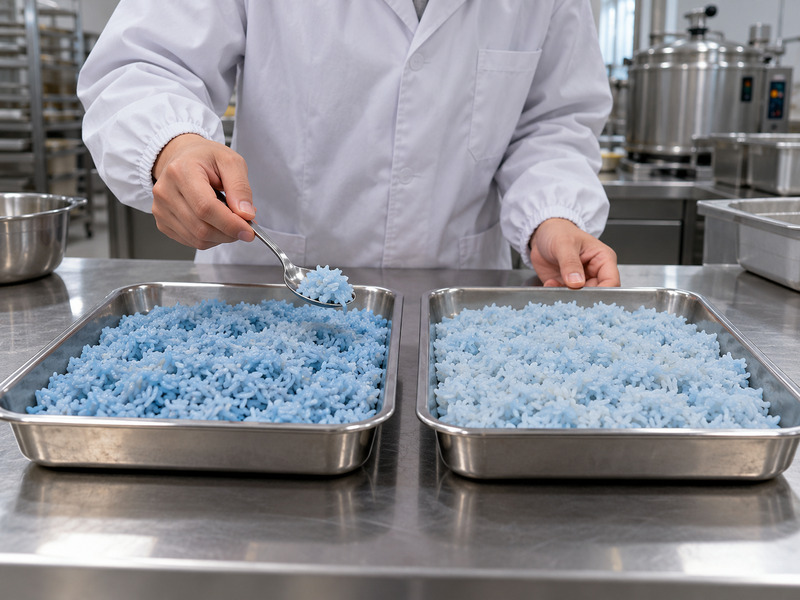
Blue spirulina rice is cooked rice colored with a phycocyanin-rich blue spirulina extract. It might be a side dish, the base of a chilled bowl, a component in a frozen meal, or a limited-service restaurant item. Write the serving brief first: specify rice variety, portion weight, cooking method, sales channel, serving temperature, and the visible shade under normal light. Each format has different heat exposure and holding time.
The Blue Butterfly Pea Spirulina Quinoa Fried Rice recipe is a real colored-grain example, but it uses quinoa and butterfly pea as well as blue spirulina. It does not prove that rice alone will achieve the same hue or withstand a commercial process. A team developing rice should make its own control and colored batches. Photograph both with a color reference and name every pigment source. If butterfly pea is also present, a blue result cannot be attributed to spirulina alone.
| Product format | Main stress | First pilot question |
|---|---|---|
| Fresh rice bowl | Cook and short hold | Does color stay even through service? |
| Chilled prepared meal | Cook, chill, storage | Does shade drift before sale? |
| Frozen meal | Freeze and reheat | Is the rice attractive after heating? |
| Shelf-stable rice | Thermal processing | Can the concept survive the validated process? |
2. Which rice format should the team develop first?
Select one process route
A ready-to-eat cold bowl, a hot takeaway side, and a retorted pouch share a name but not a process. Choose the narrowest feasible launch: pick one format and validate it before carrying the color into other categories. Rice variety affects water absorption, starch release, grain separation, and how evenly a blue solution reaches the surface. Short-grain rice may hold a different-looking coat from long-grain rice even at the same addition rate.
The format also controls how much stress the color sees. A chilled meal may avoid a second heat cycle, yet it faces days of storage and packaging contact. Freezing, thawing, and consumer reheat stress a frozen meal. A shelf-stable pouch may require intense thermal treatment that the color cannot tolerate; a visual failure cannot justify weakening the validated lethality process. Write a process flow with each time and temperature step, then decide where a color trial belongs. Procurement should not compare powder quotations until development has identified a feasible product route.
3. What does blue spirulina mean on a rice specification?
Ask for ingredient identity and lot evidence
“Blue spirulina” often describes phycocyanin-rich spirulina extract. Whole spirulina powder is typically green and cannot be treated as a color-equivalent substitute. Read the specification: check the exact ingredient statement, carriers, batch certificate, microbial criteria, storage recommendations, and market-specific regulatory support. The confirmed catalogue lists blue spirulina grades E3, E6, E18, E25, E35, and E40. Their code numbers are not proof of pigment percentage, stability, or finished-food dosage.
The rice developer should use the intended purchase grade and lot in the pilot. Make a measured premix in production-quality water and record how long it takes to disperse. Observe specks, foam, odor, and shade before the premix reaches rice. Retain a sample and lot number. If two grades are compared, use the same rice, water, method, and target shade; compare cost per accepted serving rather than equal powder weight alone. A supplier can provide technical documents, but only the manufacturer can establish performance in its own rice and process.
| Supplier document | Why it matters | Who reviews it |
|---|---|---|
| Ingredient statement | Label wording and carriers | Regulatory |
| Batch certificate | Lot-specific release evidence | Quality |
| Application guidance | Trial starting conditions | Development |
| Current quotation | Cost at expected volume | Procurement |
4. When should blue color enter the cooking process?
Compare heat exposure with distribution
The possible addition points are cooking water, a post-cook aqueous premix, or a separately colored sauce combined at packing. Test the actual route: build a small matrix of addition point and dose, using the same rice batch where practical. Cooking-water addition may reach more grains but exposes color to the entire cook. Post-cook addition may protect it from some heat but can require extra mixing and liquid. A blue sauce can avoid coloring every grain but changes the product proposition.
Record cooked yield, moisture, appearance, grain breakage, and mixing time. Take samples from different parts of the kettle or mixer; a blue top layer may hide a pale center. Do not compensate for poor distribution by overmixing rice until it becomes gummy. Nor should operators add unmeasured water to dissolve powder, because the added liquid changes texture and the food safety profile. A promising bench method must be repeated on a representative plant line with its actual transfer pipes, paddles, cooling equipment, and portioning system.
| Addition route | Reason to try it | Failure to look for |
|---|---|---|
| Cooking water | Early distribution | Color loss during cooking |
| Post-cook premix | Less cooking exposure | Patches and grain damage |
| Separate colored component | Localized visual effect | Product identity and uneven portions |
5. How do seasonings and other colors change the result?
Keep the formulation traceable
Salt, acid, oil, sauces, vegetables, and protein toppings can change how blue rice appears and tastes. An acidic sauce may alter the hue at a contact point, while a yellow ingredient can make the plate look green by contrast. Test the full meal: photograph and taste the rice alone, then the assembled meal. If the concept uses butterfly pea, record it separately and run a version without it. This is especially important because the ranking quinoa reference combines more than one source of color.
A colored rice product may also invite consumer assumptions about flavor or nutrition. Use blind sensory testing where possible and give panelists the same reheating instructions intended for sale. Compare aroma, aftertaste, grain firmness, and sauce migration. Do not claim that blue spirulina provides a finished-meal health effect without proper evidence for the product and market. The formulation team should choose an ingredient because it works in the food, not because a social-media photograph makes an unsupported benefit sound plausible.
6. Which cooked-rice safety controls are non-negotiable?
Preserve the validated process
Cooked rice requires disciplined time and temperature control. It can support growth of hazardous organisms if handled poorly, including risks associated with Bacillus cereus. Keep safety separate from color: follow the plant’s validated cooking, cooling, holding, reheat, sanitation, and shelf-life program. A blue powder does not preserve rice. Any new water-based premix needs a preparation, storage, and discard rule. Quality staff should assess the ingredient and the modified process before commercial production.
For chilled meals, monitor cooling at the product’s slowest-cooling point and verify the packed unit meets the established process. During hot service, observe the operation’s holding limits. For frozen or shelf-stable products, use the appropriate validated process and product-specific hazard analysis. Color stability is a quality measure, not a reason to lower a kill step or extend an unsafe hold. Document lot codes of both rice and color so a complaint or deviation can be traced to a real batch.
7. What should a chill-and-reheat trial measure?
Judge the serving customers will see
A rice bowl may look vivid before packing yet dull after storage or microwave reheating. Test end use: prepare matched plain and blue units, chill or freeze them by the intended process, and inspect at defined points through the proposed shelf life. Use the specified consumer or foodservice reheat method. Measure or describe shade, grain separation, surface dryness, condensate, flavor, and aroma. Photograph a stirred and an unstirred serving because customers may see both.
If the blue drains into a sauce or a white protein component, note whether that transfer is acceptable. A new colored component may change how staff interpret a normal reheat indicator, so instructions should rely on validated temperature criteria rather than appearance. Keep samples from the beginning, middle, and end of a production run. One beautifully plated sample cannot reveal nonuniform dosing across a kettle. Set acceptance limits before reviewing the images, and include sensory as well as color in the decision.
| Trial point | Color observation | Product observation |
|---|---|---|
| After cook | Uniformity across kettle | Yield and texture |
| After packing | Contact staining | Portion weight and seal |
| Mid shelf life | Shade and migration | Odor and grain quality |
| After reheat | Served appearance | Temperature and eating quality |
8. How can packaging alter the blue rice experience?
Test contact and display
The pack can affect the visual result through light exposure, condensation, oxygen, and contact with other meal components. Pack the trial in the proposed tray: include the same lid, film, labels, and compartment layout planned for launch. A white tray may make blue appear brighter, while a dark tray may hide it. Clear windows can invite light exposure. A sauce placed against the rice may create a boundary that looks unattractive even if both components are individually stable.
Inspect seal integrity and any pigment transfer to film or tray walls. Conduct distribution handling relevant to the product: vibration, stacking, chilling, freezing, and display. A product that only works in an open bowl might still be suitable for restaurant service, but it is not ready for a national chilled retail program. Record packaging lot and product lot together. The team should choose a pack based on safety and product integrity first, then consider how it presents the color in an ordinary store or delivery photograph.
9. What is the cost per saleable rice portion?
Include process yield
Powder cost per kilogram is a poor proxy for prepared-meal economics. Count accepted portions: use actual dose, cooked rice yield, premix loss, extra mixing time, rejects, packaging, and shelf-life losses. Record whether color lowers line speed or adds a cleaning changeover. A blue garnish zone may use less ingredient than fully colored rice but could increase labor. Compare at least two technically acceptable designs on cost per saleable portion.
Current supplier quotations should state grade, order volume, terms, and documentation. Do not infer price or performance from E-series grade names. If shade adjustment requires more powder on a later lot, the purchase agreement should define how changes are evaluated. A pilot run sheet can turn a novel color idea into a concrete buying decision: amount purchased, amount used, portions packed, portions rejected, and estimated annual demand. Tie a volume commitment to validated demand rather than to a sample-scale dose.
| Cost item | Source of evidence | Unit to report |
|---|---|---|
| Blue powder | Current quote and actual dose | Cost per portion |
| Premix and labor | Pilot time study | Minutes per batch |
| Yield loss | Accepted versus started portions | Percentage |
| Packaging | Proposed pack quote | Cost per accepted unit |
10. What evidence should a buyer request before bulk ordering?
Close the technical and regulatory file
Give suppliers the rice variety, process flow, addition point, target shade, serving format, sales markets, expected volume, and shelf-life goal. Ask for the exact grade’s specification, ingredient and carrier statement, batch certificate, regulatory documentation, sample-to-production lot relationship, and quotation. Require a product result: a representative line trial must show acceptable color and rice quality after the intended storage and reheat sequence.
Regulatory staff should check current color-additive permission for the exact destination food category. The FDA color-additives page notes a delayed effective date for a 2026 expansion of spirulina-extract uses; do not assume a proposed or delayed category is already permitted. Check each other market separately. Label language and claims should reflect the finished meal and its full formula. The final approval package should contain a process record, stability study, cost sheet, and signed regulatory review. Those documents support a bulk order much better than a recipe photograph.
FAQ
Q1: Does the ranking colored-grain recipe prove blue spirulina works in rice? No. It uses quinoa and butterfly pea too; rice needs its own controlled trial.
Q2: Can we add color before cooking? It is one route to test, but heat exposure and final shade must be measured in the actual process.
Q3: Does blue powder make cooked rice safer? No. Follow validated cooked-rice time, temperature, and sanitation controls.
Q4: Is the same dose suitable for chilled and frozen meals? Not automatically. The process and end-use appearance differ.
Q5: What should procurement compare? Compliant documentation and cost per accepted portion after real processing and storage.
Final thoughts
Begin with one rice format and one realistic process. Keep the cooking and safety controls intact, then test blue color at the point of consumption. A bulk ingredient decision is justified only when the finished portion remains attractive, safe, compliant, and economical.